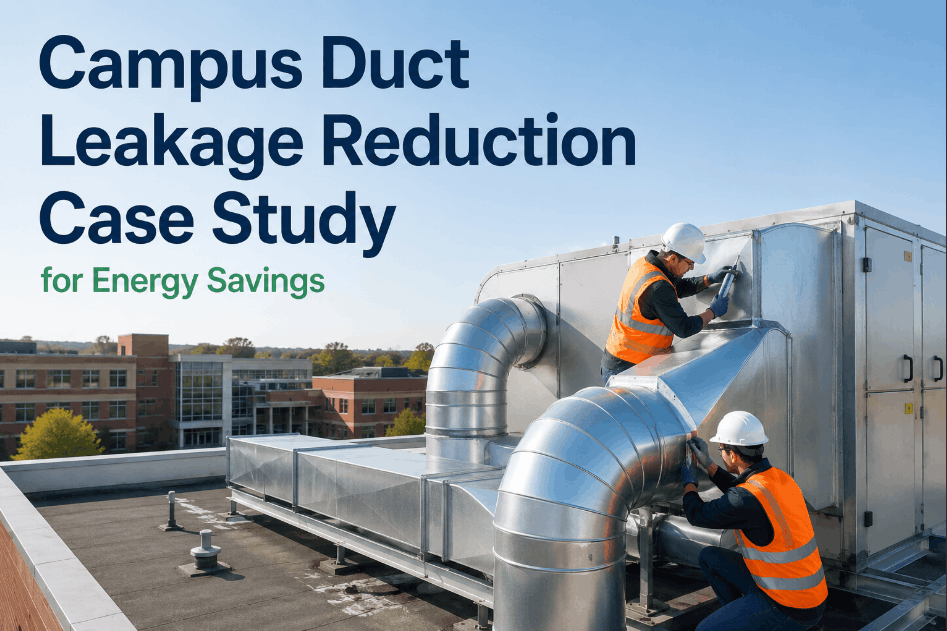
Campus energy budgets are under constant pressure, and one of the least visible contributors to waste is duct leakage — air that's conditioned, pressurized, and then lost before it ever reaches a classroom, lab, or office. A multi-building university campus discovered that their central air distribution systems were delivering significantly less airflow than intended, driving fan motors to work harder, utility bills higher, and occupant comfort lower. Without structured post-retrofit testing and acceptance tracking, leakage points went unsealed and performance regressions went undetected. If your campus facilities team is managing duct systems without documented leakage testing or systematic post-seal verification, Sign Up Free to see how Oxmaint structures HVAC performance tracking for higher education facilities — or Book a Demo with a facility engineering specialist.
Duct Leakage · Fan Energy · Airflow Performance · Retrofit Validation
Stop Losing Conditioned Air Through Unsealed Ducts and Start Validating Every Retrofit With Systematic Leakage Testing
Preventive maintenance scheduling, post-retrofit inspection records, asset-level duct performance tracking, leakage test logging, and acceptance check workflows — Oxmaint helps campus facility teams cut fan energy and sustain airflow gains after every sealing project.
Facility Profile
The Operation: Multi-Building University Campus With Aging Duct Infrastructure and No Post-Retrofit Performance Verification
Facility Overview
IndustryHigher education — multi-building university campus with central air distribution and rooftop units
Scope11 academic buildings, 48 air distribution zones, mixed duct age from 1970s to 2010s construction
Team12 facilities engineers, 3 HVAC technicians, 1 campus energy manager
Prior SystemPaper-based retrofit records, no leakage test documentation, no post-seal acceptance workflow
Oxmaint FeaturesAsset-Level Duct Tracking · Leakage Test Logs · Post-Retrofit Inspection Checklists · Work Order Management · Acceptance Check Workflows · PM Scheduling · Maintenance History · Technician Assignment
Baseline Performance Issues
31%
Average duct leakage rate across campus air distribution systems before sealing intervention — well above industry acceptance thresholds
2.1×
Fan energy consumption above design spec on buildings with the highest measured leakage — motors compensating for lost airflow
0
Buildings with documented post-retrofit leakage test results at project handoff — no acceptance verification existed before Oxmaint
Root Cause Analysis
Why Duct Leakage Persisted After Sealing Projects — and Why Fan Energy Never Came Down
A technical review of retrofit records, utility data, and airflow measurements across all campus buildings revealed four compounding failures that allowed duct leakage to persist and grow after each sealing project. The campus had skilled engineers and available budget — the failure was in tracking, testing discipline, and post-work verification. Sign Up Free to bring structured duct performance tracking to your campus facilities team — or Book a Demo to see how Oxmaint manages post-retrofit acceptance workflows across multi-building campuses.
39%
No Pre- and Post-Seal Leakage Testing Recorded Per Zone — Retrofit Outcomes Never Verified
Sealing crews completed work without capturing before-and-after test readings per duct zone. There was no way to confirm that sealing had achieved the intended leakage reduction, and problem sections were left in service without reinspection.
28%
Acceptance Checks Skipped at Project Handoff — No Minimum Leakage Standard Enforced
Projects were closed out without a defined pass/fail leakage threshold or acceptance inspection step. Ducts that still exceeded allowable leakage rates were handed back to operations without remediation requirements, and fan systems continued compensating through increased speed.
21%
Duct Age and Zone Condition Not Tracked Per Asset — No History to Guide Prioritization
There was no system linking duct zone identifiers to construction year, previous seal dates, or leakage history. The energy team had no data to prioritize which zones would yield the highest energy savings per dollar spent on future sealing rounds.
12%
Fan Energy Data Not Connected to Duct Performance Records — Efficiency Gains Couldn't Be Measured
Utility and BAS fan data existed separately from maintenance records. Even when sealing did improve leakage, the energy team had no structured link between duct work orders and fan energy trends — making ROI reporting and funding justification impossible.
The Solution
How Oxmaint Helped the Campus Reduce Duct Leakage and Sustain Fan Energy Savings Through Structured Acceptance Testing
The campus deployed Oxmaint to replace paper retrofit records with a structured, asset-level duct management system. Each duct zone across all 11 buildings was configured as a distinct asset, with construction era, zone location, and prior leakage history recorded. Technicians began capturing pre- and post-seal leakage test readings using structured inspection checklists, building a per-zone performance record for the first time. Acceptance check workflows were embedded into every retrofit work order, requiring leakage results to meet defined thresholds before project closure. Fan energy consumption data was logged alongside duct work orders to track efficiency gains over time. Book a Demo to see how condition-based duct leakage management works across multi-building campus portfolios.
01
Asset-Level Duct Zone Tracking With Pre- and Post-Seal Leakage Test History
Every duct zone was set up as a separate asset in Oxmaint. Sealing work orders were tied directly to each zone record, and technicians recorded before-and-after leakage test readings at every service visit. For the first time, the campus had a per-zone performance trend showing how effectively each sealing project had reduced leakage — enabling meaningful prioritization for future retrofit rounds.
02
Acceptance Check Workflows With Defined Leakage Thresholds at Project Handoff
A structured acceptance inspection step was added to every duct retrofit work order in Oxmaint. Projects could not be closed without a passing post-seal leakage test result meeting the campus-defined threshold. Zones that failed were automatically flagged for remediation before handoff — preventing recurrence of the pattern where over-leaking ducts were returned to service without correction.
03
Prioritization Scoring by Zone Age, Leakage Rate, and Energy Impact
Duct zones were categorized in Oxmaint by construction era, measured leakage class, and proximity to high-demand building areas. The energy team used this structured asset data to sequence future sealing projects by expected fan energy savings per dollar invested — replacing ad hoc scheduling with a defensible, data-backed prioritization model.
04
Fan Energy Logging Linked to Duct Work Orders for Efficiency Gain Reporting
Fan energy consumption readings were captured alongside duct zone work orders in Oxmaint, creating a documented link between sealing activity and energy performance. The campus energy manager could now generate before-and-after comparisons per building and per retrofit round — providing clear ROI data for utility rebate applications and capital planning submissions.
Results at 90 Days
Duct Leakage, Fan Energy, and Airflow Metrics Three Months After Deployment
44%
Reduction in average campus duct leakage rate — structured acceptance testing prevented recurrence after each sealing project
27%
Reduction in measured fan energy consumption across buildings with completed acceptance-tested sealing projects
100%
Of duct zones now tracked individually with leakage history — replacing paper retrofit records with no per-zone data
-83%
Reduction in projects handed off without passing leakage acceptance check — from near-zero enforcement to systematic verification
61%
Improvement in airflow delivery consistency across campus buildings measured against design spec
3.1×
ROI on Oxmaint platform cost within 90 days from reduced utility spend and recovered fan motor life
| Metric |
Before Oxmaint |
90 Days After |
Change |
| Average campus duct leakage rate |
31% — no post-seal verification |
44% reduction achieved |
-44% |
| Fan energy consumption |
2.1× design spec on leaky buildings |
27% reduction measured |
-27% |
| Zones with leakage test history |
0% — paper records, no per-zone data |
100% tracked in Oxmaint |
+100% |
| Projects passing acceptance check |
No acceptance standard enforced |
Threshold required at every close |
Enforced |
| Airflow delivery vs. design spec |
Inconsistent, untracked |
61% improvement across campus |
+61% |
| Sealing prioritization method |
Ad hoc, no data basis |
Per-zone leakage and energy scoring |
Optimized |
Key Business Impact
What Structured Duct Leakage Management Means for Campus Facility Operations
"Campus duct systems are some of the most overlooked energy waste sources in higher education facilities — not because engineers don't know leakage is a problem, but because no one has built a discipline around testing it consistently and holding projects accountable before handoff. The moment you attach a leakage test result to every work order and make acceptance a gate rather than an afterthought, the quality of sealing work changes immediately. Crews know the job isn't done until the number passes. Oxmaint gives campus teams the structure to make that shift without adding personnel — just systematic record-keeping and the workflow enforcement that converts it into real energy outcomes."
Marcus Ellison, Campus HVAC Engineering and Energy Performance Specialist
19 years campus facilities engineering · Former director of energy and utilities, large research university · Specialist in duct performance validation, post-retrofit acceptance testing, and fan energy optimization for higher education campuses
Leakage Testing · Fan Energy · Acceptance Workflows · Airflow Validation
Replace Incomplete Retrofit Records With Systematic Duct Leakage Testing Before Fan Energy Waste Compounds Across Every Building
Asset-level duct zone tracking, pre- and post-seal leakage test logging, acceptance check workflows, prioritization scoring, and fan energy linking — Oxmaint gives campus facility teams the data structure to reduce leakage and sustain energy gains across every retrofit project.
FAQs
Frequently Asked Questions
How does Oxmaint support duct leakage testing and post-retrofit verification on campus?
Each duct zone is tracked as a separate asset in Oxmaint. Technicians log pre- and post-seal leakage readings using structured checklists, and acceptance thresholds are embedded in work orders so projects cannot close without a verified test result.
Can Oxmaint help prioritize which duct zones to seal first based on energy impact?
Yes. Zone data including leakage rate, construction era, and building load is captured in Oxmaint, allowing the energy team to rank zones by expected fan energy savings and allocate sealing budgets to the highest-return targets first.
How does Oxmaint link duct work orders to fan energy performance data?
Fan energy readings are logged alongside duct zone work orders in Oxmaint, creating a documented before-and-after record that supports utility rebate applications and capital planning submissions.
Is Oxmaint suitable for campuses managing duct systems across buildings of different ages?
Yes. Oxmaint supports multi-site asset management with per-asset metadata including construction era and condition class, so teams can manage mixed-age duct infrastructure across all buildings from a single platform.
How quickly can duct zone tracking and acceptance workflows be configured in Oxmaint?
Asset setup and checklist configuration typically complete within the first week. Most campus teams are capturing leakage test results and enforcing acceptance standards within the first two to three weeks of deployment.
Every Leakage Test Is a Smarter Energy Decision
Give Your Campus the Duct Performance Tracking It Needs to Stop Losing Fan Energy to Unsealed Leakage Points
Oxmaint brings asset-level duct zone tracking, leakage test logging, acceptance check enforcement, and fan energy linking to campus facility teams — with no additional headcount required.