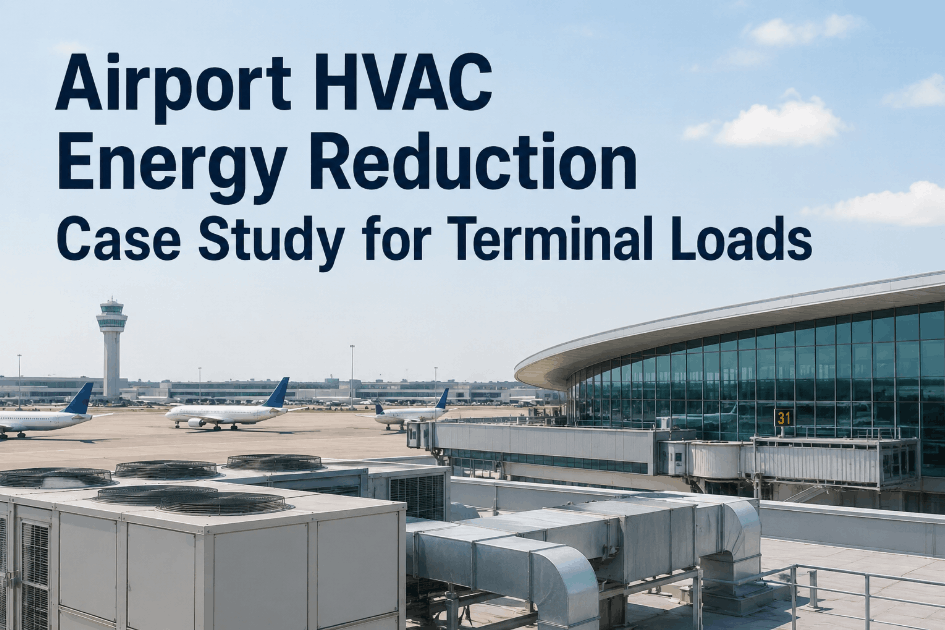
Airport terminals face some of the most unpredictable HVAC load profiles of any commercial facility — passenger surges at gate changes, wide thermal variance between concourses, and 24/7 climate control obligations that never pause. Sign Up Free on OxMaint to see how scheduling-driven HVAC automation helps airports eliminate energy waste caused by static control sequences that ignore flight-driven demand. Book a Demo to walk through a live airport terminal configuration with an OxMaint facilities specialist.
Airport HVAC Energy Reduction Using Scheduling and Control Sequence Optimization for Terminal Loads
How one major airport terminal reduced HVAC energy consumption by 41%, eliminated control sequence mismatches with flight schedules, and built a documented preventive maintenance program across all terminal HVAC assets.
The Challenge: Static Controls in a Dynamic Load Environment
A regional airport terminal handling 6.2 million annual passengers across two concourses was running HVAC systems on fixed scheduling sequences built at commissioning — sequences that bore no relationship to actual flight activity, gate assignments, or seasonal load variation. The facilities team managing 340 monitored HVAC assets across 480,000 square feet operated without any automated connection between the building management system and flight operations data. Energy waste was structurally built into every operating shift.
Terminal AHUs ran at fixed capacity regardless of gate activity — conditioning empty concourses at full load during off-peak hours while under-serving crowded gates during peak departure windows.
Variable frequency drives on 48 terminal fans operated on static setpoints. Fan speed was not modulated in response to occupancy-driven CO₂ levels or temperature differentials across gate zones.
Work orders were logged in spreadsheets with no linkage to asset records or fault history. The same cooling coil failures repeated every 6–8 weeks on high-use concourse units without root cause capture.
FAA facility audits and environmental compliance reviews required maintenance records per asset. Physical binders and email threads could not produce complete, timestamped documentation at inspection time.
Ready to Reduce Terminal HVAC Energy at Your Airport?
OxMaint connects to Honeywell EBI, Siemens Desigo, JCI Metasys, and 20+ BMS platforms. Airport facilities are live within 5 business days — no BMS replacement required.
Before vs. After: OxMaint Implementation
The Solution: Demand-Driven Scheduling Paired with Automated Maintenance Workflows
OxMaint's CMMS was deployed as the workflow and asset intelligence layer above the airport's existing Siemens Desigo BMS — without replacing any control hardware or rewriting native sequences. Sign Up Free to explore how OxMaint connects to existing BMS infrastructure. Implementation ran three parallel workstreams: control sequence optimization tied to flight activity windows, VFD fan behavior tuning linked to zone-level load data, and automated work order routing with full asset repair history at technician dispatch.
OxMaint ingested gate activity and departure schedule data via API integration with the airport's operations system. HVAC setpoints for each concourse zone were mapped to four occupancy tiers — pre-departure, peak boarding, post-departure, and overnight — with automated BMS command sequences triggered by schedule windows. Static scheduling was eliminated across all 340 assets.
OxMaint asset records were used to baseline fan performance across all 48 VFD-equipped terminal units. Fan speed modulation rules were configured in OxMaint to respond to CO₂ concentration trends and zone temperature differential data from the BMS — replacing static speed setpoints with demand-driven responses. Energy metering confirmed a 34% reduction in fan motor runtime within 60 days.
Every BMS fault was routed to an OxMaint work order pre-loaded with 18 months of asset repair history, previous fault codes, OEM service intervals, and parts consumed. Book a Demo to see how OxMaint delivers full maintenance context at technician dispatch. Priority routing rules were configured per zone — airside equipment and terminal entry zones at P1, back-of-house at P2.
Fixed-calendar PM schedules were replaced with condition-based triggers for high-criticality assets — cooling coils, chiller plant components, and pressurization units. OxMaint monitors runtime hours, fault frequency, and energy draw deviation to generate PM work orders before degradation becomes a failure event. Repeat repair cycles dropped from 54% to 11% of all service calls within the first quarter.
Measured Results — 12-Month Summary
Results tracked across a 480,000 sq ft regional airport terminal, 2 concourses, 340 monitored HVAC assets. Baseline: 12 months prior to OxMaint deployment.
| Metric | Baseline | Post-OxMaint | Improvement |
|---|---|---|---|
| HVAC energy consumption | Baseline index | -41% vs. baseline | 41% reduction |
| Unplanned equipment failures / month | 29 | 13 | -57% |
| Repeat repairs (same asset, same fault) | 54% of calls | 11% of calls | -80% |
| PM compliance rate | 38% | 89% | +51 pts |
| Fault-to-response time | 3–6 hours | Under 12 minutes | 93% faster |
| Fan motor runtime | Baseline | -34% runtime hours | 34% reduction |
| Annual energy cost avoided | Baseline | $381,000 | 1.9x ROI / 14 months |
| Compliance audit documentation | Partial — 38% complete | 100% asset records complete | Fully compliant |
Key Business Impact
Flight-schedule-linked HVAC scheduling eliminated conditioning of empty concourses — targeting energy consumption precisely to occupancy-driven demand windows.
Condition-based PM triggers replaced calendar schedules for high-criticality assets. Cooling coil repeat failures — previously the leading maintenance cost driver — dropped from 54% to 11% of all calls.
Repair history at dispatch reduced diagnostic time per incident by an average of 48 minutes. Automated routing eliminated manual triage — freeing technician time for PM execution rather than fault hunting.
FAA and environmental compliance audit preparation reduced from multi-week manual assembly to same-day export — with 100% of asset records carrying complete maintenance and fault resolution history.
Expert Review
Airport terminals represent one of the highest-complexity HVAC environments in the built world — occupancy swings of 300–400% within a single hour, thermal loads that shift with aircraft gate assignments, and 24-hour operational requirements that make equipment downtime immediately visible to passengers and regulators alike. The core energy waste problem I encounter most consistently is the persistence of commissioning-era static schedules in facilities where the actual load profile has never been modeled against flight activity. Sign Up Free to see how OxMaint's scheduling engine aligns HVAC demand to actual occupancy windows. Connecting scheduling logic to flight operations data is not a complex systems integration — it is a configuration task. The gains are structural and immediate. The second compounding issue is the absence of asset-level repair context at technician dispatch. When a VFD-equipped fan unit is generating a speed deviation fault for the third time in eight weeks, the technician needs to know that — not discover it mid-repair. Book a Demo to understand how OxMaint delivers full repair history automatically at work order dispatch. Without that context, repeat repair cycles are the default outcome, not the exception. CMMS platforms that connect BMS fault data to asset maintenance history solve this structurally — and the energy and reliability outcomes compound over time as the condition data builds.
See OxMaint Live With Your Airport BMS Configuration
Most airport facilities complete BMS integration and initial configuration within 5–10 business days. Sign Up Free to explore the platform, or Book a Demo with an airport facilities specialist.
Frequently Asked Questions
Your Terminal BMS Is Already Detecting Energy Waste. OxMaint Eliminates It.
Stop running airport HVAC on commissioning-era schedules that ignore flight activity. OxMaint aligns terminal HVAC demand to actual occupancy windows — automatically, with full asset maintenance history and compliance documentation built in.