Healthcare facilities operate under maintenance pressures few other sectors face — equipment failures in clinical environments affect not just operations but patient outcomes. When HVAC systems in hospitals generate hundreds of alarms each week, most facilities rely on manual triage, delayed dispatches, and reactive repairs that repeat because root causes are never addressed. Sign Up Free on OxMaint to see how alarm-driven work order automation transforms hospital HVAC reliability from reactive firefighting into a documented, compliance-ready maintenance program. Book a Demo to walk through a live healthcare facility configuration.
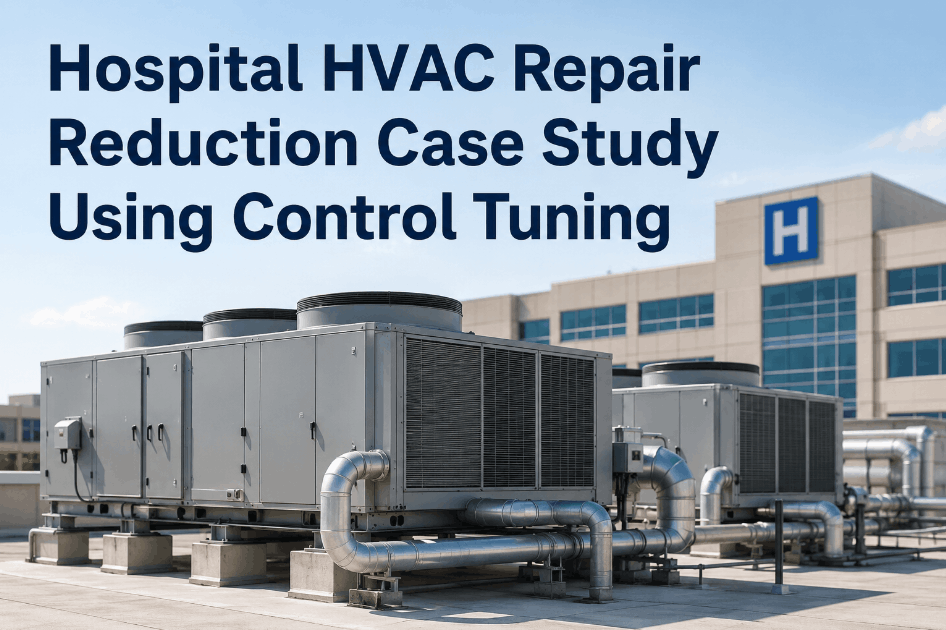
Hospital HVAC Repair Reduction Using Control Tuning and Alarm Cleanup
How one hospital reduced emergency HVAC service calls by 68%, eliminated repeat repair cycles, and achieved full documentation compliance by pairing control tuning with automated maintenance workflows.
The Challenge: Alarms Without Action, Repairs Without Resolution
A 420-bed regional hospital with five interconnected buildings was logging 300–400 BMS fault alerts per week across its air handling units, pressurization systems, isolation room controls, and chiller plant. The facilities team — six technicians managing over 1,100 monitored HVAC assets — was operating in a permanent reactive state. Alarm review happened manually once per shift; work orders were handwritten and tracked in spreadsheets. Emergency calls were generated for faults that had been quietly degrading for 12–48 hours before anyone acted.
Poorly tuned PID loops on 34 AHUs were hunting continuously — generating nuisance alarms every 8–12 minutes. Technicians became desensitized, missing real faults buried in noise.
The same assets were generating service calls every 3–5 weeks. With no linked repair history at dispatch, technicians addressed symptoms rather than causes — restarting equipment instead of investigating wear patterns.
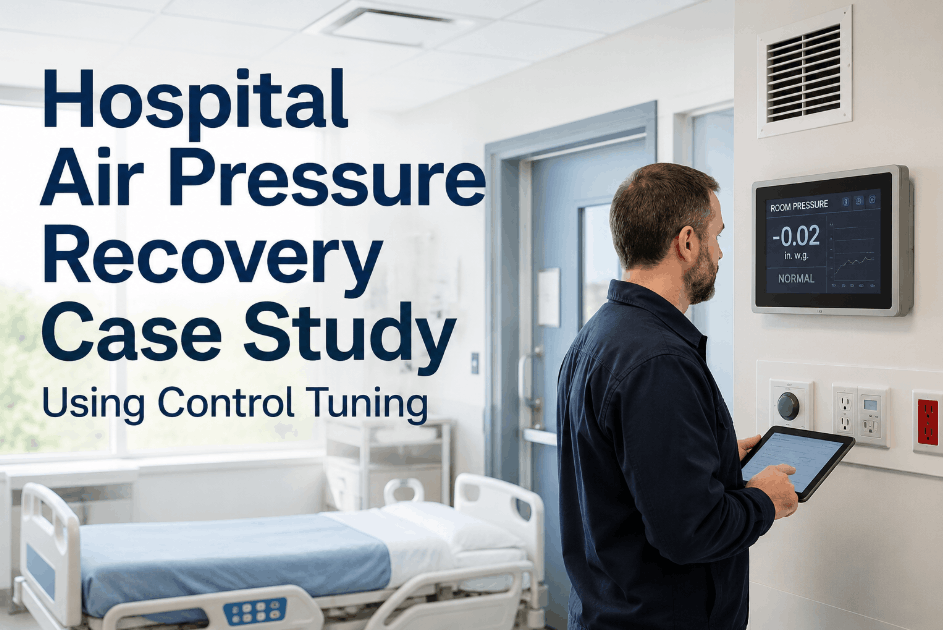
Isolation rooms, surgical suites, and pharmacy clean spaces require pressure differential maintenance within tight tolerances. Fault-to-response times of 4–7 hours represented direct infection control and regulatory risk.
Joint Commission surveys and ASHRAE 170 compliance required maintenance records per asset per inspection cycle. Records were scattered across shift logs, email threads, and physical binders — incomplete and unauditable.
Before vs. After: OxMaint Implementation
The Solution: Control Tuning Paired with Automated Maintenance Workflows
OxMaint's CMMS was deployed as the workflow layer above the hospital's existing Honeywell EBI BMS — no BMS replacement, no control system changes. Implementation combined three parallel workstreams: alarm rationalization to suppress nuisance faults, control tuning to stabilize loop-hunting assets, and automated work order routing to close the gap between fault detection and technician response.
OxMaint's maintenance history data was cross-referenced with BMS alarm logs to identify the 34 assets generating the highest nuisance alarm volume. Alarm thresholds were recalibrated using 90-day fault trending. Nuisance suppression rules were configured in OxMaint to log but not dispatch low-severity repeated faults — reducing total alarm volume by 74% while preserving detection for genuine fault conditions.
Control technicians used OxMaint asset history to identify the highest-repeat-repair AHUs and prioritized tuning sequences for those assets. Re-tuned PID parameters were documented in OxMaint asset records — creating a baseline for future drift detection. AHUs showing renewed instability are now flagged automatically via condition-based PM triggers before they escalate to emergency calls.
OxMaint's alarm-to-work-order routing was configured with a hospital-specific priority matrix: isolation rooms, surgical suites, and pharmacy clean spaces trigger P1 work orders with immediate push notification. Standard AHUs trigger P2 within 2 hours. The routing engine assigns to certified HVAC technicians by shift availability — eliminating manual triage entirely for critical zone faults.
Every work order generated from a BMS fault is pre-loaded with 24 months of asset repair history, previous fault codes, OEM guidance, and parts consumed. Technicians close work orders on mobile with resolution codes that categorize fault cause — building a searchable repeat-failure database that flags assets showing chronic failure patterns for PM schedule adjustment or capital replacement planning.
Ready to Cut Emergency HVAC Calls at Your Facility?
OxMaint connects to Honeywell EBI, Siemens Desigo, JCI Metasys, and 20+ BMS platforms. Healthcare facilities are live within 5 business days — no BMS changes required.
Measured Results — 12-Month Summary
Results tracked across 420-bed facility, 5 buildings, 1,100+ monitored HVAC assets. Baseline: 12 months prior to OxMaint deployment.
| Metric | Baseline | Post-OxMaint | Improvement |
|---|---|---|---|
| Fault-to-response time | 4–7 hours | Under 8 minutes | 96% faster |
| Emergency service calls / month | 47 | 15 | -68% |
| Repeat repairs (same asset, same fault) | 62% of calls | 12% of calls | -81% |
| PM compliance rate | 41% | 94% | +53 pts |
| Nuisance alarm rate | 78% | 19% | -76% |
| Mean time to repair (MTTR) | 4.2 hrs | 1.7 hrs | -60% |
| Annual maintenance cost avoided | Baseline | $294,000 | 2.1x ROI / 13 months |
| Joint Commission / ASHRAE 170 records | Partial — 41% complete | 100% asset records complete | Fully compliant |
Key Business Impact
Critical zone response times dropped from hours to minutes — removing HVAC-related infection control and regulatory risk from the facility's risk register.
Nuisance alarm suppression freed technician time from false-positive response. Repair history at dispatch reduced diagnostic time per incident by an average of 55 minutes.
Condition-based PM triggers replaced fixed-calendar schedules for high-criticality assets — addressing degradation before it becomes an emergency event.
Joint Commission survey preparation reduced from 3-week manual assembly to same-day export — with 100% asset records carrying complete maintenance and fault resolution history.
Expert Review
In healthcare facilities, HVAC failures carry consequences beyond occupant discomfort — pressure differential failures in isolation rooms, surgical suites, and clean spaces represent direct clinical risk. The most preventable category of failure I encounter is repeat repair: the same asset generating the same fault every four weeks because no one captured the root cause the first time. When a technician arrives at an asset without repair history, they address the symptom, not the cause — and the facility pays for that work order three more times before the pattern is recognized. Connecting BMS alarm data to an automated CMMS like OxMaint closes two gaps simultaneously: it eliminates the multi-hour window between fault detection and response, and it ensures every technician arrives with context that makes root cause resolution possible the first time. The control tuning and alarm rationalization work compounds these gains — once nuisance alarms are suppressed, the signal-to-noise ratio improves to the point where real faults are impossible to miss. The compliance documentation outcome is not secondary. Joint Commission surveyors are increasingly examining maintenance records per asset, not just program-level documentation. Facilities without digital maintenance trails are carrying regulatory risk they may not fully understand.
See OxMaint Live With Your Hospital BMS Configuration
Most healthcare facilities are live within 5 business days. Sign Up Free to explore the platform, or Book a Demo with a healthcare facilities specialist.
Frequently Asked Questions
Your BMS Is Already Detecting Problems. OxMaint Makes Sure They Get Fixed.
Stop letting hospital HVAC fault alerts sit in a dashboard. OxMaint converts every critical zone alarm into a routed, documented maintenance work order — automatically, within minutes, with full asset and repair history attached.