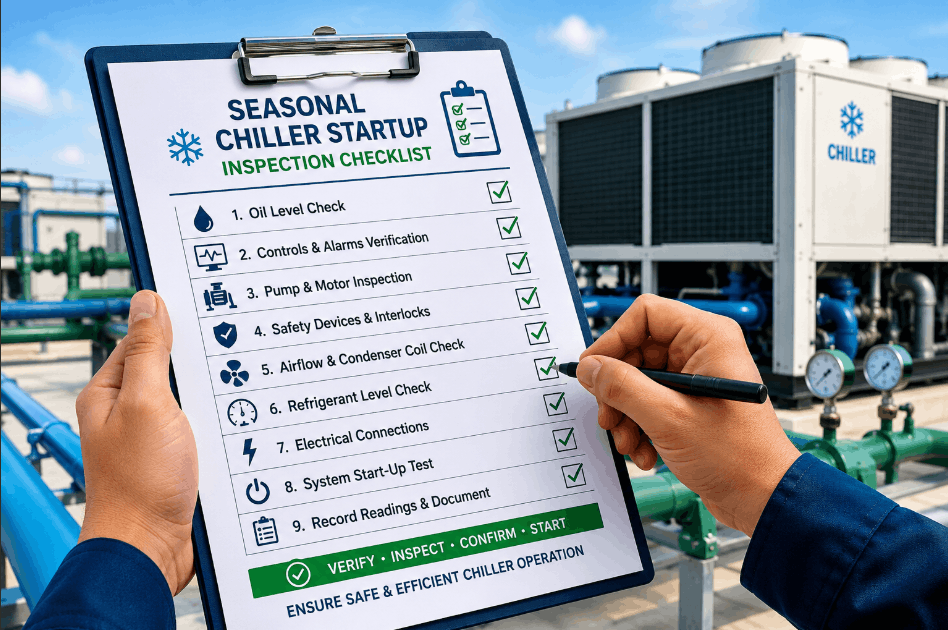
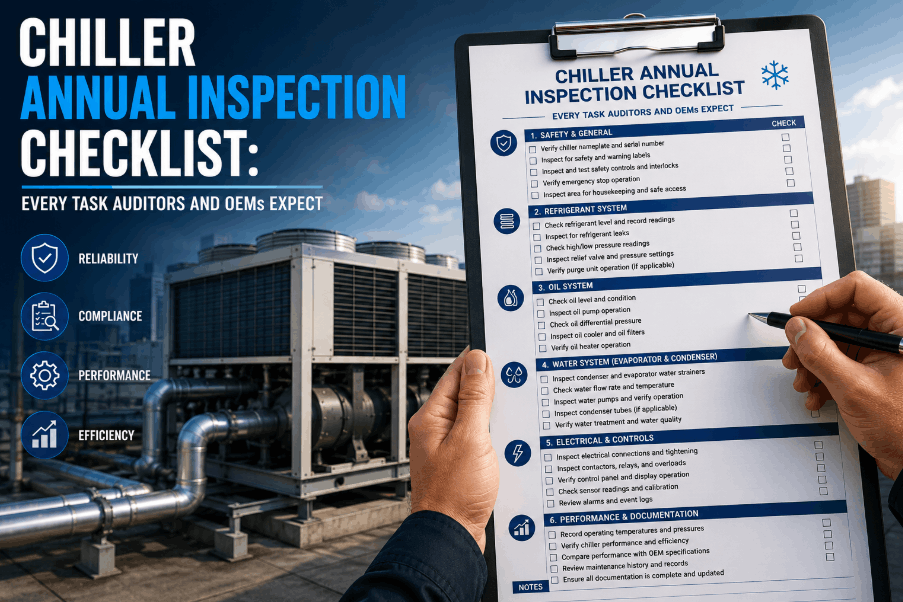
A chiller plant failure in a commercial building stops cooling for the entire facility — and with centrifugal and screw chillers costing $200,000 to $2 million to replace, unplanned failure is not an option. OxMaint helps facility teams execute detailed chiller PM inspections on schedule, document oil analysis results, track refrigerant inventory, and build the maintenance history that protects chiller warranty coverage. This checklist covers compressor checks, oil analysis, condenser and evaporator tube inspection, refrigerant analysis, controls verification, and efficiency measurement — organized by inspection frequency so your technicians know exactly what to check and when.
Checklist · Preventive Maintenance · P1 Critical
Chiller Preventive Maintenance Inspection Checklist
Compressor checks, oil analysis, condenser & evaporator inspection, refrigerant analysis, controls verification, and efficiency measurement — detailed PM for centrifugal and screw chillers.
Why Chiller PM Cannot Be Delayed
$200K+
Average chiller replacement cost (commercial)
10–15%
Efficiency loss from fouled condenser tubes
20+ yrs
Expected lifespan with consistent PM program
48 hrs
Typical lead time for emergency chiller parts
Frequency Overview
Chiller PM Task Frequency at a Glance
Weekly
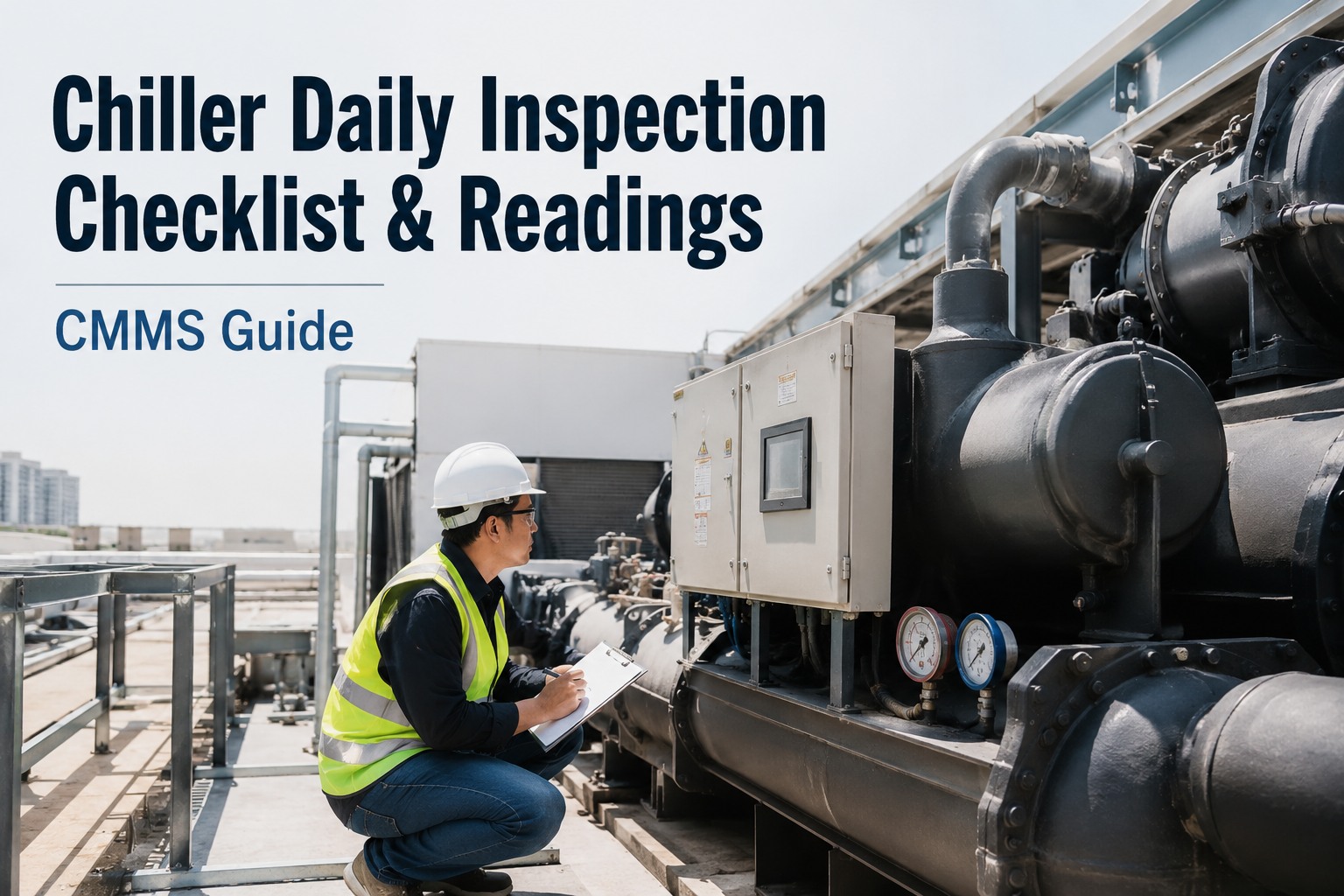
Operating data log · Leak check visual · Vibration listen
Monthly
Controls review · Purge unit check · Motor amp log · Water treatment
Quarterly
Oil analysis · Refrigerant log · Controls calibration · Bearing inspection
Annual
Tube inspection · Motor overhaul check · Refrigerant analysis · Full efficiency test
Section 1
Weekly & Monthly Operating Checks
Weekly Operating Data Log
| Parameter | Record | Normal Range |
|---|
| Chilled water supply temp | Log °F / °C | Setpoint ± 1°F |
| Chilled water return temp | Log °F / °C | 8–12°F ΔT |
| Condenser water supply temp | Log °F / °C | 65–85°F |
| Condenser water return temp | Log °F / °C | 10°F rise typical |
| Suction pressure | Log PSIG | Per refrigerant type |
| Discharge pressure | Log PSIG | Per refrigerant type |
| Motor amp draw | Log amps | Within 5% of nameplate |
| Oil pressure | Log PSIG | 15–30 PSIG above suction |
Monthly Inspection Items
Inspect purge unit operating hours and refrigerant loss rate — flag if > 10 lbs/year
Check evaporator and condenser water flow rates against design specifications
Inspect all pipe insulation and vapor barriers for damage or moisture
Verify chilled water and condenser water pump operation and amp draw
Test unit safeties — high pressure, low pressure, oil pressure differential
Review BAS chiller alarm history and active fault codes
Calculate and log kW/ton efficiency — compare to baseline commissioning data
Section 2
Quarterly PM — Oil Analysis & Compressor Checks
Oil Analysis — What to Test
| Test Parameter | Indicates | Action Threshold |
|---|
| Moisture (ppm) | Refrigerant leak into oil | > 50 ppm: investigate |
| Total Acid Number | Oil degradation / burnout | > 0.05: change oil |
| Metals (Fe, Cu, Al) | Bearing wear, erosion | Rising trend: inspect bearings |
| Viscosity (cSt) | Oil oxidation or dilution | ± 10% of spec: change |
| Refrigerant in oil % | Refrigerant migration | > 15%: check seals |
Compressor & Bearing Checks
Vibration analysis on compressor body, bearings, and motor — log velocity (in/s RMS)
Inspect oil separator sight glass and oil return line screen
Check shaft seal for refrigerant leakage — use electronic leak detector
Verify inlet vane or slide valve modulation across full range
Inspect coupling or gear elements for wear and alignment (where accessible)
Torque all accessible electrical connections — log values and compare to prior
Never Miss a Chiller Inspection with OxMaint
Set up recurring quarterly oil analysis reminders, auto-assign annual efficiency tests, and keep all chiller service records in one searchable platform.
Section 3
Annual PM — Tube Inspection, Refrigerant Analysis & Efficiency Test
T
Tube Inspection
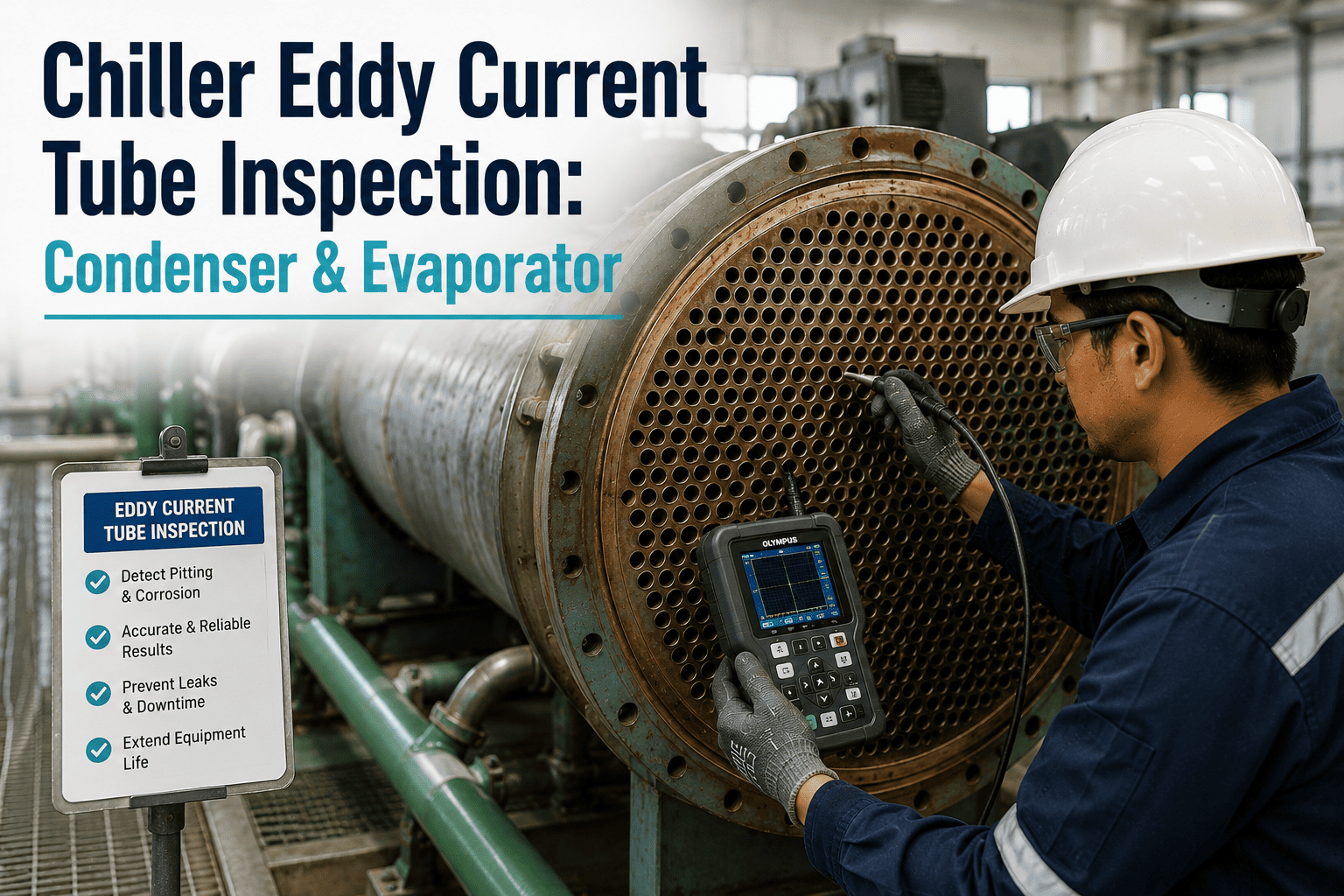
Eddy-current test all condenser and evaporator tubes — map defect location and severity
Brush clean tubes and inspect for scale, pitting, and biological fouling
Inspect tube sheet, water boxes, and gaskets for corrosion and leakage
Plug defective tubes exceeding 20% of total count — document all
R
Refrigerant Analysis
Pull refrigerant sample for laboratory analysis — moisture, acidity, non-condensables
Document total refrigerant charge and compare to nameplate specification
Log cumulative annual leak rate — EPA 608 requires < 10% per year for commercial systems
Inspect and pressure-test all refrigerant circuit connections and relief valves
E
Efficiency Performance Test
Measure actual kW/ton at 25%, 50%, 75%, and 100% load points — compare to AHRI rating
Calculate Integrated Part Load Value (IPLV) and compare to prior year baseline
Inspect approach temperatures: condenser and evaporator — fouling adds 1°F / 1–2% efficiency loss
Document all findings and produce full chiller performance report for records
Controls Verification
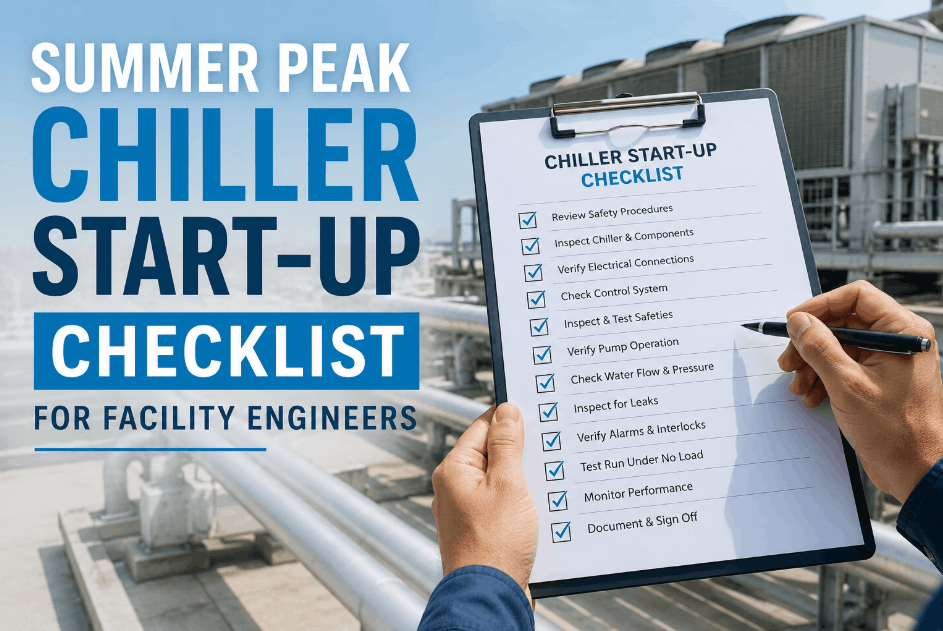
Chiller Controls & Safety Verification Checklist
Verify chilled water reset schedule and setpoint ranges in BAS
Test high-pressure cutout — confirm trip point and manual reset function
Test low-pressure cutout and verify correct setpoint for refrigerant type
Verify oil differential pressure switch trip point and time delay
Test motor overload protection at each phase — document trip amperage
Confirm anti-recycle timer prevents compressor from starting within 15 minutes of last stop
Calibrate chilled water supply, return, and leaving water temperature sensors
Test demand limiting and load shedding sequences through full range
“Chiller PM is the one maintenance program in a commercial building where cutting corners always shows up in the energy bill before it shows up as a breakdown. A 10% efficiency degradation on a 500-ton chiller costs $20,000 to $30,000 per year in additional electricity — far more than the PM program costs. The facilities that track kW/ton religiously and act on declining trends are the ones that never have emergency chiller failures.”
DP
David Park
Certified Plant Engineer (CPE) · Chiller Systems Specialist · 19 years central plant operations
FAQ
Chiller PM Inspection — Common Questions
How often should chiller oil analysis be performed? +
Most chiller manufacturers recommend oil analysis every 1,000 operating hours or quarterly — whichever comes first — as a minimum standard. Buildings with high annual run hours (5,000+ hours) should analyze oil semi-annually at minimum. Rising metal content across consecutive samples is an early warning of bearing wear that, caught early, can be addressed before it causes a catastrophic compressor failure.
OxMaint schedules oil analysis reminders automatically based on your chiller’s runtime hours logged in the system.
What does a condenser tube eddy-current test tell you? +
Eddy-current testing uses electromagnetic induction to detect wall thinning, pitting, and cracks inside condenser and evaporator tubes without removing them. A tube showing 20% or more wall loss should be plugged immediately. Defect mapping across multiple annual tests reveals whether deterioration is localized (typically inlet-end erosion) or systemic (water chemistry or corrosion issue). This test is the most reliable indicator of remaining tube life and should be performed annually on all chillers over 10 years old.
Book a demo to see how OxMaint stores eddy-current test reports linked to each tube bundle.
At what kW/ton efficiency loss should a chiller be taken offline for service? +
A 10% degradation in kW/ton efficiency from the chiller’s baseline commissioning data is the standard threshold that triggers a full PM inspection. In a 500-ton chiller running 2,500 hours per year at $0.10/kWh, 10% efficiency loss costs approximately $25,000 to $35,000 in annual electricity above the baseline. Most chiller manufacturers recommend scheduling a tube-cleaning and refrigerant inspection when approach temperature on either the condenser or evaporator rises more than 3°F above the original design specification.
Does OxMaint support EPA 608 refrigerant leak rate tracking for chillers? +
Yes. OxMaint tracks refrigerant additions by date and quantity, calculates rolling 12-month leak rate as a percentage of nameplate charge, and alerts facility managers when annual leak rate approaches the EPA 608 threshold requiring a leak inspection. All refrigerant service records are stored with technician sign-off for regulatory documentation purposes.
Create a free account to configure refrigerant tracking for your chiller plant — setup takes under 15 minutes per chiller.
Track Every Chiller Inspection in One Platform
OxMaint automates chiller PM scheduling, logs oil analysis results, tracks refrigerant inventory, and produces manufacturer-ready maintenance records for warranty compliance.