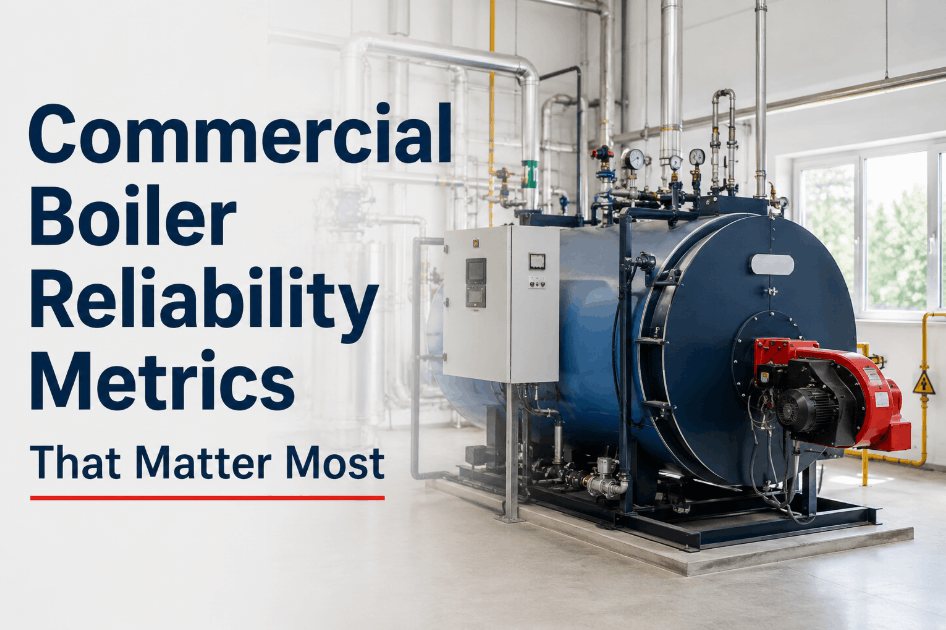
Commercial boiler reliability is measured not by whether a boiler is running today, but by how predictably it runs through the full heating season — and what the data trend says about where reliability is heading. Facility managers and HVAC maintenance teams that rely on annual service visits and visual inspection alone miss the leading indicators that distinguish a well-maintained boiler from one approaching a costly mid-winter failure. Burner start reliability, combustion efficiency swing, annual service interval adherence, and unplanned shutdown frequency are the metrics that separate proactive boiler programs from reactive ones. Sign Up Free to schedule commercial boiler PM work orders, log service readings, track unplanned shutdown events, and build the maintenance history required to judge boiler reliability trends in OxMaint CMMS. From single-boiler mechanical rooms to multi-boiler central plant operations, OxMaint structures boiler maintenance data capture so reliability metrics are visible before they become failure statistics. Book a Demo to see how commercial heating system maintenance teams use OxMaint to manage boiler reliability and service interval compliance across facility portfolios.
Track Commercial Boiler Reliability Metrics in OxMaint
Schedule boiler PM work orders, log burner performance readings, track unplanned shutdown events, and monitor service interval compliance — all linked to boiler asset history in one CMMS.
Commercial Boiler Reliability Metrics Checklist
This checklist identifies the specific reliability metrics that matter most for commercial boiler systems and the maintenance practices that generate the data needed to track them over time.
Track Burner Start Success Rate and Lockout Frequency
Burner lockout events — where the burner fails to ignite and requires manual reset — are a leading indicator of igniter wear, gas valve issues, or flame sensor degradation. Log every lockout event by date, unit, and technician response time. Sign Up Free to create burner lockout event logging work orders linked to boiler assets in OxMaint today.
Measure Combustion Efficiency at Each Service Interval
Combustion efficiency (flue gas CO2 percentage, excess air percentage, stack temperature) measured at each annual or semi-annual service visit provides the baseline for efficiency trend analysis. A 3–5% efficiency swing between service visits signals burner tuning drift requiring adjustment.
Document Mean Time Between Unplanned Shutdowns Per Boiler
Calculate the average operating hours between unplanned shutdowns for each boiler unit. Declining MTBS (mean time between shutdowns) over multiple heating seasons signals increasing unreliability and informs proactive replacement or overhaul decisions. Book a Demo to see how OxMaint's work order history enables MTBS calculation across commercial boiler assets.
Monitor Annual Service Interval Compliance Rate
Boiler service that slips beyond its annual interval window — even by 4–6 weeks — measurably increases failure probability during peak heating demand. Track service interval completion dates per unit and flag any boiler approaching or exceeding its service due date. OxMaint schedules boiler service PMs automatically and surfaces overdue tasks before the heating season.
Log Water Treatment Chemistry Results and Feedwater Quality
Scale buildup from inadequate water treatment is a primary driver of heat exchanger failure, efficiency loss, and boiler tube corrosion. Log water chemistry test results — pH, conductivity, dissolved oxygen, inhibitor concentration — at each service visit and link results to the boiler asset record. Sign Up Free to add water treatment data capture fields to boiler PM checklists in OxMaint.
Inspect Heat Exchanger for Scale, Corrosion, and Fouling Annually
Heat exchanger condition directly determines thermal transfer efficiency and long-term reliability. Visual inspection, thickness testing, or borescope inspection of heat exchanger surfaces at annual service intervals catches scale accumulation and corrosion before it causes tube failure or efficiency collapse.
Verify Safety Control Operation — Pressure, Temperature, and Low-Water Cutoffs
Safety controls that fail to trip correctly create both operational risk and insurance liability. Test and document high-pressure cutout, high-temperature limit, and low-water cutoff operation at every annual service interval. Book a Demo to see how OxMaint structures safety control verification tasks within boiler PM checklists with technician sign-off capture.
Track Gas Pressure and Supply Consistency at Boiler Train Inlet
Variable or low gas supply pressure causes burner performance inconsistency, efficiency variation, and ignition failures — particularly in buildings with multiple heating equipment items drawing from shared gas mains. Record gas inlet pressure at each service visit and investigate deviations from utility specifications.
Compare Annual Fuel Consumption Against Heating Degree Day Normalized Baseline
Year-over-year fuel consumption comparison must account for weather variation. Normalize consumption against heating degree days for valid comparison — consumption increases above 8–10% on a degree-day basis signal combustion efficiency decline or distribution system losses requiring investigation. Sign Up Free to track boiler fuel consumption data alongside maintenance history in OxMaint asset records.
Assess Flue and Venting System Integrity During Annual Service
Flue gas leakage from deteriorated venting, failed gaskets, or damaged flue pipes creates both efficiency loss and carbon monoxide risk. Inspect flue connections, draft diverter operation, and vent termination condition at every annual service — documenting condition and any corrective action taken.
Build a Per-Boiler Cumulative Repair Cost and Parts Replacement History
Accumulating repair costs and parts replacement data per boiler unit over multiple years reveals the financial trajectory of each asset — enabling data-supported replacement decisions when repair cost accumulation approaches economic thresholds. OxMaint links all work order costs to asset records, building per-boiler repair cost history automatically. Book a Demo to see how OxMaint's asset cost history supports boiler reliability analysis and replacement planning decisions.
Boiler Reliability Requires Metrics, Not Just Service Visits
OxMaint connects boiler PM scheduling, service reading capture, unplanned shutdown logging, combustion efficiency tracking, and cumulative repair cost history — giving commercial heating teams the data to manage boiler reliability proactively through every heating season.
Frequently Asked Questions: Commercial Boiler Reliability Metrics
What are the most important reliability metrics for commercial boilers?
The five most important metrics are: burner start success rate, combustion efficiency at service intervals, mean time between unplanned shutdowns, annual service interval compliance, and cumulative repair cost trend — together they indicate both current reliability and the trajectory of future performance.
How does OxMaint support commercial boiler reliability tracking?
OxMaint schedules boiler PM work orders with structured data capture fields, logs unplanned shutdown events, accumulates repair costs per asset, and provides maintenance history reports — giving commercial heating teams the data foundation to calculate and trend key reliability metrics over time.
How often should commercial boilers be serviced for reliability?
Most commercial boilers require annual service at minimum — including combustion analysis, heat exchanger inspection, safety control testing, and water treatment review. High-demand or aging boilers may benefit from semi-annual service to maintain reliability through full heating seasons.
What does a combustion efficiency swing indicate in a commercial boiler?
An efficiency swing greater than 3–5% between service intervals typically indicates burner component wear, gas pressure variation, heat exchanger fouling, or combustion air supply changes — each requiring investigation and corrective action to restore optimal thermal efficiency and reduce operating cost.
When does commercial boiler repair cost justify replacement?
When annual repair costs exceed 25–30% of replacement cost, combined with declining MTBS and efficiency trends, capital replacement typically delivers better financial return than continued service investment — particularly for boilers beyond 15–20 years of operating age.
Build the Boiler Reliability Program Your Heating System Deserves
OxMaint gives commercial heating teams the PM scheduling, service data capture, shutdown tracking, and asset cost history to measure and improve boiler reliability — before the next heating season demands it.