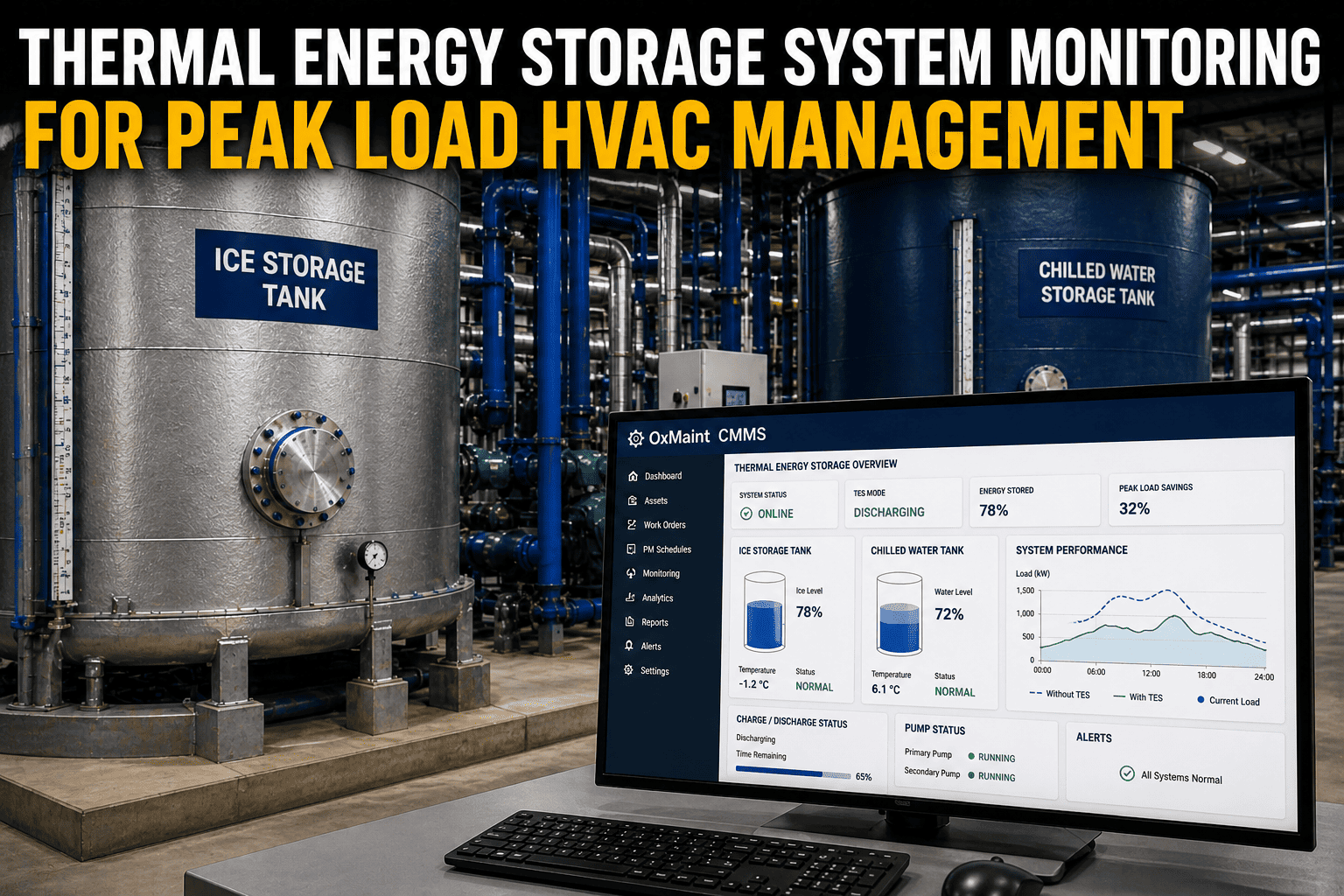
Demand charge reduction is one of the highest-leverage opportunities available to commercial facilities with central cooling plants — yet most teams leave it on the table by running chillers reactively during peak utility hours. Pre-cooling strategies shift the building's thermal load into off-peak windows, reducing the peak kilowatt draw that drives demand charges on monthly utility bills. When maintenance teams align thermal storage scheduling, chiller plant timing, and BAS control settings, the result is a measurable reduction in electricity costs without sacrificing occupant comfort. OxMaint gives facility and energy management teams the work order scheduling and PM infrastructure to Sign Up Free and implement pre-cool strategies as repeatable, documented maintenance tasks. If your cooling plant currently has no formal pre-cool protocol, Book a Demo to see how OxMaint supports demand charge reduction through structured scheduling and control verification workflows.
OxMaint connects pre-cool scheduling, control verification, and PM tasks so your team executes demand charge reduction systematically — not by memory or manual effort.
Why Demand Charges Are a Cooling Problem
In most commercial tariff structures, demand charges are calculated from the single highest 15- or 30-minute peak interval in the billing period. Cooling systems are the primary driver of that peak in most facilities. Four dynamics connect HVAC operation to demand charge exposure.
Buildings that cool from overnight setback during morning occupancy hours create demand spikes that coincide with peak utility pricing windows.
Afternoon peak utility hours overlap with maximum solar heat gain on east and south facades — driving simultaneous chiller demand at the worst possible billing moment.
Buildings without thermal storage or chilled water buffer tanks must meet instantaneous cooling load with chiller capacity — amplifying peak demand with no ability to shift load.
BAS setpoints and chiller staging that are not coordinated with utility peak windows operate efficiently in isolation but create avoidable demand exposure at the billing level.
Pre-Cool Strategy Components
An effective cooling pre-cool strategy is a coordinated set of scheduling, setpoint, and storage decisions that shift thermal load away from peak demand windows. Sign Up Free to manage each component as a documented, repeatable maintenance task in OxMaint. Here are the four operational levers that drive demand charge reduction.
Run cooling plant 2–4 hours before occupancy to pre-cool building mass — concrete, slab, and structure — so the building coasts through the demand peak without chiller operation. Requires scheduled BAS setpoint changes documented as recurring PM tasks.
Charge chilled water storage tanks or ice storage systems during off-peak hours — typically late night or early morning. Discharge into the distribution loop during peak windows to reduce or eliminate chiller runtime at peak pricing hours.
Program BAS to shift supply air temperature setpoints, chilled water differential pressure, and AHU discharge setpoints during peak windows. Control verification tasks in OxMaint confirm settings are active and documented before the billing period closes.
Sequence chiller starts to avoid simultaneous operation during peak windows. OxMaint PM scheduling supports staggered staging procedures as documented tasks with technician verification — eliminating reliance on informal operator knowledge.
Pre-Cool Schedule Framework
How OxMaint Supports Demand Charge Reduction
A pre-cool strategy documented in a building manual does not reduce demand charges — executed, verified pre-cool tasks do. Book a Demo to see how OxMaint operationalizes demand charge reduction through scheduled maintenance tasks, control verification workflows, and energy performance tracking.
Schedule pre-cool procedure verification, storage charge confirmation, and BAS setpoint checks as recurring PM tasks in OxMaint — triggered by season, billing period, or calendar date.
Create work orders for technicians to verify BAS peak period setpoints are active before billing windows open. Sign Up Free to build this workflow in your facility today.
Document chilled water buffer tanks, ice storage systems, and thermal mass assets in OxMaint's asset register — with criticality tier, capacity, and maintenance history attached to each unit.
OxMaint work order history creates an audit trail showing pre-cool tasks were completed before each billing period — supporting energy program compliance and internal accountability.
Track pre-cool task completion rates against billing period demand data. Identify months where incomplete pre-cool procedures correlated with elevated demand charges and correct scheduling gaps.
Technicians complete pre-cool verification checklists on mobile — logging BAS setpoint values, storage charge levels, and chiller staging status directly in OxMaint from the plant room.
OxMaint connects pre-cool scheduling, BAS control verification, and thermal storage maintenance into a single workflow — so demand charge reduction happens consistently, not occasionally. Sign Up Free or Book a Demo to build your demand charge reduction program.
Frequently Asked Questions
OxMaint gives your facility team the scheduling, verification, and reporting infrastructure to make cooling pre-cool strategies repeatable and accountable. Start reducing demand charges today.