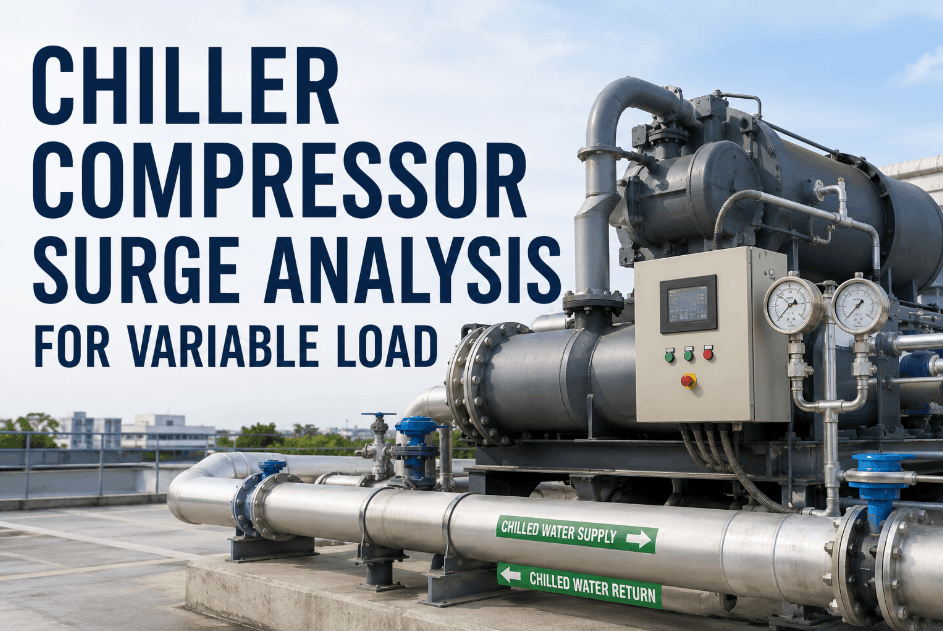
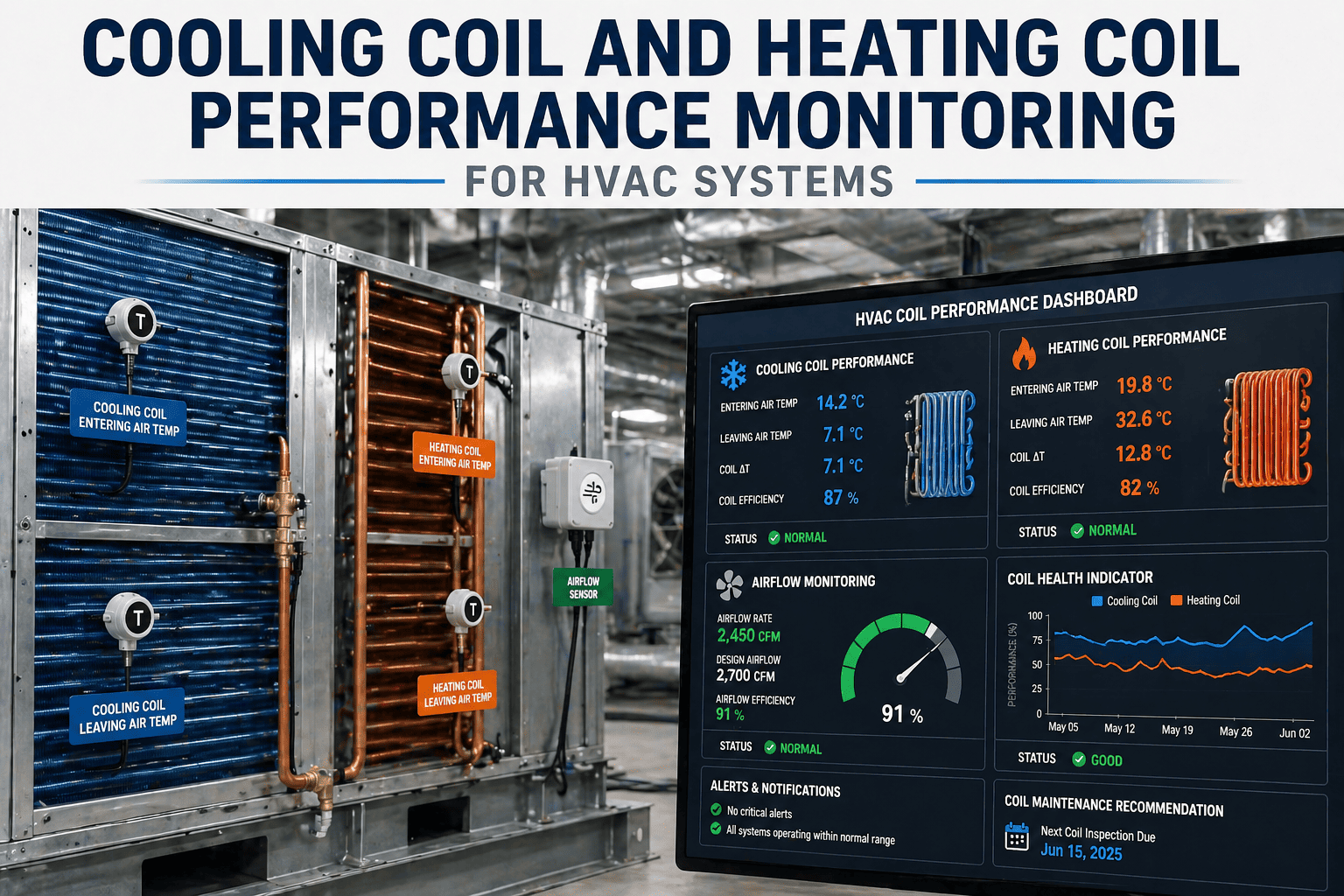
Chiller compressor surge during variable load conditions is one of the highest-risk failure modes in cooling plant operations. When demand shifts rapidly — from partial to full load or vice versa — compressors operating without adequate surge margin can experience repeated pressure oscillations that damage internals, degrade efficiency, and accelerate wear on critical components. Sign Up Free to start tracking compressor surge signals, pressure swing trends, and control response gaps in OxMaint before instability turns into unplanned downtime. OxMaint's asset monitoring and fault detection workflows give facility teams the diagnostic structure to identify surge-prone operating windows, document pressure behavior under variable demand, and link control tuning gaps to measurable reliability outcomes. Book a Demo to see how OxMaint structures chiller diagnostics for cooling plants managing dynamic load profiles across shifts and seasons.
Reliability Engineering · HVAC Analytics · 2026
Chiller Compressor Surge Analysis for Variable Load
Track pressure swings, surge signals, and control response to keep chiller compressors stable when demand moves up and down quickly.
40%Of chiller compressor failures are linked to undetected surge operating windows
−28%Energy waste reduction when surge margin is actively monitored and control-tuned
3×Faster fault escalation with automated surge signal alerts vs. manual rounds
97%Root cause documentation compliance with OxMaint incident closure requirements
Where Chiller Surge Risk Builds Under Variable Load
Variable load conditions create surge exposure in operating windows that fixed-load analysis never surfaces. The six pressure behavior patterns below represent the most common diagnostic gaps in cooling plants — and the points where OxMaint's performance monitoring and fault detection give engineering teams a structured view before surge events occur. Sign Up Free to configure OxMaint's chiller diagnostics for your cooling plant and start mapping compressor stability against actual demand patterns.
01
Lift Pressure Oscillation at Part Load
Risk Window: 20–50% load
High Risk
At part-load conditions, compressor lift requirements drop but control response often lags — creating pressure differential oscillations that push the operating point toward the surge line without triggering standard alarms.
02
Rapid Load Step Response
Risk Window: Fast demand ramp
Transition Risk
Sudden increases in cooling demand force the compressor through transient operating points. Without real-time surge margin tracking, control systems may over-correct inlet guide vanes, compressing surge risk further.
03
Condenser Pressure Drift
Risk Window: Wet-bulb fluctuation
Pressure Variable
Ambient wet-bulb changes during the day shift condenser pressure faster than most control systems compensate. Tracking condenser pressure trends alongside compressor performance data surfaces drift that tightens surge margin invisibly.
04
Evaporator Pressure Undershoot
Risk Window: Low-load pulldown
Largest Variable
When evaporator pressure drops below the setpoint band during low-load pulldown, the compressor's effective lift increases — narrowing surge margin at exactly the moment operators expect stable operation.
05
Inlet Guide Vane Control Lag
Risk Window: All load transitions
Control Gap
IGV response time versus actual load change rate determines how long the compressor operates off the optimal curve. Documenting IGV lag as a maintenance diagnostic reveals tuning gaps that no equipment alarm captures.
06
Surge Event Documentation Gap
Risk Window: Post-event
Prevention Input
Minor surge events are routinely unrecorded — operators note a noise or vibration but no formal fault is logged. Without structured incident capture, repeat surge exposure accumulates without a preventive maintenance trigger.
Surge Diagnostic Response — Without vs. With OxMaint
The difference between ad-hoc chiller monitoring and a structured CMMS-supported diagnostic workflow is measurable in compressor reliability and energy performance. The comparison below shows what changes when OxMaint structures surge signal tracking, fault escalation, and root cause documentation for variable-load chiller operations. Book a Demo to walk through your cooling plant's current chiller diagnostic structure and identify the gaps OxMaint can close.
Chiller Surge Management Maturity — Where Does Your Plant Score?
Surge management capability in cooling plants ranges from entirely reactive — operators notice symptoms after damage begins — to fully structured predictive monitoring with automated alerts, trend correlation, and mandatory root cause documentation. The maturity framework below maps where each plant's current diagnostic structure sits. Book a Demo to assess your plant's current chiller diagnostic maturity with an OxMaint solutions engineer.
Chiller Compressor Surge Management Maturity
Score 5 = structured CMMS-supported surge monitoring · Score 1 = fully reactive response
5
Full Diagnostic Map · CMMS-Integrated · Automated Alerts
All surge-related operating parameters monitored, trended, and linked to maintenance records. Automated alerts, root cause documentation, and PM schedule adjustment operating from a single CMMS workflow.
Profile: Surge exposure is measured, documented, and converted into preventive maintenance intelligence. Compressor reliability is a systematic outcome, not an individual technician's awareness.
4
Structured Monitoring · Partial Root Cause Capture
Pressure trends monitored and major surge events documented. Root cause captured on significant incidents but skipped on minor events. Control tuning gaps not systematically tracked.
Action: Enforce root cause closure on all surge-related incidents. Minor event documentation is where repeat failure prevention is built.
3
BAS Monitoring · Manual Escalation
BAS data available but reviewed manually. Surge events escalated verbally. Fault context not transferred to maintenance records. Parts and inspection gaps discovered reactively.
Gap: Manual escalation and informal documentation are the primary reliability gaps at this level. Automated alert routing and structured fault logging are the highest-impact next steps.
2
Informal Response · Operator Observation Only
Surge conditions identified through operator noise and vibration observation. No structured fault logging. Same events repeat without any prevention trigger or maintenance adjustment.
Risk: Surge exposure accumulates invisibly. Compressor damage is discovered at inspection or failure — not before.
1
No Surge Monitoring Structure
Compressor operating parameters not tracked between scheduled service intervals. Surge events undocumented. Maintenance intervals fixed by calendar regardless of actual operating stress.
Risk: Every surge exposure adds untracked cumulative damage. Reliability is a function of luck, not maintenance design.
Map Your Chiller Compressor Surge Risk Before the Next Load Swing.
OxMaint structures surge signal tracking, fault escalation, and root cause documentation for cooling plants managing variable demand — in one CMMS workflow.
How OxMaint Structures Chiller Compressor Diagnostics
OxMaint connects pressure trend monitoring, fault detection, and maintenance planning into a single workflow for cooling plant reliability teams. Every surge-related event becomes a documented maintenance record — with root cause captured, PM schedules reviewed, and recurring fault patterns surfaced before they become compressor damage. Sign Up Free to configure OxMaint's chiller diagnostics for your variable-load cooling plant. Book a Demo to see how OxMaint adapts to your plant's BAS integration, shift structure, and escalation hierarchy.
Surge Signal Alerting
Threshold → Alert in 60s
Automated pressure swing detection and technician notification
Pressure oscillation events trigger automatic work order creation and mobile notification — replacing the informal operator report chain that delays diagnosis by 10–20 minutes.
Asset History Correlation
Fault → Trend Context
Surge events linked to equipment history and PM records
OxMaint links each fault log to the asset's maintenance history — surfacing whether a surge event follows a recent service gap, seasonal load shift, or control tuning change.
Control Tuning Workflow
Before Next Incident
IGV and setpoint gaps captured as structured maintenance tasks
OxMaint creates structured follow-up tasks for control response gaps identified during surge events — ensuring tuning issues are resolved before the next variable-load cycle.
Root Cause Closure
Every Incident
Prevention trigger captured at incident close
CMMS closure requires root cause entry on every surge-related work order. Completion automatically updates PM schedules and flags high-stress units for earlier inspection cycles.
"
We had three centrifugal chillers showing intermittent surge signatures during afternoon peak ramp-up. Before OxMaint, these went unlogged — operators noted the noise but nothing entered the CMMS. After configuring OxMaint's fault detection workflow, we documented 14 surge events in 60 days that were previously invisible. Two of those events traced back to an IGV calibration drift that would have caused a compressor inspection within a season. We caught it early, tuned the control, and the surge signatures disappeared.
Chief Plant Engineer — District Cooling Facility, 4 centrifugal chillers, Dubai, UAE
Frequently Asked Questions
What causes chiller compressor surge during variable load?
Surge occurs when the compressor's flow rate drops below the minimum required for stable operation — most commonly during rapid load reductions, condenser pressure spikes, or inlet guide vane control lag. Variable load conditions create more frequent transitions through surge-prone operating windows than fixed-load operation.
How does OxMaint detect chiller compressor surge signals?
OxMaint receives fault triggers from BAS integrations or operator-logged pressure observations. Threshold-based alerts create automatic work orders when pressure swing patterns match configured surge signatures — ensuring every event is documented and escalated.
Can OxMaint track compressor performance trends over time?
Yes. OxMaint links fault history, PM records, and performance observations per asset — allowing facility teams to identify whether surge frequency is increasing, correlate events to seasonal load profiles, and adjust maintenance intervals accordingly.
Why is root cause documentation important for surge management?
Without root cause capture, repeated surge events look like isolated incidents rather than a developing failure pattern. OxMaint enforces root cause entry at incident close, converting each event into a prevention trigger that updates PM schedules automatically.
Does OxMaint integrate with existing BAS or chiller controls?
OxMaint supports integration with leading BAS platforms and accepts manual fault inputs from technicians — making it deployable in plants at any level of automation without requiring hardware changes.
Turn Every Pressure Swing Into a Structured Diagnostic Record — Not a Missed Event.
OxMaint maps surge signal tracking, automates fault escalation, and enforces root cause documentation — compressing compressor risk at the operating windows that matter most.