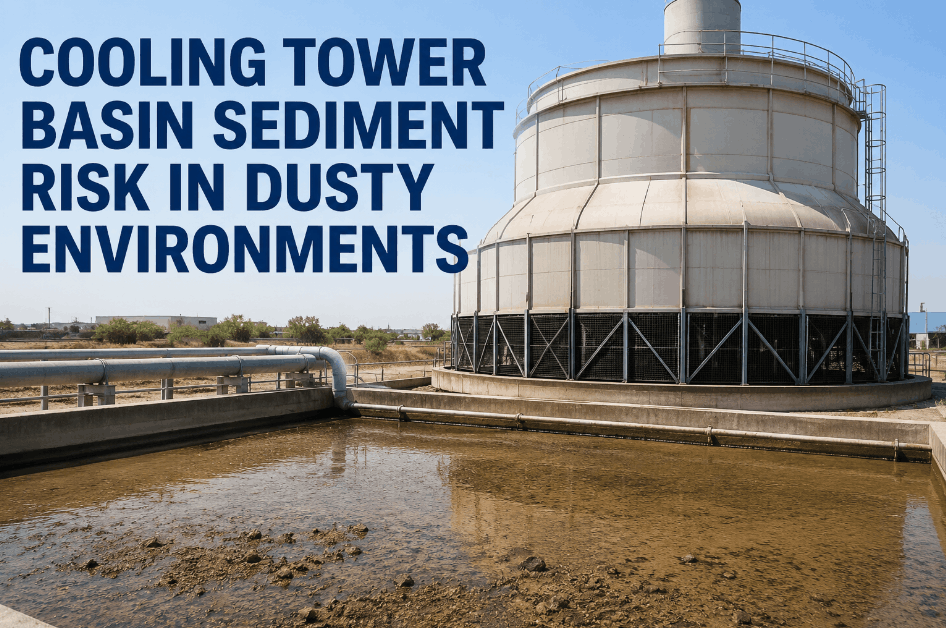
Cooling towers at cement plants, steel mills, and other dusty industrial sites take in far more than air through their fill media. Airborne dust settles into the basin water, builds up as sediment, and quietly works against everything the tower is trying to do, from water quality to heat rejection performance. Catching sediment risk early keeps blowdown costs, chemical treatment, and unplanned downtime under control. Sign Up Free with Oxmaint to connect cooling tower inspection records, water quality data, and maintenance schedules so sediment buildup gets caught before it affects plant performance.
Why Sediment Risk Is Higher for Cooling Towers in Dusty Industrial Environments
Towers operating near cement, steel, or aggregate processing carry a sediment load that towers in cleaner environments rarely see. Book a Demo to see how Oxmaint tracks basin condition and water quality trends specific to high-dust industrial sites.
Four Factors That Drive Cooling Tower Basin Sediment Risk
Sediment risk depends on more than just how dusty the site is, since design and maintenance choices significantly change the outcome. Sign Up Free to build cooling tower asset profiles in Oxmaint that track these variables together over time.
Sites near cement kilns, material handling, or unpaved haul roads expose tower intake air to far higher particulate concentrations, directly increasing the rate at which sediment settles into the basin.
Basin shape and the presence of dedicated sediment trap zones determine how easily accumulated solids can be removed versus how much settles into hard-to-reach corners and sump areas.
Blowdown rate and chemical treatment programs need to account for elevated suspended solids, since a treatment plan calibrated for clean-site conditions will under-perform at a high-dust facility.
Strainers and filters bear the brunt of sediment load in dusty environments and need a maintenance frequency that matches actual fouling rates rather than a standard manufacturer interval.
Sediment Risk Evaluation Framework for Industrial Cooling Towers
Comparing sediment risk across towers requires looking at exposure, design, and maintenance history together rather than any single factor. Book a Demo to see how Oxmaint pairs inspection data with PM scheduling to support that comparison.
| Evaluation Factor | High Sediment Risk Sites | Low Sediment Risk Sites | Key Metric to Track | Monitoring Approach |
|---|---|---|---|---|
| Site Dust Exposure | Cement, steel, aggregate plants | Office parks, light industrial sites | Particulate load near intake | Periodic basin water sampling |
| Basin Geometry | Flat basin with no sediment trap | Sloped basin with sweeper piping | Sediment depth vs. threshold | Visual basin inspection |
| Water Treatment Fit | Treatment calibrated for clean sites | Treatment adjusted for dust load | Suspended solids concentration | Water quality testing |
| Strainer Condition | Standard interval cleaning only | Condition-based cleaning schedule | Strainer pressure drop | Pressure differential monitoring |
| Fill Media Fouling | Visible sediment on fill surfaces | Clean fill media at inspection | Heat rejection vs. baseline | Performance trend tracking |
Common Cooling Tower Basin Sediment Failure Patterns
Implementing Cooling Tower Sediment Monitoring with Oxmaint
Sediment risk in dusty environments needs a maintenance program built around actual exposure, not a generic cleaning calendar. Sign Up Free and connect your cooling tower assets to Oxmaint's inspection and condition-based maintenance workflows.
- Register each cooling tower in Oxmaint with basin geometry and design heat rejection data
- Document baseline water quality and sediment depth at first inspection
- Link strainer, fill media, and sweeper piping as child assets under the tower record
- Set inspection frequency based on measured dust exposure rather than a fixed annual default
- Use digital checklists to record sediment depth and fill media condition at every visit
- Log water quality test results alongside each inspection record
- Set alert thresholds for sediment depth and suspended solids based on site conditions
- Trigger cleaning work orders automatically when thresholds are exceeded
- Route strainer pressure drop alerts to plant engineers with cleaning history attached
- Monitor heat rejection performance against design baseline to detect fouling early
- Track blowdown and chemical treatment cost trends against sediment levels
- Report basin condition and cleaning ROI to plant leadership on a recurring basis
Cooling Tower Sediment KPIs for Plant Operations
Tracking sediment performance requires metrics that connect basin condition to measurable plant outcomes. Book a Demo to see Oxmaint's analytics dashboards built for industrial cooling tower management.
Tracks accumulated sediment depth against a site-specific threshold. Approaching the limit should trigger an early cleaning cycle.
Rising pressure drop across strainers signals sediment fouling before it restricts condenser water flow significantly.
Compares current heat rejection performance to commissioning baseline, flagging fill media fouling before it affects plant output.
Tracks whether condition-based cleaning cycles are being completed on time across the cooling tower fleet.
Connects chemical treatment spend to sediment and suspended solids levels to identify when treatment programs need adjustment.
Measures downtime events linked to sediment-related fouling or strainer failures, used to validate the maintenance program's effectiveness.