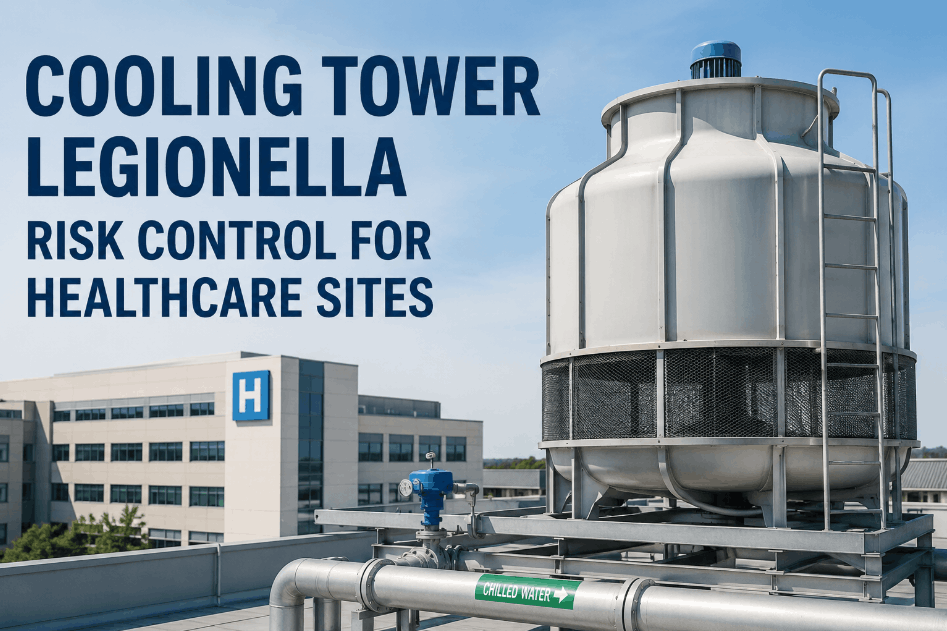
Cooling tower Legionella risk control in healthcare facilities carries consequences that no other commercial building type faces — patient populations with compromised immune systems, regulatory scrutiny under CMS and ASHRAE 188, and institutional liability exposure that makes a preventable outbreak a defining failure. Water quality management, stagnation elimination, and maintenance gap closure are not optional hygiene measures in this environment — they are enforceable compliance obligations. Healthcare facilities without a formal, documented water management program tied to their CMMS are operating with unacceptable exposure. OxMaint gives facility engineering and infection control teams the PM scheduling, work order, and compliance tracking infrastructure to Sign Up Free and manage Legionella risk as an operational program, not a reactive response. If your facility lacks a structured cooling tower maintenance and water treatment workflow, Book a Demo to see how OxMaint operationalizes ASHRAE 188-aligned water management programs.
OxMaint connects cooling tower inspection scheduling, water treatment verification, and PM compliance workflows so healthcare facility teams manage Legionella exposure systematically — not reactively.
Why Healthcare Cooling Towers Carry Higher Legionella Exposure
Healthcare cooling towers share the same mechanical components as commercial towers but operate in an environment where the margin for error is functionally zero. Four conditions elevate Legionella risk specifically in healthcare settings.
Immunocompromised patients, surgical recovery units, and ICU populations face Legionellosis mortality rates far exceeding healthy adults — turning maintenance gaps into patient safety events.
Low-census periods, planned shutdowns, and seasonal reduced-load operation create stagnation conditions where Legionella colonization accelerates in the basin and fill media.
CMS conditions of participation, The Joint Commission standards, and ASHRAE 188 require documented water management programs — with verifiable maintenance records that surveyors can audit.
Missed biocide doses, unmaintained conductivity control, or drifted blowdown schedules allow biofilm to establish on fill surfaces — creating a persistent colonization reservoir that spot treatment cannot resolve.
Cooling Tower Legionella Risk Control Program Components
An effective healthcare cooling tower risk control program integrates water treatment scheduling, physical inspection protocols, microbiological monitoring, and startup/shutdown procedures into documented maintenance tasks. Sign Up Free to manage each component as a recurring PM in OxMaint. These four components form the operational core of an ASHRAE 188-aligned program.
Schedule recurring biocide dosing verification, conductivity and pH checks, inhibitor residual testing, and blowdown rate confirmation as PM tasks. OxMaint checklists capture test values at the tower — creating a treatment compliance record tied to each asset.
Document basin inspections, fill media condition assessments, drift eliminator integrity checks, and annual disinfection procedures as OxMaint work orders. Physical inspection records close the gap between chemistry data and actual tower condition.
Schedule Legionella culture sampling, HPC bacteria counts, and rapid test interpretation as calendar-triggered PM tasks. OxMaint stores sample results against the tower asset record — making trend analysis across sampling periods visible to facility managers.
Seasonal startup and shutdown require hyperchlorination, system flushing, and fill inspection before and after extended low-use periods. OxMaint PM scheduling ensures these critical procedures execute on defined timelines — not when maintenance staff remember.
Healthcare Cooling Tower Maintenance Frequency Framework
How OxMaint Supports Healthcare Legionella Risk Programs
A water management plan binder in a facility manager's office does not reduce Legionella exposure — executed, verified maintenance tasks do. Book a Demo to see how OxMaint operationalizes cooling tower water management through recurring PM tasks, treatment verification workflows, and compliance-ready audit records.
Schedule biocide checks, chemistry tests, basin inspections, and microbiological sampling as recurring PM tasks in OxMaint — with automatic assignment and escalation on missed completion.
Technicians log chemistry readings, biocide residuals, and inspection observations directly in OxMaint mobile checklists from the tower — not from memory at a desk. Sign Up Free to build this workflow today.
Register each cooling tower in OxMaint with its water management program parameters, treatment vendor contacts, sample history, and inspection records — all attached to the asset for surveyor access.
OxMaint work order history produces a timestamped compliance record showing every treatment check, inspection, and sampling task completed — ready for CMS, TJC, or state health department review.
When chemistry values fall outside program parameters, OxMaint work order escalation routes corrective action to the responsible technician and supervisor — closing the response gap that allows biofilm to develop.
OxMaint seasonal PM scheduling ensures startup hyperchlorination and shutdown disinfection procedures execute on defined dates — regardless of staff turnover or schedule pressure. Book a Demo to see seasonal scheduling in action.
OxMaint connects cooling tower water treatment scheduling, field verification, and compliance recordkeeping into a single workflow — so healthcare facilities manage Legionella risk systematically, not reactively. Sign Up Free or Book a Demo to build your water management program.
Frequently Asked Questions
OxMaint gives healthcare facility teams the scheduling, verification, and compliance recordkeeping infrastructure to execute cooling tower water management programs with full auditability.