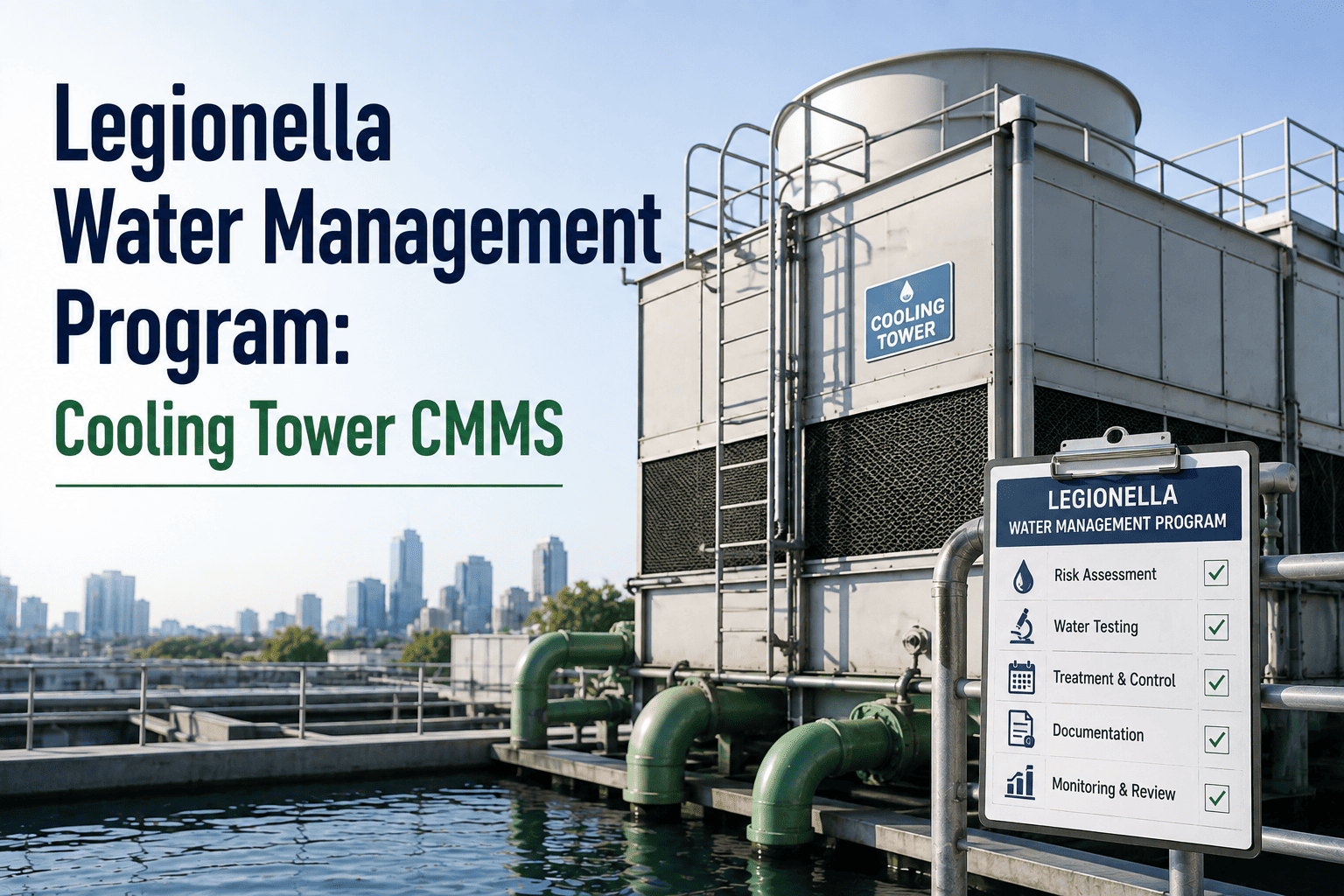
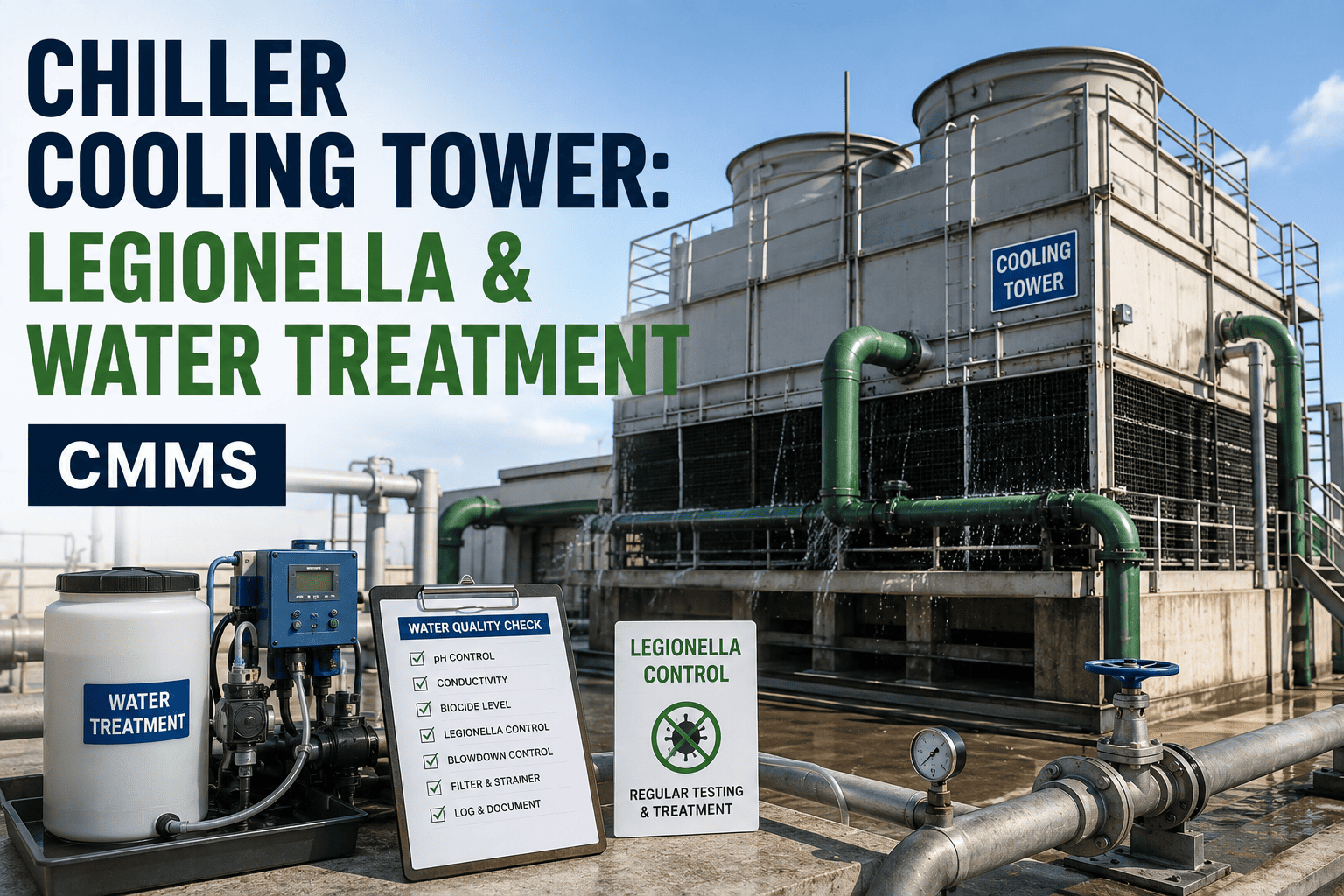
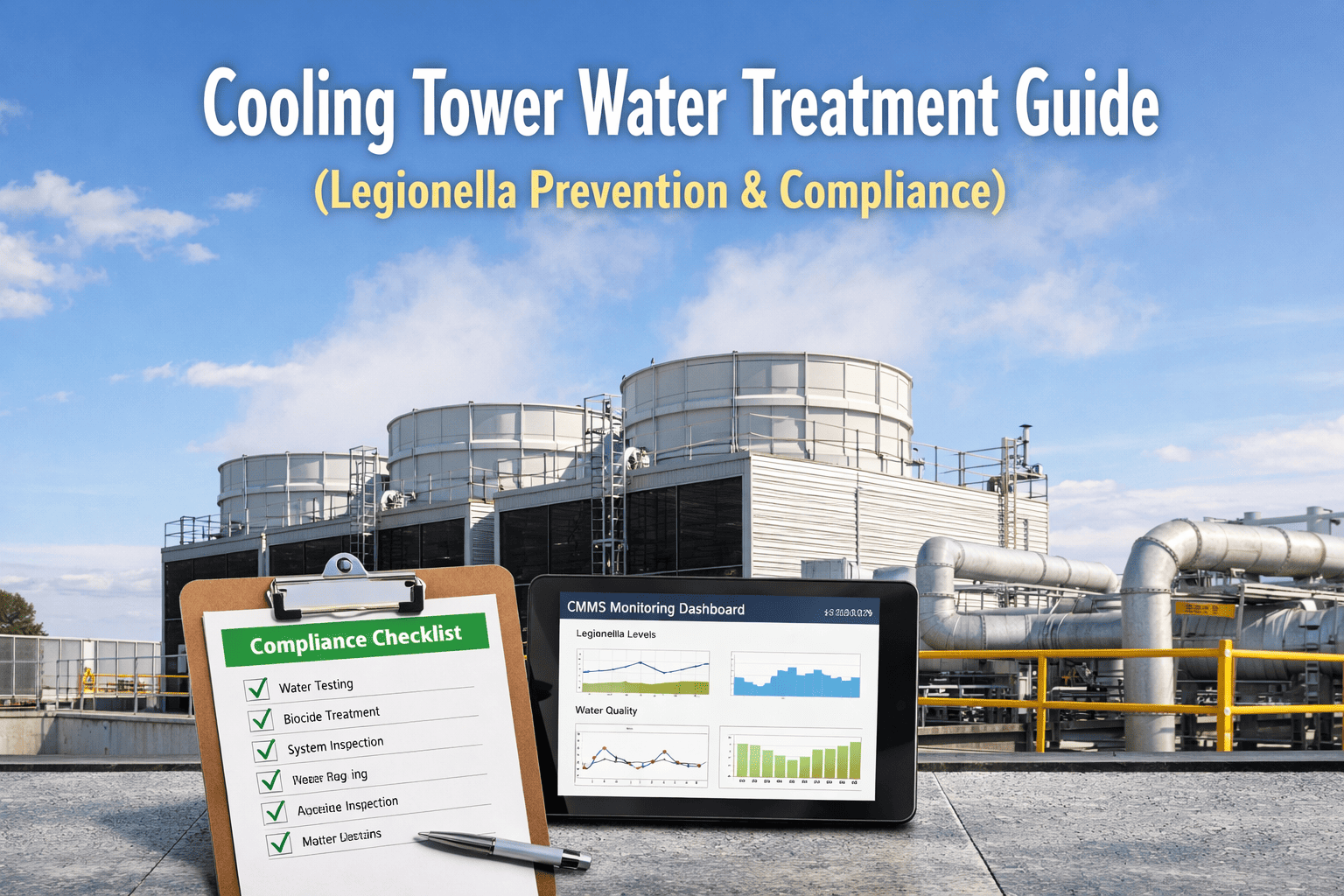
In October 2025, a New York City investigation found twelve cooling towers positive for Legionella — 113 confirmed Legionnaires' cases and six deaths across a single community cluster. The same month, an Illinois skilled nursing facility traced a Legionella outbreak directly to its cooling tower, triggering immediate remediation and water restrictions. These were not facilities that ignored maintenance entirely. They were facilities whose documentation, monitoring frequency, or corrective action protocols had gaps that allowed bacterial amplification to reach dangerous levels before detection. Sign up for Oxmaint to build the water management compliance record that prevents a crisis from becoming a catastrophe — or book a demo to see how ASHRAE 188-aligned cooling tower maintenance tracking works in practice.
Why Cooling Towers Are the Highest-Risk Water System in Your Building
Legionella pneumophila occurs naturally in freshwater at low concentrations. Cooling towers transform that low-level environmental presence into a concentrated, aerosolized hazard through three mechanisms that cannot be separated from the technology's function: warm recirculating water, nutrient-rich biofilm on fill media, and fan-driven aerosol dispersion that can carry contaminated droplets across city blocks. The bacteria grows fastest between 77°F and 113°F — precisely the operating range of most commercial cooling towers. A poorly maintained tower is not merely an inefficient asset. It is a Legionella amplification device with a built-in delivery system. Sign in to Oxmaint to configure your cooling tower water management program with automated monitoring alerts and compliance documentation.
Water Chemistry Parameters: What to Measure and Why
Water chemistry control is the first line of defense against biological contamination, scale formation, and corrosion. Each parameter serves a specific function in the overall control strategy — they cannot be managed in isolation. A pH outside the optimal range reduces disinfectant efficacy even when biocide concentration appears adequate. Book a demo to see how Oxmaint logs water chemistry readings per tower with automated alert triggers when parameters fall outside control limits.
| Parameter | Control Range | Frequency | Why It Matters | Out-of-Range Action |
|---|---|---|---|---|
| pH | 6.5–8.5 (disinfectant-dependent) | Daily minimum | Determines disinfectant efficacy and corrosion/scale balance | Adjust acid/alkali feed; investigate chemical dosing system |
| Oxidizing biocide residual | Per manufacturer spec (e.g., 0.5–1.0 ppm free chlorine) | Daily — continuous preferred | Primary bacterial control; must be measurable at all times | Check chemical feed pump; inspect for heavy organic load |
| Conductivity / TDS | Site-specific (typically 1,000–3,000 µS/cm) | Daily or automated | Controls scaling and corrosion via blowdown management | Adjust blowdown rate; verify makeup water quality |
| Cycles of concentration | Varies by makeup water quality — typically 3–5 | Weekly calculation | Determines scaling risk; too high increases deposition risk | Increase blowdown; review scale inhibitor dosing |
| Microbial plate count | <10,000 CFU/mL heterotrophic | Monthly minimum; weekly if elevated | Early indicator of biofilm activity before Legionella risk | Shock disinfection; increase biocide frequency |
| Legionella culture | <1 CFU/mL (below detection) target; <100 CFU/mL acceptable | Quarterly minimum; per WMP | Direct pathogen surveillance — regulatory notification at 1,000 CFU/mL | Immediate shock disinfection; notify authorities if above threshold |
| Corrosion inhibitor residual | Per product specification | Weekly | Protects heat exchanger and distribution system metals | Check inhibitor feed pump; review blowdown rate |
Preventive Maintenance Schedule by Frequency
Cooling tower PM must be structured around frequency bands that match the biological and mechanical risk cycles of each component. Using a single monthly PM template for all tasks consistently creates both overservice (unnecessary access) and underservice (insufficient monitoring frequency) simultaneously. Sign in to Oxmaint to configure frequency-specific PM templates for your cooling tower assets with technician-attributed completion records.
Your Water Management Program Records Are Your Legal Defense
Oxmaint stores every water chemistry log, Legionella test result, corrective action, and PM completion — timestamped and attributed — in a single compliance record that survives audits, inspections, and litigation.
ASHRAE 188 Compliance: The 7 Required WMP Elements
ASHRAE Standard 188 requires building operators to implement a Water Management Program with seven defined components. CMS requires compliance for all Medicare and Medicaid facilities under QSO-17-30. The Joint Commission enforces equivalent requirements under EC.02.05.02. An outdated or incomplete WMP creates regulatory liability even when operational practice is otherwise adequate. Book a demo to see how Oxmaint structures WMP documentation within the asset maintenance record.
Frequently Asked Questions
ASHRAE 188 does not mandate a specific testing frequency — it requires periodic validation of your Water Management Program's effectiveness, which testing supports. However, quarterly Legionella culture testing is the industry standard practice and is required by several state and local jurisdictions including New York State. New York City requires annual registration and routine testing. Healthcare facilities under CMS oversight should test at minimum quarterly. Any positive result above 100 CFU/mL requires documented corrective action; above 1,000 CFU/mL requires regulatory notification within 24 hours in New York State. Sign up for Oxmaint to schedule and track Legionella testing with automatic corrective action workflows on positive results.
ASHRAE 188 requires that cooling towers be included in a facility Water Management Program with seven defined elements: a qualified water management team, documented system description and risk mapping, hazard identification, control measures for each hazard, a monitoring schedule with corrective action protocols, annual verification that the program is working, and meticulous documentation of all program activities. CMS requires compliance with ASHRAE 188 for all Medicare and Medicaid facilities under QSO-17-30. The Joint Commission enforces equivalent requirements under EC.02.05.02. Book a demo to see how Oxmaint structures ASHRAE 188-aligned documentation within the cooling tower asset record.
The response protocol depends on the concentration. Results below 100 CFU/mL require documented review and increased monitoring frequency. Results between 100 and 1,000 CFU/mL require shock disinfection and re-testing before returning to routine monitoring. Results above 1,000 CFU/mL require immediate shock disinfection, suspension of tower operation where feasible, regulatory notification within 24 hours (in jurisdictions requiring it), and notification of building occupants per local health department direction. Your WMP must define these corrective actions in advance — the time to write the response protocol is not after a positive result arrives. Sign in to Oxmaint to configure pre-defined corrective action workflows triggered by Legionella test results.
Oxmaint creates a single cooling tower asset record that holds every water chemistry log, Legionella test result, corrective action work order, PM completion record, and Water Management Program document — all timestamped with technician attribution. When a regulator, auditor, or legal investigator requests three years of cooling tower maintenance records, the report is generated in minutes. Corrective action work orders are automatically linked to the monitoring finding that triggered them, creating the closed-loop documentation that ASHRAE 188 requires and that protects facilities during Legionella investigations.
Your Documentation Is Your Defense. Build It Now.
Oxmaint tracks every water chemistry parameter, Legionella test result, corrective action, and PM completion for your cooling towers — ASHRAE 188-aligned and audit-ready from day one of use.