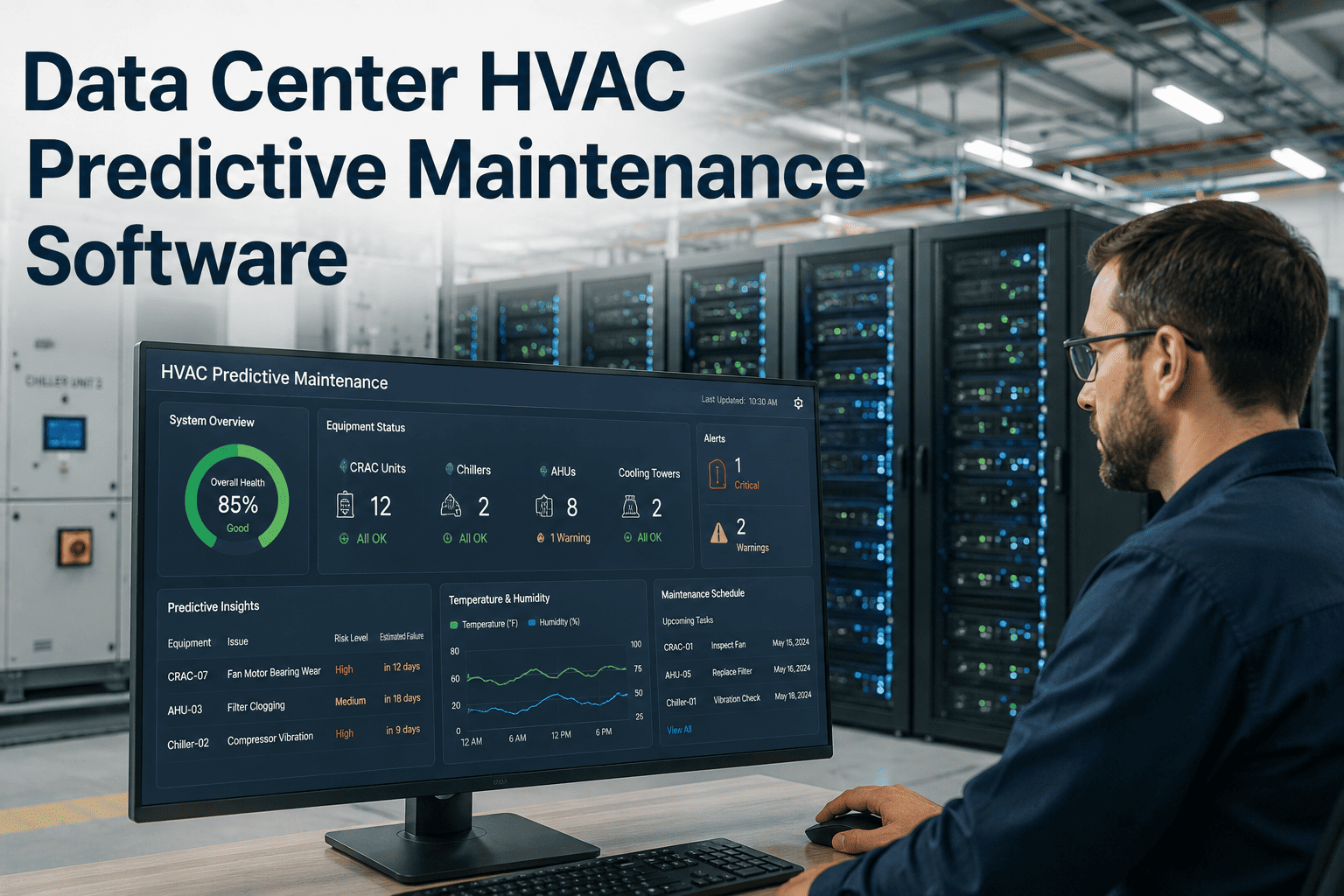
Data center HVAC maintenance in 2026 is no longer a facilities afterthought — it is a mission-critical engineering discipline that directly determines uptime, power efficiency, and operational cost. As compute density climbs and AI workloads push thermal loads to new extremes, cooling infrastructure failures carry consequences measured in millions of dollars per hour of downtime. A structured maintenance strategy built around PUE optimization, N+1 redundancy assurance, CRAC reliability, and capacity forecasting is the operational baseline every data center facility manager needs. OxMaint gives data center teams a digital work order and predictive maintenance platform that keeps cooling assets performing to specification — so PUE stays low, capacity headroom stays visible, and unplanned failures stop disrupting operations. Sign Up Free to connect your HVAC asset register to live maintenance tracking today.
Why Data Center HVAC Maintenance Is a Tier-1 Operational Priority in 2026
Modern data centers operate under continuous thermal stress. High-density server racks, GPU clusters, and hyperscale compute nodes generate concentrated heat loads that HVAC systems must neutralize without interruption — 24 hours a day, 365 days a year. A single CRAC unit failure in a high-density zone can trigger thermal shutdown of racks within minutes. Unplanned chiller downtime affects entire cooling loops serving multiple halls. The cost is not just repair spend — it is lost uptime, SLA penalties, and permanent reputational damage with enterprise clients. Book a Demo to see how OxMaint's CMMS gives data center operations teams the real-time asset visibility needed to prevent cooling failures before they cascade.
Poorly maintained cooling systems consume 15–30% more power than design spec — directly inflating PUE and energy operating costs.
Deferred CRAC maintenance silently degrades N+1 redundancy, leaving facilities exposed to single points of failure during peak load periods.
Without tracked cooling capacity per zone, IT expansion decisions outrun HVAC headroom — triggering hotspot events and emergency retrofits.
Untracked refrigerant handling, incomplete PM records, and missed calibration cycles create audit exposure under environmental and safety regulations.
6 Core Components of a Best-Practice Data Center HVAC Maintenance Strategy
A reliable data center cooling maintenance program covers six interdependent disciplines. Missing any one creates gaps that compound over time into reliability and efficiency failures. Sign Up Free on OxMaint to build a structured PM program that covers all six areas with tracked work orders, technician accountability, and real-time cost visibility.
Scheduled inspection and servicing of Computer Room Air Conditioning and Air Handling units — covering filter replacement, coil cleaning, fan belt inspection, condensate drain verification, and refrigerant charge validation. CRAC PM frequency should be risk-stratified by unit age, load factor, and redundancy status. Units operating above 85% capacity or outside N+1 coverage require higher-frequency inspection intervals than lightly loaded backup units.
Chiller maintenance programs for data centers must include compressor oil analysis, condenser tube cleaning, refrigerant leak testing, economizer mode verification, and controls calibration. Seasonal transition checks before summer peak load periods and winter economizer season are critical intervals that many facilities miss when PM scheduling is managed manually rather than through a CMMS with calendar-triggered work orders.
N+1 redundancy is only reliable if it is tested. Scheduled redundancy failover drills — rotating which unit serves as primary and verifying backup unit startup under load — are the only way to confirm that cooling redundancy actually functions when needed. OxMaint work orders can schedule and document these verification exercises as recurring maintenance tasks with pass/fail outcomes recorded against each asset, creating an auditable redundancy assurance record. Book a Demo to see how this is structured in practice.
Power Usage Effectiveness is directly influenced by cooling system efficiency. A PUE optimization maintenance program tracks chiller COP, CRAC supply/return delta-T, airflow containment integrity, and economizer utilization rates as maintenance performance metrics — not just IT metrics. Maintenance teams that document these readings at each PM visit build the trend data needed to identify efficiency degradation months before it appears in energy bills.
Capacity planning requires knowing both the installed cooling capacity per zone and the current IT load — and tracking how that gap evolves with every new server deployment. Maintenance teams that track CRAC unit rated capacity, actual load percentage, and available headroom per zone through their CMMS give the data center operations team an early warning system for thermal risk before new hardware deployments push zones into capacity constraint.
Facilities using water-cooled chillers, cooling towers, or liquid cooling loops require structured water treatment programs — Legionella risk management, conductivity and pH monitoring, biocide dosing schedules, and tower basin cleaning. These are compliance-driven maintenance tasks with documented regulatory and liability consequences if neglected, making CMMS-based tracking and completion verification essential for facilities operating under ASHRAE 188 or local water safety standards. Sign Up Free to build these compliance-linked PM schedules in OxMaint.
Data Center HVAC Maintenance Schedule: Recommended Frequency by Task Type
The following framework provides a baseline maintenance frequency model for data center cooling assets. Actual intervals should be adjusted based on manufacturer specifications, asset age, load factor, and criticality classification.
| Maintenance Task | Asset | Recommended Frequency | Criticality Driver | OxMaint Tracking |
|---|---|---|---|---|
| Filter Inspection and Replacement | CRAC / CRAH Units | Monthly | Airflow restriction raises supply temps | Recurring PM Work Order |
| Coil Cleaning and Inspection | CRAC / Condensers | Quarterly | Fouled coils degrade heat transfer efficiency | Scheduled PM with Checklist |
| Refrigerant Charge Verification | CRAC / Chillers | Semi-Annual | Low charge reduces cooling capacity and raises compressor wear | Compliance Work Order + Record |
| Chiller Compressor Oil Analysis | Centrifugal / Screw Chillers | Annual | Oil degradation precedes compressor failure | Asset-Linked PM + Lab Result Log |
| N+1 Redundancy Failover Test | All Redundant Cooling Units | Semi-Annual | Validates backup readiness under real load conditions | Verification Work Order + Pass/Fail |
| Cooling Tower Basin Cleaning | Cooling Towers | Semi-Annual | Legionella and biological growth risk management | Compliance PM + Water Test Record |
| Delta-T and PUE Efficiency Audit | Zone-Level Cooling Systems | Quarterly | Tracks efficiency trend and identifies containment failures | Inspection Work Order + Readings Log |
How to Build a Predictive Maintenance Program for Data Center Cooling in 7 Steps
Document every cooling asset — CRAC units, chillers, cooling towers, AHUs, pump sets, and fluid distribution systems — with make, model, serial number, installation date, rated capacity, and redundancy role. Assign a criticality tier (Tier 1 = single point of failure, Tier 2 = N+1 covered, Tier 3 = non-critical zone) that drives PM frequency and response priority. OxMaint's asset hierarchy allows this classification to be applied at the equipment level and inherited by all linked work orders automatically.
Document installed cooling capacity (kW) per data hall zone and track current IT load consumption from DCIM or power monitoring. Calculate headroom percentage per zone and flag zones operating above 75% capacity utilization as elevated thermal risk. This mapping becomes the foundation for both maintenance prioritization and capacity planning conversations with the IT and colocation teams. Book a Demo to see how OxMaint's asset data model supports this zone-level capacity tracking.
Use OEM maintenance manuals as baseline PM intervals, then adjust upward for assets in Tier 1 criticality positions, high-load operation, or advanced age. A CRAC unit at 90% load serving a zone with no redundancy requires more frequent inspection than an identical unit at 40% load in an N+2 configuration. Risk-stratified PM intervals prevent over-maintenance of low-risk assets while protecting high-exposure cooling infrastructure.
Integrate BMS sensor data — supply/return air temperature differential, compressor suction pressure, chiller approach temperature, vibration readings — as triggers for condition-based maintenance work orders in OxMaint. When a CRAC supply temperature rises above threshold, a maintenance task is automatically generated before a technician notices the fault on a scheduled visit. This layer of condition-based triggering is what separates predictive programs from traditional time-based PM schedules.
Create recurring OxMaint work orders for cooling redundancy failover tests — at least semi-annually for Tier 1 assets, annually for Tier 2. Document test date, technician, unit tested, load at time of test, startup time, and outcome. This creates an auditable redundancy assurance record that supports Uptime Institute tier certification, ISO 22301 business continuity documentation, and enterprise client SLA evidence packages.
Train technicians to record supply/return delta-T, CRAC leaving air temperature, economizer status, and chiller approach temperature as readings on every PM work order. These readings become a trended dataset in OxMaint that correlates maintenance activity with efficiency outcomes — demonstrating the PUE impact of PM compliance and building the evidence base for maintenance budget justification to finance and operations leadership. Sign Up Free to start capturing these metrics digitally from day one.
Use OxMaint cost history per cooling asset to calculate annual maintenance cost as a percentage of replacement value. CRAC units or chillers exceeding 20–25% of replacement cost annually are economically past their optimal replacement point. Build a rolling 5-year cooling CapEx forecast from this data — replacing aging assets proactively before they become the single point of failure in a cooling loop that has silently lost its N+1 cushion.