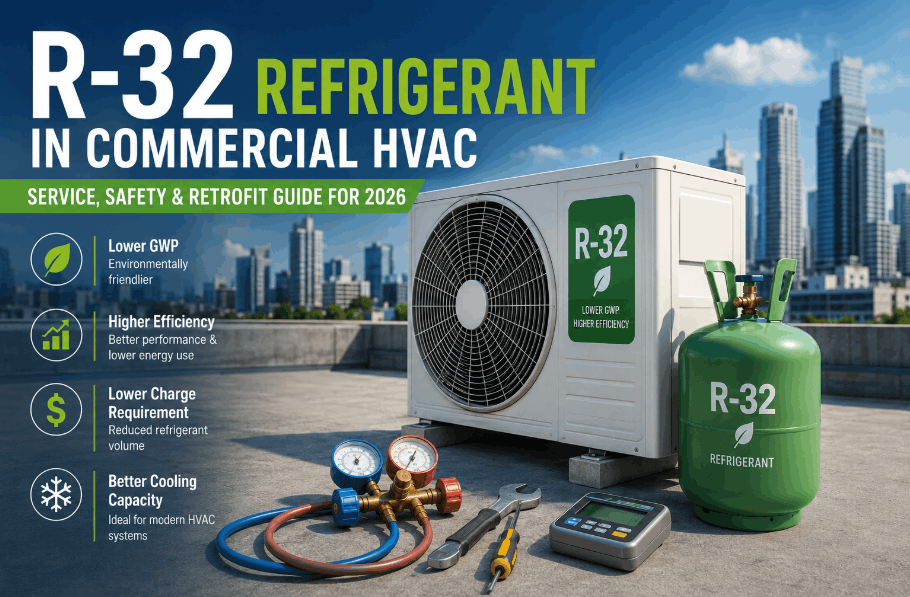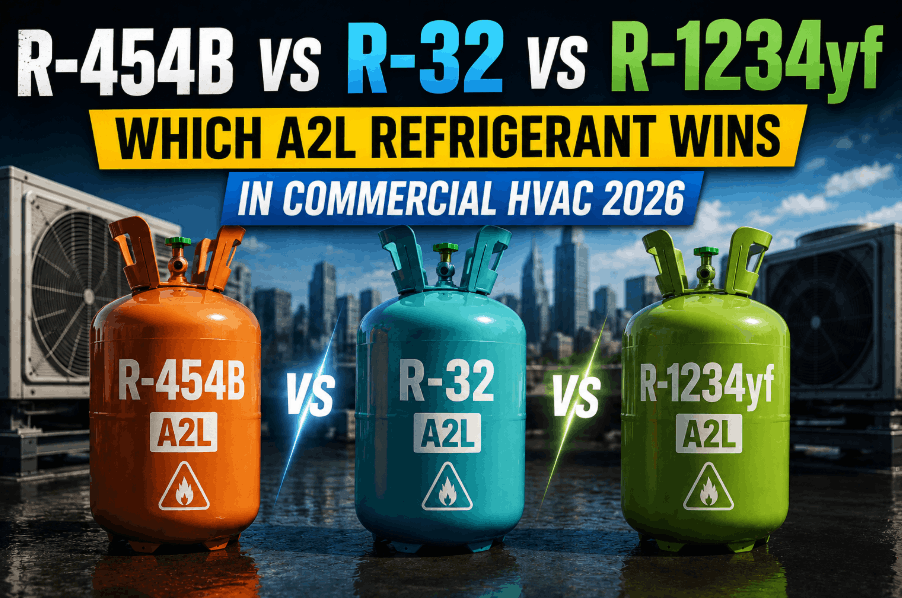
The A2L refrigerant transition is no longer theoretical — facility managers, HVAC contractors, and operations leaders are making refrigerant selection decisions right now that will define equipment lifecycles through the 2030s. With R-410A production capped under the AIM Act and new equipment mandates already in effect, the commercial HVAC industry has converged on three primary A2L candidates: R-454B, R-32, and R-1234yf. Each carries a distinct performance profile, safety classification, GWP impact, and serviceability cost structure. Choosing the wrong refrigerant path — or failing to track which refrigerant your existing and future assets use — creates compounding risk across energy costs, technician availability, and regulatory compliance. Sign Up Free on Oxmaint to register your HVAC assets by refrigerant type and build a compliance-ready portfolio view before A2L transition pressures peak. If your team manages multiple facilities or mixed refrigerant portfolios, Book a Demo to see how Oxmaint centralizes refrigerant tracking, PM scheduling, and retrofit planning in one maintenance platform.
R-454B vs R-32 vs R-1234yf: Best A2L Refrigerant for Commercial HVAC in 2026
Compare performance, safety, GWP, serviceability, and long-term cost across the three leading A2L refrigerants — and learn how Oxmaint helps facilities teams manage every refrigerant transition in one CMMS platform.
What Are A2L Refrigerants and Why Do They Matter in 2026?
A2L refrigerants are a safety classification defined by ASHRAE Standard 34 — mildly flammable, lower-toxicity alternatives that replace high-GWP HFCs like R-410A. The AIM Act's phasedown schedule has made A2L adoption mandatory for new commercial HVAC equipment, and facilities teams now face a critical question: which A2L refrigerant will drive the lowest total cost of ownership, safest operations, and smoothest compliance pathway for their specific asset base?
Head-to-Head: R-454B vs R-32 vs R-1234yf
No single A2L refrigerant is optimal for every commercial application. This comparison matrix covers the performance and operational factors that matter most to facilities and maintenance teams making procurement and retrofit decisions in 2026.
| Comparison Factor | R-454B (Opteon XL41) | R-32 | R-1234yf |
|---|---|---|---|
| GWP (Global Warming Potential) | 466 | 675 | 4 |
| Safety Class (ASHRAE 34) | A2L | A2L | A2L |
| Primary Commercial Application | RTUs, Split Systems, Light Commercial | VRF, Mini-Splits, Medium Commercial | Automotive A/C, Centrifugal Chillers |
| Drop-In Compatibility with R-410A | Partial — closest match to R-410A | No — different pressure profile | No — different application class |
| Cooling Capacity Relative to R-410A | ~98% comparable | ~85–90% per charge size | ~70–80% (lower-pressure systems) |
| Energy Efficiency (COP) | Comparable to R-410A | Slightly higher COP in optimized systems | High COP in low-pressure chiller use |
| Technician Certification Requirement | A2L handling update required | A2L handling update required | A2L + specialized chiller training |
| 2026 Commercial Availability | High — primary RTU/split replacement | High — VRF and mini-split standard | Moderate — niche commercial adoption |
| Relative Refrigerant Cost (2026) | Medium — growing supply base | Low-Medium — established production | High — specialty supply chain |
| Retrofit Feasibility for Existing Systems | Best candidate for R-410A retrofit | New equipment preferred | Not a retrofit candidate |
R-454B: The Leading Replacement for Commercial Split Systems and RTUs
R-454B has emerged as the primary R-410A replacement for light-to-medium commercial HVAC applications — particularly rooftop units, split systems, and packaged equipment. Its performance profile most closely mirrors R-410A among A2L alternatives, making it the preferred retrofit and new-equipment refrigerant for the largest installed base of commercial HVAC assets.
- GWP of 466 — 78% lower than R-410A
- Closest operating pressure match to R-410A — lowest retrofit complexity
- Broad OEM adoption across Carrier, Trane, Lennox, Daikin RTU lines
- Expanding technician training and certification availability
- Most viable drop-in candidate for compatible R-410A systems
- Strong refrigerant supply pipeline through 2026–2030
- A2L flammability requires updated service procedures and equipment
- Not all R-410A systems are retrofit-compatible — requires OEM verification
- Lubricant compatibility check required before retrofit
- A2L-rated leak detection equipment required in confined spaces
- Technician recertification adds scheduling lead time
- New safety handling protocols increase service visit duration
R-32: The Standard for VRF Systems and High-Efficiency Mini-Splits
R-32 has become the de facto standard refrigerant for variable refrigerant flow systems and modern mini-split applications globally. While it is not a retrofit candidate for R-410A equipment, facilities planning new VRF installations or mini-split expansions will overwhelmingly encounter R-32 as the factory refrigerant in 2026 and beyond.
R-1234yf: High Precision, Niche Commercial Application
R-1234yf carries the lowest GWP of the three A2L candidates at just 4 — making it the most climate-friendly option by that metric. However, its commercial HVAC adoption is largely limited to centrifugal chiller applications and specialized low-pressure systems, and it is not a viable path for the majority of commercial HVAC fleets transitioning off R-410A.
Refrigerant Selection by Commercial HVAC Equipment Type
The correct A2L refrigerant is largely dictated by equipment category. This reference guide helps facilities teams align refrigerant planning with their specific asset portfolios — and identify where Oxmaint compliance tracking is most critical.
| Equipment Type | Recommended A2L Refrigerant | Retrofit from R-410A? | Facilities Planning Priority |
|---|---|---|---|
| Rooftop Units (RTUs) | R-454B | Yes — verify OEM compatibility | Immediate — largest volume asset class |
| Split Systems (Commercial) | R-454B | Yes — component verification required | High — schedule assessment now |
| VRF Systems | R-32 | No — new equipment required | Medium — tag new installs in asset register |
| Mini-Split Systems | R-32 | No — replace at end of life | Low — routine replacement cycle |
| Centrifugal Chillers | R-1234yf or R-514A | System-specific — OEM required | High — large charge, high cost impact |
| Packaged DX Units | R-454B | Partial — depends on vintage | Medium — audit by unit age |
How Oxmaint Supports A2L Refrigerant Transition Management
Refrigerant transitions create data management complexity that spreadsheets cannot reliably handle. When assets shift from R-410A to R-454B or R-32, every downstream maintenance process — inspection protocols, technician qualifications, parts requirements, safety procedures — must update in parallel. Oxmaint's CMMS connects asset records, work orders, and compliance scheduling so nothing falls through the gaps. Sign Up Free to build your refrigerant-tagged HVAC asset register today, or Book a Demo to see the full compliance workflow in action.
A2L Refrigerant Safety: What Facilities Teams Must Implement
All three A2L refrigerants share a mildly flammable classification that requires updated safety protocols compared to R-410A. Facilities managers must ensure these operational changes are implemented and documented before A2L equipment enters their asset base. Sign Up Free to manage A2L compliance documentation and safety checklists directly in Oxmaint.