Every facility manager has faced the same gut-wrenching moment: you approve an HVAC change, technicians carry it out, and three days later the energy bills spike or occupants start filing complaints. The system behaved nothing like expected. Digital twin technology for HVAC systems exists precisely to stop that moment from ever happening. By building a virtual replica of your physical HVAC infrastructure and feeding it live sensor data, you can simulate any operational change, test any maintenance scenario, and run "what-if" analyses — all before a single wrench is turned on the real equipment.
Digital Twin for HVAC Systems
Simulate performance, predict failures, and optimize control strategies — before touching the physical system.
What Exactly Is an HVAC Digital Twin?
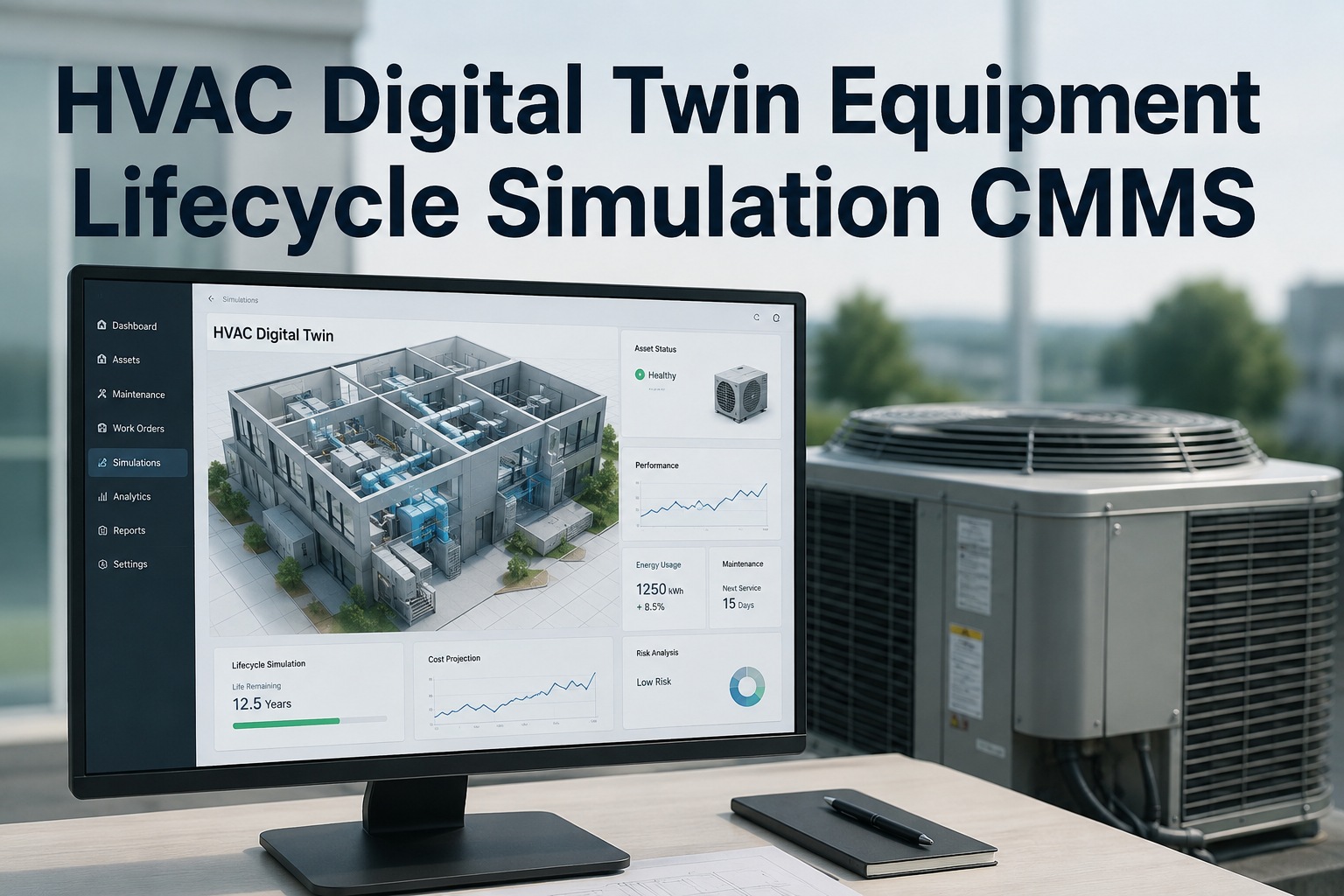
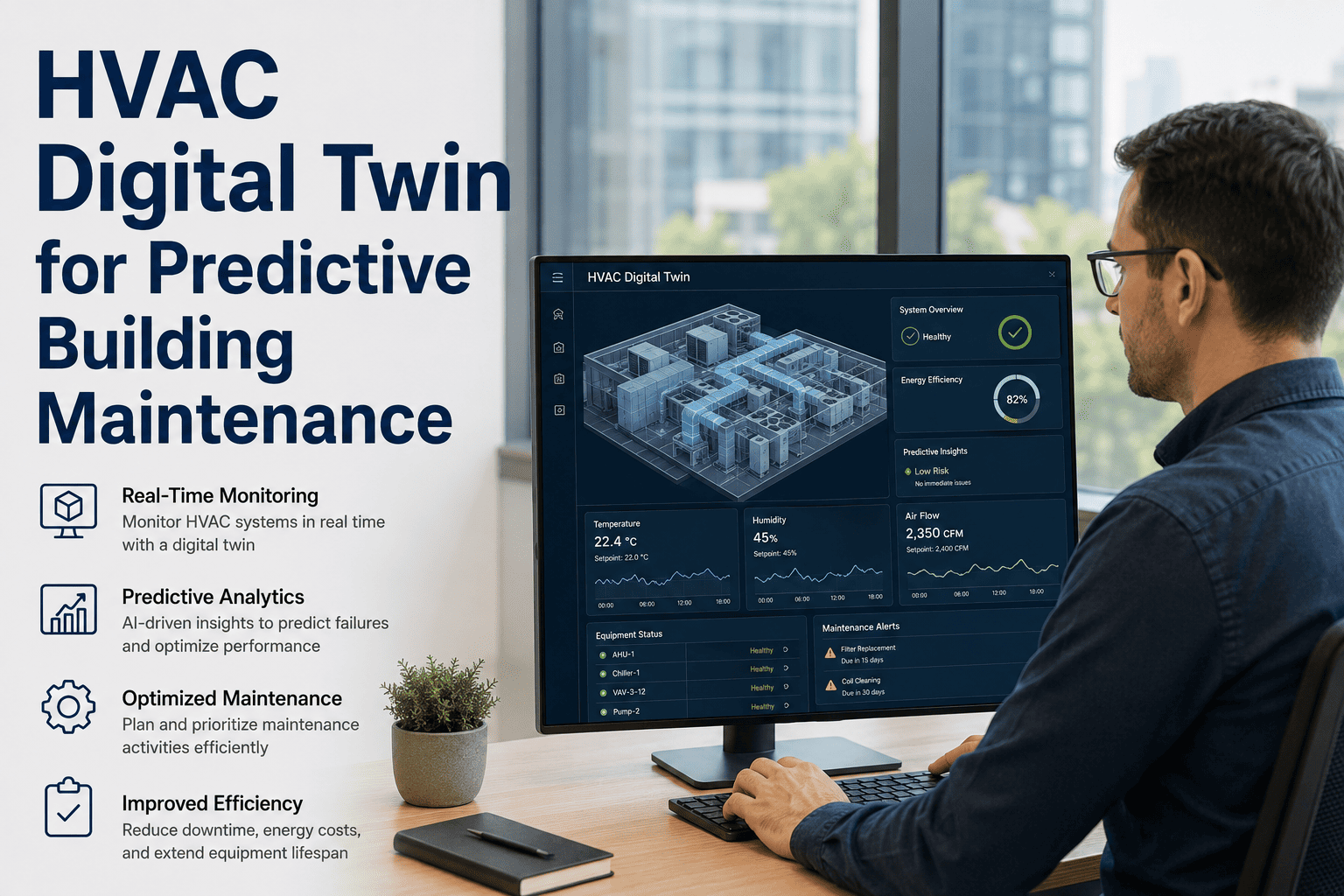
Think of it as a living blueprint of your HVAC system — a virtual model that mirrors the real one in real time. It aggregates every measurable variable: temperature readings from each zone, airflow rates, chiller performance curves, compressor cycle counts, filter pressure drops, outdoor weather conditions, and occupancy patterns. Unlike a static CAD drawing or a spreadsheet, the digital twin breathes — it updates continuously as conditions change.
The model does more than display data. Embedded physics-based algorithms and AI learn how your specific equipment responds under various loads. When you want to test a change — say, shifting the chilled water setpoint by 2°F during peak hours — the twin runs the simulation instantly and surfaces predicted energy impact, comfort scores, and equipment stress levels.
Facility managers who've adopted this approach describe it as having a "flight simulator" for their building. Pilots don't learn emergency procedures in real aircraft; they practice in simulators. The same logic now applies to HVAC management. Sign up with OxMaint to bring that same simulation capability to your facility today.
Data Sync
Why Traditional HVAC Management Falls Short
Most facilities still manage HVAC reactively — fixing problems after they surface, scheduling maintenance on calendar dates rather than actual equipment condition, and guessing at setpoint optimizations. The costs of that approach are well-documented.
Reactive Repairs Are Expensive
Emergency HVAC repairs cost 3–5x more than planned maintenance. A compressor that could have been flagged weeks earlier instead fails during peak summer demand, triggering overtime labor, expedited parts, and occupant complaints.
Blind Change Management
Adjusting control sequences, replacing equipment models, or rebalancing airflow across zones involves significant guesswork. Changes that improve one zone often degrade another, creating a whack-a-mole problem for technicians.
Energy Waste from Suboptimal Setpoints
HVAC systems typically consume 40–60% of a commercial building's total energy. Even a 10% inefficiency in setpoint control translates to thousands of dollars in annual waste — waste that shows up on utility bills but never gets traced back to its source.
Delayed ROI Justification
Decision-makers hesitate to approve HVAC upgrades because projected savings are theoretical. Without simulation data, the conversation becomes a debate of intuitions rather than a review of evidence.
Stop Guessing. Start Simulating.
OxMaint's AI-powered CMMS integrates with digital twin workflows to give your team predictive intelligence over every HVAC asset in your facility.
Key Simulation Scenarios Digital Twins Enable
The practical value of a digital twin emerges when facility teams use it to answer real operational questions. Here are the scenarios where simulation delivers the highest return.
Equipment Upgrade Justification
A hospital in the UK used a digital twin to diagnose excessive gas usage and model the impact of targeted HVAC improvements. The simulation projected savings of 10 million kilowatt-hours and £285,000 annually — numbers concrete enough to win board approval and secure budget. The twin also compared the HVAC upgrade against an electrical retrofit, revealing that the HVAC path delivered 23% energy and carbon reduction versus just 9% for the alternative.
For facility managers, this is transformative. Instead of lobbying for upgrades with general industry benchmarks, you can walk into a budget meeting with your specific building's simulation results. Book a demo to see how OxMaint surfaces this level of insight.
Control Strategy Testing & Setpoint Optimization
HVAC control sequences — supply air temperature resets, demand-controlled ventilation, economizer strategies — have a profound impact on energy use and comfort. Yet most facilities run whatever sequence was commissioned at installation, often years or decades ago, without revisiting it.
Digital twins let engineers simulate dozens of control variations simultaneously. Siemens used this approach at its Munich facility, reducing power consumption by 30% while measurably improving occupant comfort. Microsoft applied similar techniques across its campus buildings, achieving a 15% reduction in energy usage alongside higher productivity scores.
Predictive Maintenance Scenario Planning
Rather than reacting to component failures, digital twins continuously analyze degradation patterns and model failure trajectories. When a compressor's vibration signature starts drifting from baseline, the twin calculates time-to-failure probability and the cascading impact on zone temperatures if the component is not addressed.
IBM demonstrated this capability in its data centers, cutting maintenance costs and downtime by 50% through digital twin-enabled predictive protocols. For HVAC systems in commercial buildings, the same approach eliminates the most expensive category of maintenance: emergency repairs during peak occupancy periods. Sign up for OxMaint and enable predictive maintenance workflows across your facility.
New Construction & Virtual Commissioning
During new building projects, HVAC digital twins allow designers, facility managers, and technicians to resolve conflicts before breaking ground. A well-known automaker used digital twins during early construction phases of new factories, resolving HVAC and plumbing conflicts that would otherwise have caused costly on-site delays.
Virtual commissioning through digital twins also ensures that control sequences are validated against the actual building's thermal load model — not just the design assumptions — before occupants move in. The result is a system that performs as intended from day one, rather than requiring months of post-occupancy tuning.
How a Digital Twin HVAC System Actually Works
Understanding the architecture demystifies the technology and helps facility teams evaluate implementation requirements clearly.
Data Collection Layer
IoT sensors embedded across HVAC components — chillers, air handling units, variable air volume boxes, thermostats, occupancy detectors — stream continuous data into a central platform. This includes temperature, pressure, humidity, airflow velocity, energy consumption, and equipment runtime.
Physics-Based Modeling Engine
The platform builds a dynamic model of your building's thermal behavior using physics equations, BIM geometry, and historical performance data. Unlike generic benchmarks, this model is calibrated to your specific equipment, envelope, and occupancy patterns — making predictions highly accurate.
AI / Machine Learning Optimization
Neural networks trained on the building's operational history learn complex relationships between variables. The AI identifies efficiency opportunities invisible to human analysis — for example, correlating chiller staging sequences with outdoor dew point to reduce compressor cycling.
Simulation & What-If Interface
Facility managers and engineers interact with a dashboard to define scenarios: "What if I raise the cooling setpoint by 1°F during unoccupied hours?" The twin instantly computes predicted energy savings, comfort impact, and equipment wear — displayed as clear, decision-ready metrics.
Closed-Loop Feedback
Once a tested change is implemented in the physical system, the twin captures real-world results and updates its model accordingly. Over time, the twin becomes more accurate — a virtuous cycle that continuously improves simulation fidelity and prediction quality.
OxMaint's maintenance management platform is built to integrate with this architecture, connecting simulation insights directly to work order creation and technician dispatch. Create your free account and see the difference intelligent maintenance makes.
Connecting the Digital Twin to Your CMMS
A digital twin without an integrated Computerized Maintenance Management System is like having a diagnostic result without a doctor to act on it. The simulation identifies that a cooling tower fan bearing is entering its failure window — but unless that insight automatically generates a maintenance work order, assigns it to a technician, and tracks completion, the intelligence goes to waste.
OxMaint bridges this gap. When the digital twin flags a performance anomaly or a predicted failure, the platform creates a prioritized work order, attaches the diagnostic data, and routes it to the right team member. After the repair, asset history is updated and the twin recalibrates against the restored baseline.
This closed loop — detect, dispatch, repair, verify — is what transforms simulation from an interesting concept into measurable operational outcomes. Book a demo to walk through the full workflow with our team.
Detects Anomaly
Creates Work Order
Executes Repair
Validates Outcome
Loop
Ready to Simulate Before You Change?
Join facility teams across industries that use OxMaint to connect digital intelligence with maintenance execution — reducing costs, improving uptime, and building the case for every HVAC decision.
Frequently Asked Questions
What is a digital twin in the context of HVAC systems?
A digital twin is a virtual, real-time model of your physical HVAC infrastructure. It aggregates live sensor data — temperatures, pressures, airflows, energy consumption — and uses physics-based modeling combined with AI to mirror how your actual system behaves. Unlike static building models, the digital twin updates continuously, enabling simulation of operational changes before they are applied to the real equipment.
How accurate are the simulations produced by HVAC digital twins?
Simulation accuracy depends on the quality of the underlying model and the richness of sensor data feeding it. Well-implemented HVAC digital twins calibrated against real operational data typically achieve prediction accuracy in the 90–95% range for energy consumption and thermal comfort outcomes. Over time, the model improves as it learns from the actual results of changes implemented in the physical system.
What types of HVAC changes can be simulated with a digital twin?
Virtually any operational or control change can be modeled: setpoint adjustments, equipment replacements, control sequence modifications, damper rebalancing, scheduling changes, ventilation rate adjustments, chiller staging strategies, economizer configurations, and more. You can also simulate the impact of occupancy changes, weather extremes, or equipment failures to assess system resilience.
Do I need to replace my existing BMS or controls infrastructure to use a digital twin?
Not necessarily. Most digital twin platforms are designed to integrate with existing Building Management Systems (BMS), PLCs, and IoT sensors via standard protocols. The twin reads data from your current infrastructure and adds a simulation and analytics layer on top. In some cases, additional sensors may be needed to improve model granularity, but wholesale system replacement is rarely required to get started.
How does a digital twin support predictive maintenance for HVAC?
The twin continuously monitors equipment performance signatures — vibration patterns, current draw, pressure differentials, temperature offsets — and compares them against baseline models. When a component begins degrading, the twin detects the statistical deviation early, models the failure trajectory, and generates an alert with a recommended maintenance window. This allows technicians to plan repairs proactively, avoiding the cost and disruption of emergency failures.
How does OxMaint integrate with HVAC digital twin technology?
OxMaint serves as the maintenance execution layer that acts on digital twin insights. When the twin identifies an anomaly, predicted failure, or optimization opportunity, OxMaint automatically creates a prioritized work order, assigns it to the appropriate technician, and tracks completion. After the maintenance task is done, asset records are updated and the twin verifies that the repair restored the expected performance baseline. This closed-loop system turns simulation intelligence into tangible maintenance outcomes.
What ROI can facility managers realistically expect from HVAC digital twins?
Real-world deployments demonstrate consistent returns. Energy savings of 15–30% are commonly reported within the first year. Maintenance cost reductions of 25–40% are achievable through predictive protocols that eliminate emergency repairs. Equipment lifespan extensions of 15–20% reduce capital replacement costs over time. When combined with productivity gains from fewer comfort complaints and system outages, the ROI case for HVAC digital twins is typically compelling within 18–36 months of deployment.