HVAC CapEx forecasting turns unpredictable boiler, chiller and rooftop-unit replacements into a disciplined, data-driven capital plan — and a modern CMMS makes it achievable without spreadsheets or guesswork. According to industry benchmarks, deferred HVAC capital replacements cost facility teams 2–3x more in emergency labor and energy waste than planned swap-outs. This guide walks maintenance and reliability leaders through building a 3–5 year HVAC capital forecast using asset condition data, digital-twin modeling and CMMS-driven budgeting, so you can confidently request capital, avoid unplanned downtime and extend asset life. Ready to replace guesswork with live asset data? Start Free Trial and build your first forecast today.
Can you predict which HVAC assets will fail — and when you'll need the capital to replace them?
Without a CMMS-backed capital replacement plan, 60% of HVAC equipment is replaced reactively — after a failure, at premium cost, and with no budget reserved. OxMaint's AI-powered asset tracking and digital-twin modeling let you forecast 3–5 years of HVAC capital needs with confidence, so you request the right budget at the right time.
The real cost of reactive HVAC capital replacement
When a 15-year-old chiller dies in July, you don't shop for a deal — you pay emergency premiums, absorb overtime labor, and lose tenant comfort or production uptime while you wait 12–20 weeks for a replacement unit. Planned, forecast-driven replacement costs 40–60% less on average.
A 180-asset commercial portfolio spending $42K/yr on reactive HVAC repairs was running a 14% emergency-replacement rate. After implementing OxMaint CMMS for capital replacement planning, condition scores flagged 22 assets in the "replace within 18 months" zone. The team phased replacements across two fiscal years, negotiated volume pricing, and cut emergency CapEx spend by 61% in year one — roughly $128K avoided.
How to build an HVAC capital forecast in 5 steps
A defensible HVAC capital forecast blends asset-level data — age, condition, repair history, criticality — with replacement cost models and a multi-year phasing timeline. Here's the process OxMaint automates inside your CMMS.
Inventory & Asset Hierarchy
Catalog every HVAC asset — chillers, boilers, RTUs, AHUs, pumps, cooling towers — with install date, make/model, capacity, location and criticality rating. OxMaint's asset tree gives you a single source of truth across sites.
Condition & Risk Scoring
Score each asset 1–5 on physical condition, performance degradation, maintenance cost trend and failure risk. OxMaint's AI engine auto-adjusts scores based on work-order history, meter readings and inspection data.
Replacement Cost Modeling
Assign current replacement cost (equipment + labor + disposal + soft costs) to each asset, adjusted for inflation and lead time. Build a digital-twin scenario to model "replace now vs. repair-and-defer" for each unit.
3–5 Year Capital Timeline
Rank assets by risk score and remaining useful life, then phase replacements across fiscal years. Balance annual budget caps with criticality — never let a Tier-1 asset enter a fiscal year without funded replacement.
Budget Approval & Live Recalibration
Export the forecast as a capital request with full asset-level justification. As condition data and work-order trends update monthly, OxMaint recalculates the forecast — so your capital plan is always current, not a once-a-year spreadsheet.
HVAC CapEx forecasting formulas every facility leader should know
A capital replacement CMMS does the math automatically — but understanding the formulas behind the forecast helps you defend your budget request with finance and ownership.
EUL benchmarks: RTU 15 yr, Chiller 20 yr, Boiler 25 yr, Cooling Tower 20 yr. OxMaint flags any asset below 2 years RUL for capital review.
Scores 1–5 each. Assets with RPN above 60 enter the 12-month replacement queue; above 80 triggers immediate capital review.
The minimum you should budget each year to stay ahead of replacements. A 180-asset portfolio typically shows $85K–$140K/yr ACR.
Industry standard: when 12-month repair cost exceeds 50–60% of replacement cost, the asset is a capital replacement candidate.
CMMS CapEx forecasting: how OxMaint turns asset data into capital plans
OxMaint replaces spreadsheets and tribal knowledge with a live, AI-powered asset intelligence engine — purpose-built for maintenance and reliability teams who need to justify capital requests with hard data.
AI-Driven Condition Scoring
OxMaint continuously evaluates each HVAC asset's health using work-order history, inspection results, meter readings and failure patterns — auto-updating condition scores so your capital forecast reflects reality, not last year's spreadsheet.
Outcome: Catch 80%+ of approaching failures 6–12 months early3–5 Year Capital Timeline Builder
Drag-and-drop asset replacements across fiscal years, set annual budget caps, and instantly see which assets are funded, deferred or at-risk. Export a board-ready capital request with full justification in one click.
Outcome: Cut capital planning cycle from weeks to hoursDigital Twin Capital Forecasting
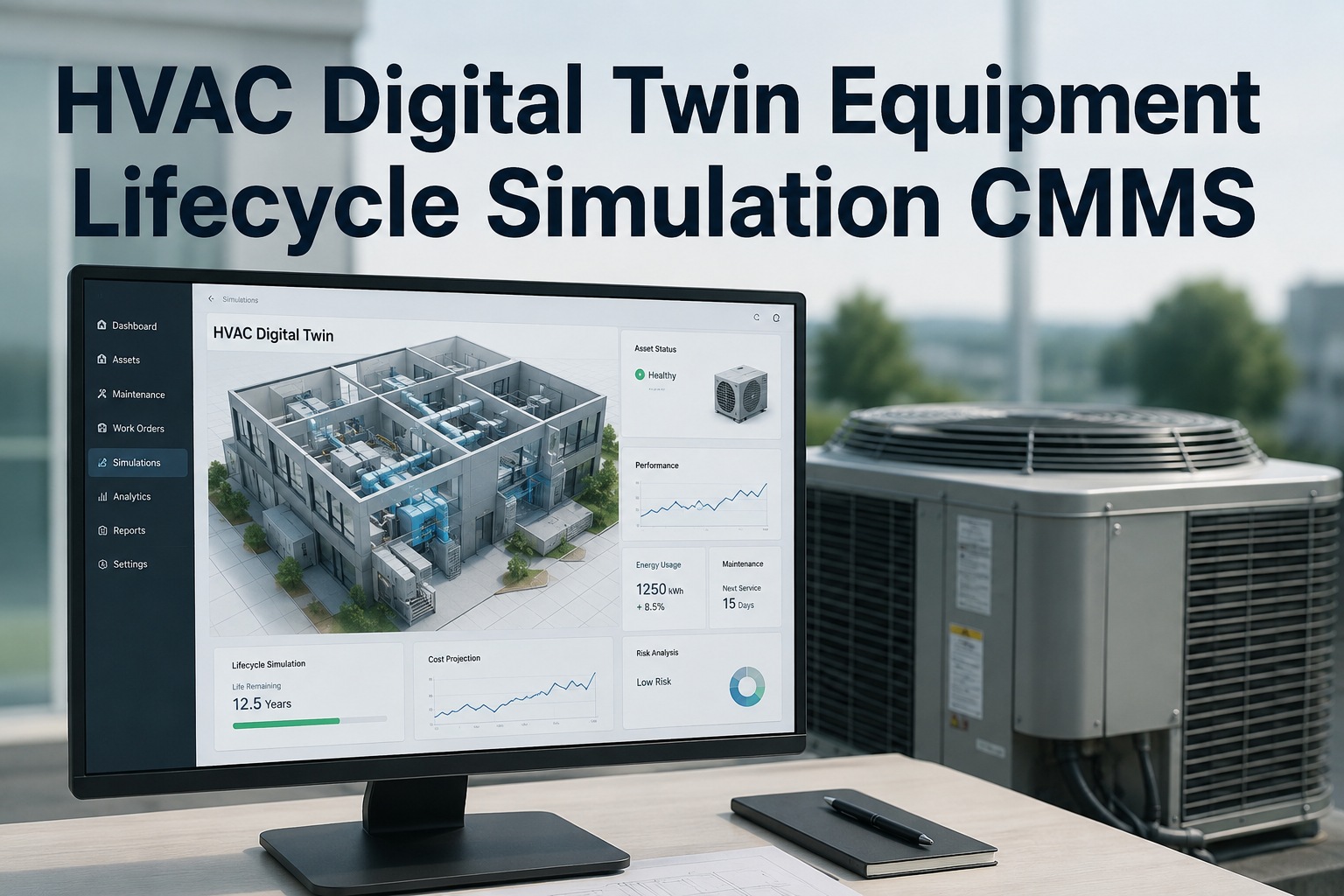
Model "replace now vs. repair-and-defer" scenarios for every asset. OxMaint's digital twin simulates cost, energy, downtime and risk outcomes across multiple capital strategies — so you choose the lowest total cost of ownership.
Outcome: Reduce lifetime HVAC TCO by 20–35%Audit-Ready Capital Justification
Every replacement recommendation links to a complete asset history — work orders, repair costs, inspections, downtime events. Walk into any budget meeting or ISO 55000 audit with defensible, data-backed capital requests.
Outcome: 100% audit-ready capital requests, zero guessworkCapital planning with CMMS vs. spreadsheets: what changes
Most facility teams still forecast HVAC capital replacements in Excel — using install dates, gut-feel criticality and last year's budget as a baseline. Here's what shifts when you move to a purpose-built capital replacement CMMS.
| Capability | Spreadsheet Forecasting | OxMaint CMMS Forecasting |
|---|---|---|
| Asset condition data | Manual entry, updated annually | Auto-updated from work orders, inspections & sensors |
| Failure prediction | Age-based estimates only | AI pattern detection across 10K+ failure modes |
| Budget phasing | Static rows, manual recalculation | Drag-and-drop timeline with live cost recalculation |
| Scenario modeling | Separate tabs, error-prone | Digital-twin simulation of replace vs. repair vs. defer |
| Capital request output | Hand-formatted PDFs | One-click board-ready report with full asset history |
| Forecast accuracy | ±30–40% (stale data) | ±5–10% (live condition data + AI) |
| Audit traceability | Disconnected from actual maintenance records | Every recommendation links to verified work-order history |
Your HVAC CapEx forecast 2026: what to plan for now
A well-structured capital forecast doesn't just list replacements — it sequences them by risk, budget capacity and operational impact. Here's a sample 3-year phasing view OxMaint generates automatically from your asset data.
Critical Replacements
Assets with RUL below 1 year or RPN above 80. Funded immediately — deferred replacement means failure risk.
Planned Phase-Out
Assets approaching end of useful life within 12–24 months. Schedule replacements around low-demand seasons for minimal disruption.
Watch & Monitor
Assets in acceptable condition but trending toward replacement. OxMaint recalibrates their forecast quarterly based on condition data.
See your HVAC capital forecast built live on your assets
Book a 30-minute demo and we'll load your HVAC asset data into OxMaint — you'll see your first 3-year capital replacement timeline before the call ends.
HVAC CapEx forecasting & capital replacement planning: FAQ
What is HVAC CapEx forecasting and why does it matter?
HVAC CapEx forecasting is the process of predicting when heating, ventilation and air-conditioning equipment will need replacement and reserving capital accordingly — typically over a 3–5 year horizon. It matters because reactive HVAC replacement costs 2–3x more than planned replacement, and unplanned failures cause downtime, comfort complaints and emergency labor premiums. A CMMS like OxMaint automates the data collection and modeling so forecasts stay accurate year-round.
How does a CMMS improve capital replacement planning for HVAC?
A CMMS replaces static spreadsheets with live asset condition data — work-order history, inspection results, repair-cost trends and sensor readings — feeding AI-driven risk scores and replacement recommendations. This cuts forecast error from ±30–40% down to ±5–10%, and every capital recommendation is traceable to verified maintenance records for audit readiness. You can book a demo to see the forecasting engine on your own asset data.
How far ahead should I forecast HVAC capital replacements?
The industry standard is 3–5 years. Less than 3 years leaves no time to phase replacements or negotiate pricing; beyond 5 years, condition data becomes too stale for accurate predictions. OxMaint recommends a 5-year rolling forecast updated quarterly, with a firm Year 1 budget, a flexible Year 2 plan, and directional projections for Years 3–5 that recalibrate as new condition data arrives.
What data do I need to start HVAC capital forecasting?
You need a complete HVAC asset inventory (make, model, install date, capacity, location), repair and maintenance history for at least 12 months, current replacement cost estimates, and a criticality rating for each asset. OxMaint can import existing asset data from spreadsheets or your current CMMS in a few hours, and the AI engine begins generating condition scores and replacement recommendations immediately — you can Start Free Trial and upload your asset list today.
How accurate is digital-twin-based capital forecasting for HVAC?
Digital-twin modeling — which simulates each asset's degradation path, energy efficiency decline, repair-cost trajectory and failure probability — typically achieves ±5–10% forecast accuracy versus ±30–40% for age-based spreadsheet models. The key advantage is that the digital twin updates continuously as real-world condition data flows in, so your capital plan recalibrates automatically rather than going stale between annual budget cycles.
Stop guessing. Start forecasting your HVAC capital with confidence.
Join the maintenance teams using OxMaint to cut emergency HVAC CapEx by up to 60%, extend asset life and walk into every budget cycle with a data-backed capital plan.
Free 14-day trial · No credit card