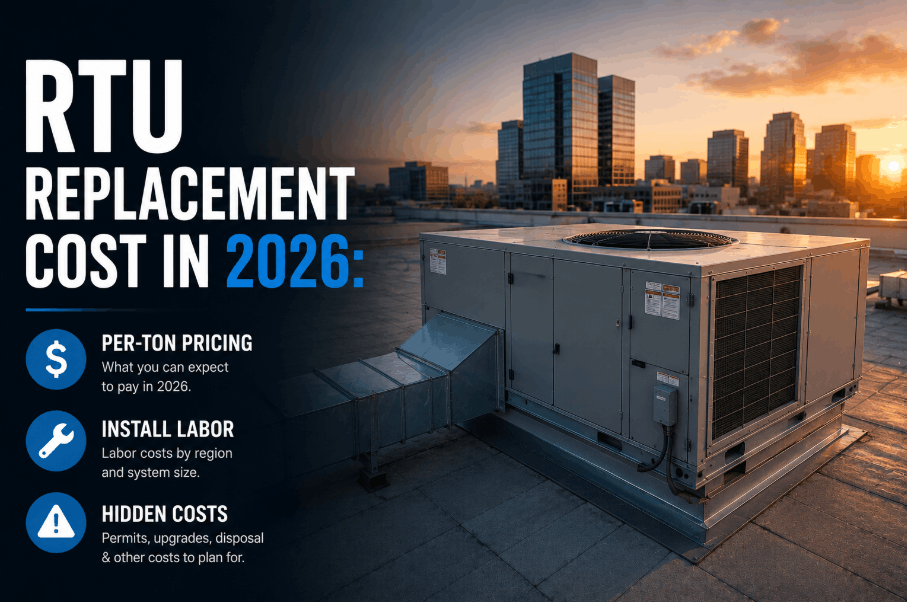
Commercial HVAC replacement cost in 2026 is one of the most significant capital decisions a facility manager or building owner faces — and one of the least predictable without structured asset lifecycle data. Whether you are planning a rooftop unit swap at a 20,000 sq ft retail center, an AHU overhaul across a multi-floor office building, or a full chiller plant replacement at an industrial campus, pricing variability in 2026 is driven by factors that didn't exist three years ago: R-22 phase-out legacy surcharges, R-410A transition costs, post-pandemic equipment lead times, and labor market tightening in skilled HVAC trades. This guide breaks down commercial HVAC replacement costs by equipment type, building size, and lifecycle stage — and shows how asset management platforms like Oxmaint help facility teams plan and budget HVAC capital expenditure before a failure forces the decision. If your facility is still tracking HVAC lifecycles in spreadsheets, Sign Up Free and see how automated asset lifecycle tracking changes the capital planning equation.
Facility Asset Management · HVAC · Capital Planning
Know When Your HVAC Assets Will Need Replacement — Before They Fail
Oxmaint tracks HVAC asset age, runtime hours, maintenance history, and cost trends in one place — giving facility managers the lifecycle data needed to plan capital budgets accurately and avoid emergency replacement costs.
What Drives Commercial HVAC Replacement Costs in 2026
Replacement pricing in 2026 is being shaped by a combination of regulatory, supply chain, and labor forces that affect every equipment category from small packaged RTUs to large central plant chillers. Understanding these cost drivers is the first step to building a capital budget that won't be blindsided at bid time. Facility teams that Book a Demo with Oxmaint often discover their HVAC asset data is years out of date — which directly translates to budget variance at project time.
Refrigerant Transition Surcharges
R-410A phase-down under the AIM Act is adding 8–15% to equipment costs as manufacturers transition to lower-GWP refrigerants (R-32, R-454B). Legacy R-22 system removal adds separate disposal cost.
Equipment Lead Times
Large AHUs and custom air handlers now carry 16–28 week lead times from major manufacturers. Emergency replacement procurement commands 20–35% premium over planned procurement.
Skilled Labor Scarcity
Commercial HVAC installer rates have risen 18–24% since 2022 in most US metros. Labor now represents 30–45% of total replacement cost on larger systems.
Controls and Integration Complexity
BAS/BMS integration of new equipment adds $8,000–$45,000 to larger projects. Modern HVAC units require updated control sequences and often new DDC hardware.
Structural and Access Costs
Rooftop RTU replacements on occupied buildings require crane lifts, temporary roof patching, and after-hours scheduling — adding $2,000–$12,000 per unit beyond equipment cost.
Efficiency Code Upgrades
2026 ASHRAE 90.1 and local energy codes mandate minimum efficiency levels that can eliminate certain equipment classes, forcing higher-cost replacements than for-like swaps.
Commercial HVAC Replacement Cost by Equipment Type — 2026 Benchmarks
The following cost benchmarks represent installed replacement cost in 2026 for typical commercial applications, including equipment, labor, refrigerant, permits, and standard controls integration. Pricing ranges reflect regional labor variation and project complexity. Book a Demo with Oxmaint to see how asset lifecycle tracking gives facility teams the lead time to plan procurements at budgeted rates rather than emergency rates.
| Equipment Type |
Typical Capacity Range |
2026 Replacement Cost Range |
Expected Lifespan |
Key Cost Driver |
| Packaged RTU (Rooftop Unit) |
3–25 tons |
$8,000 – $38,000 installed |
15–20 years |
Crane access + refrigerant transition |
| Split System (Commercial) |
2–20 tons |
$6,500 – $28,000 installed |
15–20 years |
Lineset routing + electrical upgrade |
| Air Handling Unit (AHU) |
2,000–50,000 CFM |
$18,000 – $180,000 installed |
20–30 years |
Custom fabrication lead time |
| Chiller (Air-Cooled) |
50–500 tons |
$85,000 – $650,000 installed |
20–25 years |
Refrigerant charge + labor hours |
| Chiller (Water-Cooled) |
100–2,000 tons |
$150,000 – $2,500,000 installed |
25–30 years |
Mechanical room scope + BAS |
| Cooling Tower |
50–500 tons |
$25,000 – $280,000 installed |
20–25 years |
Structural support + water treatment |
| Commercial Boiler (Hot Water) |
500 MBH – 6,000 MBH |
$18,000 – $220,000 installed |
25–35 years |
Gas line upgrade + flue rework |
| Fan Coil Units (System) |
Building-wide |
$1,800 – $6,500 per unit |
20–25 years |
Quantity + coordination scheduling |
Commercial HVAC Cost Per Square Foot by Building Type
Cost-per-square-foot benchmarks give facility managers a rapid-order-of-magnitude check for capital budgeting before engaging contractors. These figures represent full HVAC system replacement — not spot equipment swaps — and vary significantly by building use intensity, occupancy hours, and existing infrastructure condition. Facilities using Oxmaint for asset lifecycle tracking can benchmark their actual cost-per-square-foot against these ranges and identify outlier assets driving above-average spend. Sign Up Free to start building the maintenance cost data that makes capital planning defensible.
Office / Professional
$18 – $34 / sq ft
Standard occupancy, 8–10 hr/day operation, VAV systems typical
Retail / Big Box
$14 – $28 / sq ft
High RTU density, simpler zoning, open floor plan access advantage
Light Manufacturing
$12 – $22 / sq ft
Process exhaust integration, high-bay makeup air, lower zone count
Healthcare / Medical
$38 – $85 / sq ft
Infection control airflow, pressurization requirements, 24/7 operation
Data Center / Server Room
$55 – $140 / sq ft
Precision cooling, redundancy requirements, 100% uptime constraint
Education / Institutional
$22 – $44 / sq ft
Seasonal scheduling complexity, deferred maintenance backlog typical
The Real Cost of Emergency vs. Planned HVAC Replacement
The difference between a planned HVAC replacement and an emergency replacement is not just scheduling — it is 25–45% more total project cost when procurement is reactive. Facility managers who Sign Up Free with Oxmaint gain access to the asset lifecycle data that makes the difference between a planned capital project and a crisis procurement event.
Planned Replacement
Bid process with 3+ contractors — lowest competitive price
Standard lead time procurement — no emergency freight
Scheduled installation — regular labor rates
Phased tenant / occupant coordination — minimal disruption cost
Capital budget approval cycle — financing options available
Baseline project cost
Emergency Replacement
Single-source or two-bid procurement — 15–25% price premium
Expedited equipment freight — $3,000–$18,000 surcharge
Overtime / after-hours labor — 1.5–2x standard labor rate
Temporary cooling rental during downtime — $800–$4,500/week
Business interruption losses — $2,000–$40,000+ depending on use
+25–45% above planned cost
HVAC Asset Lifecycle and Capital Planning with Oxmaint
The core problem driving emergency HVAC replacements is not equipment failure — it is the absence of structured asset lifecycle data. When facility teams don't know the age, runtime history, maintenance cost trend, and remaining useful life of each HVAC asset, capital planning becomes guesswork. Oxmaint closes this gap by giving facility managers a single platform where HVAC asset history, PM compliance, repair cost accumulation, and replacement triggers are all tracked automatically. Book a Demo to see how Oxmaint transforms HVAC cost data into actionable capital budget projections.
Asset Age and Lifecycle Tracking
Every HVAC unit in Oxmaint carries its installation date, manufacturer lifecycle expectancy, and actual runtime hours — giving facility managers a real-time view of remaining useful life across the entire equipment portfolio. This data drives the 3–5 year capital forecast that CFOs and boards require for facilities budgeting.
Maintenance Cost Accumulation per Asset
Oxmaint automatically aggregates every work order, parts charge, and contractor invoice against each HVAC asset. When cumulative repair costs approach 50–60% of replacement value, the platform flags the asset for capital review — the standard threshold used in professional facilities management for replacement justification.
Preventive Maintenance Compliance Tracking
PM compliance directly affects HVAC equipment longevity and warranty validity. Oxmaint tracks scheduled vs completed PM rates per asset, surfaces compliance gaps before they void equipment warranties, and documents the maintenance history that insurance and regulatory auditors require during incident reviews.
Capital Replacement Planning Dashboard
Facility managers using Oxmaint can view all assets approaching end-of-life in a single capital planning view — sorted by criticality, replacement cost estimate, and projected replacement year. This output feeds directly into annual capital budget submissions without manual data assembly.
Sign Up Free to build your first HVAC capital forecast from real asset data.
HVAC Replacement ROI: When Does Replacement Beat Continued Repair?
The repair-vs-replace decision for commercial HVAC equipment is the highest-stakes judgment call in facilities capital planning. Making this decision without structured cost data typically results in either premature capital expenditure or extended operation of equipment whose total lifecycle cost has already exceeded replacement value. Book a Demo with Oxmaint to see how cumulative maintenance cost tracking changes the quality of this decision at your facility.
1
Apply the 50% Rule as a Trigger Threshold
When cumulative repair costs in the past 12 months exceed 50% of current replacement cost, replacement is almost always the economically correct decision. For a $35,000 RTU, that threshold is $17,500 in annual repair spend — a figure Oxmaint surfaces automatically from work order history without manual calculation.
2
Calculate Energy Cost Differential
HVAC equipment manufactured before 2015 typically operates at 20–35% lower efficiency than 2026 equivalents. For a 20-ton RTU running 3,000 hours/year, upgrading from a 10 EER unit to a 14+ EER unit saves $2,800–$5,600 annually in energy cost alone — often covering 15–25% of replacement cost within the first year of operation.
3
Factor Refrigerant Phase-Out Exposure
Equipment still running R-22 or older R-410A blends carries increasing refrigerant cost risk as supply tightens under AIM Act phase-down schedules. A single 20-lb R-22 recharge that cost $600 in 2018 now costs $2,400–$4,800 in 2026 — a recurring cost that accelerates the repair-vs-replace break-even timeline significantly.
4
Model Downtime Risk on Critical Assets
For HVAC equipment serving process-critical, data-sensitive, or patient-care spaces, continued operation of aging equipment carries downtime risk that must be quantified in the replacement ROI model. Even a single 48-hour failure event in a critical zone can exceed total replacement cost in business impact — a risk that disappears with a planned replacement on a controlled timeline.
CMMS · HVAC Asset Management · Capital Planning
Build Your HVAC Capital Replacement Plan from Real Asset Data
Oxmaint gives facility managers a complete view of HVAC asset age, cumulative repair cost, PM compliance, and projected replacement year — in one platform, without spreadsheet assembly. Turn your maintenance history into a defensible 5-year capital budget.
Frequently Asked Questions — Commercial HVAC Replacement Cost 2026
How much does it cost to replace a commercial rooftop HVAC unit in 2026?
Installed replacement cost for a commercial packaged RTU ranges from $8,000 for a 3-ton unit to $38,000+ for a 25-ton unit in 2026. Crane access, refrigerant transition costs, and controls integration are the primary variables that push projects toward the top of the range.
What is the average commercial HVAC replacement cost per square foot?
Full HVAC system replacement for office and retail buildings runs $14–$34 per square foot in 2026. Healthcare and data center facilities range from $38–$140 per square foot due to redundancy and airflow code requirements.
How does the R-410A refrigerant phase-down affect HVAC replacement costs in 2026?
Equipment transitioning to low-GWP refrigerants (R-32, R-454B) carries 8–15% higher upfront cost in 2026. Legacy R-22 system decommissioning adds $500–$3,000 per unit in refrigerant recovery and disposal fees on top of equipment replacement cost.
When should a facility replace HVAC equipment rather than continue repairing it?
Replace when annual repair costs exceed 50% of replacement value, when the unit is past its manufacturer lifecycle expectancy, or when continued operation of an aging refrigerant system creates escalating recharge costs. Oxmaint tracks all three of these metrics automatically against each asset.
How can a CMMS help reduce commercial HVAC replacement costs?
A CMMS like Oxmaint reduces total HVAC replacement cost by enabling planned procurement over emergency procurement (saving 25–45%), maintaining PM compliance that extends equipment life, and providing the capital planning data that allows facilities to budget and bid replacements at competitive rates.
What is a realistic budget for replacing all HVAC in a 50,000 sq ft commercial building?
For a standard office or light commercial 50,000 sq ft building, full HVAC replacement in 2026 typically ranges from $900,000 to $1,700,000 installed, depending on system type, complexity, and regional labor rates. Phased replacement by zone or equipment type can spread this across 3–5 capital budget cycles.
How long does commercial HVAC replacement typically take?
Single RTU replacements take 1–3 days from equipment delivery. AHU replacements run 1–3 weeks depending on access and controls scope. Full central plant (chiller, cooling tower, boiler) replacements span 4–16 weeks. Equipment lead times of 16–28 weeks for large custom units make advance planning critical.
HVAC · Asset Lifecycle · Facilities Management
Stop Reacting to HVAC Failures. Start Planning Capital Replacements.
Oxmaint gives facility teams the HVAC asset history, maintenance cost data, and lifecycle tracking needed to move from reactive emergency replacements to planned capital projects — at budgeted cost, on your schedule.