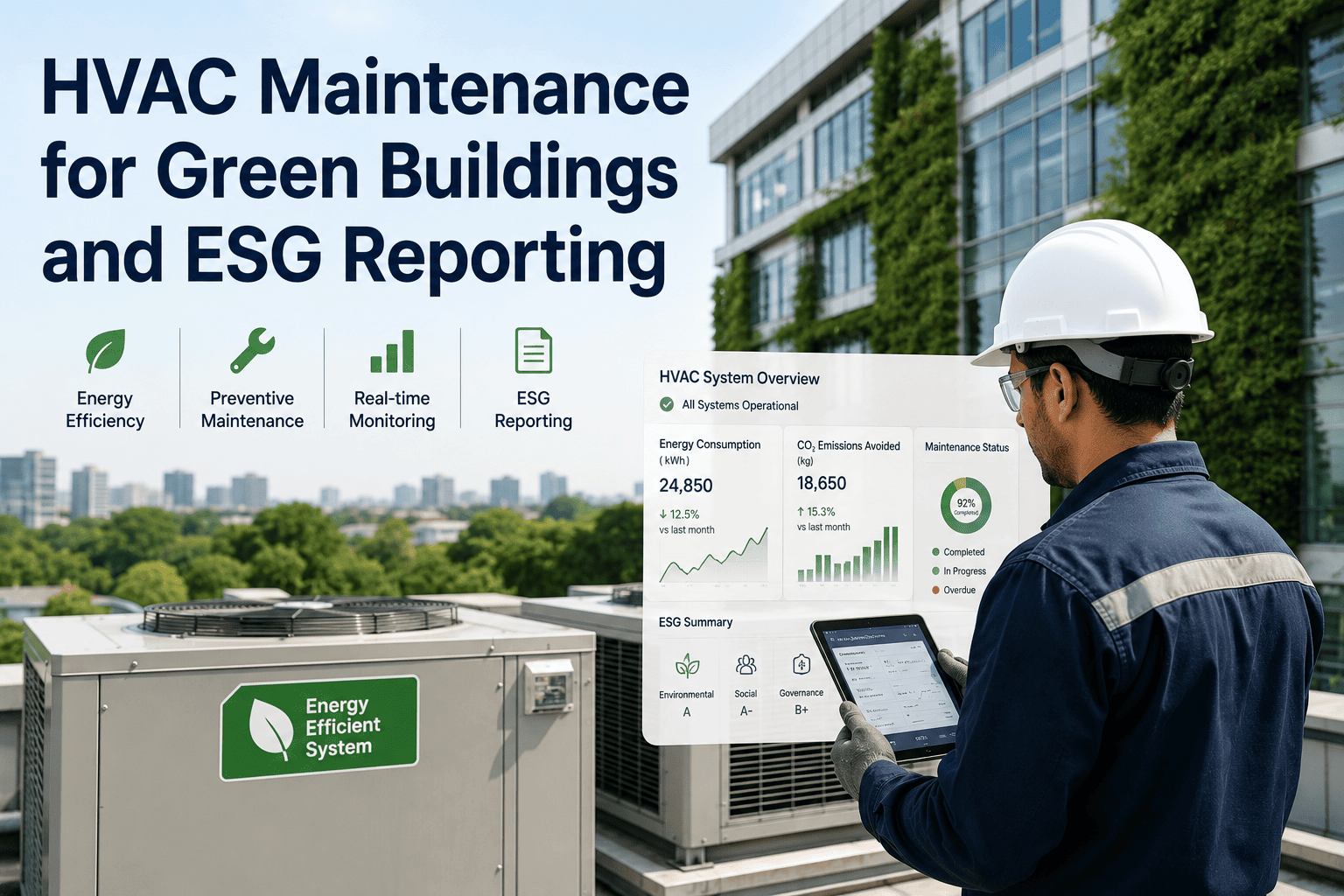
Heating, ventilation, and air conditioning (HVAC) systems account for up to 40% of a commercial building's total energy consumption and represent one of the largest sources of Scope 1 and Scope 2 emissions in facility operations. For facility managers and building owners pursuing net zero targets, HVAC carbon reduction isn't an optional upgrade—it's a core operational imperative. A practical decarbonization roadmap starts with benchmarking and energy assessment before moving into capital upgrades and ongoing maintenance optimization. Sign Up Free to begin centralizing your HVAC maintenance records and energy performance data in one platform.
Why HVAC Is the Priority Target for Building Decarbonization
Buildings are responsible for nearly 40% of global energy consumption, and within that total, HVAC systems dominate the load. With 80% of existing buildings expected to still be in use by 2050, retrofits and operational improvements to existing HVAC equipment are essential for widespread decarbonization. Book a Demo to explore how Oxmaint's energy dashboard helps prioritize the highest-impact HVAC assets first.
Six High-Impact HVAC Carbon Reduction Strategies for Your Roadmap
An effective decarbonization roadmap requires a staged approach that moves from operational improvement to strategic capital investment. These six strategies deliver measurable emissions reductions across the building lifecycle. Sign Up Free to track all six strategies within your unified CMMS platform.
Energy Benchmarking and Continuous Monitoring — Baseline current HVAC energy intensity (kWh per square foot) and track real-time consumption against that baseline. Oxmaint's energy dashboard automatically flags equipment consuming 10%+ above expected levels, triggering maintenance investigation. Add Book a Demo to see live monitoring.
Preventive HVAC Maintenance Optimization — Dirty filters can increase energy consumption by extending equipment run time due to reduced airflow. A CMMS automates filter change schedules, coil cleaning, and belt tension inspections that deliver 15–30% HVAC energy savings.
Refrigerant Leak Detection and Management — Refrigerant leaks are direct Scope 1 emissions events that also degrade system efficiency. Lifecycle refrigerant management prevents leaks, recovers gases, and documents every maintenance intervention for ESG disclosure. A single kg of R410A leak equals 1.85t CO₂e emissions.
Building Automation System (BAS) Integration — Modern BAS platforms optimize set points across hundreds of assets every 15 minutes to maintain peak efficiency. Integrating BAS data into Oxmaint creates a closed loop between automation decisions and preventive maintenance execution.
Continuous Commissioning and Retro-Commissioning — HVAC commissioning activities can reduce building energy consumption by approximately 15% annually. Ongoing recommissioning identifies low-cost operational improvements with payback periods under two years.
Electrification and Heat Pump Transition — The net zero roadmap eventually requires replacing fossil-fuel heating with electric heat pumps. Facility managers need CMMS records to track equipment lifecycle, plan replacement timing, and document emissions reductions from electrification projects.
How Oxmaint Powers the HVAC Carbon Reduction Roadmap
Leading facility teams are embedding ESG reporting into operational CMMS discipline: every work order becomes an emissions record, every preventive task becomes a carbon-reduction lever, and every KPI is already audit-ready before the reporting deadline. Book a Demo to see how Oxmaint connects your HVAC maintenance data directly to ESG frameworks like GRESB, ENERGY STAR, and LEED. Sign Up Free and begin building your carbon reduction roadmap today.
- Import all HVAC assets with nameplate efficiency ratings and expected energy baselines
- Oxmaint automatically flags equipment consuming 10%+ above baseline for investigation
- Correlate energy spikes with specific maintenance events or deferred work orders
- Configure automated PM reminders for coil cleaning, filter replacement, and refrigerant checks
- Maintenance compliance below 85% predicts energy waste increases—automated alerts prevent delays
- Link every PM task to expected energy impact for ROI verification
- Log every refrigerant charge, recovery, and leak event per asset ID
- Oxmaint automatically calculates CO₂e emissions from high-GWP refrigerant losses
- Generate refrigerant management reports aligned with F-gas regulations and ESG disclosure
- Automatically feed HVAC energy consumption, refrigerant logs, and PM records into ESG dashboards
- Oxmaint generates reports in GRESB, ENERGY STAR Portfolio Manager, and LEED formats
- Eliminate manual data collection that consumes hundreds of hours per reporting cycle