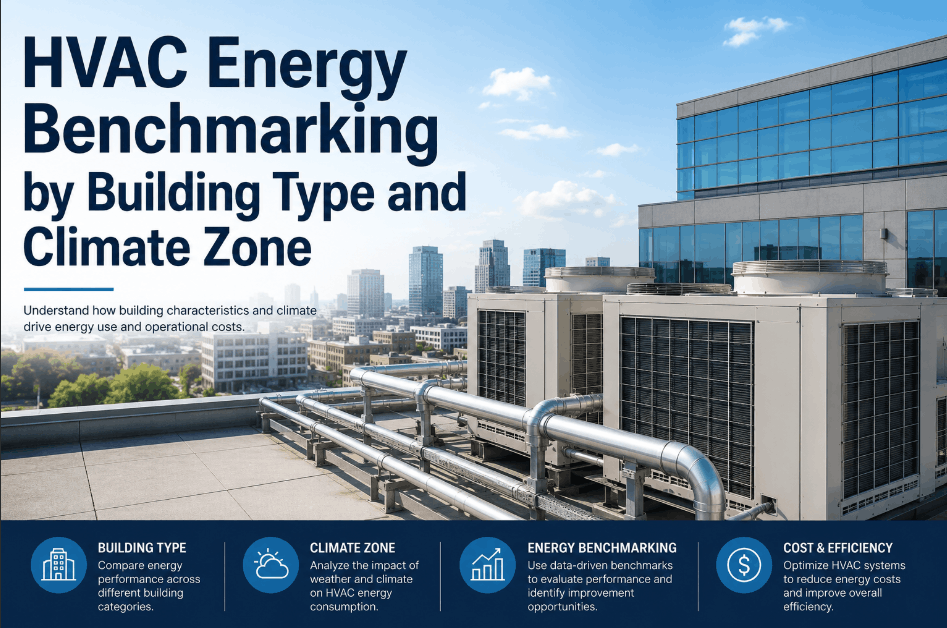
Most facility managers receive utility bills every month but never truly know if their building is performing well or hemorrhaging energy. HVAC systems are the single largest energy consumer in commercial buildings, yet benchmarking them against industry standards remains one of the most overlooked practices in facilities management. If your HVAC costs are climbing year over year, the answer isn't always a system upgrade — sometimes it's simply knowing where you stand.
Energy benchmarking gives you a clear, data-backed snapshot of your building's HVAC performance relative to similar buildings nationwide. It's the starting point for any serious energy reduction strategy — and it directly determines your Energy Star score, which affects everything from operating costs to property value. Whether you manage a single office tower or a portfolio of facilities, understanding your Energy Use Intensity (EUI) is non-negotiable in today's cost-conscious landscape. Sign up on OxMaint to start tracking your HVAC energy metrics in one place.
What Is EUI and Why Should You Care?
Energy Use Intensity (EUI) is the universal language of building energy benchmarking. Think of it like miles-per-gallon for your building — a lower EUI means you're doing more with less energy. The U.S. EPA's ENERGY STAR Portfolio Manager uses EUI as the foundation for its 1–100 building score. Buildings scoring 75 or above earn the coveted ENERGY STAR certification.
For HVAC specifically, EUI helps isolate how much of your building's total energy footprint belongs to heating, cooling, and ventilation — allowing targeted intervention rather than blanket cost-cutting.
Where Does Your Building Type Stand?
National medians vary significantly by building type. Comparing your building against the right peer group is critical — an office building and a hospital have entirely different energy demands. Here's how major commercial building categories benchmark against each other:
Source: U.S. EIA CBECS, ENERGY STAR Portfolio Manager National Medians (2024)
What's Actually Consuming Your Energy?
HVAC is consistently the #1 energy consumer across nearly all commercial building types. Poorly maintained HVAC systems can waste 15–30% of the energy they consume through duct leaks, dirty filters, and degraded components.
Is Your HVAC Draining Your Budget?
OxMaint helps facility teams track HVAC maintenance schedules, flag energy anomalies, and benchmark performance — all from a single dashboard.
How Maintenance Quality Directly Affects Your Energy Star Score
Here's the connection most building owners miss: your HVAC maintenance quality isn't just a reliability issue — it's a direct driver of your Energy Star score. A well-maintained system operating at peak efficiency will consistently score higher than a neglected one, even if both systems are the same model and age. Sign up for OxMaint to build preventive maintenance schedules that protect your rating.
| Maintenance Issue | Energy Impact | EUI Penalty | Risk Level |
|---|---|---|---|
| Clogged air filters | Increases fan energy 10–15% | +3–6 kBtu/sq ft | High |
| Refrigerant leak | Compressor works 20–30% harder | +5–10 kBtu/sq ft | High |
| Dirty condenser coils | Reduces heat transfer efficiency 15–20% | +4–8 kBtu/sq ft | High |
| Leaky ductwork | 15–30% conditioned air lost | +6–12 kBtu/sq ft | Critical |
| Thermostat miscalibration | ±2°F = 5–8% extra energy use | +2–5 kBtu/sq ft | Medium |
| Worn belt / motor issues | Drive inefficiency adds 5–12% | +2–4 kBtu/sq ft | Medium |
The HVAC Energy Performance Spectrum
HVAC-specific EUI ranges for a mid-size commercial office building. Results vary by climate zone, occupancy, and building envelope quality. Buildings in the "Critical" zone typically have Energy Star scores below 40, while "Excellent" performers often score 85+.
4 Steps to Benchmark and Improve Your HVAC Performance
Calculate Your Current EUI
Pull 12 months of utility bills. Divide total energy consumed (convert to kBtu) by your building's gross square footage. This is your baseline — the number everything else is measured against. Sign up to OxMaint to automate this tracking.
Compare Against Your Peer Group
Use ENERGY STAR Portfolio Manager or ASHRAE benchmarks to compare your EUI against buildings with the same primary function, size range, and climate zone. Comparing apples to apples is what makes benchmarking meaningful.
Audit HVAC Maintenance Gaps
Map every piece of HVAC equipment against its last service date. Filters, coils, belts, refrigerant — these aren't just maintenance checkboxes. They are direct energy cost multipliers. Book a demo to see how OxMaint tracks these automatically.
Set a Target and Track Monthly
Don't benchmark once and forget. Set a 12-month EUI reduction goal — even a 10% improvement can translate to tens of thousands in annual savings for a mid-size building. Monthly tracking reveals seasonal patterns and early degradation signals.
ASHRAE and Energy Star: The Two Benchmarking Pillars
ASHRAE 90.1 & 100
ASHRAE Standard 90.1 sets minimum energy efficiency requirements for new commercial construction, while Standard 100 addresses existing buildings. Together, they define acceptable HVAC system performance thresholds and provide the engineering baseline for energy audits at Levels 1, 2, and 3.
- Governs HVAC system design efficiency
- Required for most local building codes
- Defines acceptable EUI targets by climate zone
Portfolio Manager Score
The EPA's ENERGY STAR score ranks your building from 1 to 100 against similar facilities nationwide. A score of 75 or above qualifies for ENERGY STAR certification. The score is directly tied to your EUI and takes into account climate, occupancy hours, and building characteristics.
- Score 75+ earns ENERGY STAR certification
- Directly impacts property value and leasing appeal
- Required for many municipal benchmarking laws
Ready to Benchmark Smarter?
OxMaint's AI-powered CMMS connects HVAC maintenance data directly to your energy performance metrics. Know when a missed PM task is costing you kilowatts — before it shows up on your utility bill.