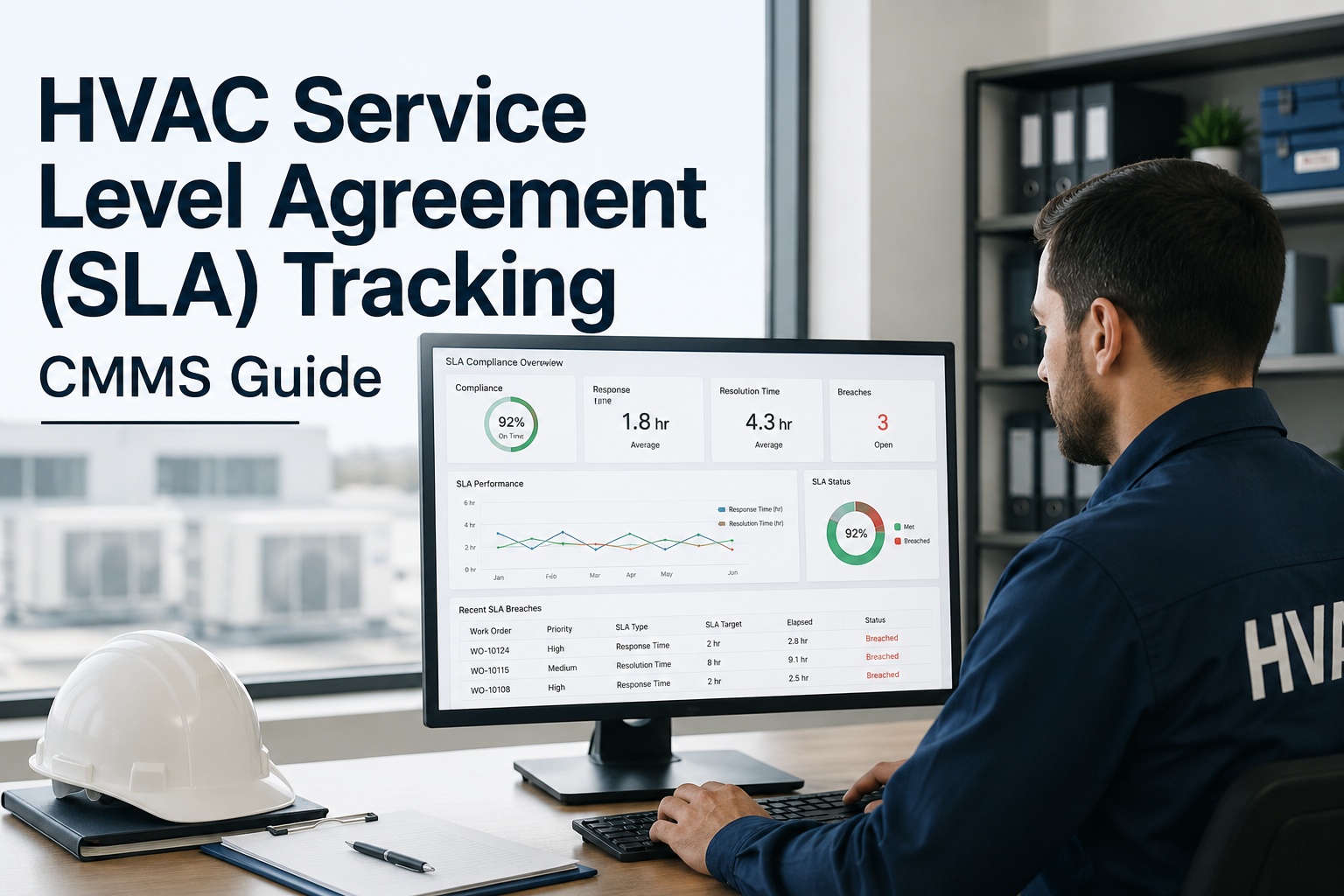
HVAC contractor and vendor management is where most facility maintenance budgets quietly leak — not because vendors are dishonest, but because contracts nobody tracks, SLAs nobody measures, and invoices nobody verifies against work orders. The average facility management operation runs 60% to 70% of its maintenance work through contracted providers, yet fewer than 30% have a documented SLA against which contractor performance is measured. The result is predictable: an HVAC contractor arrives without the right certification, services the wrong equipment because scope was communicated verbally, and submits an invoice that does not match the agreed rate schedule. Sign Up Free to bring every contractor work order, compliance document, and SLA timer into one OxMaint dashboard. When a technician whose refrigerant certification lapsed three months ago is still working on a charged system, liability flows straight to the facility the moment an incident occurs. Book a Demo to see how OxMaint blocks unqualified assignment and tracks vendor performance with data instead of memory.
HVAC Preventive Maintenance · Vendor Management · 2026
HVAC Contractor & Vendor Management CMMS Guide 2026
Assign specialized tasks, verify insurance, enforce SLAs, and track completion — manage every HVAC contractor from one CMMS instead of scattered emails and spreadsheets.
60–70%Share of FM maintenance work run through contracted providers in a typical operation
<30%Of those operations have a documented SLA against which contractor performance is measured
91%Response-time SLA compliance with automatic escalation vs 70% without CMMS tracking
15–24%Cost reduction typical within 12 months of systematic vendor tracking and consolidation
4 Contractor Management Gaps That Cost Facilities Money
Outsourced HVAC work sits in a blind spot for most operations — expensive, compliance-critical, and almost entirely invisible in spreadsheet-based management. The gaps below are where OxMaint's vendor module turns anecdote into accountability, giving facilities teams the same visibility over contractor work that they have over their own crew. Sign Up Free to register every contractor with certifications and scope in OxMaint.
01
Untracked SLA Compliance
Gap: No Response-Time Enforcement
Silent Breach
Emergency response SLAs of two to four hours are routinely exceeded with no consequence when tracking is manual. Contractors who miss response windows are not flagged until a tenant complaint arrives — by which time the penalty clause is irrelevant.
02
Expired Insurance & Certification
Gap: Manual Credential Checking
Liability Exposure
Paper certificate folders go out of date silently. A technician with a lapsed refrigerant certificate working on a charged system creates both a compliance violation and an insurance exposure that nobody catches until an incident investigation asks for current credentials.
03
Verbal Scope & Invoice Disputes
Gap: No Digital Approval Trail
Billing Risk
Verbal scope additions during site visits produce invoices that do not match the original work order. Without a digital approval trail, disputes are settled by negotiation rather than evidence — and out-of-scope charges go unchallenged.
04
Renewals Without Performance Data
Gap: No Objective Scorecard
Weak Negotiation
Without tracked SLA compliance, first-time-fix rates, and cost-per-work-order data, renewal decisions rest on relationship comfort. Poor performers retain contracts and high performers have no mechanism to prove their value.
HVAC Vendor Management — Without vs. With OxMaint
The difference between hoping vendors deliver and managing them is documentation: a complete, work-order-matched record for every assignment, credential, and invoice. The comparison below shows what changes when OxMaint structures contractor scheduling, compliance tracking, and performance scoring. Book a Demo to review your current contractor process and find the gaps OxMaint closes.
Vendor Management Maturity — Where Does Your FM Operation Score?
Contractor management capability ranges from spreadsheet-and-email chaos to a fully structured CMMS program with automatic escalation, compliance blocking, and performance scorecards. The framework below identifies where an operation sits today and the highest-impact gap driving overspend. Book a Demo to assess your vendor management maturity with an OxMaint solutions engineer.
HVAC Vendor Management Maturity
Score 5 = full CMMS vendor program · Score 1 = spreadsheet and email
5
Digital Work Orders · Compliance Blocking · Performance Scorecards
Every contractor accepts scope via mobile. Expired credentials block assignment automatically. SLA timers escalate on breach. Renewals run on objective scorecards.
Profile: Vendor overspend is visible and controlled. Consolidation and competitive rebidding run on documented performance data.
4
Digital Work Orders · Partial Performance Tracking
Contractor work orders run in the CMMS with photo sign-off. SLA compliance tracked but not consistently used in renewals. Credential expiry alerted but not enforced at assignment.
Action: Enforce compliance blocking and bring scorecards into every renewal. The data is there — use it to negotiate.
3
Structured Assignment · No SLA Enforcement
Work orders issued through a system but SLA timers are not tracked. Compliance documents stored but expiry not alerted. Invoices approved without work-order matching.
Gap: SLA tracking and invoice-to-work-order matching are the highest-impact next steps to stop silent overspend.
2
Email Assignment · Paper Compliance
Jobs assigned by email or phone. Certificates in a physical folder. No performance record. The same underperforming contractor keeps getting called because no one documented the pattern.
Risk: Liability exposure from lapsed credentials and no defensible record when invoices are disputed.
1
No Vendor Structure
Contractor jobs in one spreadsheet, internal work orders in another, parts tracked nowhere. Maintenance history is half the story at best.
Risk: Overspend is invisible until an audit or incident forces a reckoning. Every relationship runs on memory.
Manage Every Contractor With Data — Not Memory and Emails.
OxMaint structures contractor scheduling, insurance verification, SLA enforcement, and performance scoring for HVAC vendor management — in one CMMS platform.
How OxMaint Structures HVAC Vendor Management
OxMaint connects contractor onboarding, credential verification, SLA tracking, and performance scoring into a single workflow — giving facilities teams full control over every vendor relationship from work order assignment to photo-verified completion. Each contractor work order carries scope, required certifications, and an SLA window, so there are no verbal briefings and no invoice disputes. Sign Up Free to register your vendor pool in OxMaint. Book a Demo to see SLA scorecards configured for your contractor categories.
Credential Repository
90/60/30-Day Alerts
Insurance and licenses in one place
OxMaint stores certificates of insurance, trade licenses, and certifications with automatic expiry alerts — and blocks assignment to any contractor with lapsed credentials.
SLA Timers & Escalation
Auto-Escalate at 80%
Response tracked per work order
Every contractor work order carries an SLA timer. At 80% of the window an alert fires; at 100% the job escalates to FM lead review with the breach logged for reporting.
Photo-Verified Completion
Sign-Off Before Invoice
Work matched to the work order
Contractors close jobs with before-and-after photos, materials, and hours. Invoices link to a specific work order — line items without a match are flagged before payment.
Vendor Scorecards
Four KPIs Automatically
Objective renewal evidence
OxMaint scores every vendor on response time, first-time-fix rate, recall rate, and cost per repair — so renewals run on numbers, not anecdotes.
"
We were carrying twelve HVAC contractors and had no real idea which ones were performing. After moving assignments into OxMaint, the scorecards showed one of our primary vendors was hitting the response SLA only 68% of the time and needed a second visit on nearly a third of calls. The data was invisible before because it lived in email threads and a project manager's memory. We consolidated to four strategic partners, and the ones who stayed actually appreciated the transparency. The compliance blocking alone gave us peace of mind — an expired certificate can no longer be assigned to a refrigerant job.
Facilities Manager — Multi-Site Commercial Portfolio, 22 buildings, Midwest, USA
Frequently Asked Questions
How does OxMaint prevent assigning work to unqualified contractors?
OxMaint blocks work order assignment to contractors with expired licenses or certificates of insurance. A technician with a lapsed refrigerant certificate cannot be assigned to a refrigerant job before the visit is even scheduled.
What compliance documents can OxMaint track for HVAC vendors?
OxMaint stores certificates of insurance, trade licenses, safety certifications, and required training records in one repository, with automatic expiry alerts at 90, 60, and 30 days so coverage gaps never go unnoticed.
How does OxMaint track HVAC contractor SLA compliance?
Every contractor work order carries an SLA timer. At 80% of the window an escalation alert fires, and at 100% the job escalates automatically with the breach logged — driving compliance from around 70% to 91%.
How does OxMaint help match invoices to actual work?
Contractors must close work orders with photo sign-off before invoicing. Each invoice links to a specific work order, and any line item without a matching order is flagged for review before payment is approved.
Can OxMaint manage HVAC contractors across multiple properties?
Yes. A contractor registered in OxMaint can be assigned across multiple properties, with performance, compliance, and job history accumulating group-wide for a complete portfolio-level view of each vendor.
Turn Every Contractor Relationship Into a Documented, Scored Record.
OxMaint structures HVAC contractor assignment, insurance verification, SLA enforcement, and performance scoring — so facilities teams negotiate renewals from evidence and close the gaps that leak budget.