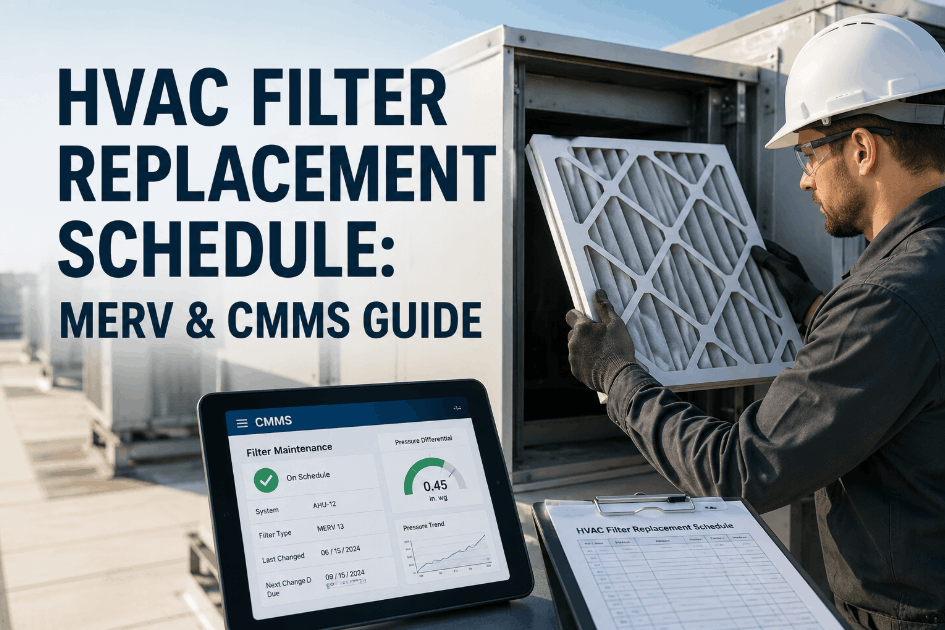
An HVAC filter replacement schedule built on calendar dates alone misses what actually drives filter wear — dust loading, occupancy, and MERV rating all change how fast a filter clogs, which means two identical AHUs on the same 90-day change cycle can have completely different real-world replacement needs. Facility teams that switch to pressure differential-based replacement, monitored through a CMMS instead of a wall calendar, catch loaded filters before airflow and energy efficiency suffer. Teams using Sign Up Free on Oxmaint can log MERV rating, pressure readings, and replacement history against every AHU and RTU, turning filter maintenance from a fixed-date guess into a data-driven schedule.
Why Calendar-Based Filter Replacement Falls Short
A fixed 30, 60, or 90-day filter change interval assumes every unit loads dust at the same rate, but occupancy, outdoor air percentage, and MERV rating all change that rate significantly between units. Book a Demo to see how Oxmaint links pressure differential readings and inspection findings to each asset so filter replacement timing reflects real conditions.
Six Factors That Should Set Your HVAC Filter Replacement Interval
Choosing the right MERV rating and replacement trigger requires weighing filtration need against airflow resistance and dust load. Sign Up Free to log these six factors per asset in Oxmaint and let the platform flag when a filter change is actually due.
MERV Rating Selected for the Space
Higher MERV filters capture finer particles but add airflow resistance, so the rating should match the space's indoor air quality requirement, not just habit.
Pressure Differential Across the Filter Bank
A rising pressure drop across the filter is the most direct signal that it's loading with dust and approaching the point where airflow and energy efficiency suffer.
Outdoor Air Percentage and Local Dust Load
Units running higher outdoor air fractions in dusty or high-pollen environments load filters faster than units in cleaner, low-OA settings.
Occupancy and Space Type
High-occupancy spaces generate more particulates and require more frequent filter checks than low-traffic storage or mechanical areas.
Seasonal Variation
Pollen seasons and construction nearby can shorten filter life temporarily, which fixed calendar schedules don't account for.
Manufacturer Filter Media Specification
Filter media type and depth affect dust-holding capacity, so replacement intervals should reference manufacturer data alongside field readings.
MERV Rating and Replacement Trigger Reference
Book a Demo to see how Oxmaint's inspection checklists capture the pressure and condition data behind each row below.
| MERV Range | Typical Use | Replacement Trigger | Check Frequency | Oxmaint Record Type |
|---|---|---|---|---|
| MERV 8–9 | General commercial ventilation | Pressure drop above design threshold | Monthly visual, quarterly pressure check | PM inspection checklist |
| MERV 11–13 | Office, healthcare-adjacent spaces | Pressure drop or visible loading | Monthly pressure check | Filter condition record |
| MERV 14+ | Healthcare, cleanroom-adjacent | Pressure drop at manufacturer limit | Weekly to biweekly pressure check | Critical asset PM work order |
| Pre-filters | Protecting final filter stage | Visible dust loading | Monthly visual inspection | Standard inspection log |
Four Outcomes a CMMS-Based Filter Program Delivers
Sign Up Free to build a condition-based filter replacement program in Oxmaint across your HVAC fleet.
Setting Up a Filter Replacement Program in Oxmaint
Book a Demo to configure condition-based filter PM schedules across your AHU and RTU fleet in Oxmaint.
Record MERV Rating per Unit
Log the current filter MERV rating and media type for each AHU and RTU in its asset record.
Set Pressure Differential Thresholds
Define the pressure drop level that triggers a replacement work order, based on manufacturer specs.
Digitize the Filter Inspection Checklist
Use Oxmaint's digital checklist to log pressure readings and visual condition at every scheduled check.
Auto-Generate Replacement Work Orders
Configure Oxmaint to create a corrective work order automatically when a logged reading crosses the threshold.
Track Filter Compliance Rate Monthly
Review the filter compliance KPI each month to confirm replacement work orders are being closed on time.
Frequently Asked Questions: HVAC Filter Replacement Schedules
Should HVAC filters be replaced on a calendar schedule or by pressure reading?
Pressure differential readings give a more accurate replacement trigger than fixed calendar dates, since dust loading varies by unit and season.
What MERV rating is right for a commercial building?
MERV 8–13 covers most general commercial spaces, while healthcare and cleanroom-adjacent areas typically require MERV 14 or higher.
How often should filter pressure be checked?
Monthly checks work for most general spaces, while high-MERV or high-occupancy areas benefit from weekly to biweekly pressure checks.
What is a good filter compliance rate target?
High-performing facility teams typically target a 95% or higher on-time filter replacement rate across their fleet.
How does Oxmaint support HVAC filter maintenance?
Oxmaint logs MERV rating, pressure readings, and inspection history per asset, and can auto-generate replacement work orders when thresholds are crossed.