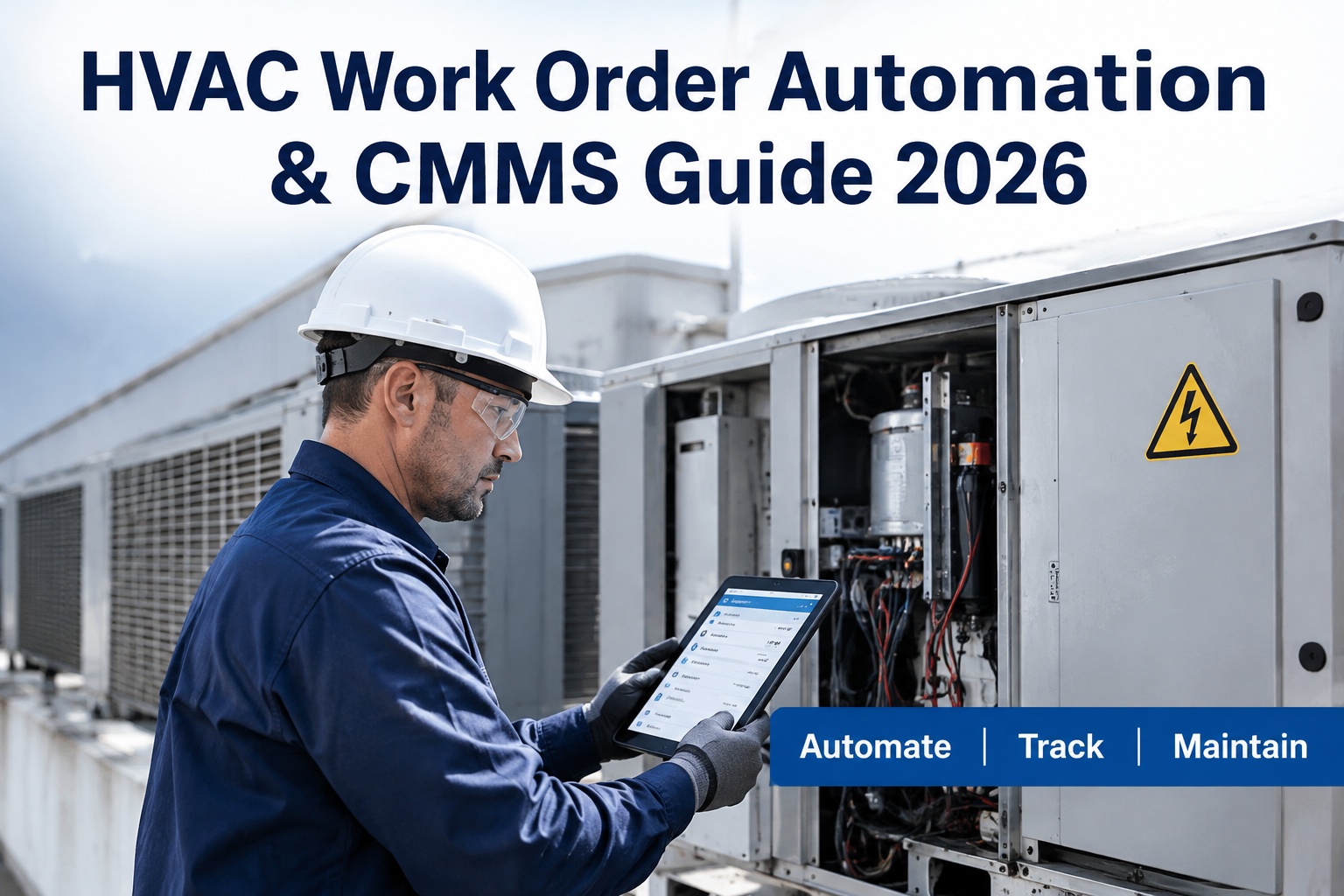
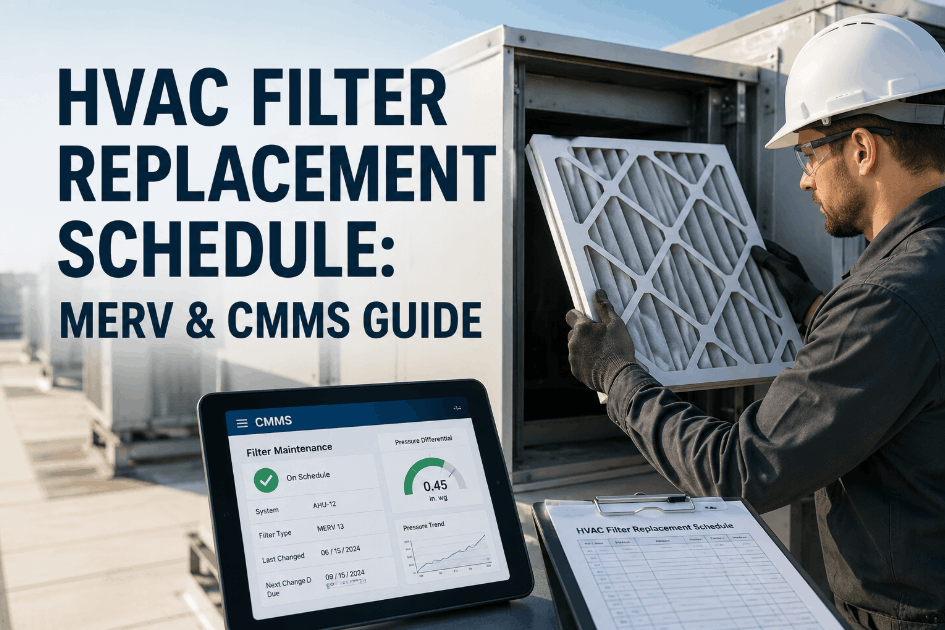
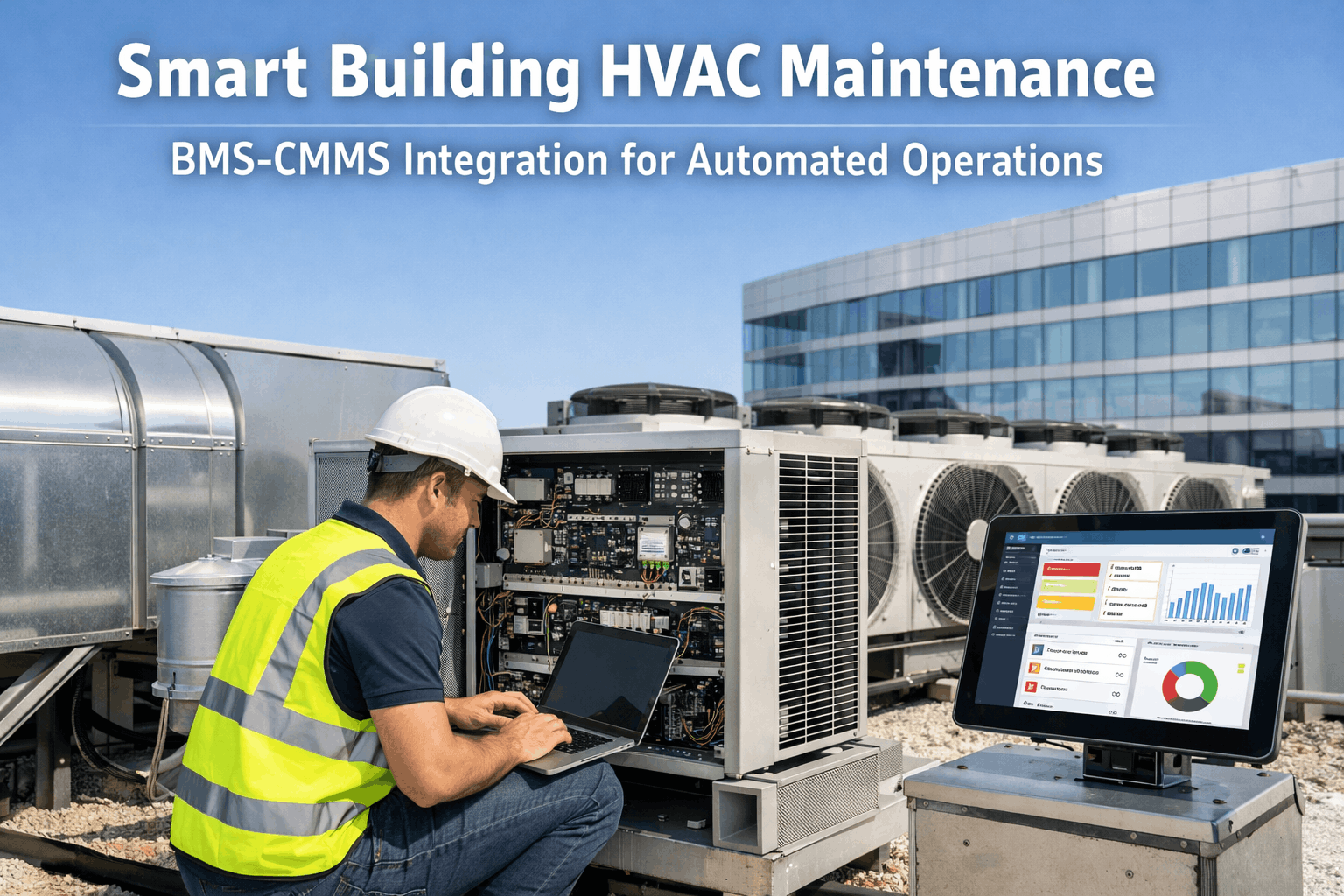
A facilities technician climbs a 12-foot ladder for the fourth time today, removes a ceiling panel, pulls a clogged HVAC filter from an air handling unit above a hospital corridor, and replaces it with a clean one — a 25-minute task repeated across 1,400 filter positions every 90 days. That is 2,330 labor hours per year spent on a repetitive, physically demanding task that contributes to ladder-related injuries, disrupts occupied spaces, and still misses optimal change intervals because every filter is replaced on the same calendar schedule regardless of actual loading. Facilities operating HVAC filter replacement robots automate 60–80% of standard filter changes, reduce filter-related labor by 70%, and shift from time-based to condition-based replacement — cutting filter waste by 25–40% while maintaining or improving indoor air quality. A 2.8-million-square-foot healthcare campus deployed 34 robotic filter change modules across 190 air handling units over 16 months — linking every robotic filter change event directly to Oxmaint CMMS for automated scheduling, filter lifecycle tracking, pressure drop trending, and compliance documentation. This guide explains exactly how HVAC filter replacement robots work, what equipment configurations they support, and how CMMS integration turns automated filter changes into intelligent air quality management.
35%
Filters Changed Too Early
Average percentage of HVAC filters replaced on calendar schedules that still have 30–50% remaining useful life — wasting filter media, labor, and disposal costs
2,300 hr
Annual Filter Labor
Typical labor hours per year for manual HVAC filter replacement at a 1M+ sq ft commercial or institutional facility with 90-day change cycles
$8.2B
U.S. HVAC Filter Market
Annual U.S. commercial HVAC filter market — a cost category ripe for optimization through robotics and condition-based replacement intelligence
Facilities teams ready to
Sign Up connect robotic filter change events to structured maintenance workflows — linking every filter position to its pressure drop history, replacement record, air quality compliance data, and condition-based scheduling in a single platform.
What HVAC Filter Replacement Robots Actually Do
Filter replacement robots are not general-purpose humanoid machines that walk through buildings changing filters. They are purpose-built mechanical modules installed inside or adjacent to air handling units that automatically eject a loaded filter, index a clean replacement into the airstream, and log the change event — all without human intervention, ladder access, or building disruption. The robot does not replace the entire filter maintenance program — it automates the repetitive physical task of swapping standard-size panel and bag filters in high-volume AHUs while freeing technicians for higher-value diagnostic and repair work. The real value emerges when robotic change data connects to operational systems. Facilities implementing Sign Up for Oxmaint establish the critical link — connecting every robotic filter change to pressure drop trends, filter lifecycle data, air quality compliance records, and condition-based scheduling so that automated filter management and maintenance intelligence reinforce each other continuously.
5
Compliance & Reporting Layer
Automated documentation of every filter change — date, time, filter position, pressure drop at change, filter type, and technician verification. Reports generated for JCAHO healthcare compliance, LEED IAQ credits, ASHRAE 62.1 ventilation standards, and insurance underwriter requirements without manual data entry.
Outputs: Regulatory compliance reports, IAQ certification documentation, energy optimization reports, filter lifecycle cost analysis, capital budget justifications
4
CMMS Integration Layer
Each robotic filter module reports change events, pressure drop readings, and filter magazine inventory levels to Oxmaint via API or BACnet gateway. CMMS auto-generates resupply orders when magazine inventory drops below threshold, schedules technician visits only for magazine reloads, and tracks filter lifecycle costs per AHU.
Technologies: Oxmaint CMMS, BACnet/IP integration, REST APIs, automated PO generation, filter inventory management, pressure drop trending
3
Condition-Based Decision Layer
Differential pressure sensors continuously monitor filter loading across every equipped AHU. When pressure drop reaches the optimal change threshold — balancing energy cost, filter life, and air quality — the system triggers a robotic filter change or alerts the CMMS for manual change on non-robotic units.
Technologies: Differential pressure transmitters, BAS integration, pressure-to-energy cost algorithms, ASHRAE filter loading curves, IAQ threshold monitoring
2
Robotic Execution Layer
Mechanical filter change modules eject loaded filters into a sealed used-filter cassette and index a clean filter from the supply magazine into the airstream. Change cycle completes in 45–120 seconds depending on filter size. No airflow interruption, no ceiling access, no ladder work required.
Technologies: Linear actuators, magazine-fed filter supply, sealed cassette collection, position sensors, motor controllers, safety interlocks
1
Physical Infrastructure Layer
Robotic filter modules are installed in AHU filter sections during new construction, major renovation, or retrofit. Modules require standard filter rack dimensions, power supply (120V/24V), network connectivity, and access space for magazine reload. Compatible with MERV 8–16 panel and bag filter configurations.
Technologies: Custom filter rack modules, standard filter media (20×20, 24×24, 20×25 common sizes), BACnet/IP controllers, PoE connectivity, sealed enclosures
Critical Integration Point: Oxmaint operates at Layer 4, connecting every robotic filter change event to the AHU's maintenance record — so filter management data and HVAC maintenance workflows reinforce each other across every change cycle and compliance audit.
Filter Replacement Robot Technologies: Platform Comparison
Robotic filter replacement is an emerging category with several distinct approaches — from fully integrated AHU modules to mobile robotic platforms that service multiple units. The right platform depends on building type, AHU configuration, filter volume, and whether the installation is new construction or retrofit. Facilities leaders evaluating robotic filter programs can Book a Demo to see how Oxmaint connects automated filter data to maintenance workflows regardless of robotic platform.
Most facilities deploying filter robots start with integrated AHU magazine modules on their highest-volume, highest-compliance AHUs (operating rooms, clean rooms, data halls) and expand to retrofit slide-rail systems across standard commercial AHUs. Regardless of platform, all filter change events flow into the same CMMS scheduling structure through
Sign Up for Oxmaint.
Connect Robotic Filter Data to CMMS Scheduling Intelligence
Oxmaint links every robotic filter change event to pressure drop trends, filter lifecycle tracking, resupply automation, and compliance documentation — so every AHU becomes a self-managing air quality asset, not a calendar-based labor task.
CMMS Scheduling: What Changes When Robots Handle Filter Replacement
Automating the physical filter change is only half the value. The other half — and often the larger ROI driver — is the transformation of CMMS scheduling from rigid calendar intervals to intelligent, condition-based filter management. Understanding what the CMMS gains from robotic integration ensures the software investment matches the hardware deployment.
Condition-Based Change Triggers
Differential pressure sensors on every robotic module feed real-time loading data to the CMMS. Filter changes trigger at optimal pressure drop thresholds — not fixed 90-day intervals. Each AHU changes filters based on its actual loading rate, which varies by season, occupancy, outdoor air quality, and construction activity.
CMMS Value: Eliminates premature filter changes (saving 25–40% in filter media costs) while preventing overloaded filters from degrading IAQ or increasing fan energy
Automated Resupply Scheduling
Each robotic module reports remaining clean filter inventory in its magazine. When inventory drops below configurable thresholds (e.g., 2 filters remaining), the CMMS auto-generates a resupply work order and can trigger a purchase order to the filter vendor — ensuring technicians reload magazines before the supply runs out.
CMMS Value: Zero stockout risk for filter supply — technician visits are planned, not reactive, and bundled for route efficiency
Pressure Drop Trending & Analytics
Continuous pressure drop data across every equipped AHU builds loading curves over time. The CMMS identifies AHUs with abnormally fast loading rates — indicating upstream ductwork issues, outdoor air quality events, or filter bypass — and generates diagnostic work orders automatically.
CMMS Value: Converts filter data from a replacement task into an HVAC system diagnostic tool that detects problems beyond the filter itself
Energy Cost Optimization
Filter loading directly increases fan energy consumption — a fully loaded filter can increase AHU energy use by 15–30%. The CMMS calculates the economic crossover point where the energy cost of running a loaded filter exceeds the cost of a new filter and triggers the change at the cost-optimal moment.
CMMS Value: Filter changes optimized for total cost of ownership — not just filter media cost, but filter + energy cost combined
Compliance Documentation Automation
Every robotic filter change generates a timestamped record — filter position, AHU identifier, pressure drop at change, filter type and MERV rating, change trigger (condition or schedule). These records auto-populate compliance reports for JCAHO, LEED, ASHRAE 62.1, and local health authority inspections.
CMMS Value: Audit-ready filter change documentation generated automatically — zero manual logging, zero missing records
Technician Route Optimization
Instead of sending technicians to every AHU on a fixed schedule, the CMMS generates optimized reload routes — grouping magazine reloads by building zone, floor level, and access requirements. Technicians visit only the units that need attention, in the most efficient sequence.
CMMS Value: Technician time on filter management reduced by 70% — remaining visits are planned, routed, and productive
New Construction vs. Retrofit vs. Phased: Implementation Strategy
The deployment decision depends on building lifecycle stage, AHU configuration, filter volume, and available capital. Most facilities start with a targeted retrofit on highest-value AHUs and expand as ROI is demonstrated. The critical factor is ensuring that regardless of deployment timing, all robotic and manual filter data flows into the same CMMS scheduling structure for unified filter management.
New Construction Integration
Best for: New buildings & major AHU replacements
Cost: $6K–$18K per AHU (included in design)
Advantages
- Lowest installation cost — designed into AHU spec
- Optimal filter rack geometry for robotic modules
- Network and power provisioned during construction
- BAS and CMMS integration configured at commissioning
Considerations
- Only applies to new or replacement AHU projects
- Requires specification during design phase
- Contractor familiarity may be limited
- Commissioning requires robotic system validation
Recommended
Targeted Retrofit Program
Best for: 20–100 AHUs in existing buildings
Cost: $4K–$25K per AHU retrofit
Advantages
- Targets highest-value AHUs first for fastest ROI
- Phased investment matches budget availability
- Proves concept before campus-wide commitment
- Hybrid manual/robotic managed in single CMMS
Considerations
- Existing AHU geometry may limit module options
- Network and power retrofit adds installation cost
- Two filter management workflows during transition
- Some AHUs may not be retrofit-compatible
Mobile Robot Fleet
Best for: Large campuses with 100+ AHUs
Cost: $80K–$250K per robot + infrastructure
Advantages
- Single robot services many AHUs — high utilization
- No permanent modification to AHU required
- Handles multiple filter sizes per mission
- Scales with campus growth without per-AHU cost
Considerations
- Highest single capital investment
- Requires accessible mechanical room layouts
- Navigation infrastructure (mapping, wayfinding)
- Technology maturity still developing (early market)
Most facilities begin with a targeted retrofit of 10–30 high-compliance or high-frequency AHUs (operating rooms, data center CRAHs, clean rooms) to prove ROI and build operational familiarity. New construction projects then specify integrated modules as standard, and campus-wide expansion follows documented savings. All filter data — robotic and manual — feeds into the same Oxmaint scheduling structure.
The Maintenance Connection: Why CMMS Scheduling Is the Backbone
A filter robot without CMMS integration is an automated mechanism. A CMMS without filter condition data schedules changes by calendar instead of need. The integration of robotic filter change events with CMMS scheduling transforms both — giving automation operational intelligence and giving maintenance workflows condition-based precision. This is where robotic filter investment compounds in value across every filter cycle, energy bill, and compliance audit.
1
Pressure Monitoring
Differential pressure sensors feed real-time loading data to CMMS — trending filter condition across every equipped AHU
→
2
Change Trigger
CMMS or BAS triggers robotic filter change at optimal pressure drop — balancing energy cost, filter life, and IAQ requirements
→
3
Automated Execution
Robot ejects loaded filter, indexes clean replacement in 45–120 seconds — CMMS logs change event with timestamp and pressure data
→
4
Resupply Management
Magazine inventory tracked — CMMS auto-generates technician reload work orders and filter purchase orders at threshold
→
5
Compliance & Analytics
Auto-generated compliance reports, energy optimization analytics, filter lifecycle cost tracking, and IAQ trend dashboards
Example Scenario 1: Hospital Operating Suite Air Quality Compliance
A 14-operating-room surgical suite required MERV 14 pre-filters changed every 45–60 days based on surgical schedule loading. Manual changes required after-hours access, infection control protocols, and a two-technician team — each change event consuming 35 minutes of labor plus 20 minutes of documentation. Robotic magazine modules installed in all 7 AHUs serving the suite now execute filter changes in 90 seconds based on differential pressure triggers, with zero room access required. Oxmaint auto-generates JCAHO-compliant filter change records instantly. Annual labor reduction: 840 hours. Filter waste reduction: 32% (condition-based changes replaced conservative 45-day calendar). Energy savings from optimized change timing: $18,400/year across the suite. The $112,000 installation cost was recovered in 14 months.
Example Scenario 2: University Campus Condition-Based Filter Management
A 62-building university campus was replacing MERV 11 filters across 240 AHUs every 90 days — regardless of actual loading. Retrofit slide-rail robotic modules were installed on the 48 highest-volume AHUs (20% of units handling 55% of total campus airflow). Pressure drop trending through Oxmaint revealed that 60% of these AHUs needed changes at 120–150 days during low-occupancy periods (summer, breaks) and 60–75 days during peak fall/spring semesters. Condition-based scheduling reduced annual filter consumption on robotic AHUs by 38% — saving $67,000 in filter media costs. Technician labor reallocation from filter changes to deferred HVAC maintenance projects added an estimated $145,000 in additional value. The diagnostic data also identified 6 AHUs with abnormally fast loading rates caused by ductwork leaks that were drawing unfiltered attic air — a previously undetected indoor air quality risk.
Robots Change the Filters. Oxmaint Schedules the Intelligence.
Connect every robotic filter change event to pressure drop trends, condition-based scheduling, resupply automation, compliance documentation, and energy optimization — all in one platform designed for facilities managing hundreds of AHUs across complex building portfolios.
Expert Perspective: HVAC Filter Robots and CMMS Integration
Everyone focuses on the labor savings — and yes, we eliminated 1,600 technician-hours per year from filter changes. But the real transformation was what the data told us. When you change filters on a fixed 90-day schedule, you learn nothing about your HVAC systems. When every AHU has a continuous pressure drop trend feeding the CMMS, you suddenly see which units are loading in 30 days versus 180 days — and you ask why. We found ductwork leaks, failed economizer dampers, and above-ceiling construction debris causing filter overloading that we never would have detected with calendar-based changes. The CMMS integration was non-negotiable from day one. Without it, the robots are just faster filter changers. With it, they are diagnostic sensors that happen to also change filters. The condition-based scheduling alone cut our filter spend by 34% because we stopped changing filters that had months of life remaining. That single improvement paid for the entire robotic installation in under two years.
Start with High-Compliance, High-Frequency AHUs
Deploy filter robots first on AHUs where change frequency is highest and documentation requirements are strictest — operating rooms, clean rooms, data center CRAHs, pharmaceutical production. These units deliver the fastest ROI through combined labor savings, compliance automation, and condition-based optimization.
Integrate Before You Automate
Connect differential pressure sensors to the CMMS before installing robotic modules. Six months of pressure drop trending data on target AHUs reveals actual loading patterns, identifies AHUs that will benefit most from condition-based changes, and builds the baseline for measuring robotic ROI after deployment.
Keep Technicians in the Loop for Diagnostics
Robotic filter changes eliminate the routine physical task — but technicians still need to inspect filter seating, check gaskets, verify bypass integrity, and respond to abnormal loading patterns flagged by the CMMS. The goal is to shift technician time from repetitive labor to diagnostic expertise, not eliminate human oversight entirely.
Frequently Asked Questions
How much does it cost to deploy HVAC filter replacement robots?
Costs depend on platform type, AHU configuration, and installation complexity. Integrated magazine modules for new construction or major AHU replacement cost $6,000–$18,000 per AHU including installation and commissioning. Retrofit slide-rail systems for existing AHUs run $4,000–$25,000 per unit depending on AHU access and modification requirements. Mobile robotic platforms cost $80,000–$250,000 per robot and can service 20–60 AHUs per shift. Most facilities achieve 12–24 month payback through combined labor reduction (70%), filter waste elimination (25–40%), energy optimization (10–20% fan energy savings), and compliance documentation automation.
Book a Demo to model costs and ROI for your AHU portfolio.
What filter types and sizes do robotic systems support?
Most integrated and retrofit robotic modules support standard commercial HVAC filter sizes — 20×20, 24×24, 20×25, and 24×12 inches are the most commonly supported dimensions. MERV ratings from 8 through 16 are supported in panel filter configurations. Some systems also handle pocket/bag filters in standard header sizes. Conveyor-based continuous systems use roll media rather than individual filters. HEPA filters (MERV 17+) typically require manual change due to seal verification and integrity testing requirements. Before deploying, audit your AHU filter inventory to confirm size and type compatibility with the robotic platform — most facilities find that 70–85% of their AHU filter positions use standard sizes compatible with available robotic modules.
How does condition-based filter scheduling work through the CMMS?
Differential pressure transmitters installed across each filter bank measure the pressure drop across the filter — which increases as the filter loads with particulate. This data feeds to Oxmaint CMMS via BACnet gateway or direct API integration. The CMMS compares current pressure drop to configured thresholds — a "caution" threshold triggers monitoring alerts, and a "change" threshold triggers either an automated robotic change or a manual change work order. Thresholds are set per AHU based on filter type, fan capacity, and air quality requirements. Over time, the CMMS builds loading curves for each AHU, enabling predictive scheduling that anticipates change needs weeks in advance.
Sign Up to start building condition-based filter intelligence across your AHU portfolio.
Can robotic filter systems operate in occupied buildings without disruption?
Yes — and this is one of the primary advantages over manual filter changes. Integrated AHU magazine modules operate entirely within the mechanical enclosure — no ceiling access, no ladder work, no occupied-space disruption. Filter changes complete in 45–120 seconds with no airflow interruption. Technicians only access the AHU for magazine reloads, which are scheduled during off-peak hours via the CMMS. Mobile robotic platforms operate in mechanical rooms and service corridors, not occupied spaces. The only occupied-space disruption remaining is used filter cassette removal and clean filter magazine delivery — both of which are scheduled, routed, and completed in minutes per AHU versus 25+ minutes per manual filter change.
Should we start with a pilot or deploy across the entire building portfolio?
Phased deployment is strongly recommended. Start with a filter management audit — inventory every AHU, document filter sizes and types, measure current change frequencies, and calculate per-AHU labor costs. Install differential pressure sensors on 20–50 target AHUs and feed data to Oxmaint CMMS for 3–6 months to establish loading baselines. Deploy robotic modules on the 10–20 highest-value AHUs first — prioritized by change frequency, compliance requirements, and access difficulty. Measure ROI after 12 months: labor reduction, filter waste savings, energy optimization, and compliance documentation hours eliminated. Present documented ROI to justify phased campus-wide expansion. Specify robotic filter modules in all new construction and major AHU replacement projects going forward.