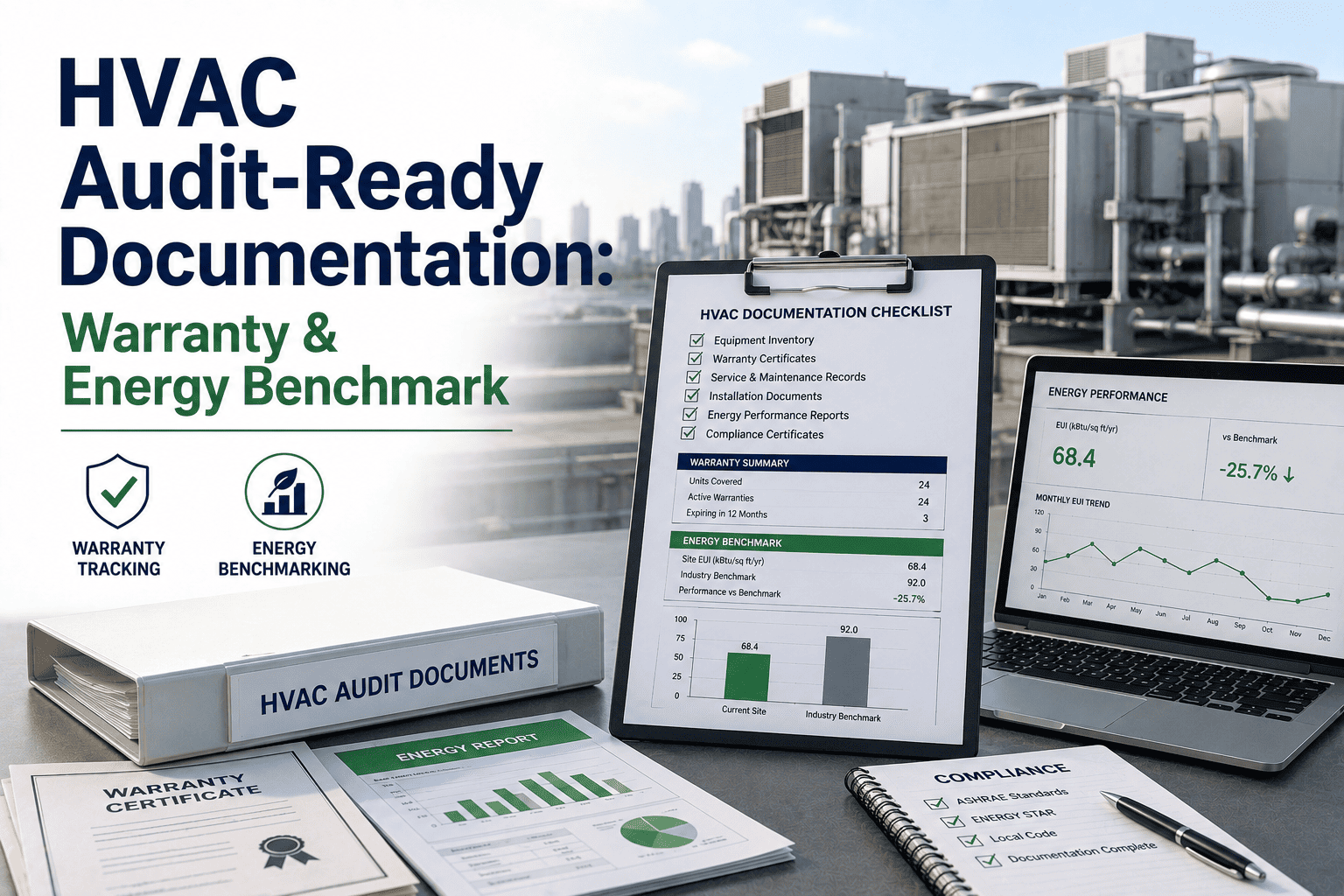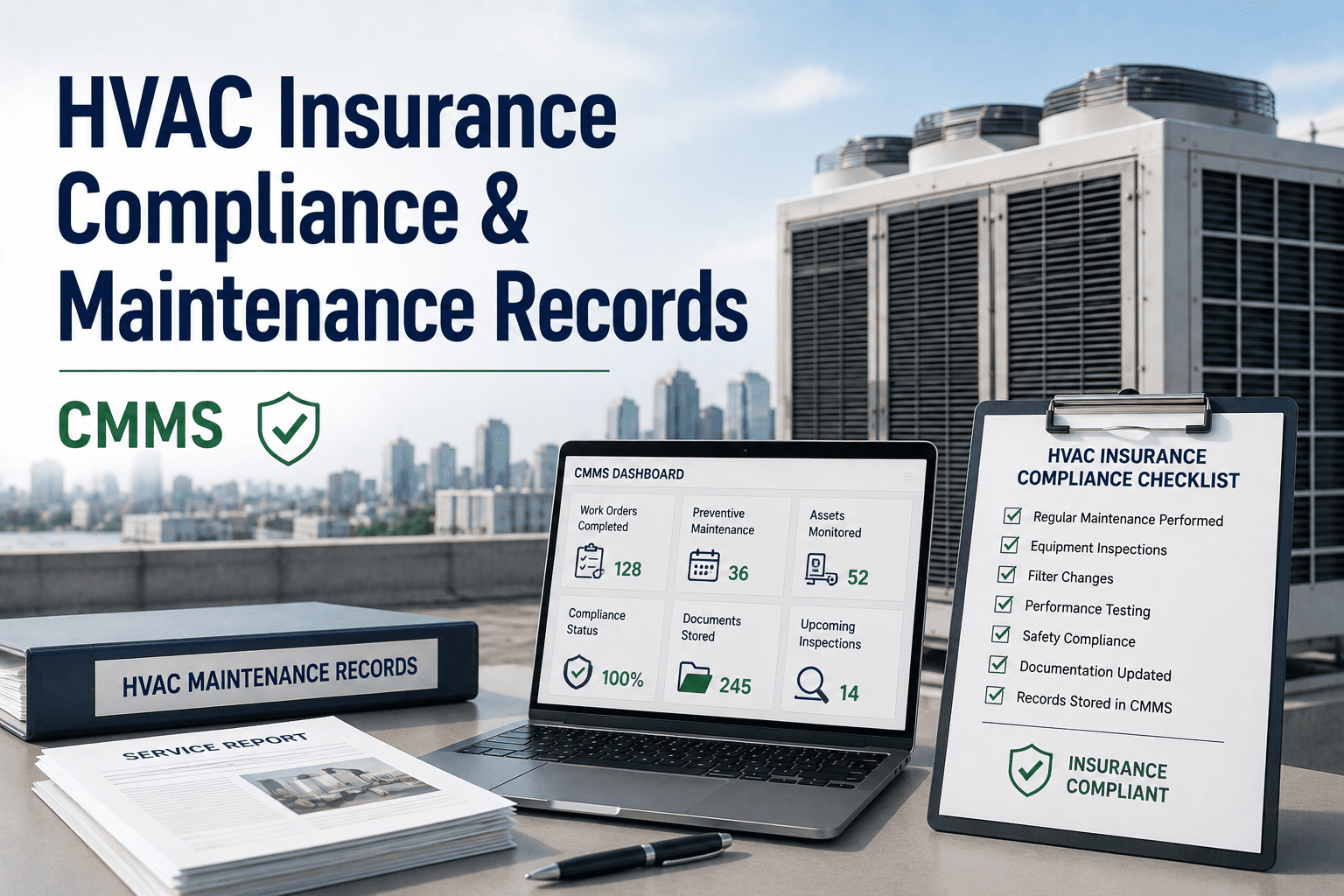
HVAC insurance compliance hinges on one non-negotiable requirement: provable, documented maintenance records that underwriters accept during audits and claims. A structured preventive maintenance program not only satisfies coverage stipulations but can unlock 10–25% premium reduction by demonstrating lower risk to commercial property insurers. By centralizing work orders, asset histories and inspection checklists in a CMMS, facility and reliability teams transform scattered paperwork into an ironclad insurance audit trail — ready for Start Free Trial to see how OxMaint streamlines the entire compliance documentation process.
HVAC Insurance Compliance Guide
Can you prove your HVAC maintenance history in 48 hours?
When an underwriter or adjuster requests maintenance documentation, missing records can trigger claim denials, coverage lapses or 30%+ premium hikes. A CMMS-based insurance audit trail eliminates that risk — every work order, inspection and part replacement timestamped and retrievable in seconds.
Insurance Audit Requirements
What HVAC maintenance records do insurers actually require?
Commercial property policies covering HVAC systems typically mandate documented evidence of routine preventive maintenance, seasonal inspections and timely repairs. An insurance audit HVAC review examines whether your organization met the duty-of-care standard spelled out in the policy schedule — and vague verbal assurances do not qualify.
Preventive Maintenance Schedules
Dated PM checklists showing filter changes, coil cleaning, belt replacements and refrigerant-level checks performed at OEM-recommended intervals. Insurers look for consistency — gaps of 60+ days between scheduled PMs flag as neglect.
Licensed Technician Logs
Work orders signed by certified HVAC technicians with license numbers, on-site time stamps and detailed findings. Policies often require that major servicing — refrigerant handling, electrical components — be performed by licensed contractors, not in-house generalists.
Repair & Replacement History
Chronological asset records documenting every repair, replaced component (with part numbers) and cost. Insurers use this to verify you did not defer known-defective equipment — a common basis for claim denial under wear-and-tear exclusions.
Inspection & Test Records
Seasonal startup/shutdown inspections, combustion-analysis printouts, pressure-test results and controls-verification logs. Codes such as ASHRAE 180 and NFPA 90A define inspection frequency — your records must show alignment with these standards.
Premium Reduction Math
How structured PM lowers HVAC insurance premiums
Insurers price risk on probability and severity of loss. When you can prove a disciplined PM program — documented in a CMMS — you shift both variables in your favor. Here is the formula underwriters apply when evaluating a HVAC insurance program for premium credits:
Worked Example
A 180-asset commercial office portfolio in Texas was paying $94,000/year in property premiums with a 1.8% HVAC loss rate. After implementing OxMaint CMMS — raising PM compliance from 64% to 96% and producing a full digital audit trail — their broker negotiated a 19% premium reduction, saving $17,860 annually. The CMMS subscription cost recovered in under 7 weeks.
Compliance Documentation
HVAC insurance documentation checklist for audit readiness
Use this checklist to verify your maintenance insurance records will survive an underwriter's scrutiny. Every item below should be retrievable in under five minutes — if it takes longer, you need a CMMS.
Asset & Equipment Records
- Complete asset register with make, model, serial number and install date
- OEM maintenance schedule attached to each asset record
- Warranty documentation and expiration alerts
- Location mapping and criticality classification
Work Order & PM History
- Dated work orders with technician name and license number
- Completed PM checklists with measurements and readings
- Parts replaced with OEM part numbers and costs
- Corrective action notes linked to triggering work order
Compliance & Inspection Logs
- ASHRAE 180-aligned seasonal inspection records
- Refrigerant log per EPA Section 608 requirements
- NFPA 90A fire/smoke damper inspection documentation
- Third-party or internal audit sign-off reports
How OxMaint Helps
CMMS insurance HVAC: how OxMaint builds your audit trail
OxMaint was engineered to close every documentation gap that sinks insurance claims and inflates premiums. Each capability below maps directly to a requirement underwriters verify during a CMMS insurance audit.
Automated PM Scheduling & Work Orders
OxMaint auto-generates preventive maintenance work orders based on OEM intervals, runtime hours or calendar triggers — every completion logged with technician, timestamp and readings. Outcome: 90%+ PM compliance rate, zero missed-schedule gaps in your audit trail.
Immutable Asset History & Audit Log
Every work order, inspection, part replacement and photo is permanently attached to the asset record — timestamped and tamper-evident. Export a full history PDF for any asset in one click. Outcome: produce complete documentation for any asset in under 60 seconds.
Compliance Dashboard & Alerts
Real-time dashboards track PM compliance percentage, overdue inspections and open corrective actions — with automatic alerts before deadlines lapse. Built-in report templates align with ASHRAE 180 and NFPA 90A. Outcome: maintain continuous compliance, not scramble before renewal.
Spare-Parts Inventory Tracking
Track every part installed — OEM number, batch, cost and replacing technician — directly on the work order. Automatic reorder points prevent critical-part stockouts that delay repairs. Outcome: prove timely repairs and eliminate "part unavailable" claim defenses.
Audit Trail Comparison
Spreadsheets vs CMMS for HVAC coverage compliance
Most facility teams start with Excel or paper binders. The gap between those methods and a purpose-built CMMS becomes catastrophic the moment an adjuster asks for three years of maintenance history on a failed rooftop unit.
| Audit Criterion | Spreadsheets / Paper | OxMaint CMMS |
|---|---|---|
| Records retrieval time | 2–7 days of manual searching across files | Under 60 seconds — filtered by asset, date or technician |
| Tamper evidence | None — cells can be edited or overwritten silently | Immutable timestamped log with full change history |
| PM compliance visibility | Manual formula updates; often weeks behind reality | Live dashboard with overdue alerts and trend charts |
| Photo & attachment evidence | Loose files in shared drives; rarely linked to work order | Attached directly to work order, geotagged and timestamped |
| Insurer-ready report generation | Hours of manual formatting per audit request | One-click PDF export aligned to insurer templates |
| Premium negotiation leverage | Low — unverifiable, inconsistent records | High — quantitative PM-compliance data accepted by underwriters |
See OxMaint build your insurance audit trail — book a 30-min demo
Walk through a live HVAC asset, generate a compliance report on the spot, and see exactly what your underwriter will receive. Bring your toughest documentation gap.
FAQ
HVAC insurance compliance & CMMS documentation: frequently asked questions
Does HVAC insurance require maintenance records?
Yes. Nearly all commercial property and equipment-breakdown policies covering HVAC systems require documented evidence of routine preventive maintenance as a condition of coverage. Without dated work orders, inspection logs and technician records, insurers can deny claims citing failure to maintain — or void coverage entirely. A CMMS like OxMaint automates this documentation so records are always audit-ready.
How long should HVAC maintenance records be kept for insurance?
Most insurers and code authorities require 3 to 7 years of maintenance history, depending on policy terms and local jurisdiction. Equipment-breakdown (boiler & machinery) coverage often demands the full lifecycle history of the insured asset. OxMaint stores immutable records indefinitely in the cloud, so you can export a multi-year history for any unit in seconds. Start Free Trial to begin building your archive.
Can a CMMS lower my HVAC insurance premium?
Yes — facilities that demonstrate a documented, high-compliance PM program typically see 10–25% premium reductions. Underwriters reward verifiable risk reduction. When your broker can present a CMMS-generated compliance report showing 90%+ on-time PM completion, full asset histories and zero overdue critical inspections, the actuarial risk profile improves measurably.
What happens if I cannot produce maintenance records during an insurance audit?
Failure to produce documentation can result in claim denial, coverage retroactively voided, or non-renewal of the policy. In a loss event — say a compressor failure causing $50K+ in damage — the adjuster will request maintenance history within 48 hours. Missing or incomplete records give the insurer grounds to attribute the failure to neglect, shifting the loss entirely to you. Book a Demo to close that gap before renewal.
Is CMMS insurance documentation accepted by all major commercial insurers?
Yes. Digital CMMS records are widely accepted by major commercial property and equipment-breakdown insurers — including those requiring ASHRAE 180, NFPA 90A and ISO 55000 alignment. The key requirements are immutability (tamper-evident logs), completeness (every PM, repair and inspection captured) and retrievability (exportable on demand). OxMaint meets all three, and its report templates are designed to match common underwriter documentation requests.
Make your next HVAC insurance audit the easiest one yet
Join the facility teams who replaced binders and spreadsheets with OxMaint — 90%+ PM compliance, 60-second record retrieval, and premium negotiations backed by real data.
Free 14-day trial · No credit card