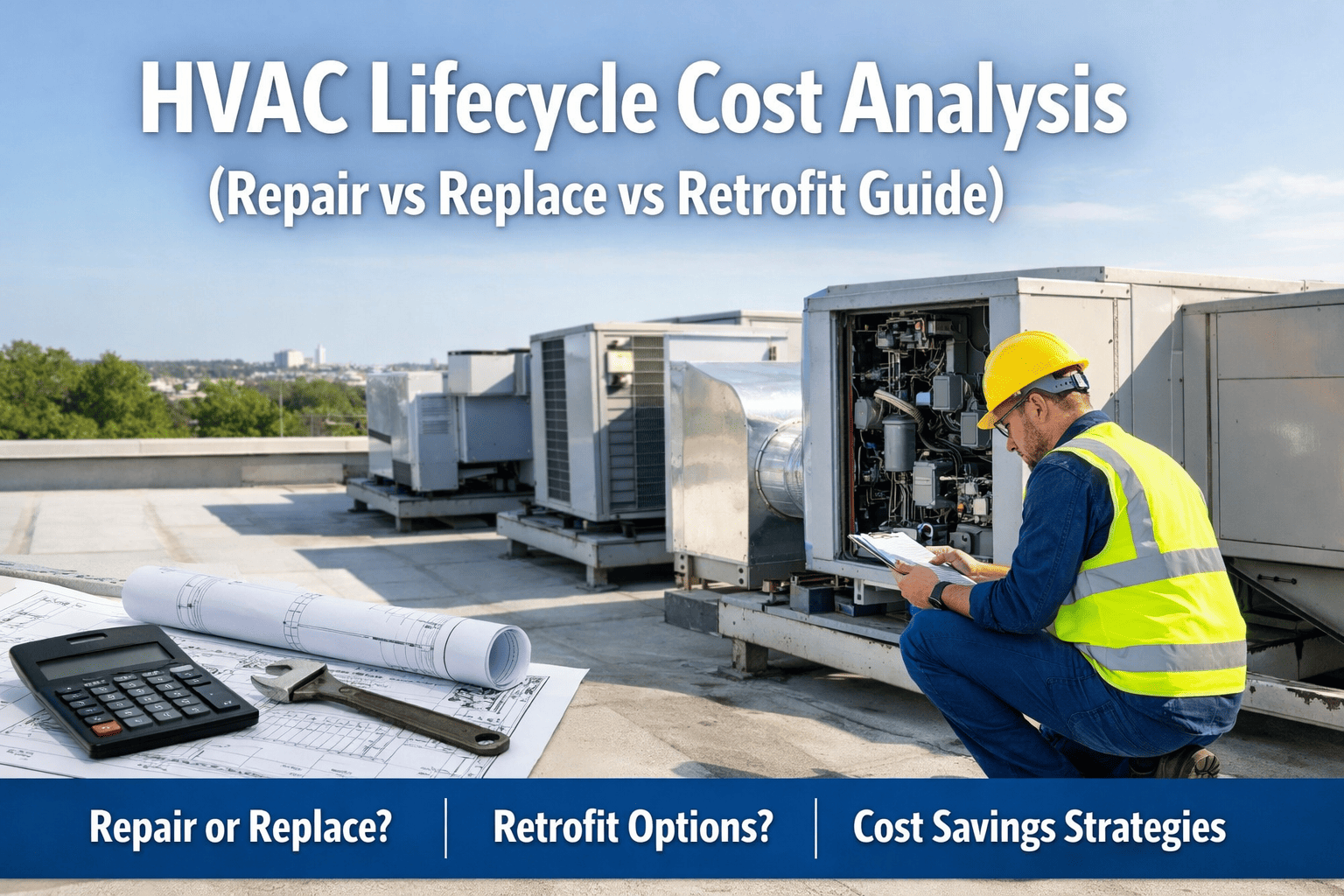
HVAC Lifecycle Cost Analysis (Repair vs Replace vs Retrofit Guide)
By James smith on April 13, 2026
The rooftop unit on your building has now generated its fourth repair work order in 14 months. The maintenance manager wants to replace it. The CFO wants to get one more year out of it. Neither has the data to win the argument — because lifecycle cost analysis requires knowing the asset's true total cost of ownership: initial installation, cumulative maintenance spend, energy cost trend, remaining useful life, and replacement cost all modeled together. Without that data, the repair-vs-replace decision gets made on gut feel. A rooftop unit with a $28,000 purchase price can easily carry a total lifecycle cost exceeding $120,000 when energy consumption, labor, parts, and downtime costs are properly attributed over its service life. The facilities that make consistently better capital decisions track every cost against every asset — and use that data to run lifecycle cost analysis before approving each major repair. Book a demo to see how OxMaint's asset lifecycle management module tracks cumulative costs and runs repair-vs-replace analysis from your actual maintenance history.
Blog · HVAC · Asset Lifecycle Management · Capital Planning
HVAC Lifecycle Cost Analysis: Repair vs Replace vs Retrofit Guide
A $28,000 rooftop unit can carry a $120,000+ total lifecycle cost. The repair-vs-replace decision made without CMMS data costs facilities millions over time. Here is the complete framework with the exact thresholds, cost categories, and CMMS tracking methods that make the decision a calculation instead of a guess.
The repair cost threshold — when to run a replacement analysis
40–70%
Higher cost of reactive vs planned HVAC replacement
The Real Cost of an HVAC Asset
Why Purchase Price Is the Least Important Number in Lifecycle Cost
Most facilities track HVAC purchase price and annual maintenance contracts. Almost none track the full lifecycle cost — and that gap is where poor capital decisions are born. For a typical commercial rooftop unit, energy cost over its service life is 3 to 4 times the initial purchase price. Maintenance and repair cumulates to 1 to 2 times purchase price. Total lifecycle cost is the only number that tells you whether a repair is an investment or a subsidy for a failing asset.
Rooftop Unit — Total Lifecycle Cost Breakdown (15-year life, $28,000 purchase)
Initial Purchase & Installation
$28,000
Energy Cost (15 yr at typical consumption)
$62,000–$84,000
Maintenance & Repairs (cumulative)
$18,000–$32,000
Downtime & Occupant Impact
$4,000–$12,000
Total Lifecycle Cost: $112,000–$156,000 on a $28,000 asset. Energy is the dominant cost — not the purchase price.
ASHRAE Service Life Reference
Equipment Lifespan and Replace Threshold Signals by Type
Well-maintained HVAC equipment regularly exceeds ASHRAE median service life by 5 years or more. Equipment on reactive maintenance typically falls 3 to 5 years short. The difference is almost entirely determined by maintenance program quality and how consistently it is documented in CMMS.
Equipment Type
ASHRAE Median Life
With Good PM
Reactive Only
Replace Signal
Rooftop Units (RTUs)
15–20 years
20–25 years
10–14 years
Repair >50% of replacement value
Chillers (centrifugal)
20–25 years
25–30 years
15–18 years
COP below 85% of nameplate
Air Handling Units
20 years
25+ years
12–16 years
Coil leaks; repeated motor failures
Boilers (hot water)
20–25 years
28+ years
14–18 years
Efficiency below 80% net
Split Systems
12–15 years
17–20 years
8–11 years
Compressor cost >60% of new system
Cooling Towers
20 years
25+ years
12–15 years
Basin corrosion; repeated fill replacement
The Decision Framework
Repair vs Replace vs Retrofit — When Each Option Wins
Made without data, the repair-vs-replace decision costs facilities millions over time. Made with CMMS-tracked lifecycle cost data, it becomes a structured economic comparison. These are the criteria that determine which path delivers the best 10-year economics.
Repair Is Right When
Asset is under 60% of median service life
Cumulative repair cost is under 30% of replacement value
Repair cost is under 50% of remaining asset value
Energy efficiency has not declined measurably from baseline
Failure is isolated — not a pattern across multiple systems
Replace When
Single repair quote exceeds 50% of replacement cost
Asset has exceeded ASHRAE median service life
Three or more repairs in 24 months on the same failure mode
Energy efficiency has declined 15%+ from commissioning baseline
OEM parts availability is restricted or discontinued
Retrofit When
Asset is structurally sound but controls or refrigerant are obsolete
Full replacement is not feasible within current capital budget
VFD or economizer retrofit recovers 10%+ energy within 3 years
Refrigerant transition (R-22, R-410A phase-out) requires system update
8+ years of remaining useful life exist to amortize retrofit cost
Interactive Calculator
Quick Repair vs Replace Decision Threshold Calculator
Enter your asset details below for an instant threshold assessment. For a full lifecycle analysis using your actual CMMS cost history, book a demo with OxMaint.
HVAC Lifecycle Management · OxMaint · Free to Start
Stop Making Repair-vs-Replace Decisions Without the Data.
OxMaint tracks cumulative HVAC costs per asset, flags repair-vs-replace thresholds automatically, trends energy efficiency degradation, and builds capital replacement plans from real maintenance data. Book a demo to see how facilities teams use OxMaint to turn HVAC capital decisions from guesses into calculations.
Why You Cannot Run Lifecycle Cost Analysis Without CMMS Data
Lifecycle cost analysis is only as accurate as the cost data feeding it. Facilities that track HVAC costs only through invoices miss 40 to 60% of the true cost picture. OxMaint captures all costs automatically as work orders are created and completed, building the asset-level history that makes lifecycle analysis a calculation rather than an estimate.
01
Cumulative Cost Tracking Per Asset
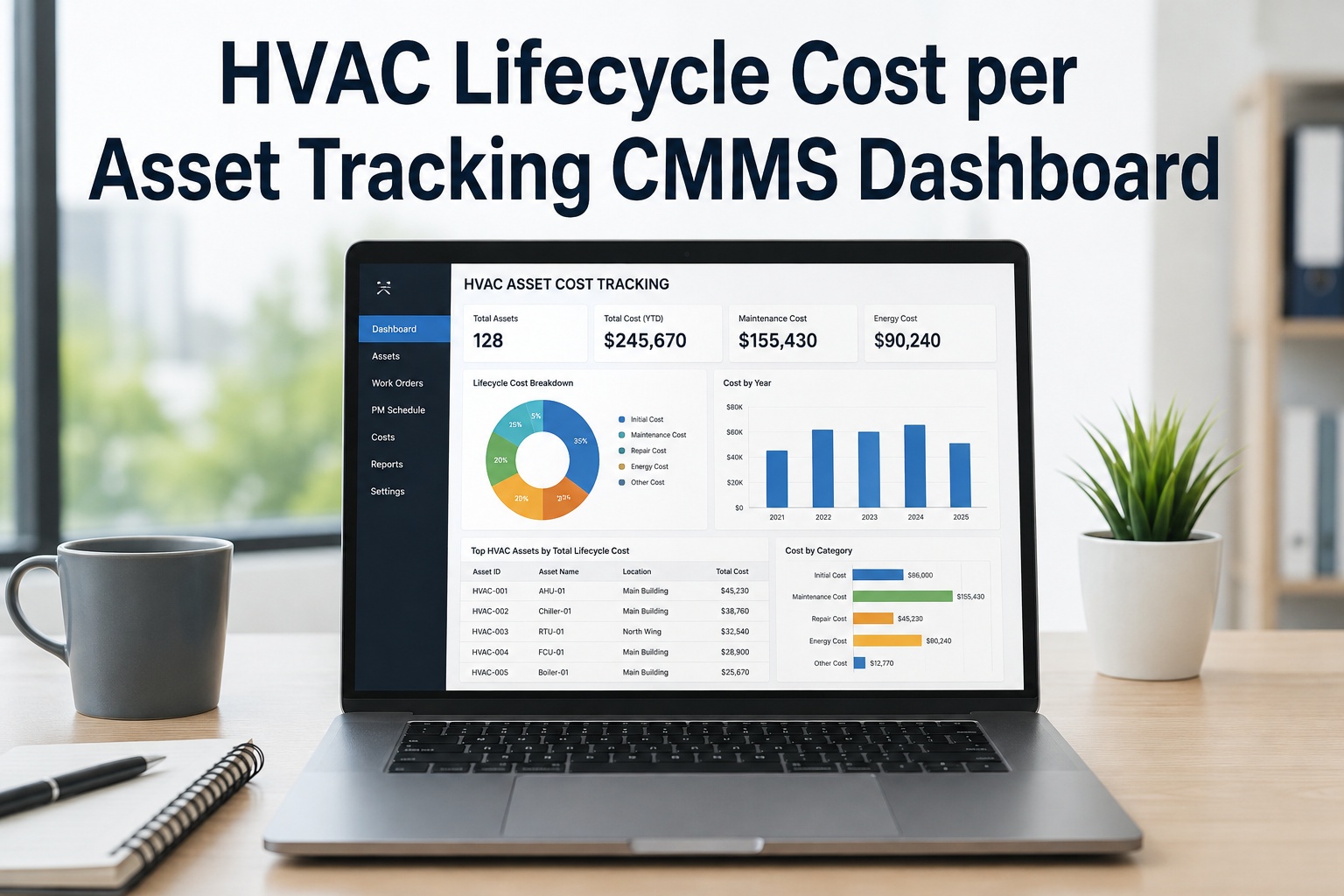
Every work order closed against an HVAC asset accumulates its labor cost, parts cost, and contractor cost in OxMaint's asset lifecycle record. The total is always current — no manual spreadsheet update. When a repair quote arrives, OxMaint instantly shows what the asset has already cost versus its replacement value.
02
Repair-vs-Replace Threshold Alerts
OxMaint flags automatically when a high-cost work order is created against an aging asset — surfacing the repair-vs-replace threshold comparison before the repair is approved. The 50% remaining-asset-value rule triggers a prompt to run a formal lifecycle comparison, preventing the most common expensive mistake: approving a major repair on an asset that should have been replaced.
03
Energy Efficiency Degradation Tracking
OxMaint tracks energy consumption per HVAC asset against the baseline established at commissioning. Efficiency degradation of 10% or more from baseline is one of the strongest replacement signals — it means the asset is consuming excess energy every day it remains in service. This cost compounds annually and is rarely visible without systematic tracking.
04
Capital Replacement Budget Planning
OxMaint's capital planning view shows every HVAC asset ordered by age, cumulative cost, and remaining life — giving facilities managers 3 to 5 year visibility into upcoming replacements. Reactive capital spending on emergency HVAC replacement is consistently 40 to 70% more expensive than planned replacement. OxMaint converts reactive emergencies into scheduled capital events.
Expert Perspective
What Facilities Directors Say About Lifecycle Cost Tracking
★★★★★
We approved a $14,000 compressor replacement on a 17-year-old chiller because it was less than a new chiller. OxMaint showed us we had spent $38,000 on that chiller in the previous 3 years — the compressor was the fourth major repair. If we had tracked cumulative costs from the start, we would have replaced it two repairs ago and been $22,000 ahead. Now every repair above $5,000 triggers an automatic lifecycle review before approval.
BH
Brian H.
VP of Facilities, Commercial Real Estate Portfolio, USA
★★★★★
The energy efficiency degradation tracking changed how we think about older equipment. We had a 14-year-old AHU still running reliably with no failure events. OxMaint showed it consuming 19% more energy per ton than its commissioning baseline. Calculating that forward at current energy rates, replacement paid for itself in 2.4 years on energy savings alone. Without the trend data, we would have kept running it to failure while bleeding $31,000 per year in excess energy cost.
AM
Anjali M.
Director of Engineering, Hospital Campus, India
★★★★☆
The capital planning view got finance on board. I could show them the next 4 years of HVAC replacements ordered by urgency, cost, and remaining life — not a list of equipment I thought needed replacing, but a data-backed schedule with asset-level cost history attached to every line. Budget approval went from a fight to a conversation. They approved the full 4-year plan in one cycle because the data was there.
CL
Chris L.
Facilities Manager, University Campus, UK
Frequently Asked Questions
HVAC Lifecycle Cost Analysis — Common Questions
What is the 50% rule for HVAC repair-vs-replace decisions?
The 50% rule states that when a single repair estimate exceeds 50% of the equipment's current replacement cost, replacement almost always delivers better 10-year economics. Applied more precisely, the threshold compares repair cost to 50% of the asset's remaining value — replacement cost multiplied by remaining useful life divided by total service life. A repair exceeding this threshold subsidizes a failing asset rather than extending a viable one. OxMaint surfaces this threshold automatically when a high-cost work order is created against an aging asset, prompting a lifecycle comparison before the repair is approved. Book a demo to see how OxMaint's repair-vs-replace threshold alert works in practice.
What cost categories must be included in a proper HVAC lifecycle cost analysis?
A complete HVAC lifecycle cost analysis includes initial purchase and installation cost, cumulative maintenance and repair spend (parts and labor separately), energy consumption cost over the analysis period using actual efficiency data rather than nameplate assumptions, downtime cost in environments where HVAC failure creates revenue or productivity impact, and disposal cost at end of life. Energy cost is consistently the largest lifecycle category — accounting for 50 to 60% of total lifecycle cost for most commercial HVAC equipment. Facilities that track only purchase price and maintenance contracts are systematically underestimating their true HVAC spend and making worse capital decisions as a result. Start a free trial to track all lifecycle cost categories per HVAC asset in OxMaint.
When does HVAC retrofit make more sense than replacement?
Retrofit is the right choice when the HVAC asset is structurally sound but one or more subsystems are obsolete or inefficient. The most common retrofit opportunities are adding VFDs to constant-speed fans and pumps (energy savings of 20 to 40% on those loads), upgrading controls to enable monitoring and scheduling optimization, and refrigerant conversion when equipment must comply with phase-out regulations. The retrofit decision requires a payback period calculation — if payback is under 3 years and the base equipment has 8 or more years of remaining useful life, retrofit typically wins over replacement on lifecycle economics. Book a demo to see how OxMaint models retrofit vs replace economics using your actual asset data.
How does CMMS data improve HVAC capital planning accuracy?
CMMS-tracked asset data improves capital planning accuracy in four ways: it provides actual cumulative maintenance costs per asset rather than budget estimates, it reveals failure patterns that predict upcoming capital needs before assets fail, it tracks age and remaining useful life across the entire fleet so replacements can be planned rather than reacted to, and it documents energy efficiency degradation that changes the economics of keeping aging equipment. Reactive capital spending on emergency HVAC replacement is consistently 40 to 70% more expensive than planned replacement because emergency procurement eliminates competitive bidding. CMMS data converts those emergencies into scheduled capital events. Book a demo to see OxMaint's capital planning view for a multi-unit HVAC fleet.
function runLCCalc(){var rc=parseFloat(document.getElementById('lc-replace-cost').value)||0;var age=parseFloat(document.getElementById('lc-asset-age').value)||0;var life=parseFloat(document.getElementById('lc-service-life').value)||1;var repair=parseFloat(document.getElementById('lc-repair-cost').value)||0;var el=document.getElementById('lc-result');if(!rc||!age||!life||!repair){el.style.display='block';el.className='lc-calc-result lc-result-warn';el.innerHTML='
Please fill in all four fields to calculate.
';return;}var pctLife=Math.min((age/life)*100,100);var remLife=Math.max(life-age,0);var remValue=rc*(remLife/life);var threshold=remValue*0.5;var repairPctReplace=(repair/rc)*100;var recommendation,cls;if(repair>threshold&&pctLife>60){recommendation='
Replace
— repair cost of $'+repair.toLocaleString()+' exceeds 50% of remaining asset value ($'+Math.round(remValue).toLocaleString()+'). At '+Math.round(pctLife)+'% of service life consumed, replacement economics are stronger.';cls='lc-result-replace';}else if(repair>threshold){recommendation='
Evaluate carefully
— repair cost exceeds the 50% threshold but asset is under 60% of service life. Run a full lifecycle cost comparison before approving.';cls='lc-result-warn';}else{recommendation='
Repair is justified
— repair cost of $'+repair.toLocaleString()+' is within the threshold for an asset with '+remLife.toFixed(1)+' years of remaining life and $'+Math.round(remValue).toLocaleString()+' in remaining value.';cls='lc-result-repair';}el.style.display='block';el.className='lc-calc-result '+cls;el.innerHTML='
'+recommendation+'
Life consumed: '+Math.round(pctLife)+'%Remaining value: $'+Math.round(remValue).toLocaleString()+'50% threshold: $'+Math.round(threshold).toLocaleString()+'Repair as % of replacement: '+Math.round(repairPctReplace)+'%