HVAC Maintenance Cost Breakdown | Commercial Cost Analysis Guide

By Riley Quinn on February 9, 2026

hvac-maintenance-cost-breakdown

Your facility's HVAC system is running right now. It accounts for roughly 40% of your building's total energy bill—the single largest operating expense under your roof. But here's what most facility managers don't realize until budget season hits: the difference between a well-maintained HVAC system and a neglected one isn't just comfort. It's $4,500 or more per year in wasted energy alone on a mid-sized commercial building. Add emergency repairs, premature equipment replacement, and lost productivity from climate complaints, and you're looking at a cost gap that can quietly consume 15-30% of your total facility budget. This guide breaks down exactly where every HVAC maintenance dollar goes—so you can stop guessing and start controlling what you spend.

Commercial HVAC Cost Snapshot
Where your maintenance dollars actually go each year
Labor & Service Calls 35%
$2,100 – $3,500 /yr
Energy Waste (Poor Maintenance) 28%
$1,700 – $4,500 /yr
Parts & Consumables 22%
$1,300 – $2,200 /yr
Emergency Repairs 15%
$900 – $3,000 /yr

Why HVAC Maintenance Cost Visibility Matters

The U.S. HVAC repair and maintenance industry generates approximately $80 billion in annual revenue, and most businesses spend between $1,000 and $10,000 per year on commercial HVAC maintenance depending on system size and complexity. Yet many facility managers only see the invoice total—not the breakdown behind it. Without visibility into how costs distribute across labor, parts, energy, and emergency work, you can't identify where money is being wasted or where small investments would prevent large expenses. Commercial maintenance contracts alone range from $500 to $2,000 per year for basic coverage, but those figures tell you nothing about the hidden costs accumulating inside a poorly maintained system.

The real problem isn't what you're spending on maintenance. It's what you're spending because of insufficient maintenance. HVAC systems that skip routine service consume up to 20% more energy than properly maintained units. On a building spending $15,000 annually on HVAC energy, that's $3,000 walking out the ductwork every year. Facilities that track maintenance costs with a structured platform can identify these leaks before they compound into serious budget overruns.

Labor Costs: The Largest Piece of the Puzzle

Labor typically represents 35% or more of total HVAC maintenance spending. This includes routine servicing (filter changes, coil cleaning, belt inspections), scheduled preventive maintenance visits, diagnostic troubleshooting, and emergency repair labor. The HVAC industry currently faces a shortage of 110,000 technicians with 25,000 leaving annually, which means labor rates continue to climb—particularly for emergency and after-hours calls.

Labor Cost Breakdown by Service Type
Routine Service
$75 – $150 /visit
Quarterly
Filter swaps, visual inspections, basic cleaning, thermostat calibration
Preventive Maintenance
$150 – $500 /visit
Bi-Annual
Refrigerant checks, coil deep-clean, electrical testing, belt replacement
Diagnostic / Troubleshooting
$100 – $250 /hr
As Needed
Performance analysis, fault isolation, control system diagnostics
Emergency Repair
$150 – $400 /hr
Unplanned
After-hours calls, weekend rates, rush diagnostics—typically 2-3x standard labor cost

Emergency labor is where budgets get destroyed. A single after-hours compressor failure can run $800 to $1,500 in labor alone before parts even enter the equation. Facilities that schedule a walkthrough with our maintenance specialists consistently find that shifting even 30% of reactive work to planned service cuts total labor costs by 18-25% annually.

Spare Parts and Consumables: The Steady Drain

Parts and consumables account for roughly 22% of annual HVAC maintenance costs, and they're the category most likely to surprise facility managers who don't track replacement cycles. HVAC component prices have risen steadily—manufacturers announced increases of 2% to 13% across parts categories in 2024. Without a system tracking component age, failure history, and replacement schedules, you're either replacing parts too early (wasting money) or too late (causing secondary damage that multiplies the repair bill).

Common HVAC Parts & Replacement Costs
Swipe to view full table on mobile
Component Cost Range Typical Life Failure Impact
Air Filters $20 – $80 each 1 – 3 months Reduced airflow, 5-15% energy spike
Drive Belts $30 – $120 each 3 – 5 years Fan failure, complete air stoppage
Contactors / Relays $50 – $200 5 – 10 years System won't start, compressor damage
Capacitors $60 – $300 5 – 10 years Motor failure, hard start damage
Blower Motor $300 – $900 10 – 15 years Total airflow loss
Compressor $1,500 – $3,500 10 – 15 years Full system down, major expense
Refrigerant (R-410A) $50 – $150 /lb System-dependent Reduced cooling, compressor stress

Preventive Maintenance vs. Breakdown Costs

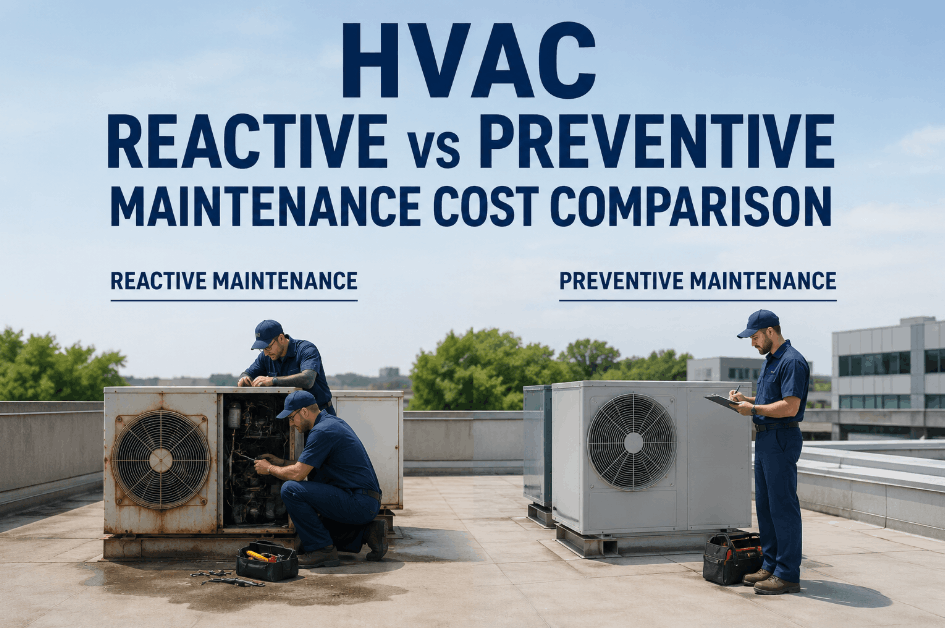
This is the comparison that changes how facility managers think about HVAC budgets. Preventive maintenance costs money on a schedule—but breakdown maintenance costs significantly more on someone else's schedule. A commercial HVAC system running without preventive care has an average lifespan of 10-12 years. The same system under a structured maintenance program lasts 15-20 years. That's 50-70% more useful life from the same capital investment. When a single commercial rooftop unit costs $5,000 to $15,000 to replace, the math becomes unmistakable.

The Real Cost of Waiting vs. Planning
5-year total cost comparison for a mid-size commercial facility
Reactive Approach
Annual service cost $500 – $1,000
Emergency repairs (avg/yr) $3,000 – $6,000
Energy waste penalty +15-20%
Equipment lifespan 10 – 12 years
Downtime events per year 4 – 8
5-Year Estimated Total $42,000 – $68,000
VS
Preventive Approach
Annual PM contract $1,500 – $3,000
Unplanned repairs (avg/yr) $500 – $1,500
Energy efficiency gain Up to 20% savings
Equipment lifespan 15 – 20 years
Downtime events per year 0 – 2
5-Year Estimated Total $18,000 – $32,000
Potential 5-Year Savings with Preventive Maintenance $24,000 – $36,000
Take Control of Your HVAC Budget
See how facility teams use structured maintenance scheduling to reduce HVAC costs by 25-40%. Get a personalized walkthrough of automated work orders, cost tracking, and asset monitoring.

Energy Cost Impact of Poor Maintenance

HVAC systems account for approximately 40% of total energy consumption in commercial buildings—more than lighting, equipment, and everything else combined. When those systems aren't maintained, energy waste compounds invisibly. A dirty condenser coil alone can increase energy consumption by 30%. Duct leakage wastes 15-30% of conditioned air before it reaches occupied spaces. Clogged filters force blower motors to work harder, drawing more electricity for less airflow. These aren't hypothetical numbers; they're documented performance losses that accumulate on every utility bill.

The Hidden Energy Penalty
How deferred maintenance silently inflates your utility bill
30%
Dirty Coils
Condenser and evaporator coils coated with grime reduce heat transfer efficiency
25%
Duct Leakage
Unsealed ductwork loses conditioned air into unconditioned spaces
15%
Clogged Filters
Restricted airflow forces motors into overtime, spiking electrical draw
10%
Low Refrigerant
Undercharged systems run longer cycles to meet setpoints, stressing compressors
$4,500 Average annual energy savings from proper HVAC maintenance on a $15K energy budget

Upgrading to energy-efficient HVAC systems can reduce energy consumption by 20-50%, according to the U.S. Department of Energy. But you don't need a full system replacement to see savings. Regular coil cleaning, filter replacement, duct sealing, and refrigerant optimization recover the majority of efficiency losses at a fraction of the cost. Facilities using a CMMS to automate maintenance schedules and track energy performance catch these issues before they appear on a utility bill.

Expert Perspective: Structuring Your HVAC Maintenance Budget

The biggest mistake in commercial HVAC budgeting isn't spending too little on maintenance—it's spending in the wrong places. Facilities that track cost per asset, monitor energy baselines, and schedule service by condition rather than calendar date consistently outperform those running on fixed-interval contracts alone. The data shows that a well-maintained HVAC system cuts energy consumption by up to 20%, and every dollar invested in preventive care returns $4-6 in avoided emergency costs and extended equipment life.

Budget by Asset, Not Lump Sum
Assign maintenance budgets to individual HVAC units. High-use or aging units need 40-60% more than newer systems. Averaging costs across all equipment masks where money should go.
Track the 80/20 Rule
In most facilities, 20% of HVAC assets generate 80% of maintenance costs. Identifying those units lets you target upgrades and monitoring where ROI is highest.
Measure Cost per Ton of Cooling
Normalize maintenance spending against system capacity. This metric reveals whether older units cost more to keep running than replacing—a critical capital planning insight.

The facilities succeeding at HVAC cost management share a common thread: they've connected maintenance scheduling, cost tracking, and energy monitoring into a single platform. They're not chasing invoices across spreadsheets—they're getting real-time visibility into which assets cost the most and why. If you're ready to see how that works in practice, our team can walk through a live demo tailored to your facility type.

Strategies to Reduce HVAC Maintenance Costs

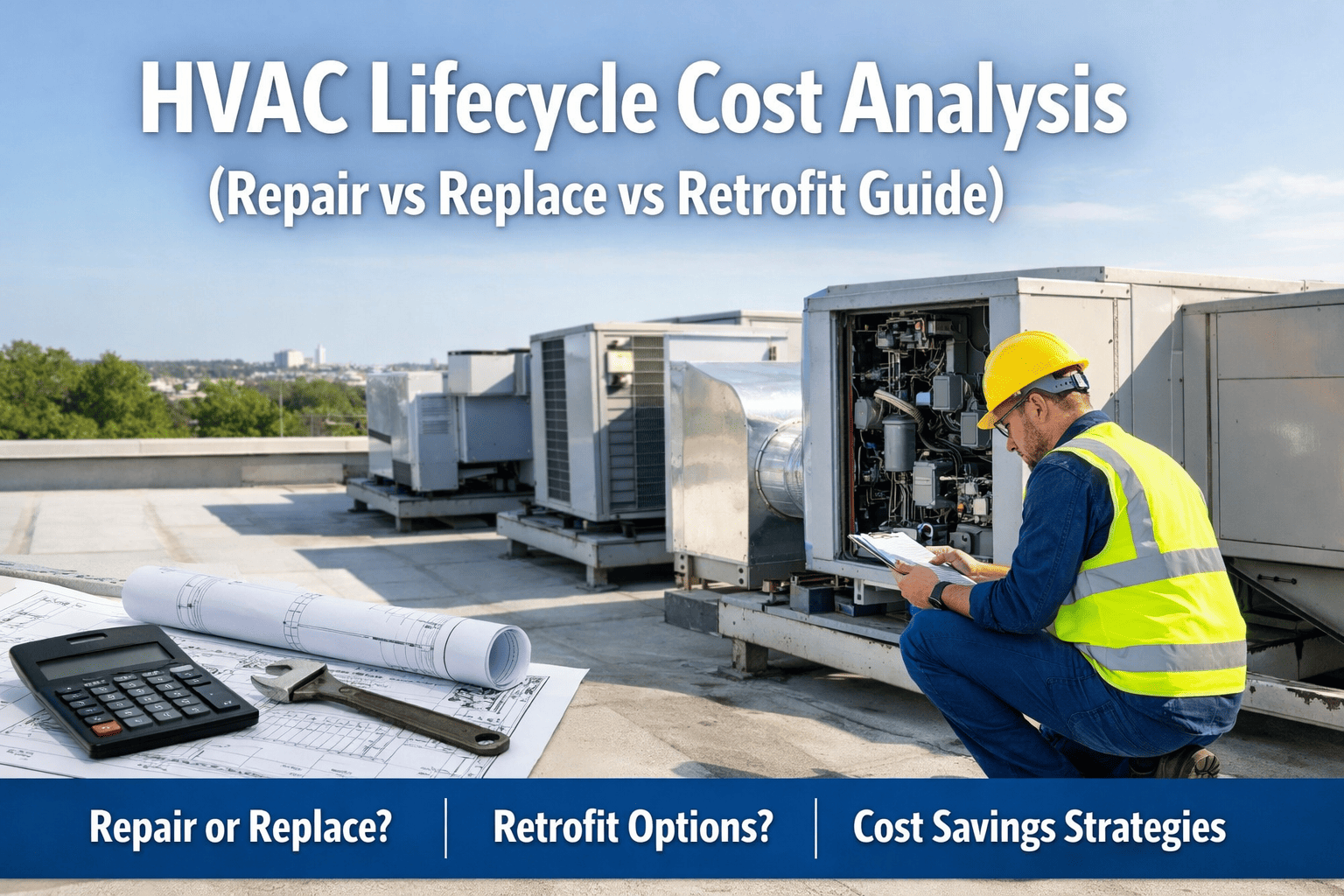
Controlling HVAC costs isn't about cutting corners on service. It's about spending smarter—investing where returns are highest and eliminating the waste that hides inside reactive maintenance workflows. Here are the strategies that deliver measurable results for commercial facilities.

Cost Reduction Roadmap
01
Shift to Condition-Based Scheduling
Replace fixed calendar intervals with maintenance triggered by actual equipment condition—runtime hours, vibration data, temperature differentials. This eliminates unnecessary service visits while catching real problems earlier.
Saves 15-25% on labor costs
02
Centralize Maintenance Records Digitally
Paper logs and scattered spreadsheets hide patterns. A CMMS captures every work order, part replacement, and technician note in one place—making cost trends visible and actionable across your entire HVAC fleet.
Reduces repeat failures by 30%
03
Automate Filter and Inspection Cycles
Filter changes and seasonal inspections are the most commonly missed tasks—and the cheapest to perform. Automated reminders and recurring work orders ensure these basics never slip, preventing the 5-15% energy waste from clogged filters.
Prevents $1,500-$3,000/yr in energy waste
04
Monitor Energy Baselines Per Unit
When a unit's energy consumption rises 10% above its baseline, something has changed. Tracking per-unit energy data turns your utility bill into an early warning system for maintenance needs before equipment fails.
Catches issues 3-6 weeks earlier
05
Negotiate Contracts Using Real Data
With 12+ months of maintenance data, you can negotiate service contracts based on actual needs rather than vendor estimates. Facilities with documented maintenance histories typically secure 10-20% better contract terms.
Saves 10-20% on contract renewals

The common thread across every strategy: data. You can't optimize what you don't measure. Facilities that start tracking HVAC maintenance in a centralized system see the clearest path from spending blindly to spending strategically.
Stop Guessing What Your HVAC Costs
Join facility teams using OXmaint to track every dollar across labor, parts, energy, and emergency repairs. See the complete cost picture—and where to cut first.

Frequently Asked Questions

How much does commercial HVAC maintenance cost per year?
Most commercial facilities spend between $1,000 and $10,000 annually on HVAC maintenance, depending on system size, complexity, and number of units. A small retail space with a single rooftop unit may spend $1,000-$2,000, while a multi-zone office building or industrial facility can easily exceed $5,000-$10,000. These figures typically cover preventive maintenance contracts, routine service visits, and minor repairs—but do not include emergency breakdown costs or the hidden energy waste from deferred maintenance, which can add 20-40% to true operating costs.
What is the biggest hidden cost in HVAC maintenance?
Energy waste from deferred maintenance is the single largest hidden cost. HVAC systems account for roughly 40% of a commercial building's total energy use. When filters are clogged, coils are dirty, or ducts leak, that percentage climbs significantly. A building spending $15,000 per year on HVAC energy can lose $3,000-$4,500 annually to maintenance-related inefficiencies alone. This cost never appears on a maintenance invoice—it shows up on utility bills, making it invisible unless you're tracking energy baselines per unit.
How does preventive maintenance reduce HVAC repair costs?
Preventive maintenance catches small issues—worn belts, low refrigerant, loose electrical connections—before they cause compressor failures, motor burnouts, or complete system shutdowns. Emergency repairs typically cost 2-3 times more than planned repairs due to after-hours labor rates, rush parts ordering, and the secondary damage caused by running equipment past its failure point. Facilities with structured PM programs report 50-70% fewer emergency service calls and equipment lifespans that extend from 10-12 years to 15-20 years.
How often should commercial HVAC systems be serviced?
Most HVAC professionals recommend quarterly service visits for commercial systems, with comprehensive preventive maintenance performed at least twice per year—typically before cooling season and before heating season. High-demand environments like restaurants, data centers, or healthcare facilities often require monthly filter checks and more frequent inspections. The optimal frequency depends on system age, usage intensity, and environmental conditions such as dust, humidity, or chemical exposure.
Can a CMMS help reduce HVAC maintenance costs?
Yes. A Computerized Maintenance Management System (CMMS) automates scheduling, tracks cost per asset, monitors parts inventory, and generates work orders based on actual equipment condition rather than fixed calendars. Facilities using a CMMS for HVAC management typically reduce emergency repairs by 30-50%, cut labor costs by 18-25% through better scheduling, and gain visibility into which specific units drive the most expense—enabling targeted upgrades and smarter contract negotiations.

Share This Story, Choose Your Platform!