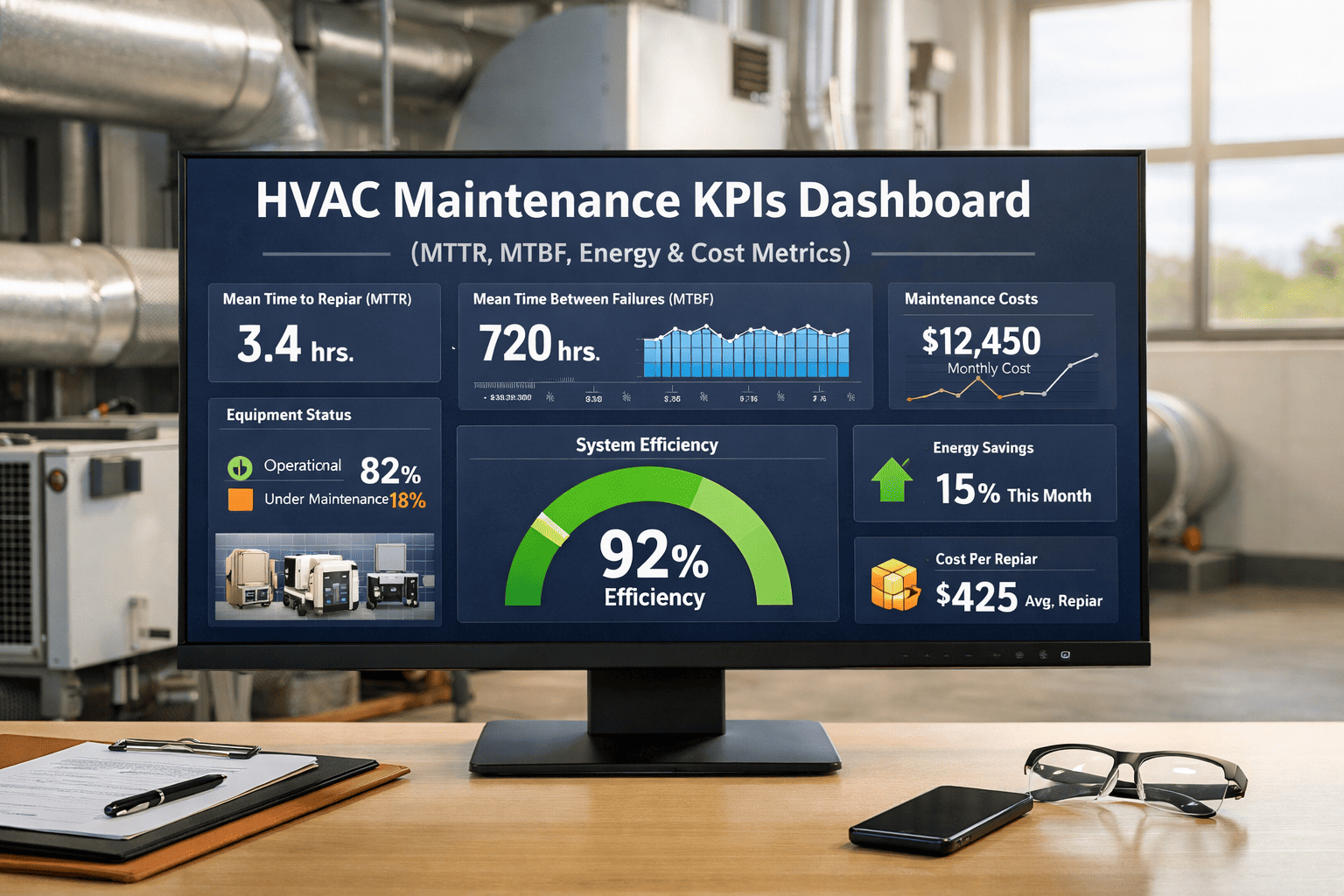
HVAC Maintenance KPIs Dashboard (MTTR, MTBF, Energy & Cost Metrics)

By James smith on April 14, 2026

hvac-maintenance-kpis-dashboard-mttr-mtbf-energy

Most facility managers know their HVAC is underperforming — they just can't prove it in numbers that a CFO or ownership group will act on. MTTR sitting at 4.2 hours when world-class is 90 minutes, MTBF declining quarter-over-quarter while PM compliance is reported at 85%, energy costs rising but no asset-level attribution — these are the gaps that analytics dashboards close. Oxmaint's analytics dashboard and AI insights module tracks every HVAC maintenance KPI in real time — from technician wrench time to energy deviation per asset — turning maintenance data into the financial and operational evidence your leadership team needs to approve PM programs, capital replacements, and headcount decisions.

Blog · Analytics Dashboard + AI Insights

HVAC Maintenance KPIs Dashboard: MTTR, MTBF, Energy & Cost Metrics

The 8 KPIs that define world-class HVAC maintenance performance — with real-time dashboard visualization, AI-powered insights, and the benchmarks your team needs to move from lagging to leading indicators.


Live HVAC Maintenance KPI Dashboard Updated: Now
94 min
Avg MTTR
World-class target: 90 min
847 hrs
Avg MTBF
Target: 1,200+ hrs — declining
91%
PM Compliance
Up from 74% last quarter
34%
Reactive Work %
Target: under 20% — needs action
$4.82
Cost Per Sq Ft / Yr
Benchmark: $3.50–$4.50
18%
Energy Saved (YTD)
vs. same period last year

8 HVAC Maintenance KPIs — Definition, Formula & Benchmark

KPI Definition Formula Industry Avg World-Class Target
MTTR (Mean Time to Repair)Avg time from failure detection to system restorationTotal repair hours ÷ Number of failures3–6 hoursUnder 90 min
MTBF (Mean Time Between Failures)Avg time equipment operates before next failureTotal uptime ÷ Number of failures500–900 hrs1,200+ hours
PM Compliance Rate% of scheduled PMs completed on time(Completed on-time PMs ÷ Total scheduled PMs) × 10065–75%95%+
Reactive Work %% of work orders that are unplanned reactive repairs(Reactive WOs ÷ Total WOs) × 10030–45%Under 20%
Maintenance Cost Per Sq FtTotal annual HVAC maintenance spend per square footAnnual HVAC cost ÷ Total sq ft$4.00–$6.00Under $3.50
Energy Efficiency Index (EUI)HVAC energy use per sq ft per yearAnnual HVAC kBtu ÷ Building area (sq ft)Varies by climateENERGY STAR top quartile
First-Time Fix Rate% of work orders resolved in a single technician visit(Single-visit repairs ÷ Total repairs) × 10065–75%88%+
Technician Wrench Time% of shift time spent on actual maintenance workProductive hours ÷ Total paid hours × 10025–35%55–65%

Your KPIs vs. World-Class Benchmarks

MTTR (lower is better)
World Class
90 min
Your Team
94 min
Industry Avg
4.5 hrs
PM Compliance Rate (higher is better)
World Class
95%
Your Team
91%
Industry Avg
70%
Reactive Work % (lower is better)
World Class
20%
Your Team
34%
Industry Avg
42%
Live Dashboard Demo

See Your HVAC KPIs Live — MTTR, MTBF, Energy, and Cost in a Single Dashboard

Oxmaint's analytics dashboard tracks all 8 maintenance KPIs in real time — from work order closure rates to energy deviation by asset. AI identifies which KPIs are trending toward failure and surfaces the specific maintenance actions that will move each metric toward benchmark.

What AI Identifies When KPIs Are Trending Wrong

MTBF Alert
Chiller #1 MTBF Declining — Now 420 hrs vs. 890 hrs Baseline
Failure frequency has doubled in 60 days. Root cause analysis flags missed condenser tube cleaning as probable driver. Recommended action: schedule descaling service within 14 days.
Projected MTBF recovery to 800+ hrs if condenser service completed this cycle.
Wrench Time Insight
Floor 3–5 HVAC Zone Technician Wrench Time: 28% — Below 40% Threshold
Work order travel time exceeding 45 minutes per job in these zones. Parts pre-staging not occurring on 62% of preventive work orders. Mobile dispatch routing suboptimal for floor coverage.
Recommended: Enable floor-zone routing and parts pre-kit scheduling in Oxmaint dispatch settings.
Energy KPI
AHU-4 Energy Consumption +22% Above Baseline for 3rd Consecutive Week
Coil fouling index exceeds 0.7 — indicating significant heat transfer degradation. Dirty coil forcing compressor to run longer to achieve setpoint, generating the energy deviation signal.
Scheduled coil cleaning at this efficiency level recovers approximately $4,200/year in energy cost per AHU.
"

The facilities that struggle most with HVAC KPI improvement are not the ones with the worst maintenance teams — they are the ones tracking the wrong metrics. PM completion rate is a lagging indicator that tells you what happened last month. What drives improvement is leading indicators: technician wrench time trending upward, first-time fix rate approaching 85%, reactive work percentage declining as PM compliance rises. When these leading indicators move, MTTR and MTBF follow within one to two quarters. The value of an analytics dashboard like Oxmaint's is not in the KPI display — it is in the AI insight layer that connects a declining MTBF on a specific chiller to the missed condenser service from 8 weeks ago. That causal link is what turns data into a maintenance decision, and maintenance decisions into ROI that a CFO understands.

Priya Mehta, CEFP, FMP
Director of FM Analytics — IFMA Member / CFE Media Contributing Expert / 16 Years in Facility KPI Design and HVAC Performance Benchmarking

HVAC Maintenance KPIs — Frequently Asked Questions

What is a good MTTR target for commercial HVAC systems?
World-class HVAC MTTR for commercial facilities is under 90 minutes from failure detection to system restoration. The industry average sits between 3 and 6 hours, with facilities running paper-based work orders and no mobile dispatch commonly exceeding 4 hours. MTTR improvements come from three levers in sequence: faster complaint-to-dispatch (mobile work orders eliminate 1–2 hours), better first-time fix rate (mobile asset history eliminates repeat visits), and pre-staged parts kits for high-frequency PM events (eliminates storeroom round-trips). Facilities that address all three consistently hit 60–90 minute MTTR within 6–9 months. Track your MTTR trend in Oxmaint's analytics dashboard.
How is HVAC maintenance cost per square foot calculated, and what is the benchmark?
HVAC maintenance cost per square foot is calculated as total annual HVAC maintenance spend (labor, parts, contractor fees, and PM service contracts) divided by the total conditioned area in square feet. Industry benchmarks vary by building type and climate: Class A office typically runs $3.50–$5.50 per sq ft, healthcare $6.00–$9.00, and industrial $2.00–$4.00. The BOMA Experience Exchange Report and IFMA Facility Cost Report are the primary benchmarking references. Most facilities track total maintenance cost but cannot attribute it to specific assets or systems — which is where CMMS analytics becomes essential for identifying cost outliers by equipment class. Book a demo to see asset-level HVAC cost tracking in Oxmaint.
What percentage of maintenance work should be planned vs. reactive?
World-class facilities target 80% or more planned preventive and predictive work, with reactive unplanned work below 20% of total work orders. The industry average sits at 55–70% planned, meaning 30–45% of maintenance work is reactive — and reactive repairs consistently cost 3–5 times more per event than the same work performed as planned maintenance. The reactive-to-planned ratio is one of the most sensitive leading indicators of maintenance program quality: when reactive work drops below 20%, MTTR, MTBF, and maintenance cost per square foot all improve simultaneously because the team is no longer constantly interrupted by emergency repairs while scheduled PMs accumulate overdue. Track your planned vs. reactive ratio in real time with Oxmaint analytics.
How does Oxmaint's AI identify which KPI improvements will have the highest ROI?
Oxmaint's AI insights engine analyzes KPI trends in combination rather than in isolation — identifying which lagging KPI deviations (rising MTTR, declining MTBF) are causally linked to which leading indicator gaps (declining PM compliance on specific equipment classes, increasing reactive work on specific zones). The AI then calculates the financial impact of each causal chain — for example, condenser tube fouling on a 200-ton chiller adding 22% to energy consumption translates to a specific dollar figure per year recoverable through a $2,400 tube cleaning service. This ROI framing converts maintenance recommendations into capital justification language that facility leadership and finance teams can approve immediately. Book a demo to see AI-powered KPI insights for your facility.
Real-Time Analytics + AI Insights

Track Every HVAC Maintenance KPI — From Wrench Time to Energy Deviation — in One Live Dashboard

Oxmaint gives your facility operations leadership the MTTR, MTBF, PM compliance, reactive work ratio, and cost-per-asset data they need to make informed maintenance investment decisions — with AI surfacing the causal insights that explain why each KPI is trending the way it is and what to do about it.


Share This Story, Choose Your Platform!