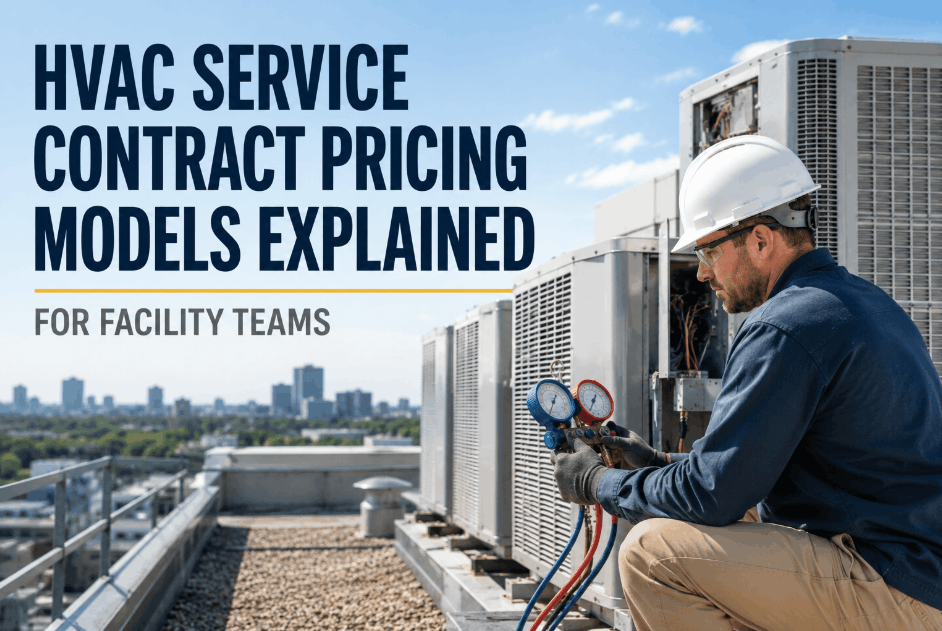
You're budgeting for next year's HVAC maintenance, and the numbers don't add up. Last year's emergency repair bills were triple the original estimate. The rooftop units keep failing three months after service. And your current vendor's "preventive maintenance plan" is really just a filter swap and a visual inspection billed at premium rates. Sound familiar? Facilities that overpay for HVAC maintenance almost never have a pricing problem—they have a planning problem. Without a clear framework for calculating what maintenance should cost, you're either overpaying vendors, underfunding preventive care, or both. The average commercial building spends $2.15 per square foot annually on HVAC maintenance, but that number swings wildly depending on equipment age, climate zone, building use, and whether you're running planned or reactive programs. This guide breaks down exactly how to calculate your HVAC maintenance plan pricing—so you stop guessing and start budgeting with precision.
What Goes Into HVAC Maintenance Plan Pricing
HVAC maintenance plan pricing isn't a single line item—it's a composite of labor, parts, frequency, equipment complexity, and contract structure. Facilities that treat it as a flat fee inevitably end up surprised when the invoice arrives. Understanding each cost driver lets you benchmark vendor proposals, negotiate intelligently, and allocate budgets that actually hold up over 12 months.
The core pricing components break down into predictable categories. Labor rates vary by region, certification level, and whether the work is scheduled or emergency. Parts costs depend on equipment brand, age, and availability. Service frequency is driven by manufacturer recommendations, equipment condition, and regulatory requirements. And contract type—full coverage, labor-only, or time-and-materials—determines how risk is shared between you and the provider. Facilities that sign up to track maintenance costs digitally can benchmark these components against actual spend, identifying exactly where their budget leaks.
HVAC Maintenance Plan Tiers: What You Get at Each Price Point
Most HVAC service providers structure their maintenance plans into three or four tiers. The differences aren't just about price—they determine response times, parts coverage, and whether you're protected when a major component fails mid-summer. Understanding what each tier actually delivers helps you avoid underpaying for critical coverage or overpaying for services your facility doesn't need.
The math is clear: facilities relying on on-call or basic plans spend 3–5x more over five years compared to those investing in standard or premium plans. That's because reactive service calls carry emergency labor premiums, expedited parts markups, and the hidden cost of extended downtime. Teams that schedule a demo to see automated maintenance planning can model these cost scenarios against their actual equipment inventory—making the right tier choice obvious.
Cost Calculator: Estimating Your Annual HVAC Maintenance Budget
Every facility's maintenance budget depends on its specific equipment profile. A 50,000 sq ft office building with five rooftop units has fundamentally different maintenance economics than a 200,000 sq ft hospital with central plant chillers. The calculator framework below helps you build a bottom-up estimate using your actual equipment inventory, rather than relying on industry averages that may not apply.
| Equipment Type | Basic Plan (Annual) | Full-Coverage (Annual) |
|---|---|---|
| Rooftop Unit (5–15 ton) | $300–$600 | $800–$1,500 |
| Split System (1–5 ton) | $150–$350 | $400–$800 |
| Chiller (50–200 ton) | $2,000–$5,000 | $6,000–$15,000 |
| Boiler (Commercial) | $500–$1,200 | $1,500–$3,500 |
| AHU / Fan Coil Unit | $200–$500 | $600–$1,200 |
| VRF/VRV System (per zone) | $250–$600 | $700–$1,400 |
To build your estimate: inventory every HVAC asset, multiply by the per-unit cost for your chosen plan tier, then add 15–20% for contingency to cover unplanned repairs. For a 50,000 sq ft office with eight rooftop units and four split systems on a standard plan, the annual budget typically lands between $8,000 and $16,000—a fraction of the cost a single compressor replacement would run without coverage.
Hidden Costs That Inflate Your Maintenance Spend
The sticker price on a maintenance contract is never the whole story. Facilities routinely underbudget by 25–40% because they miss the indirect costs that don't show up on the service invoice but absolutely show up in your operating expenses. Identifying these hidden costs is how you move from a maintenance budget that looks good on paper to one that actually survives the year.
When you add emergency premiums, energy waste, accelerated depreciation, and compliance risk to your base contract cost, the true cost of underfunding maintenance becomes stark. A $15,000 annual preventive plan for a mid-size facility prevents $50,000–$80,000 in avoidable reactive spending. Facilities that sign up to track total maintenance costs can see these hidden expenses in real time, connecting every work order to its true financial impact.
How to Evaluate and Compare Vendor Proposals
Getting three maintenance proposals on your desk is the easy part. Comparing them accurately is where most facility managers get burned. Vendors structure proposals differently on purpose—some lead with low base prices and bury exclusions, while others quote comprehensive coverage that looks expensive until you factor in what's included. A structured evaluation framework eliminates the apples-to-oranges problem.
| Evaluation Criteria | Red Flag | Strong Indicator |
|---|---|---|
| Parts Coverage | "Parts billed at list price" | Parts included or capped markup (<20%) |
| Response Time SLA | No defined response window | Written SLA with penalty for missed targets |
| Inspection Scope | "Visual inspection & filter check" | Multi-point checklist with documented findings |
| Documentation | Paper invoices only | Digital records with asset history & photos |
| Escalation Path | Single tech, no backup | Defined escalation with backup team |
| Contract Flexibility | Multi-year lock-in, auto-renewal | Annual terms with 30-day cancellation |
The most important comparison metric isn't the base contract price—it's the total cost of service including parts markups, emergency call charges, and excluded equipment. A $12,000 "basic" contract with uncovered components frequently exceeds a $20,000 full-coverage plan by year-end. Request a side-by-side scope matrix from each vendor and insist on written SLAs with measurable response-time commitments.
Expert Perspective: Pricing Your Maintenance Plan for Long-Term Value
The most expensive HVAC maintenance plan is the one you underfund. I've seen facilities save $5,000 on a maintenance contract and then spend $45,000 replacing a chiller that failed because nobody inspected it for 18 months. The right way to price maintenance is backwards—start with the cost of failure for each asset, then work back to the investment needed to prevent it. When your maintenance budget is built on replacement cost avoidance rather than hourly rates, the numbers always justify comprehensive coverage. The data to make this case lives in your work order history. If you're not capturing it, you're negotiating blind.
The facilities that negotiate the best maintenance contracts are the ones that show up with data—asset history, failure patterns, and cost-per-unit benchmarks. That intelligence comes from a structured work order and asset management process. If you're ready to build that foundation, book a free demo to see how maintenance cost tracking works in practice.