Ultimate HVAC Preventive Maintenance Checklist (2026): Complete PM Guide for All Systems
By Liam Neeson on March 24, 2026
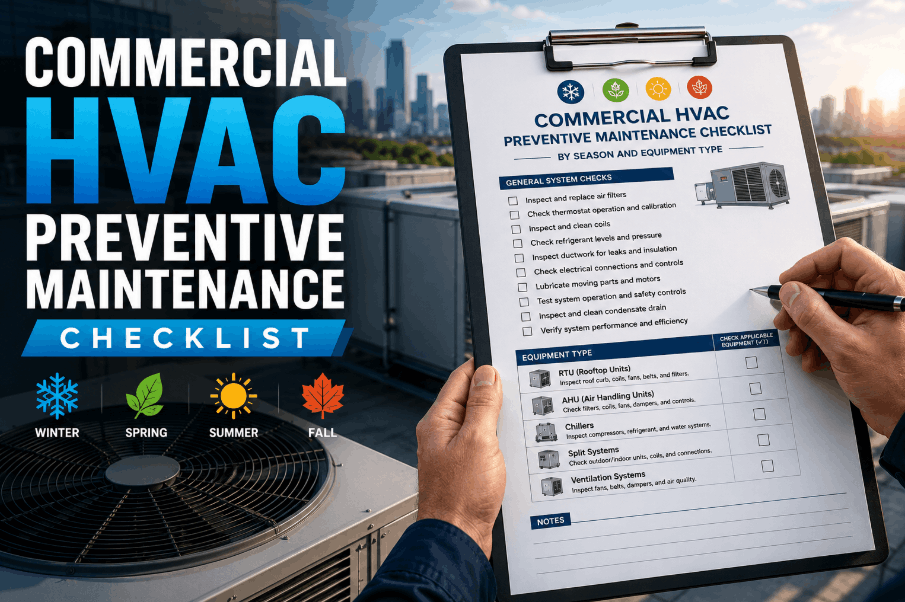
Commercial HVAC systems account for 40–50% of a building's total energy consumption — and a poorly maintained system running at degraded efficiency for a single quarter costs more than a full annual PM contract. Unplanned HVAC failures are not equipment accidents. They are the predictable outcome of skipped inspections, unchecked refrigerant levels, and filters that were never replaced on schedule. This checklist covers five system zones across four maintenance frequencies — monthly, quarterly, semi-annual, and annual — with component-level thresholds and priority classification. Every item runs natively on Oxmaint mobile, where out-of-range entries trigger automatic work orders without leaving the equipment. Book a demo to see this checklist configured for your building's HVAC asset register.
5
System zones covered per PM cycle
40+
Individual inspection checkpoints
4
Maintenance frequencies mapped
25%
Avg. energy savings from fully maintained systems
Checklist Scope
Five system zones — Air Handling Units, Cooling Systems, Heating Equipment, Ventilation and Ductwork, and Controls and Electrical. Tasks are mapped to monthly, quarterly, semi-annual, and annual service intervals. Priority classification at point of recording routes directly to the correct maintenance response in Oxmaint.
Zone 1 — Air Handling Units (AHU)
Frequency: Monthly + Quarterly
Air filter inspection — check pressure drop across filter bank; replace when differential pressure exceeds manufacturer limit or at 30-day interval in high-occupancy buildings; record filter type and MERV rating
Critical
Evaporator coil inspection — check for dirt accumulation, ice formation, and fin damage; a coil with 10% fouling increases energy consumption by up to 15%; clean coil surfaces with approved non-acid coil cleaner
Critical
Supply and return fan inspection — check belt tension and condition; worn or loose belts reduce airflow and cause premature motor wear; replace belts showing cracking, glazing, or stretch beyond adjustment range
High
Fan bearing lubrication — apply manufacturer-specified grease to all accessible bearing fittings quarterly; over-lubrication is as damaging as under-lubrication; record lubricant type and quantity applied
High
Condensate drain pan and drain line — inspect for standing water, biological growth, and scale; a blocked condensate line causes water overflow that damages ceiling structures and creates mold conditions
High
AHU cabinet and access panels — inspect for air bypassing filters, damaged insulation, and loose fasteners; cabinet air leakage reduces delivered airflow efficiency and allows unfiltered air into the supply stream
Medium
Outdoor air damper operation — verify actuator moves damper through full stroke; confirm minimum outdoor air position per design; stuck or failed dampers are a primary cause of indoor air quality complaints
Medium
Zone 2 — Cooling Systems (Chiller, Condenser, DX Units)
Frequency: Monthly + Quarterly + Annual
Refrigerant charge — check system operating pressures against manufacturer superheat and subcooling specifications; low refrigerant reduces cooling capacity and risks compressor damage from liquid slugging; note any pressure deviation
Critical
Refrigerant leak check — inspect all joints, valve stems, and brazed connections with electronic leak detector; EPA Section 608 requires leak repair within 30 days when system with 50+ lbs charge exceeds annual leak threshold
Critical
Condenser coil cleaning — clean fin surfaces of dirt, debris, and biological growth; a fouled condenser coil raises condensing pressure and head pressure, reducing compressor efficiency and shortening compressor life
Critical
Compressor amperage draw — measure running amperage on all phases and compare to nameplate; amperage consistently above nameplate indicates a developing mechanical or electrical fault requiring investigation before failure
High
Cooling tower water treatment — verify biocide dosing, pH (7.0–8.0 range), and bleed-off rate; Legionella risk is elevated in warm recirculating water systems; document water quality readings for compliance record
High
Condenser fan motors — check motor temperature, vibration, and blade condition on all condenser fans; a failed condenser fan in summer causes high-head pressure lockout and full system shutdown within minutes
High
Chiller tube inspection (annual) — inspect evaporator and condenser tubes for fouling, pitting, or scale; tube fouling adds thermal resistance that degrades chiller efficiency; perform eddy-current testing every 3–5 years
Medium
Run This Checklist Digitally on Oxmaint Mobile
Every checkpoint above is a configured digital PM task in Oxmaint — readings logged against asset records, out-of-range values auto-escalated, service reports generated on completion without manual compilation.
Heat exchanger inspection — inspect for cracks, holes, or corrosion; a cracked heat exchanger allows combustion gases including carbon monoxide to enter the supply air stream — an immediate shutdown and replacement condition
Critical
Flue and venting system — inspect for blockages, corrosion, improper pitch, and joint integrity; flue gas recirculation from a compromised vent is a life-safety hazard; test CO levels in supply air after start-up
Critical
Gas pressure test — measure manifold gas pressure against nameplate specification; incorrect gas pressure causes incomplete combustion, carbon deposits on burners, and elevated CO production in flue gas
Critical
Burner assembly — inspect for carbon deposits, pilot flame condition, and ignitor electrode gap; clean burner orifices and verify flame pattern matches manufacturer specification; record combustion analysis results
High
Safety controls test — test high-limit switch, pressure relief valve, low-water cutoff (boilers), and rollout switches; document test results; safety control failures are the primary cause of heating equipment fire and CO incidents
High
Heat pump reversing valve — verify switching operation and confirm adequate temperature differential in heating mode; a sticky reversing valve causes failure to heat that appears as a refrigeration system fault and delays correct diagnosis
High
Boiler water quality — test pH, dissolved oxygen, and hardness; scale buildup of 1 mm on boiler heat transfer surfaces increases fuel consumption by approximately 7%; record and document treatment chemical additions
Medium
Zone 4 — Ventilation and Ductwork
Frequency: Quarterly + Annual
Ductwork leak test — measure system static pressure and identify supply-side leaks; duct leakage of 20–30% is common in aging commercial systems; a 10% leakage reduction reduces fan energy consumption by 18–20%
Critical
Supply and return air volume — measure airflow at a representative sample of diffusers using a flow hood or vane anemometer; compare to design CFM; significant deviation indicates duct obstruction, damper failure, or filter overloading
High
VAV box actuator and damper inspection — verify actuator responds correctly to BAS signal; a failed VAV box damper in maximum cooling position causes zone overcooling that increases system energy load while generating occupant complaints
High
Exhaust fan inspection — verify all kitchen, bathroom, and mechanical room exhaust fans are operational; test actuated fire/smoke dampers in exhaust systems; a stalled exhaust fan reverses pressure differential and creates cross-contamination risk
High
Duct insulation condition — inspect accessible ductwork insulation for damage, moisture, and separation; wet insulation harbors microbial growth; missing insulation on cold supply ducts causes condensation and ceiling staining
Medium
Grilles, registers, and diffusers — clean supply and return air grilles; confirm all are open and unobstructed; blocked supply diffusers reduce zone airflow, increase static pressure, and accelerate filter loading upstream
Medium
Zone 5 — Controls, Electrical, and Safety Systems
Frequency: Quarterly + Annual
Thermostat and BAS calibration — verify thermostat accuracy against calibrated reference thermometer; recalibrate sensors with deviation greater than ±2°F; a thermostat reading 5°F high in cooling mode runs system continuously and doubles cooling energy cost
Critical
Electrical connections — tighten all terminal connections on contactors, disconnects, and motor starters; measure voltage and current on all phases; loose connections cause arcing, overheating, and component failure; use torque wrench to OEM specification
Critical
Capacitor test — test run and start capacitors with capacitance meter; capacitors within 6% of nameplate rating pass; a failed start capacitor prevents compressor starting; a failed run capacitor increases motor amperage and causes thermal overload
High
Contactor inspection — inspect contactor tips for pitting, carbon deposits, and welding; contacts worn beyond manufacturer specifications must be replaced; a welded contactor causes continuous compressor operation and system freeze-up
High
Safety control verification — test freeze protection thermostat, high-pressure cutout, low-pressure cutout, and motor thermal protectors; simulate fault conditions where safe to do so; document test results against set-point specifications
High
BAS sequence of operations verification — confirm heating, cooling, and ventilation sequences operate correctly under simulated setpoint changes; verify occupied/unoccupied scheduling is programmed correctly for current season and occupancy calendar
Medium
CO and CO2 sensor calibration — calibrate carbon monoxide and carbon dioxide sensors against reference gas; CO sensors older than 2 years require replacement of sensing element regardless of apparent function
Medium
Load This Checklist into Oxmaint — Free
Every zone, every frequency, every threshold — pre-built as digital PM tasks with auto-escalation for out-of-range readings. No manual report writing. No missed intervals.