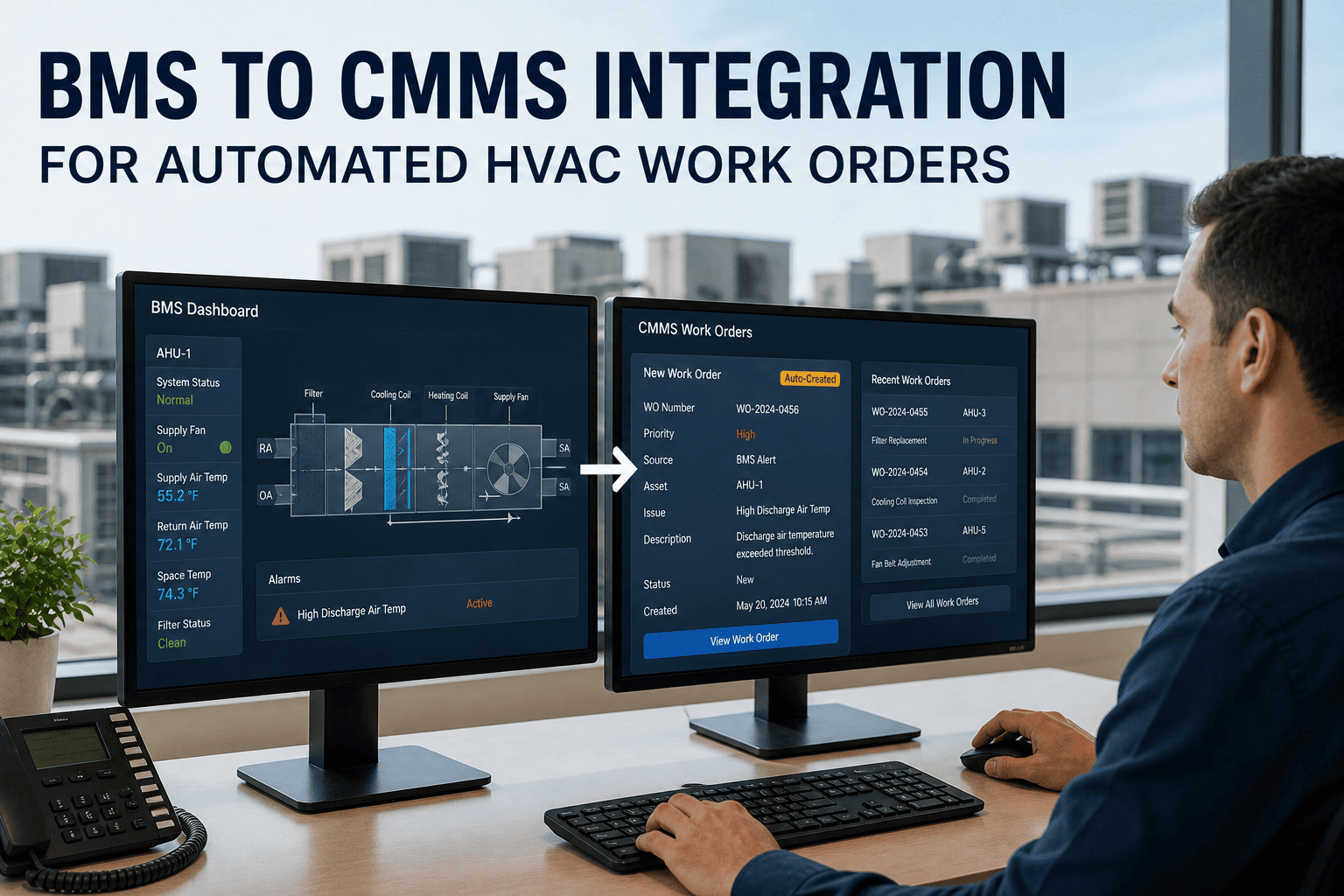
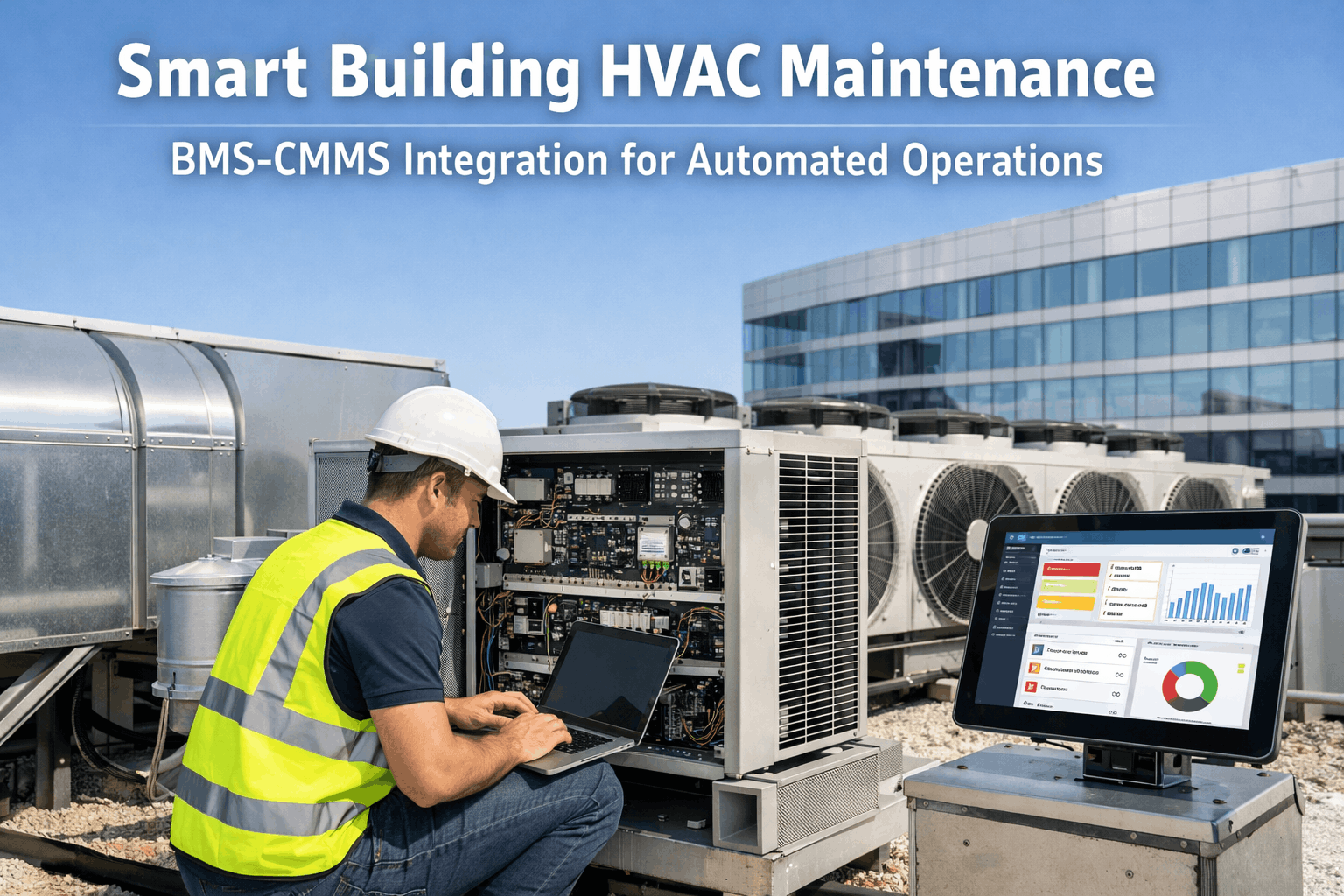
Most commercial buildings run HVAC systems that were commissioned once and never validated again. Setpoints drift, control sequences go unverified, and BMS logic silently diverges from design intent — wasting energy and triggering unnecessary equipment stress. HVAC sequence of operations validation closes this gap by continuously cross-checking actual system behavior against programmed control logic, surfacing deviations before they become failures. Sign Up Free to see how OxMaint connects BMS sequence validation to automated work orders that route findings directly to your facilities team. Whether you manage a single campus or a multi-site portfolio, structured sequence validation — backed by a CMMS that tracks every deviation — converts your building automation investment from a passive monitor into an active maintenance driver. Book a Demo to see how OxMaint's BMS integration module captures sequence anomalies and links them to corrective action workflows automatically.
Validate HVAC Sequences. Automate Corrective Work Orders.
OxMaint connects BMS sequence validation events to structured work orders — tracking every deviation, every technician response, and every resolution across your entire building portfolio.
Why HVAC Sequence Validation Fails Without a CMMS
BMS platforms generate alerts — but they rarely close the loop. A sequence deviation logged in a BMS dashboard that never becomes a work order is a risk event with no owner, no timeline, and no resolution record. These are the structural gaps that make HVAC sequence validation unreliable in most commercial facilities.
No Baseline to Validate Against
Without a documented sequence of operations stored at the asset level, technicians cannot determine whether current BMS behavior represents drift, override, or intentional change.
Alert Fatigue From Unlinked Faults
BMS systems produce high volumes of sequence alerts. Without automatic work order creation, teams triage manually — and low-priority deviations accumulate into high-cost energy waste.
Control Sequence Drift After Commissioning
Sequences validated at commissioning degrade over time as setpoints are manually overridden, schedules are adjusted, and control logic is patched — often without documentation.
Cross-System Integration Gaps
Mini-splits, VAV systems, and AHUs on separate BMS controllers produce sequence data in isolation. Reconciling across systems requires a CMMS layer that aggregates and normalizes deviation events.
Energy Waste Without Root Cause
Utility bills reflect the cumulative cost of sequence deviations, but energy teams cannot isolate which control failures drove which cost increases without per-asset sequence tracking history.
Compliance Gaps in Commissioning Records
LEED, ASHRAE Guideline 36, and energy code compliance require documented sequence verification. Facilities without automated validation records face audit exposure and recertification gaps.
8 HVAC Sequence Validation Checks OxMaint Automates
The sequence checks below cover the most critical BMS validation points for commercial AHUs, VAV systems, chillers, and ductless zones. Each check connects to a structured work order in OxMaint when a deviation is detected. Sign Up Free to configure these checks as automated triggers for your HVAC assets in OxMaint.
What Is Validated
- BMS schedule matches approved occupancy calendar
- Setback temperatures active during unoccupied hours
- Override durations within policy limits
- Weekend and holiday modes executing correctly
OxMaint Action
Schedule deviations trigger a low-priority corrective work order with timestamp, zone ID, and deviation duration. Repeat deviations on the same zone within 30 days automatically escalate priority and flag for PM schedule review.
What Is Validated
- Damper position matches outdoor air enthalpy conditions
- Economizer enabling when conditions permit free cooling
- High-limit control not bypassed
- Mixed air temperature within design range
OxMaint Action
Economizer failures that prevent free cooling generate work orders tagged with estimated energy cost impact — enabling facilities managers to prioritize repairs by financial consequence rather than queue order alone.
What Is Validated
- SAT reset executing with outdoor air temperature changes
- Reset range within ASHRAE Guideline 36 parameters
- Cooling coil valve responding correctly to reset commands
- Zone demand signals driving reset logic as designed
OxMaint Action
Static SAT setpoints — where reset should be dynamic — are flagged as sequence deviations. OxMaint links these findings to the commissioning record for the AHU, enabling direct comparison against original design intent.
What Is Validated
- Minimum CFM setpoints meeting ASHRAE 62.1 ventilation rates
- Damper not driving to zero during occupied mode
- Reheat sequence activating at correct damper position
- Zone CO₂ sensor feedback influencing airflow as designed
OxMaint Action
Minimum airflow violations create compliance-tagged work orders with ventilation code reference. OxMaint retains a timestamped record of each violation for IAQ audit documentation and regulatory reporting.
What Is Validated
- Lead-lag staging sequence executing per design
- Chiller runtime balanced across units in plant
- Condenser water temperature reset active
- Chiller not operating outside rated load range
OxMaint Action
Chiller staging deviations generate high-priority work orders with runtime data for both units. OxMaint's asset history allows maintenance managers to identify whether staging failures are recurring, pointing to a control logic issue versus a one-time fault.
What Is Validated
- VFD speed tracking PID output correctly
- Static pressure setpoint resetting per zone demand
- Fan not running at 100% speed when partial load is sufficient
- Duct pressure sensor readings within calibration range
OxMaint Action
Fans detected running at fixed high speed when VFD reset should be active are flagged with estimated excess kWh consumption. Work orders include the static pressure trend log for the prior 7 days to support technician diagnosis.
What Is Validated
- Simultaneous heating and cooling not active on same zone
- Changeover sequences following deadband logic
- Lockout temperatures preventing unnecessary equipment starts
- Economizer disabled during heating sequence correctly
OxMaint Action
Simultaneous heating and cooling — one of the highest-cost sequence failures in commercial buildings — triggers an immediate high-priority work order.
Book a Demo to see how OxMaint quantifies the energy cost of this fault type per occurrence.
What Is Validated
- Active alarm suppression durations exceeding policy limits
- Manual overrides persisting beyond authorized time windows
- Points in override with no associated work order
- Suppressed alarms on life-safety or compliance-critical points
OxMaint Action
Override points without an associated OxMaint work order are flagged as uncontrolled exceptions. This creates a closed-loop audit trail — every override requires a work order, every work order has a resolution, and every deviation is documented for compliance reporting.
Sequence Validation by HVAC System Type
Different HVAC system types require different validation logic. The table below maps system type to the highest-priority sequence checks and the OxMaint work order category each deviation generates. Sign Up Free to map these system types to assets in your OxMaint portfolio and activate automated sequence monitoring.
| HVAC System Type |
Primary Sequence Check |
Common Deviation |
OxMaint Work Order Type |
Energy Impact |
| Air Handling Unit (AHU) |
Economizer + SAT Reset |
Fixed SAT, damper stuck |
Corrective — Controls |
High |
| VAV System |
Minimum airflow, reheat |
Zero-flow during occupied hours |
Compliance — Ventilation |
Medium |
| Chiller Plant |
Lead-lag staging, runtime balance |
One chiller running all load |
Corrective — Mechanical |
High |
| Commercial Mini-Split |
Setpoint schedule, BMS override |
Manual override persisting overnight |
Corrective — Controls |
Medium |
| Boiler System |
Hot water reset, lockout temp |
Fixed HWS temp in mild weather |
Corrective — Controls |
High |
| Fan Coil Units (FCU) |
Occupancy schedule, valve position |
Valve stuck open — overcooling |
Corrective — Mechanical |
Medium |
How OxMaint Structures HVAC Sequence Validation Operations
01
Asset-Level Sequence Documentation
Store the approved sequence of operations for each HVAC asset inside OxMaint's asset record — creating a persistent baseline that survives staff turnover, system upgrades, and recommissioning cycles.
02
BMS-to-Work-Order Bridge
OxMaint's BMS integration layer converts sequence deviation alerts into structured work orders with asset ID, fault type, deviation timestamp, and recommended corrective action — no manual transcription required.
03
Deviation Frequency Tracking
A sequence deviation that occurs once is an anomaly. One that recurs monthly is a systemic controls failure. OxMaint tracks deviation frequency per asset and surfaces chronic failures before the next energy audit or commissioning review.
04
Energy Cost Attribution
OxMaint links sequence deviation records to energy consumption data, enabling facilities teams to attribute utility cost increases to specific control failures — and justify capital repair investments with documented ROI.
05
Commissioning Verification Records
Every sequence validation check completed in OxMaint generates a timestamped record tied to the asset. This creates an ongoing commissioning verification trail that supports LEED recertification and energy code compliance audits.
Book a Demo to configure compliance reporting for your portfolio.
06
Predictive PM From Sequence Data
Sequence deviations frequently precede mechanical failures — a stuck damper precedes actuator failure; a VFD running at fixed speed precedes drive fault. OxMaint uses deviation patterns to trigger preventive maintenance before equipment failure occurs.
Sign Up Free to activate this for your HVAC assets.
Connect BMS Sequence Validation to Automated Work Orders
OxMaint bridges your building automation system and your maintenance operations — turning every sequence deviation into a tracked, assigned, and resolved work order with full audit history.
HVAC Sequence Validation — Frequently Asked Questions
What is HVAC sequence of operations validation?
It is the process of verifying that a building's HVAC control sequences are executing as designed — checking that setpoints, schedules, staging logic, and damper positions match the approved control sequence documentation rather than drifting over time.
How does OxMaint support HVAC sequence validation?
OxMaint connects to BMS platforms to capture sequence deviation events, converts them into structured work orders, tracks deviation frequency per asset, and links findings to commissioning records — creating a closed-loop validation and correction process.
Which HVAC systems benefit most from sequence validation software?
AHUs with economizer and SAT reset sequences, VAV systems with minimum airflow requirements, chiller plants with lead-lag staging, and any BMS-connected zone with occupancy scheduling see the highest energy and compliance impact from structured validation.
Does sequence validation help with LEED or energy code compliance?
Yes. OxMaint generates timestamped deviation records and resolution documentation that supports LEED Existing Buildings recertification, ASHRAE 90.1 compliance, and commissioning authority reviews requiring evidence of ongoing sequence verification.
How often should HVAC control sequences be validated in commercial buildings?
High-load systems like AHUs and chiller plants should be validated continuously via BMS integration. Standalone zone equipment should be validated quarterly as part of a structured PM program — both intervals are automatable within OxMaint's scheduler.
Can OxMaint detect simultaneous heating and cooling as a sequence fault?
Yes. Simultaneous heating and cooling is one of the highest-priority sequence deviation types OxMaint flags. It generates an immediate high-priority corrective work order with the affected zone, timestamp, and duration data for rapid response.
What is the energy cost impact of unvalidated HVAC control sequences?
Industry benchmarks indicate that uncontrolled sequence deviations — stuck dampers, fixed setpoints, staging failures — account for 15–30% of excess HVAC energy consumption in commercial buildings. OxMaint attributes these costs at the asset level for prioritized corrective action.
Build a Validated, Energy-Efficient HVAC Program With OxMaint
Sequence validation. BMS integration. Automated work orders. Compliance records. One platform for commercial facilities teams managing complex HVAC portfolios.