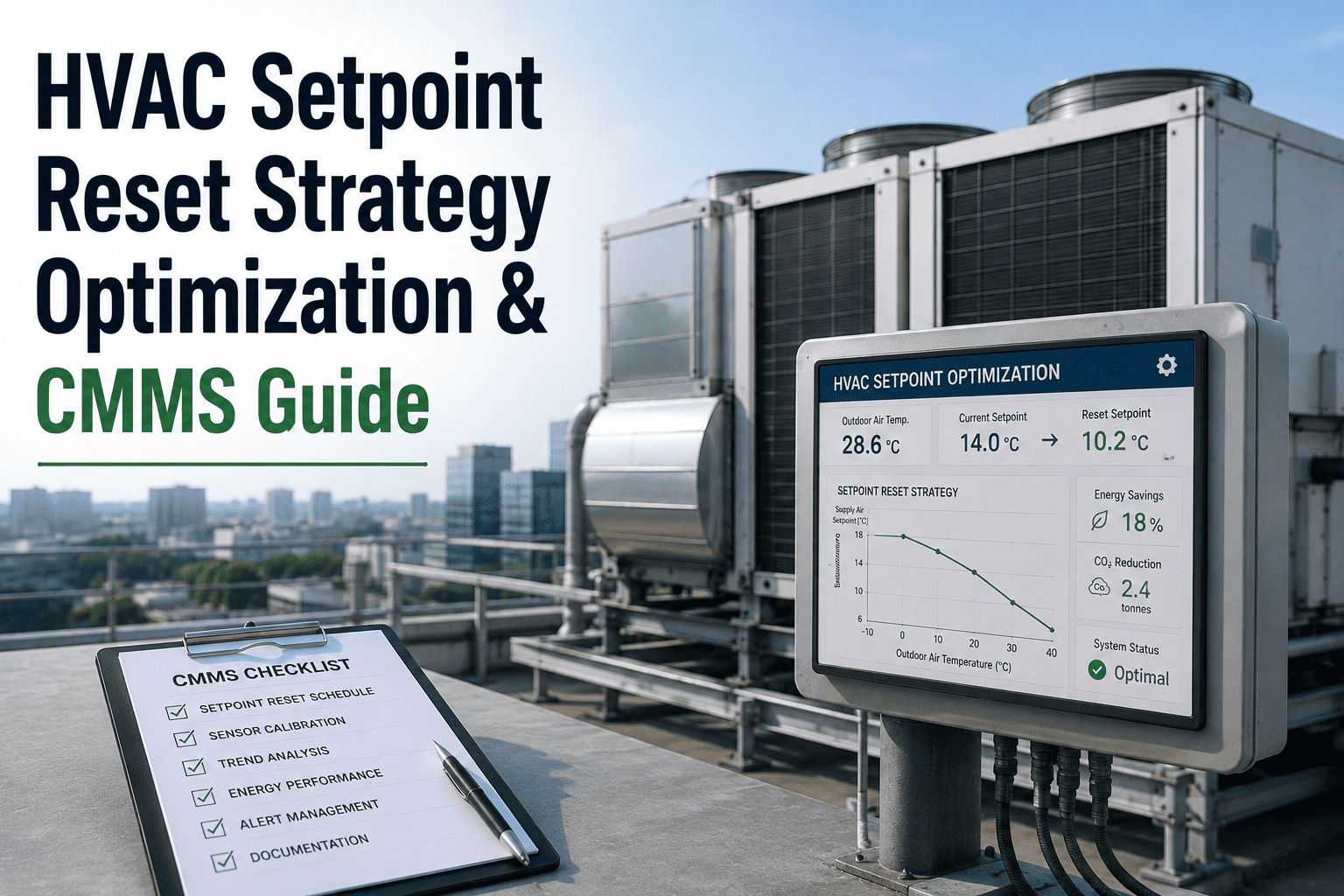
An HVAC setpoint reset strategy dynamically adjusts temperature and pressure targets based on real-time zone demand, cutting fan and compressor energy use by 15–30% across a typical commercial portfolio. When setpoint optimization HVAC protocols are paired with a modern CMMS, maintenance teams gain automated scheduling, anomaly detection, and documentation in one place—eliminating the drift that quietly erodes efficiency between manual audits. This guide covers supply air temperature reset, static pressure reset, and minimum outdoor air reset, and shows how OxMaint turns each into a tracked, compliant workflow. Ready to stop wasting energy on fixed setpoints? Start Free Trial and see the difference on your assets.
Is your HVAC system burning 30% more energy than it should?
Fixed setpoints are the single biggest hidden energy drain in commercial buildings. A demand-driven HVAC reset strategy—governed and tracked inside a CMMS—recovers that waste, extends equipment life, and gives maintenance teams a defensible audit trail for every adjustment.
The four HVAC setpoint reset strategies every team should master
A well-designed HVAC reset strategy can cut annual energy costs by $0.25–$0.50 per square foot. These four approaches form the backbone of any demand-driven optimization program.
Supply Air Temperature Reset
Raises the supply air temperature setpoint from 55°F toward 60–62°F as zone cooling demand drops. Each 1°F increase in supply temperature reduces chiller energy by roughly 1.5–2%.
Static Pressure Reset HVAC
Reduces duct static pressure setpoint based on the most open VAV damper position. Trimming 0.2 in. w.c. from a 50,000 CFM system can save 8–12% in annual fan energy.
HVAC Zone Demand Reset
Resets hot-water and chilled-water temperatures based on zone valve positions or zone temperature deviations. Maintains comfort while minimizing simultaneous heating and cooling losses.
Minimum Outdoor Air Reset
Adjusts ventilation rates in response to CO₂ and occupancy sensors. Demand-controlled ventilation can cut outside-air conditioning loads by 20–30% in partially occupied spaces.
What does setpoint optimization HVAC cost—and save?
A 180-asset commercial facility spending $42,000 per year on HVAC energy can recover $8,000–$12,000 annually with a properly maintained reset schedule. Below is the math behind the savings.
Supply Air Reset Savings Formula
Example: A 50 HP supply fan running 3,000 hrs/yr at $0.12/kWh. Raising supply temp from 55°F to 58°F drops fan kW by 2.8 kW. Annual savings = 2.8 × 3,000 × $0.12 = $1,008 per fan.
Static Pressure Reset Savings Formula
Example: Reducing static pressure by 0.25 in. w.c. on a 40,000 CFM VAV system. Fan affinity laws predict ~10% kW reduction. At 2,500 hrs and $0.12/kWh, annual savings reach $1,440.
| Reset Strategy | Typical Implementation Cost | Annual Energy Savings | Payback Period |
|---|---|---|---|
| Supply Air Temp Reset | $1,500 – $3,000 | $1,000 – $2,500 | 9 – 18 months |
| Static Pressure Reset | $2,000 – $4,500 | $1,400 – $3,200 | 10 – 20 months |
| Zone Demand Reset | $3,000 – $6,000 | $2,500 – $5,000 | 12 – 24 months |
| Minimum OA / CO₂ Reset | $2,500 – $5,000 | $1,800 – $4,000 | 10 – 22 months |
| Full CMMS-Tracked Program | $4,000 – $8,000 | $6,500 – $14,000 | 8 – 14 months |
How to deploy an HVAC reset schedule in 90 days
Most facilities can move from fixed setpoints to a fully tracked, CMMS-governed reset program in a single quarter. Here is the proven three-month path.
Baseline Audit & Asset Mapping
Catalog every AHU, VAV, chiller, and sensor in the CMMS. Log current fixed setpoints, nameplate data, and historical energy use. Identify the 3–5 highest-impact units for the initial reset rollout.
Outcome: Complete asset register with baseline energy and setpoint data captured.Reset Schedule HVAC Programming
Program supply air temperature reset, static pressure reset, and zone demand reset logic into the BAS. Link each reset parameter to a CMMS preventive maintenance trigger for quarterly verification and trend analysis.
Outcome: All reset strategies live and linked to automated CMMS inspection tasks.Commissioning & CMMS Verification
Trend log key parameters for 30 days. Verify that VAV dampers modulate correctly and that no zones are starved. Use CMMS analytics to flag persistent deviations and lock in the verified reset schedule as the new standard.
Outcome: Documented 15–30% energy reduction with a defensible, audit-ready trail.Why teams trust OxMaint to govern setpoint reset CMMS workflows
Spreadsheets and clipboard audits let reset strategies silently drift. OxMaint's AI-powered CMMS turns every setpoint adjustment into a tracked, verifiable, and predictable maintenance event.
Automated Reset Verification Work Orders
OxMaint auto-generates quarterly work orders to verify each AHU's supply air and static pressure reset schedule. Technicians get step-by-step checklists on mobile—no missed units, no paper.
Predictive Analytics for HVAC Trends
AI models analyze trend-log data imported from your BAS to detect when a reset strategy is underperforming—flagging a fouled coil or stuck damper before it wastes thousands in excess energy.
Audit-Ready Compliance Records
Every setpoint change, sensor calibration, and reset verification is timestamped and attached to the asset record. Generate a full ISO 50001 or ASHRAE Level 1 compliance report in one click.
Asset-Level Setpoint Standardization
Define the optimal reset schedule HVAC profile for each equipment class. OxMaint compares actual BAS setpoints against the standard and alerts technicians when a unit has been overridden or drifts off-spec.
Stop letting fixed setpoints drain your energy budget
See how OxMaint automates HVAC setpoint reset tracking, flags drift before it costs you, and gives you a defensible audit trail. Book a 30-minute demo on your assets today.
Real-world HVAC setpoint CMMS impact: a 180-asset portfolio
Consider a commercial office complex with 12 AHUs, 80 VAV boxes, and 4 chillers spread across 180 tracked assets. The maintenance team had been using spreadsheets and quarterly manual audits.
Reactive, Spreadsheet-Tracked
- Annual HVAC energy spend: $42,000
- Setpoint drift detected 4–6 months after occurrence
- 2 full days spent compiling ASHRAE compliance data
- 3–4 comfort complaints per month from stuck dampers
- No predictive visibility into coil fouling or sensor failure
Proactive, CMMS-Governed
- Annual HVAC energy spend: $31,200 (26% reduction)
- Setpoint drift flagged within 48 hours via AI analytics
- Compliance report generated in under 5 minutes
- Comfort complaints dropped to fewer than 1 per month
- Predictive alerts caught 2 fouled coils before failure
"OxMaint paid for itself in the first quarter. The automated reset verification work orders alone recovered $10,800 in energy waste we didn't even know we had."
— Facilities Director, 320,000 sq. ft. commercial portfolioHVAC setpoint reset strategy: common questions answered
What is an HVAC setpoint reset strategy?
An HVAC setpoint reset strategy dynamically adjusts temperature, pressure, or ventilation setpoints based on real-time building loads rather than holding them fixed. Common examples include supply air temperature reset (raising supply temp as cooling demand drops) and static pressure reset (lowering duct pressure as VAV dampers close). This approach typically saves 15–30% on HVAC energy compared to fixed setpoints.
How does a CMMS improve setpoint optimization HVAC programs?
A CMMS like OxMaint automates the verification and documentation of reset strategies, ensuring they don't drift over time. It generates scheduled work orders for technicians to confirm BAS setpoints match the designed reset schedule, logs every adjustment for compliance, and uses AI analytics to flag underperforming units—something spreadsheets simply cannot do. You can Book a Demo to see this workflow live.
How much can static pressure reset HVAC save?
Static pressure reset can reduce annual fan energy consumption by 8–12% on VAV systems. For a 50,000 CFM system running 3,000 hours per year at $0.12/kWh, trimming 0.2 in. w.c. from the static pressure setpoint typically saves $1,200–$1,800 annually. The exact figure depends on fan size, operating hours, and how aggressively the reset is tuned.
How often should HVAC reset schedules be verified?
Reset schedules should be verified quarterly at minimum, with monthly trend-log reviews for high-criticality equipment. Seasonal changes, sensor drift, and manual overrides by occupants or contractors cause setpoints to deviate from design intent within 3–6 months if left unchecked. A CMMS automates this cadence so no unit is missed.
Can OxMaint integrate with my existing building automation system?
Yes. OxMaint is designed to work alongside your BAS by importing trend-log data and mapping it to asset records in the CMMS. This lets maintenance teams correlate setpoint deviations with work order history, predictive alerts, and spare-parts inventory—all in one platform. Start your Start Free Trial to connect your first assets today.
Ready to lock in 15–30% HVAC energy savings?
Join the maintenance teams using OxMaint to automate setpoint reset verification, predict failures before they happen, and eliminate paper work orders for good.
Free 14-day trial · No credit card