A laboratory fume hood that fails to contain chemical vapours does not generate a maintenance work order — it generates a toxic exposure event, an OSHA investigation, and a potential facility shutdown pending corrective action. Laboratory ventilation systems are not building amenities. They are primary engineering controls for researcher safety, classified under OSHA 29 CFR 1910.1450, required to meet ASHRAE 110 performance standards, and subject to mandatory periodic certification regardless of visible condition. A biosafety cabinet with degraded HEPA filtration does not look different from a functioning one — but it exposes researchers to the pathogens it is designed to contain. The research institutions and industrial laboratories consistently maintaining researcher safety and regulatory compliance share one structural advantage: a systematic, documented maintenance programme covering every fume hood, every BSC, every exhaust fan, and every pressure relationship across the facility. Book a demo to see how Oxmaint manages laboratory ventilation compliance across your full facility.
OSHA
29 CFR 1910.1450 requires documented fume hood and chemical hygiene controls with annual inspection and performance verification
NSF 49
Biological safety cabinet certification standard — BSCs must be certified annually and after any relocation, filter change, or contamination event
ASHRAE
Standard 110 AM-8 fume hood face velocity test — the definitive performance standard for chemical fume hood containment verification
40%
Of laboratory fume hoods fail containment testing when face velocity is outside the 80–120 fpm specification — most without visible indication
Why Laboratory Ventilation Is a Safety-Critical System
Every piece of ventilation equipment in a research or industrial laboratory is a primary safety barrier — not a comfort system. When any component fails to perform to specification, the consequence is researcher exposure, not occupant discomfort.
FUME
Chemical Fume Hoods
Primary engineering control for volatile chemical handling. Face velocity must remain within 80–120 fpm to maintain containment. Velocity outside this range — too low or too high — compromises containment. Annual ASHRAE 110 testing is standard; quarterly face velocity checks are best practice in active research facilities.
BSC
Biological Safety Cabinets
Class II BSCs protect both researcher and product from biological material through HEPA-filtered inflow and downflow. NSF 49 requires annual certification by an accredited field certifier — testing HEPA filter integrity, airflow, alarms, and cabinet performance. Every certification must be documented and retained.
VAV
VAV Lab Exhaust Systems
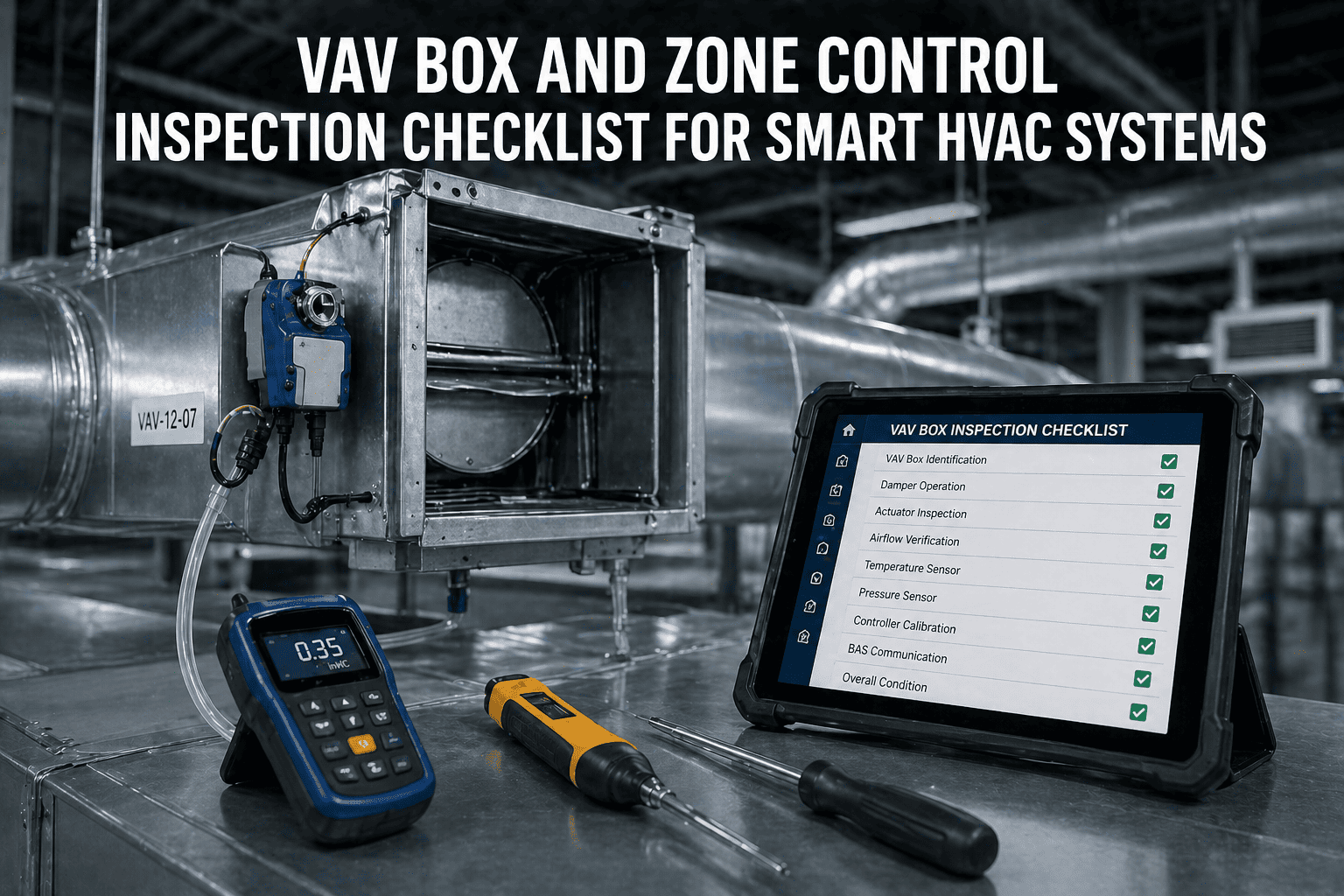
Variable air volume systems modulate exhaust based on sash position and fume hood usage. When actuators drift, dampers fail, or controls lose calibration, exhaust volumes deviate from design — compromising pressure relationships between lab and corridor and allowing contaminated air to migrate into occupied spaces.
PRESS
Room Pressure Controls
Laboratories handling hazardous materials must maintain negative pressure relative to corridors. Cleanrooms and sterile labs require positive pressure. These relationships are maintained by the balance between supply and exhaust volumes — and must be verified at defined intervals with records retained for safety, accreditation, and regulatory review.
Laboratory Ventilation Assets: Certification and PM Requirements
Each laboratory ventilation asset carries a distinct certification standard, maintenance interval, and regulatory basis. A structured programme must address all of them — by asset, not by building. See how Oxmaint maps certification schedules to every fume hood and BSC in your facility.
| Asset Type |
Standard |
Certification Interval |
Key Test Parameters |
Risk if Overdue |
| Chemical Fume Hood |
ASHRAE 110 AM-8, OSHA 29 CFR 1910.1450 |
Annual; quarterly face velocity check |
Face velocity (80–120 fpm), tracer gas containment, alarm function |
Toxic chemical exposure, OSHA violation, Chemical Hygiene Plan non-compliance |
| Class II BSC |
NSF/ANSI 49, CDC/NIH BMBL guidelines |
Annual; after relocation, filter change, or contamination |
HEPA integrity, inflow/downflow velocity, cabinet leak test, alarms |
Biohazard exposure, biosafety programme violation, accreditation risk |
| Perchloric Acid Hood |
NFPA 45, lab-specific SOPs |
After every use, deep clean periodic |
Wash-down system function, duct condition, perchlorate residue accumulation |
Perchlorate explosion risk — most dangerous deferred maintenance in any lab |
| VAV Exhaust System |
ASHRAE 62.1, lab commissioning standards |
Annual; after any HVAC modification |
Airflow volumes, actuator calibration, pressure differential, control sequence |
Room pressure reversal, cross-contamination between zones, regulatory finding |
| Exhaust Fan and Stack |
NFPA 45, local fire codes |
Semi-annual inspection; monthly belt and bearing check |
Fan performance, belt condition, stack height and dilution, motor amp draw |
System failure during active chemical use, exposure to exhaust re-entry |
| Room Pressure Monitors |
ASHRAE 170 (if healthcare), NIH/CDC guidelines |
Annual calibration; quarterly functional check |
Calibration accuracy, alarm setpoints, data logging continuity |
Undetected pressure reversal, cross-contamination, compliance failure |
Four Failures That Turn Lab Maintenance Into a Safety Event
These four patterns are the root cause of laboratory ventilation safety incidents and regulatory citations. Each is preventable — and each is the direct consequence of reactive or undocumented maintenance.
01
Fume Hood Certification Drift
Annual ASHRAE 110 testing is the minimum. Between annual certifications, face velocity drifts as exhaust fans degrade, ductwork accumulates deposits, and VAV controls lose calibration. Without quarterly face velocity checks, a hood performing at 60 fpm — well below containment threshold — may be in daily use with no visible indication of hazard to researchers.
02
BSC HEPA Filter Overdue Status
NSF 49 requires annual BSC certification. When certification lapses — which happens routinely in laboratories without automated scheduling — researchers continue working with biological materials under the assumption that the cabinet is functioning. A cabinet with a compromised HEPA filter or unverified airflow provides no barrier while appearing operationally normal.
03
Room Pressure Reversal Events
Negative pressure in a hazardous material laboratory depends on the continuous balance of supply and exhaust volumes. A single stuck VAV damper, a failed exhaust fan, or an improperly commissioned renovation can reverse this relationship — allowing contaminated air to migrate into corridors and adjacent spaces. Without continuous monitoring and calibrated verification, reversals persist undetected until a researcher or safety officer notices a problem.
04
No Documentation for Safety Audits
OSHA, institutional biosafety committees, and accreditation bodies request fume hood and BSC maintenance records during safety audits and inspections. Facilities relying on paper logs, binder systems, or technician memory routinely fail to produce complete records — triggering corrective action, programme probation, or research permit restrictions that halt laboratory operations far more disruptively than any planned maintenance event.
One Overdue BSC Certification. One Exposure Event. One Research Programme Suspended.
Oxmaint auto-schedules every fume hood face velocity check, BSC annual certification, exhaust fan PM, and room pressure calibration — with digital records that satisfy OSHA, NSF 49, biosafety committees, and institutional accreditors at any time.
Reactive vs. Structured Lab Ventilation Maintenance
In laboratory environments, reactive maintenance is not just a budget problem — it is a researcher safety risk and a regulatory compliance failure that can halt research programmes entirely.
Fume Hood Certification Management
Reactive — No Schedule
Annual certifications tracked manually in binders. Hoods operate beyond certification date routinely. Face velocity drift undetected between annual tests. OSHA audit or safety incident reveals non-compliance with Chemical Hygiene Plan.
With Oxmaint PM Schedule
Annual ASHRAE 110 tests auto-scheduled with 30-day advance notification. Quarterly face velocity checks logged per hood with pass/fail outcome. Certification status dashboard always current. Safety officer sees compliance across every hood in the facility at a glance.
Biosafety Cabinet Annual Certification
Manual Tracking
BSC certification dates tracked in spreadsheets. Manager turnover breaks the tracking chain. Cabinets operate with lapsed NSF 49 certification for months — researchers unaware. Biosafety committee audit finds multiple overdue units, triggering research suspension pending recertification.
With Oxmaint PM Schedule
Every BSC registered with installation date and certification cycle. Certification work orders auto-generate with accredited field certifier assigned. Certification reports uploaded to asset record on completion. Zero overdue certifications — regardless of staff turnover.
Room Pressure Verification
Reactive — No Verification
Room pressure monitors installed but calibration overdue. VAV dampers drifted since last commissioning. Pressure differential readings not logged. Reversal event discovered when a researcher notices doors behaving abnormally — or during an accreditation inspection.
With Oxmaint PM Schedule
Quarterly pressure differential verification scheduled per laboratory zone. Monitor calibration tracked with annual certificates. Any out-of-specification reading generates a corrective work order automatically. Full pressure verification history available for any accreditation or regulatory review.
How Oxmaint Manages Laboratory Ventilation Compliance
Laboratory ventilation compliance requires a maintenance system that tracks certification status per individual asset, enforces mandatory documentation fields, and produces audit-ready records without advance notice. Book a demo to see Oxmaint running on a live laboratory asset register.
01
Asset Registry by Lab Zone and Safety Classification
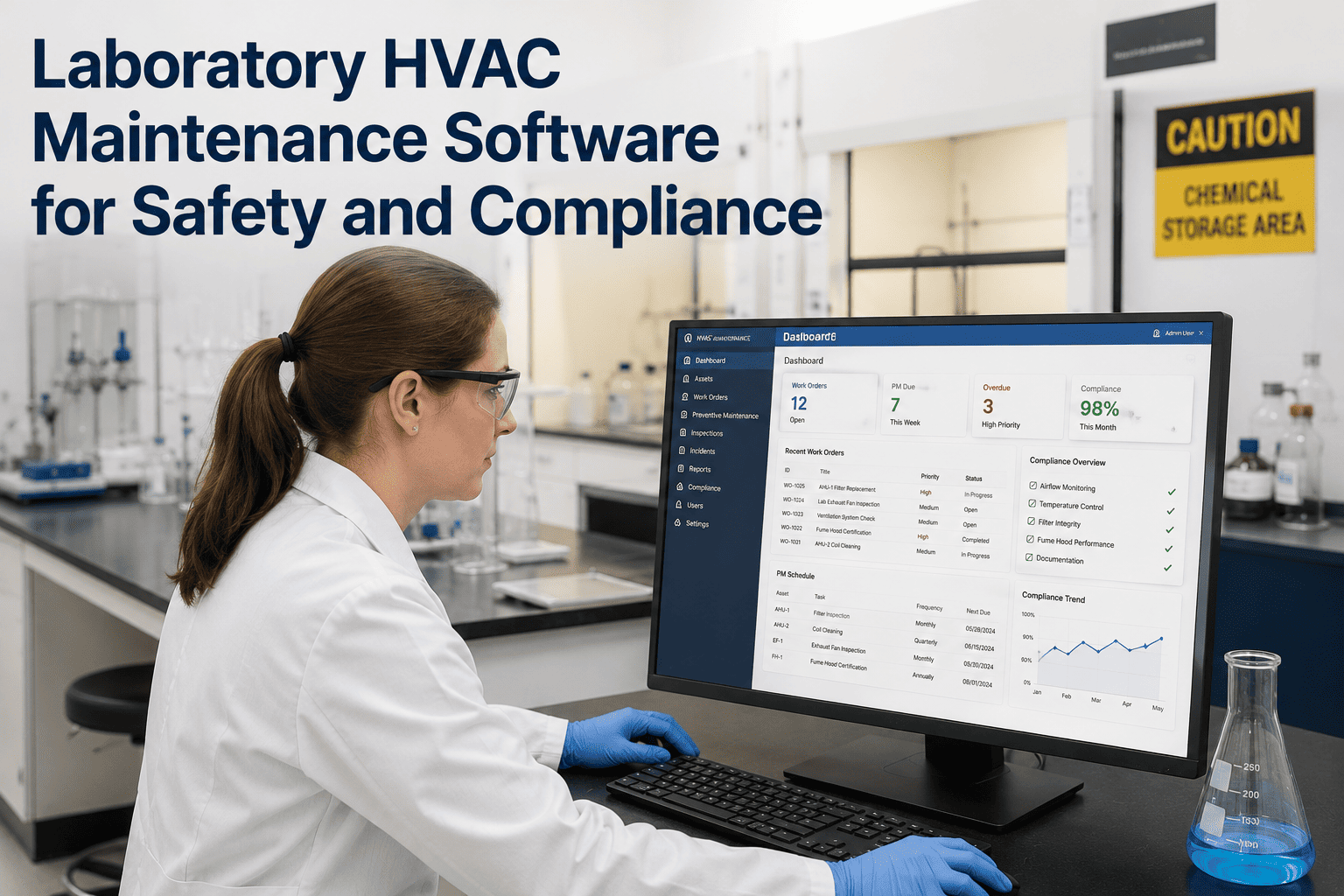
Every fume hood, BSC, exhaust fan, VAV controller, and room pressure monitor registered with lab zone, biosafety level, certification standard, and current certification status. Certification expiry dates tracked per unit — not per building. Safety officers see the real-time compliance status of every critical ventilation asset in the facility from a single dashboard.
02
Automated Certification Scheduling With 30-Day Alerts
Annual fume hood and BSC certification work orders auto-generate with accredited service providers pre-assigned. Alerts sent at 30, 14, and 7 days before due date to safety officers, facility managers, and the certification contractor. Quarterly face velocity checks and room pressure verifications scheduled as recurring tasks — no manual calendar management required.
03
Mandatory Documentation Fields Per Certification Event
Every fume hood test captures: face velocity readings at defined sash heights, tracer gas test result, technician certification number, calibration reference for test equipment, and pass/fail outcome. Every BSC certification uploads the NSF 49 test certificate directly to the asset record. Work orders cannot be closed without required documentation — eliminating the record gaps that drive audit findings.
04
Instant Compliance Export for Any Inspection
When OSHA arrives, when the biosafety committee requests records, or when institutional accreditation reviewers need evidence — a complete laboratory ventilation compliance report exports in under 2 minutes. Every hood, every BSC, every certification date, every test result, and every corrective action — per lab, per building, or facility-wide — always current without any preparation.
Research Safety Does Not Wait for Annual Inspections. Neither Should Your Maintenance Programme.
Oxmaint keeps every fume hood, BSC, and lab ventilation system certified, documented, and compliant — continuously, not just before inspection. Because the only acceptable number of researcher exposure events from a maintenance failure is zero.
0
Overdue certifications when every asset has auto-scheduled PM with 30-day advance alerts
2 Min
To export complete fume hood and BSC compliance records for any OSHA or biosafety audit
100%
Documentation capture rate when work orders enforce mandatory certification fields before closure
60 Days
To active compliance schedules across all lab ventilation assets — no implementation fees
Regulatory Frameworks Governing Laboratory Ventilation
Laboratory ventilation maintenance obligations span occupational safety, biosafety, building codes, and institutional accreditation standards — each with its own documentation requirements and inspection expectations.
| Framework |
Jurisdiction / Applicability |
Key Requirement |
Oxmaint Coverage |
| OSHA 29 CFR 1910.1450 |
USA — all laboratories using hazardous chemicals |
Chemical Hygiene Plan must include fume hood inspection programme with documented annual testing and corrective actions |
Annual fume hood PM scheduling, ASHRAE 110 result capture, corrective work order generation, exportable compliance report |
| NSF/ANSI 49 |
USA / International — all Class II BSC users |
Annual BSC certification by accredited field certifier, documentation retained on-site, recertification after relocation or filter change |
Annual certification scheduling, accredited certifier assignment, NSF 49 certificate upload per asset, post-event recertification alerts |
| CDC/NIH BMBL |
USA — BSL-2, BSL-3 research facilities |
Documented ventilation performance verification, directional airflow records, BSC certification, institutional biosafety committee compliance |
BSL-classified asset registry, directional airflow PM scheduling, IBC-ready compliance exports |
| COSHH / UK HSE |
UK — all laboratories using COSHH-regulated substances |
LEV examination and test every 14 months, records retained 5 years, test reports retained for each examination |
14-month LEV examination scheduling, 5-year record retention, COSHH-aligned PM intervals |
| ISO 15189 / CAP Accreditation |
Clinical and medical laboratories |
Equipment maintenance records required for accreditation; BSC and fume hood certification part of facility review |
Equipment maintenance history per asset, accreditation-ready documentation, ISO-aligned record structure |
The ROI of Structured Laboratory Ventilation Maintenance
$0
Research funding recoverable after a researcher exposure event linked to a documented maintenance failure in the laboratory
40%
Of fume hoods fail ASHRAE 110 containment testing when face velocity is outside specification — without any visible indication to users
2 Min
To generate a complete laboratory ventilation compliance report for OSHA, biosafety committee, or institutional accreditor
60 Days
To active certification schedules across all fume hoods, BSCs, and ventilation assets with Oxmaint — no implementation fees
Frequently Asked Questions: Laboratory HVAC Maintenance
How often must chemical fume hoods be certified?
OSHA 29 CFR 1910.1450 requires that fume hoods be part of a documented inspection programme — annual ASHRAE 110 AM-8 tracer gas testing is the accepted standard for containment verification. In addition, face velocity should be checked quarterly using a calibrated anemometer. Any hood returning a face velocity outside 80–120 fpm, or failing tracer gas containment criteria, must be taken out of service pending corrective action. All test results and corrective actions must be retained as part of the facility's Chemical Hygiene Plan documentation.
What triggers a BSC recertification outside the annual cycle?
NSF/ANSI 49 requires BSC recertification after any of the following events: relocation of the cabinet, replacement of HEPA filters, repair or service to the cabinet interior or airflow system, known or suspected contamination event inside the cabinet, or any maintenance that could affect cabinet performance. The recertification must be performed by an accredited field certifier and a new NSF 49 test certificate must be generated and retained before the cabinet is returned to service with biological materials.
What is ASHRAE 110 AM-8 testing and why does it matter?
ASHRAE Standard 110 — Method of Testing Performance of Laboratory Fume Hoods — defines the test methodology for evaluating fume hood containment using sulfur hexafluoride tracer gas. The AM-8 protocol tests containment at a release rate of 4 litres per minute with a manikin positioned at the hood face. A hood passes when the measured concentration at the breathing zone remains below 0.1 ppm. Face velocity alone does not determine containment — a hood can have the correct face velocity and still fail containment due to poor airfoil design, turbulence, or room cross-drafts. ASHRAE 110 is the definitive performance test.
How should a laboratory maintain room pressure compliance?
Hazardous material laboratories must maintain negative pressure relative to adjacent corridors — typically 0.03–0.05 inches water gauge. This requires quarterly verification of pressure differential using a calibrated instrument, with results logged per room. Room pressure monitors require annual calibration with NIST-traceable reference instruments. Any reversal event — even brief — must be investigated, documented, and resolved with a corrective action before research activities resume. Oxmaint schedules all these tasks automatically per room and retains all records for regulatory and accreditation review.
Does Oxmaint support BSL-2 and BSL-3 laboratory compliance documentation?
Yes. Oxmaint registers every BSC, fume hood, and ventilation asset with its biosafety level classification, applicable standards, and required maintenance intervals. All work orders capture the documentation required by CDC/NIH BMBL — including airflow verification results, HEPA filter integrity, alarm function checks, and certification details. Complete compliance histories per BSL zone export in under 2 minutes for institutional biosafety committee review, NIH site visits, or CDC inspection response.
Laboratory Safety Is Built on Documentation. Oxmaint Makes It Automatic.
Every fume hood certified. Every BSC tracked. Every room pressure verified. Every record stored. Oxmaint gives research and industrial laboratories automated ventilation compliance scheduling, mandatory documentation capture, certification status dashboards, and instant audit-ready exports — for every asset, in every lab, with no implementation fees.
Fume hood ASHRAE 110 scheduling
BSC NSF 49 certification tracking
Room pressure verification records
OSHA and biosafety audit exports