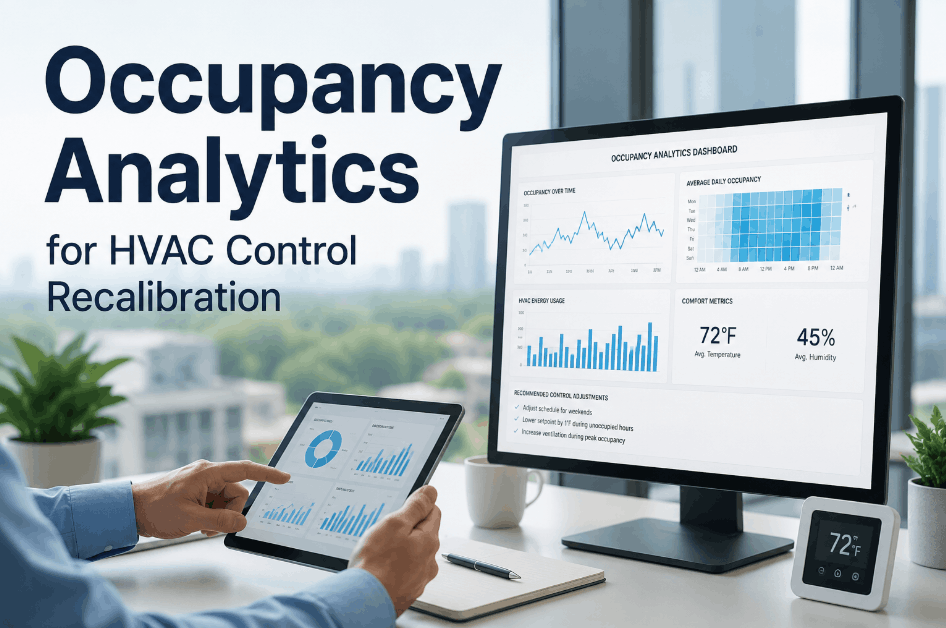
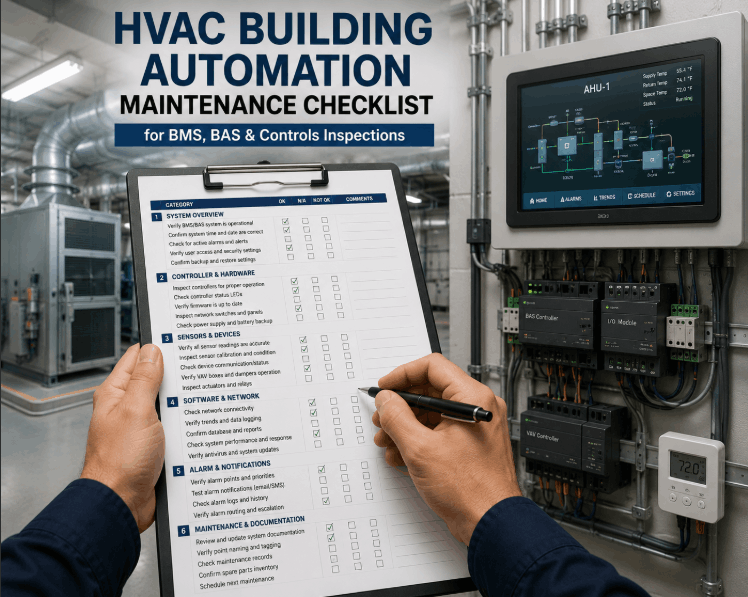
HVAC control schedules are set at commissioning and rarely revisited — which means they keep serving the occupancy pattern of a building that no longer exists. Hybrid work, shifting tenancy, and seasonal behaviour gaps make setpoints and ventilation rates designed for full occupancy into an energy and comfort liability when real use is lower, uneven, or unpredictable. Sign Up Free to log occupancy-linked control readings, track setpoint deviation against actual use data, and generate recalibration work orders in OxMaint before the gap between scheduled and real occupancy shows up on the energy bill. HVAC recalibration driven by occupancy analytics is a maintenance discipline, not an annual engineering project.
Facility Operations · Blog · Building Automation & Energy Management
Occupancy Analytics for HVAC Control Recalibration
Schedule alignment, setpoint recalibration, ventilation demand response, and CMMS-linked work orders — practical occupancy analytics for commercial HVAC control optimisation.
61%Of commercial HVAC energy waste traced to schedules and setpoints misaligned with actual occupancy
23%Average energy reduction when HVAC control is recalibrated using real occupancy data
−46%Reduction in comfort complaints when ventilation rates are tied to measured occupant density
1.9×Faster recalibration cycles when occupancy data is linked to CMMS control work orders
Occupancy-Driven Recalibration Components — What Every Control Review Needs
A complete recalibration record aligns occupancy data, current control parameters, and verified post-adjustment performance against the same asset — not in separate systems that never connect. Book a Demo to see how OxMaint structures occupancy-linked control readings and recalibration work orders against each HVAC asset for continuous system optimisation.
Step 1
Occupancy Baseline
Actual occupant counts and timing patterns recorded per zone from sensor, access, or booking data — establishing the real use baseline the control schedule should serve.
Foundation
Step 2
Schedule Gap Analysis
Current BAS schedule compared against occupancy baseline — identifying zones running conditioning during unoccupied periods or holding back ventilation during peak use.
Core Metric
Step 3
Setpoint Recalibration
Temperature and humidity setpoints adjusted per zone to match actual occupant density and thermal load, not the design-day assumptions from original commissioning.
Diagnostic
Step 4
Ventilation Demand Response
Outdoor air rates adjusted to measured CO₂ and occupant density rather than fixed design minimums — reducing energy waste in under-occupied zones automatically.
Critical Gate
Step 5
Work Order Trigger
Control deviations beyond the recalibrated tolerance threshold auto-generate a work order with the zone's occupancy data and current parameter set attached.
Action
Step 6
Performance Confirmation
Post-recalibration energy and comfort readings confirm alignment with updated occupancy baseline before the control schedule is locked for the next review cycle.
Closure
The Occupancy Drift Cascade — How a Stale Schedule Becomes an Energy and Comfort Problem
HVAC control misalignment with real occupancy does not announce itself — it shows up first as unexplained energy cost and tenant complaints that get directed to comfort, not controls. Sign Up Free to track occupancy data against control parameters per zone in OxMaint and trigger recalibration before the gap shows up on the utility bill.
Occupancy-HVAC Drift Cascade — 5 Stages from Stale Schedule to Energy and Comfort Failure
Stage 1
Occupancy Pattern Shifts
Building occupancy changes — hybrid working reduces Monday and Friday load by 40%. HVAC schedule unchanged from original commissioning.
$0
Cost if flagged at monthly review
↓
Stage 2
Conditioning Waste Begins
Full ventilation rates and setpoints maintained in empty zones. Energy cost rises invisibly against the original budget baseline.
$1,800
Monthly energy premium, undetected
↓
Stage 3
Overcooled Zones Generate Complaints
High-density meeting rooms overcrowded against a low-occupancy setpoint. Comfort complaints logged. FM team adjusts room thermostats, not the BAS schedule.
$3,200
Misdirected FM investigation
↓
Stage 4
Tenant Escalation
Recurring comfort issues escalate to landlord. Formal investigation commissioned. Controls consultant engaged without access to occupancy or historical BAS data.
$8,400
Consultant engagement and review
↓
Stage 5
Full Control Recalibration Required
Complete schedule and setpoint audit required across all zones. Occupancy data sourced retrospectively. 14-month energy overspend identified with no recovery mechanism.
$24,000+
Recalibration, wasted energy, disputes
Occupancy Analytics Maturity Score — How Well Does Your HVAC Control Reflect Real Use?
Use the scoring framework below to assess your current occupancy-linked HVAC control recalibration programme.
Occupancy Analytics Maturity Score for HVAC Control
Score 5 = real-time occupancy-driven control · Score 1 = commissioning-day schedule only · Assess per zone or per floor
5
Fully Aligned — Continuous Occupancy-Linked Control
Control schedules, setpoints, and ventilation rates continuously recalibrated against live occupancy data with automated CMMS work orders on deviation.
Action: Maintain recalibration cadence. Review occupancy baseline quarterly against access and booking data.
4
Mostly Aligned — Periodic Manual Review
Occupancy data reviewed and schedules adjusted periodically, but not linked to CMMS. Recalibration driven by FM judgement, not data triggers.
Action: Connect occupancy data to CMMS. Set recalibration triggers for schedule gaps above 15% deviation.
3
Partially Managed — Complaint-Triggered Recalibration
Control schedules reviewed only after comfort complaints. Occupancy data not formally used as an input to the recalibration decision.
Action: Pull occupancy baseline for critical zones this month. Compare against current BAS schedule settings.
2
Reactive — Annual or Less Frequent Review
Control schedules reviewed annually at best. Occupancy pattern changes between reviews are absorbed as undetected energy waste and comfort drift.
Action: Identify zones with highest occupancy variability. Schedule an occupancy-linked control review this quarter.
1
Commissioning-Day Schedule — Active Energy Risk
HVAC control unchanged since original commissioning. No occupancy data used. Energy waste and comfort misalignment accumulate without detection.
Action: Conduct an occupancy baseline survey immediately. Build a zone-level recalibration plan this week.
Technology Integration: CMMS Control Data and Occupancy-Linked Work Orders
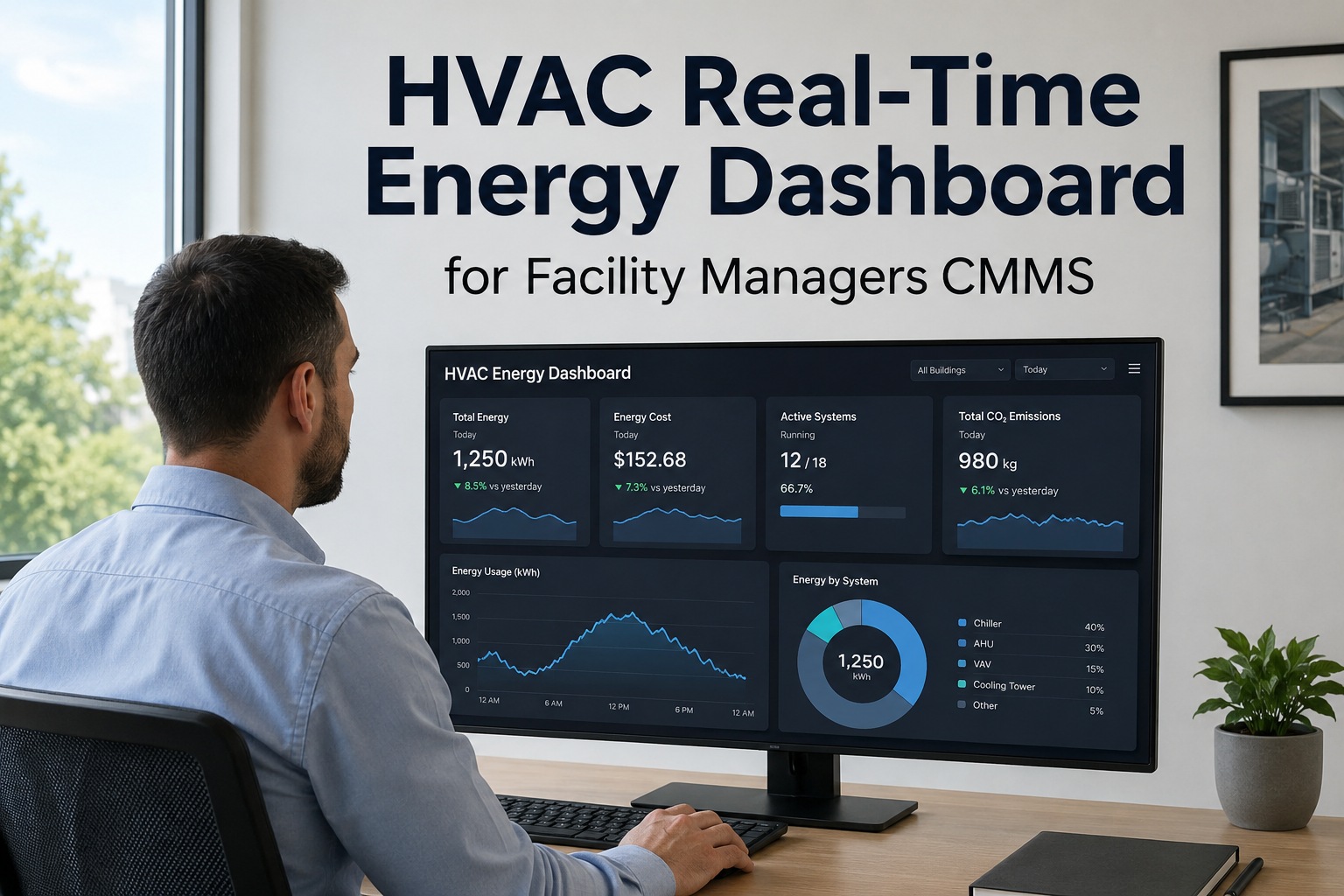
Occupancy-driven HVAC recalibration requires connected data — not a BAS export reviewed once a year and an FM log that never references the same asset. Book a Demo to see how OxMaint links occupancy readings, control parameters, and recalibration work orders to each HVAC zone asset for continuous system alignment.
Asset-Linked Control Records
100%
Occupancy and setpoint history visible per HVAC zone
Occupancy readings and control parameter changes logged against the zone asset, viewable alongside the full PM and work order history.
Schedule Deviation Alerts
−46%
Reduction in comfort complaints with occupancy-aligned control
Control schedules deviating from occupancy baseline trigger an automatic alert and recalibration work order before tenant complaints escalate.
Work Order Automation
1.9×
Faster recalibration cycles with CMMS-linked occupancy triggers
Occupancy-control deviations auto-generate work orders with the asset's control history and current occupancy data attached for the technician.
Mobile Field Access
Offline
Control readings and adjustments logged from the plant room floor
Technicians log recalibration results on mobile without connectivity; data queues and syncs automatically when the device reconnects.
"
We were running full Monday morning conditioning schedules in zones that averaged 11% occupancy after the shift to hybrid working. Once we linked our building access data to HVAC asset records in OxMaint, the schedule misalignment was visible in a week and the recalibration work order closed within the month. Energy cost on those floors dropped 19%.
Facilities Manager — Grade A commercial office building
Root Causes of HVAC Control Misalignment with Actual Occupancy
Occupancy-control misalignment in commercial HVAC systems clusters into six recurring root causes. Sign Up Free to address all six through structured occupancy analytics and control recalibration workflows in OxMaint.
HVAC Occupancy-Control Misalignment — Root Cause Distribution (%)
Schedule unchanged since original commissioning
71%
No occupancy data linked to HVAC control records
64%
Ventilation rates fixed at design minimum regardless of density
57%
Recalibration triggered by complaint, not data
49%
No CMMS work order generated for setpoint drift
42%
Post-recalibration performance not formally confirmed
35%
Recalibrate Your HVAC Control Against Real Occupancy — Not Assumptions.
OxMaint links occupancy data, control parameters, and recalibration work orders per HVAC zone — so schedule drift triggers a correction before it becomes an energy or comfort problem.
Frequently Asked Questions
What is occupancy analytics for HVAC recalibration?
It is the use of actual occupant count and timing data to adjust control schedules, setpoints, and ventilation rates so the HVAC system responds to real building use rather than fixed design assumptions.
How much energy can occupancy-driven HVAC recalibration save?
Buildings with significant occupancy variability typically achieve 15–25% energy reduction when control schedules are realigned with actual use patterns and ventilation is linked to measured density.
How often should HVAC controls be recalibrated for occupancy?
In buildings with variable or hybrid occupancy, a quarterly occupancy-control review is recommended, with CMMS-triggered recalibration whenever measured deviation exceeds the defined threshold.
What occupancy data sources work with a CMMS recalibration workflow?
Access control counts, room booking systems, CO₂ sensor readings, and space utilisation sensors can all serve as occupancy inputs linked to HVAC asset records in OxMaint.
Can OxMaint auto-generate a work order when HVAC control drifts from occupancy baseline?
Yes — when a control reading deviates beyond the defined tolerance, OxMaint automatically creates a recalibration work order with the asset's control and occupancy history attached.
Build Your Occupancy-Linked HVAC Recalibration Programme in OxMaint.
Track occupancy data, control parameters, and recalibration results per zone — free to start, mobile-ready, and built for facilities teams managing variable-use buildings.