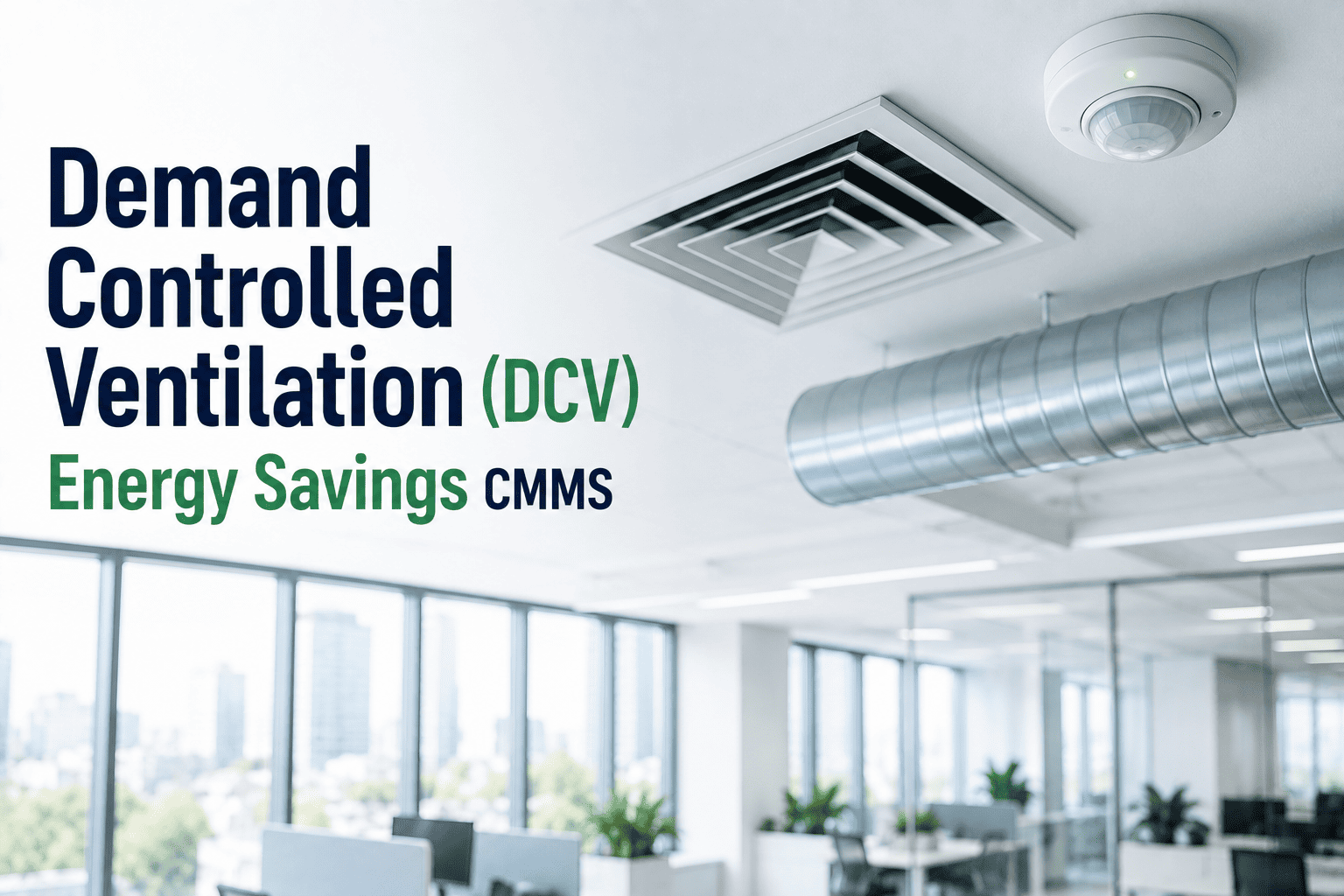
Demand-Controlled Ventilation is one of the most energy-intelligent concepts in modern building management — a system that delivers exactly the right amount of fresh air based on how many people are actually in a space, rather than assuming full occupancy around the clock. When DCV works as designed, it reduces ventilation energy consumption by 20 to 30% while simultaneously maintaining or improving indoor air quality. The problem is that DCV systems are only as good as the components that drive them. A CO2 sensor that has drifted 200 ppm from calibration will cause the system to either under-ventilate occupied spaces — harming occupant health and productivity — or over-ventilate empty ones, erasing every energy benefit the system was designed to deliver. Damper actuators that have lost their mechanical accuracy, control sequences that have been overridden and never restored, and communication failures between sensors and controllers are all maintenance failures that silently degrade DCV performance over months and years. This guide covers everything facility managers and building engineers need to know about maintaining DCV systems at peak performance — and how iFactory's AI platform automates the continuous monitoring that makes optimal DCV operation sustainable at scale.
Demand-Controlled Ventilation Maintenance
Optimizing Fresh Air Delivery and Energy Performance Through Proactive DCV Asset Management
System
Sensors
Actuators
Sequences
Monitoring
How DCV Works — And Why Maintenance Determines Everything
DCV systems modulate outdoor air intake based on real-time occupancy signals — primarily CO2 concentration measured within occupied spaces. The control logic is elegant: as occupancy rises, CO2 climbs, and the outdoor air damper opens further. As occupancy drops, CO2 falls, and fresh air delivery is reduced. Under ASHRAE Standard 62.1, which governs ventilation for acceptable indoor air quality, DCV is recognized as a legitimate compliance pathway for variable-occupancy spaces.
Is Your DCV System Actually Performing
Most DCV degradation is invisible to routine inspection. iFactory's AI continuously validates CO2 sensor accuracy, damper response, and control sequence performance — so you know your system is delivering the energy savings it was designed for.
The Four Pillars of DCV Maintenance
Effective DCV maintenance is not a single task — it is a structured program covering four interdependent system elements. Neglecting any one pillar progressively degrades the performance of the others.
NDIR (Non-Dispersive Infrared) CO2 sensors — the most common technology in commercial DCV systems — are highly accurate when properly calibrated, but they drift over time due to optical contamination, temperature cycling, and component aging. A sensor reading 200 ppm higher than actual CO2 will cause the DCV system to over-ventilate even low-occupancy spaces, eliminating energy savings. A sensor reading 200 ppm lower will under-ventilate high-occupancy spaces, violating ASHRAE 62.1 requirements and degrading occupant comfort and cognitive performance. Proper CO2 sensor maintenance includes annual or biannual field calibration against a reference gas standard, cleaning of optical surfaces, verification of sensor placement (avoiding air supply diffusers and exterior walls), and replacement of sensors exceeding their operational lifespan (typically 10–15 years). iFactory's platform continuously cross-validates CO2 sensor readings against expected occupancy patterns and adjacent sensor values to flag sensors that have likely drifted before the next scheduled calibration date. Book a demo to see iFactory's CO2 sensor monitoring dashboard live.
The outdoor air damper actuator is the mechanical output device of the entire DCV control chain — the component that physically translates the controller's calculated fresh air demand into actual airflow. Actuators fail in ways that are difficult to detect through visual inspection: mechanical binding that causes the damper to stick at a fixed position, backlash between the actuator and damper blade that introduces position error, and feedback signal failures that cause the controller to believe the damper is positioned correctly when it is not. Annual damper maintenance should include full-stroke mechanical testing (commanding the actuator from 0% to 100% and measuring response), position feedback verification, lubrication of linkages and pivot points, and inspection of damper blade seals for wear. For DCV systems, it is particularly important to verify that the minimum outdoor air position is correctly maintained — a damper that cannot fully close to its minimum position will over-ventilate during unoccupied hours regardless of what the CO2 sensor reads. Sign up with iFactory to track damper actuator health and position accuracy across your entire building portfolio.
The DCV control sequence is the logic that translates CO2 measurements into damper positions — and it is one of the most commonly corrupted elements in building automation systems. Control overrides implemented during a comfort complaint or maintenance event and never removed, setpoint changes made without documentation, and software updates that reset programmed sequences to factory defaults are all common causes of DCV control sequence failures. Annual sequence verification should walk through every operating mode — occupied, unoccupied, economizer, and morning warm-up — confirming that CO2 setpoints are correctly configured, that the DCV logic is active (not overridden), that minimum outdoor air limits are enforced, and that the sequence correctly handles edge cases such as CO2 sensor failure or communications loss. ASHRAE Guideline 36, the High-Performance Sequences of Operation standard, provides the benchmark for well-implemented DCV control logic and should be referenced during every sequence verification exercise. Book a demo with iFactory to see how our platform flags control sequence anomalies and override events automatically.
Maintaining a DCV system without continuously monitoring its IAQ output is like servicing a car without ever test-driving it. DCV performance validation means confirming that occupied spaces are consistently maintaining CO2 concentrations within ASHRAE 62.1 limits — typically a maximum of 1,100 ppm above the outdoor CO2 baseline, which in most locations equates to approximately 1,500 ppm absolute. Regular IAQ performance reporting also provides the data needed to identify spaces where the DCV system is chronically under-performing, whether due to sensor placement issues, occupancy pattern changes, or HVAC system modifications that have altered the original design airflows. iFactory's continuous IAQ monitoring layer tracks CO2 trends in every DCV-served zone, generates compliance status reports for ASHRAE 62.1 and LEED certification, and alerts facility teams when any zone shows a pattern of IAQ limit breaches. Sign up with iFactory to activate continuous IAQ performance monitoring across your buildings today.
DCV Maintenance Schedule at a Glance
Use this framework as the foundation of your DCV preventive maintenance program. iFactory automates the continuous monitoring layer, while scheduled physical maintenance tasks complete the program.
| Task | Monthly | Quarterly | Annually | Every 2 Years |
|---|---|---|---|---|
| CO2 sensor readings vs. portable reference | Verify | |||
| DCV control override audit | Review | |||
| IAQ compliance report generation | Generate | |||
| Damper actuator stroke test | Test | |||
| Outdoor air damper seal inspection | Inspect | |||
| DCV control sequence verification | Verify | |||
| Actuator linkage lubrication | Lubricate | |||
| CO2 sensor field calibration (reference gas) | Calibrate | |||
| Full DCV commissioning verification | Recommission | |||
| CO2 sensor replacement assessment | Assess |
Automate Your DCV Monitoring with iFactory AI
Replace manual monthly checks with continuous AI-powered DCV performance monitoring. iFactory tracks CO2 sensor accuracy, damper response, control sequence status, and IAQ compliance — all from a single dashboard.