Retail HVAC failures do not stay in the mechanical room — they reach the sales floor in minutes, affecting customer comfort, staff productivity, and revenue in ways that reactive maintenance programs cannot prevent. Rooftop units in retail properties run under extreme demand cycles: high occupancy loads, frequent compressor starts, and seasonal temperature swings that accelerate degradation faster than calendar-based service schedules detect. Facilities that Sign Up Free on Oxmaint can structure predictive maintenance programs for rooftop units using runtime patterns, compressor start counts, and fault code histories — catching failure indicators before they become comfort or sales events. For retail operations teams managing multi-site RTU fleets, Book a Demo to see how Oxmaint connects RTU performance data to condition-based maintenance workflows.
Oxmaint connects RTU runtime data, compressor start counts, and fault code history to predictive work orders — so your retail HVAC team acts on data, not complaints.
6 Rooftop Unit Performance Indicators That Predict Failure in Retail Properties
Rooftop unit failures in retail are predictable — not inevitable. The right runtime and operational signals surface degradation weeks before complete failure. Teams that Sign Up Free on Oxmaint can configure condition-based monitoring for each of these RTU performance indicators across their retail property portfolio.
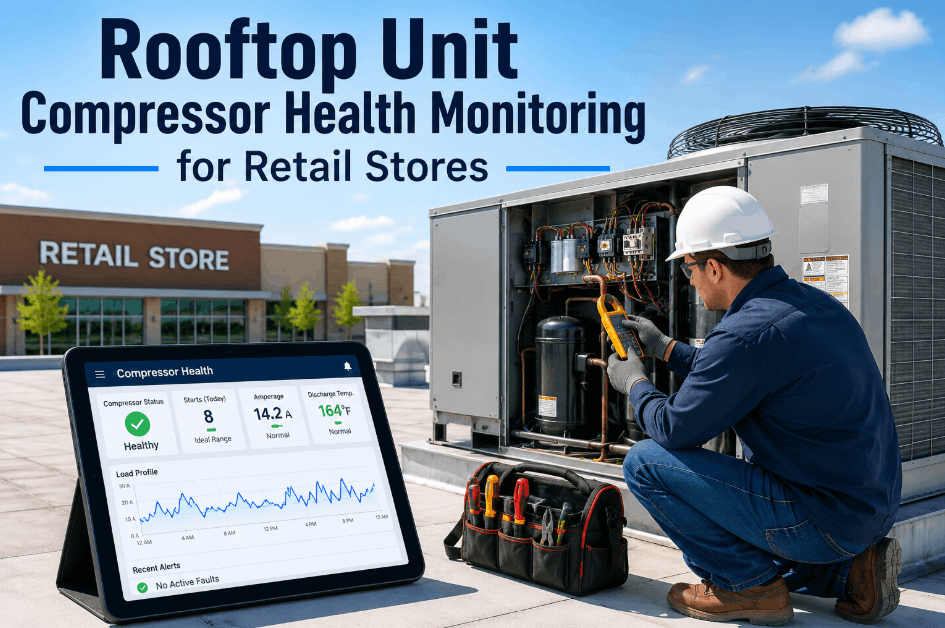
Excessive compressor cycling in retail environments — driven by door traffic and occupancy fluctuations — accelerates wear beyond manufacturer start-count thresholds. Tracking starts-per-hour against design limits predicts contactor and compressor degradation before electrical failure.
Increasing runtime required to reach zone setpoints indicates capacity degradation from refrigerant loss, coil fouling, or compressor wear — detectable as a trend before the unit fails to condition the space entirely.
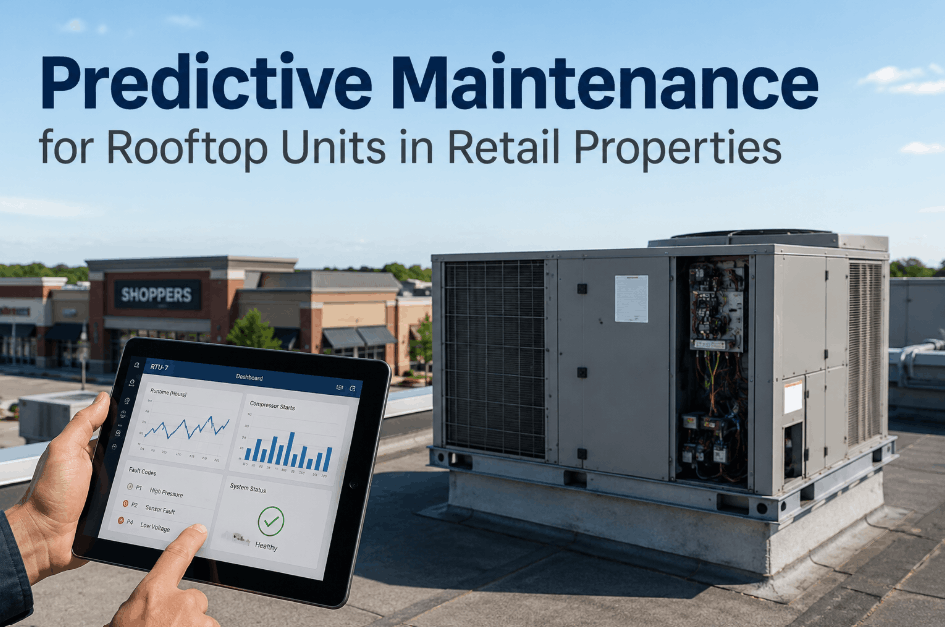
Single fault events are informational. Recurring fault codes on the same RTU across a 30–90 day window are predictive — signalling a systemic issue that a reset resolves temporarily but does not correct.
Drift in supply air temperature delivery relative to setpoint and outdoor conditions indicates refrigerant circuit or heat exchanger degradation — measurable weeks before occupant comfort complaints begin on the sales floor.
Failed economiser dampers in retail RTUs force compressor operation during moderate outdoor conditions — raising energy consumption without triggering alarms. Operational validation detects this silent efficiency loss.
Retail environments — particularly food, home improvement, and high-traffic stores — load RTU filters faster than standard replacement schedules account for. Differential pressure trending enables condition-based replacement before airflow restriction causes system strain.
RTU Predictive Maintenance Protocol: Performance Signals, Thresholds, and Retail Response
Each rooftop unit performance indicator carries a specific monitoring source, alert threshold, and maintenance response aligned to retail operating requirements. Use this protocol reference to evaluate your current RTU monitoring coverage. Retail facilities without structured predictive maintenance programs are encouraged to Book a Demo to see Oxmaint's condition-based RTU workflows in action.
| Performance Signal | Monitoring Source | Alert Threshold | Maintenance Response | Priority |
|---|---|---|---|---|
| Compressor Start Count | BMS / RTU controller | Exceeds 6 starts/hour sustained | Controls review and short-cycle investigation | Critical |
| Runtime-to-Setpoint Ratio | Zone temp sensor + runtime log | 20% increase over 14-day baseline | Refrigerant check and coil inspection WO | Critical |
| Recurring Fault Codes | RTU fault log / BMS alarm feed | Same fault code 3+ times in 30 days | Root cause investigation work order | Critical |
| Supply Air Temp Variance | Supply duct sensor | Delta >3°C from design at equal conditions | Refrigerant circuit and heat exchanger inspection | Important |
| Filter Differential Pressure | Differential pressure sensor | Exceeds 125% of clean filter baseline | Condition-based filter replacement WO | Important |
| Economiser Damper Operation | Damper position feedback | No economiser operation in qualifying conditions | Damper actuator and controls inspection | Important |
| Seasonal Performance Baseline | Historical runtime and energy data | Seasonal transition trigger | Full RTU predictive checklist — all parameters | Routine |
How Retail Facilities Deploy RTU Predictive Maintenance Across Multi-Site Portfolios
Managing rooftop unit health across a retail portfolio — from single stores to multi-site chains — requires a maintenance system that scales monitoring and work order generation without scaling headcount. Oxmaint enables retail facilities teams to connect RTU performance data to predictive work orders across any number of sites from a central operations view. Teams can Sign Up Free and configure RTU predictive rules against their property asset hierarchy in the first session.
- RTU assets mapped with performance monitoring attributes per store
- Condition-based alert rules configured for each predictive indicator
- Fault code recurrence patterns trigger investigation work orders automatically
- Mobile app delivers RTU inspection tasks with asset context and checklist
- Technician findings and readings captured at the rooftop, not back at the office
- Multi-site RTU fleet performance visible in a single portfolio dashboard
ROI of RTU Predictive Maintenance: Retail Comfort, Energy Savings, and Equipment Life
Per-user SaaS pricing with no infrastructure overhead. Most retail facilities configure RTU predictive maintenance workflows within 30–45 days using Oxmaint's no-code asset and alert configuration tools.
Detecting RTU degradation before full failure prevents the temperature events that reduce customer dwell time, affect staff productivity, and trigger emergency service calls during peak trading periods.
Predictive intervention converts emergency repair costs — after-hours callouts, expedited parts, contractor premiums — into scheduled maintenance events at standard labour and parts rates.
Catching compressor short-cycling, coil fouling, and refrigerant loss before they cause secondary damage extends rooftop unit service life — deferring capital replacement costs on high-value equipment.
RTUs operating with degraded refrigerant circuits, fouled coils, or failed economisers consume significantly more energy per conditioned degree. Predictive correction measurably reduces utility costs per store.
Portfolio-level RTU performance data surfaces systemic issues across store types and equipment ages — enabling procurement and maintenance strategy decisions based on fleet performance evidence.
Oxmaint gives retail facilities teams RTU condition monitoring, automated predictive work orders, and multi-site fleet visibility — without adding headcount.
Predictive Maintenance for Retail Rooftop Units — Questions Operations Teams Ask
The strongest predictors are compressor start count accumulation, runtime-to-setpoint ratio increase, and recurring fault code patterns. Combined, these surface 80–90% of RTU failures weeks before complete breakdown.
Oxmaint maps RTU performance data and fault code feeds to condition-based alert rules, then automatically generates work orders with asset context and inspection checklists when thresholds are breached.
Yes. Oxmaint's multi-site asset hierarchy enables condition-based alert rules and predictive work orders across any number of retail locations, with portfolio-level RTU performance visible in a central dashboard.
Continuous monitoring for compressor starts, runtime ratios, and fault codes is recommended for high-traffic retail RTUs. Filter differential and economiser validation should be reviewed monthly or following any fault event.
Preventive maintenance runs on fixed schedules regardless of equipment condition. Predictive maintenance triggers on actual performance signals — reducing unnecessary service visits while catching real degradation earlier than calendar intervals allow.
Oxmaint gives retail operations teams structured RTU condition monitoring, automated predictive work orders, and multi-site fleet management — go live without an IT project.