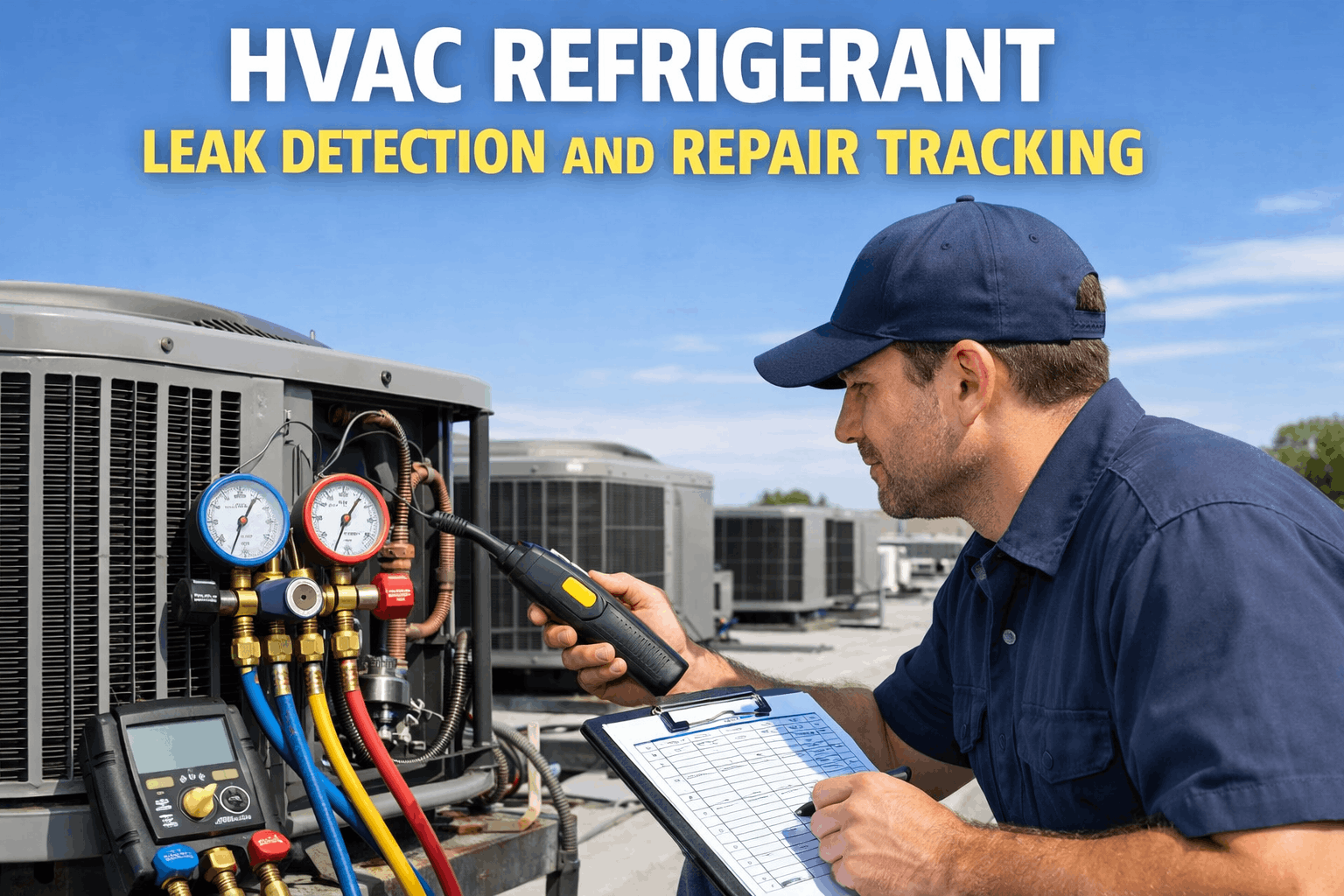
EPA Section 608 of the Clean Air Act is not a checklist suggestion — it is a federal compliance requirement with civil penalties up to $44,539 per day per violation. As of 2025, regulations have expanded the threshold to equipment containing 15+ pounds of refrigerant (down from 50+), and high-GWP HFCs including R-410A face phase-down restrictions that took effect January 1, 2025. Every technician who services refrigerant-containing equipment, and every owner or operator of such equipment, must maintain records accessible for a minimum of three years. Sign in to OxMaint to digitise your refrigerant compliance records, or book a demo to see the compliance tracking module.
Compliance / HVAC
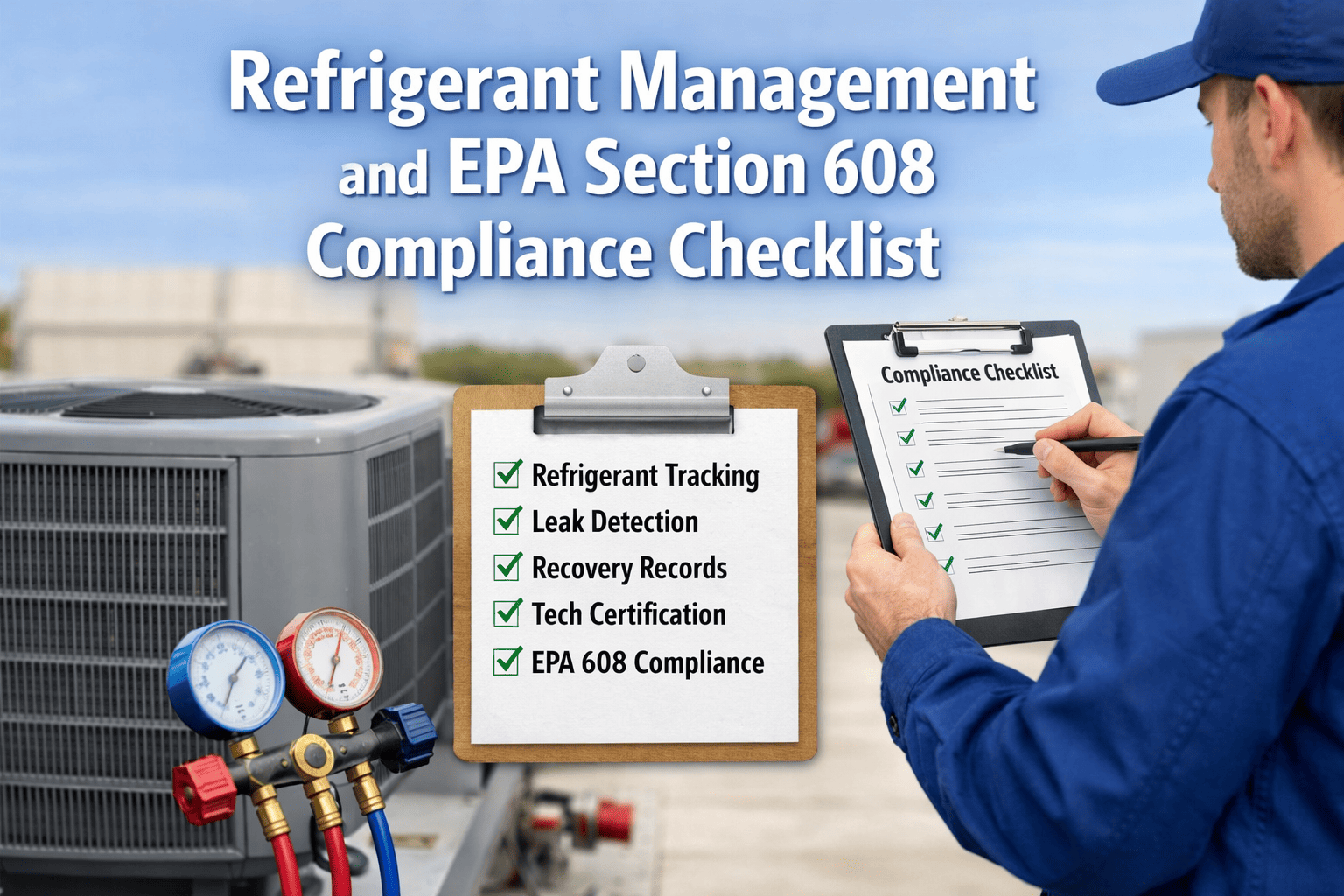
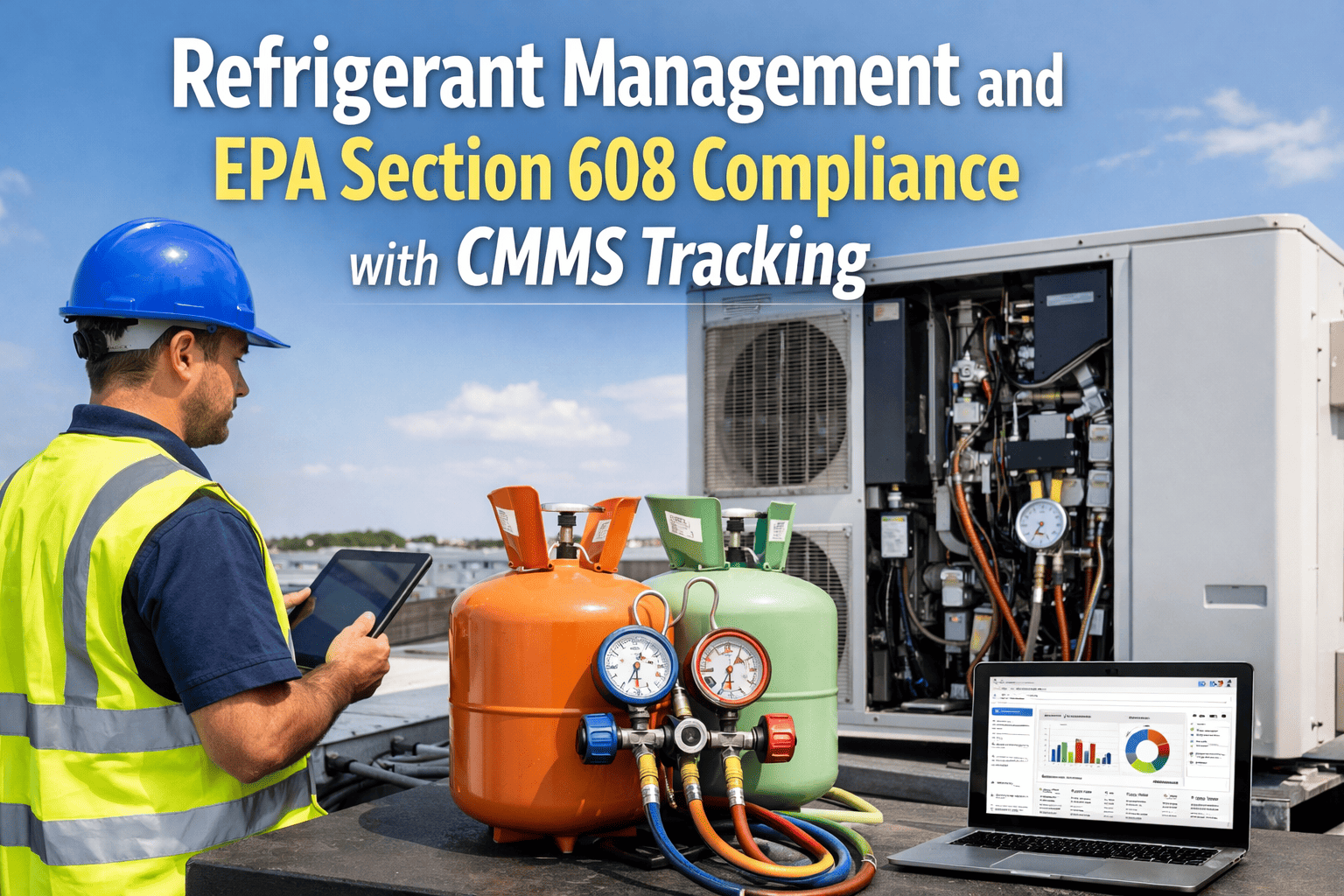
Refrigerant Management & EPA Section 608 Compliance Checklist
Charge tracking, leak rate calculation, recovery documentation, technician certification verification, and EPA Section 608 records — the complete compliance framework for HVAC technicians, facility managers, and equipment owners.
$44,539
Maximum civil penalty per day per violation
15 lbs
New 2025 threshold for regulated equipment (was 50 lbs)
3 Years
Minimum record retention period — accessible on EPA demand
30 Days
Time to repair after leak rate threshold exceeded
Leak Rate Thresholds That Trigger Mandatory Action
The EPA sets different leak rate thresholds by equipment type. Exceeding these rates triggers a mandatory repair timeline, verification testing requirements, and in some cases reporting obligations. Leak rate must be recalculated every time refrigerant is added — using either the annualising or rolling average method.
Comfort Cooling
10%
Annual leak rate threshold
Office HVAC, retail HVAC, building chillers used for space conditioning
Repair within 30 days of discovery
Commercial Refrigeration
20%
Annual leak rate threshold
Supermarket cases, walk-in coolers, convenience store refrigerators
Repair within 30 days of discovery
Industrial Process
30%
Annual leak rate threshold
Chillers and refrigeration systems integral to manufacturing or chemical processing
Repair within 30 days of discovery
Leak Rate Formula — Required by EPA
Annualising Method
Leak Rate = (lbs added ÷ full charge lbs) × (365 ÷ days since last addition) × 100%
Rolling Average Method
Leak Rate = (lbs added in past 365 days ÷ full charge lbs) × 100%
Recalculate and log after every refrigerant addition. Document the method used. Both methods are EPA-approved — use one consistently per appliance.
Section 1 — Technician Certification Verification
Verify Before Any Refrigerant Work Begins
40 CFR Part 82, Subpart F
All technicians hold valid EPA Section 608 certification — Type I (small appliances), Type II (high-pressure), Type III (low-pressure), or Universal
Certification type matches the equipment being serviced — Type II cannot legally service Type III equipment
Certification cards or copies maintained at the place of business and accessible for EPA inspection on demand
Certified recovery equipment used for all refrigerant removal — equipment model and certification number logged on service record
Recovery equipment calibrated and certified — certification current, available on request from EPA or owner
Evacuation to required level achieved before equipment is opened for service — documented on service record with vacuum level reading
Section 2 — Refrigerant Charge Tracking
Per Service Event — Every Refrigerant Addition
Required for 15+ lb systems (2025)
Full charge of the appliance documented — nameplate or manufacturer specification, date established, and any changes to full charge value logged
Refrigerant type confirmed and logged — R-22, R-410A, R-32, R-454B, or other. No commingling of different refrigerants in records
Amount of refrigerant added — weight in pounds logged on service invoice and in appliance record
Amount of refrigerant recovered — weight in pounds logged. Recovery cylinder identification noted
Running annual total updated — cumulative pounds added in the current calendar year for this appliance
Leak rate recalculated using approved method — logged with method used (annualising or rolling average)
Invoice provided to appliance owner — quantity and type of refrigerant added explicitly noted on invoice
Section 3 — Leak Inspection & Detection Records
At Every Inspection — Document Method & Findings
Quarterly for appliances with prior exceedance
Inspection method logged — electronic detector, UV dye with light, bubble solution, or ultrasonic — specify method used at each inspection point
High-probability leak points checked — compressor shaft seals, Schrader valve cores, brazed and flared fittings, sight glass, service valve packing, and all joint points
Oil staining noted at any connection point — oil traces indicate past or active refrigerant leak from that location
Result recorded — leak found (location documented) or no leak detected, with technician name and date
Appliances with prior leak rate exceedance scheduled for quarterly inspection — not annual — until two consecutive clean inspections are recorded
OxMaint Converts Every Checklist Item into a Timestamped, Auditor-Ready Record
EPA auditors don't accept "we think we checked it." OxMaint stores technician certifications, leak rate calculations, refrigerant addition logs, and repair verification records against each appliance — exportable in one click when the inspector arrives.
Section 4 — Repair, Verification & Reporting
When Leak Rate Threshold Is Exceeded
30-day repair window applies
Date leak rate threshold exceedance identified — documented. 30-day repair clock starts from this date
Repair completed within 30 days — or retrofit/retirement decision documented with timeline if repair is not technically or economically feasible
Follow-up verification test performed after repair — date, type, and result recorded. Verification must confirm leak is resolved before system is recharged
Refrigerant added only after verification test passes — no recharge before leak is confirmed repaired
Chronically leaking appliance reporting — if appliance exceeds threshold a second time within 12 months, report to EPA within 30 days of second exceedance
Section 5 — Record Retention & EPA Audit Readiness
What Must Be Kept
Service records for every appliance containing 15+ pounds of refrigerant
Date, type, and amount of refrigerant added at every service event
Leak rate calculations — method used, date calculated, result
Leak inspection dates, methods, and results
Repair dates and follow-up verification test results
Technician certification numbers and types for all personnel who serviced the appliance
Recovery equipment model and certification number used
Retention & Access Requirements
Minimum 3-year retention from date of record entry
Records must be available at the place of business — not just with the technician or contractor
EPA can request records at any time — retrieval must be prompt, not subject to delay
Electronic records acceptable — must be readable format, accessible without specialist software
Technician must provide invoice to appliance owner at time of service — not retrospectively
Owner or operator ultimately responsible for records — not the contractor
"
The most common compliance failure I encounter during EPA Section 608 audits is not missing refrigerant records — it is records that exist but cannot be produced. A technician's logbook sitting in a van, a contractor's spreadsheet that the owner has never seen, an invoice that notes the refrigerant type but not the amount — these are compliance failures even when the physical work was done correctly. Section 608 requires that the owner or operator of the appliance maintain the records, not the technician who serviced it. That responsibility distinction matters enormously when the EPA inspector is standing in your building and your contractor is unavailable. Digital compliance tracking that links every service record to the specific appliance and makes it retrievable by the owner in 30 seconds is not a convenience — it is what separates an audit that ends with a warning from one that ends with a penalty.
Dr. Priya Nambiar, JD, CEM
Environmental Attorney · Certified Energy Manager · 17 years EPA Clean Air Act compliance, Section 608 enforcement defence · Former EPA Regional Counsel · Specialist in refrigerant management regulatory compliance and facility audit readiness
EPA Auditors Don't Accept "We Think We Checked It." OxMaint Makes Every Record Instant.
Technician certifications, charge logs, leak rate calculations, repair verification records, and three-year audit history — all stored against each appliance in OxMaint and exportable in one click when the inspector arrives.
Frequently Asked Questions
Who is legally responsible for maintaining EPA Section 608 refrigerant records — the owner or the contractor?
Both have obligations, but the owner or operator of the appliance bears ultimate responsibility for record availability. Technicians must provide an invoice to the appliance owner at the time of service noting the type and quantity of refrigerant added. The owner must maintain those service records, leak inspection logs, and repair verification records at the place of business for a minimum of three years — and produce them promptly when the EPA requests them. A contractor's records that the owner cannot access do not satisfy the owner's legal obligation.
Sign in to OxMaint to store all service records against your appliances — regardless of which contractor performed the work.
What changed in the 2025 EPA refrigerant regulations that affects facility managers?
Two significant changes took effect in 2025. First, the threshold for regulated equipment was lowered from 50+ pounds to 15+ pounds of refrigerant — bringing a much larger number of rooftop units, split systems, and commercial refrigeration equipment under full Section 608 recordkeeping requirements. Second, restrictions on high-GWP HFCs including R-410A took effect January 1, 2025, under the AIM Act — meaning new equipment installations must use lower-GWP alternatives, and existing equipment face accelerating phase-down requirements. Facility managers with R-410A systems should be documenting current charge status and planning transition timelines now.
How is the annual leak rate calculated under EPA Section 608, and when must it be recalculated?
The EPA approves two calculation methods. The annualising method divides pounds added by the full system charge, multiplied by 365 divided by days since the last addition, multiplied by 100% — giving an annualised leak rate from a single addition event. The rolling average method divides total pounds added in the past 365 days by the full charge, multiplied by 100%. Leak rate must be recalculated every time refrigerant is added to a regulated appliance — not just at scheduled inspection intervals. The method used must be documented alongside the result.
Book a demo to see OxMaint's automated leak rate calculation and threshold alert workflow.