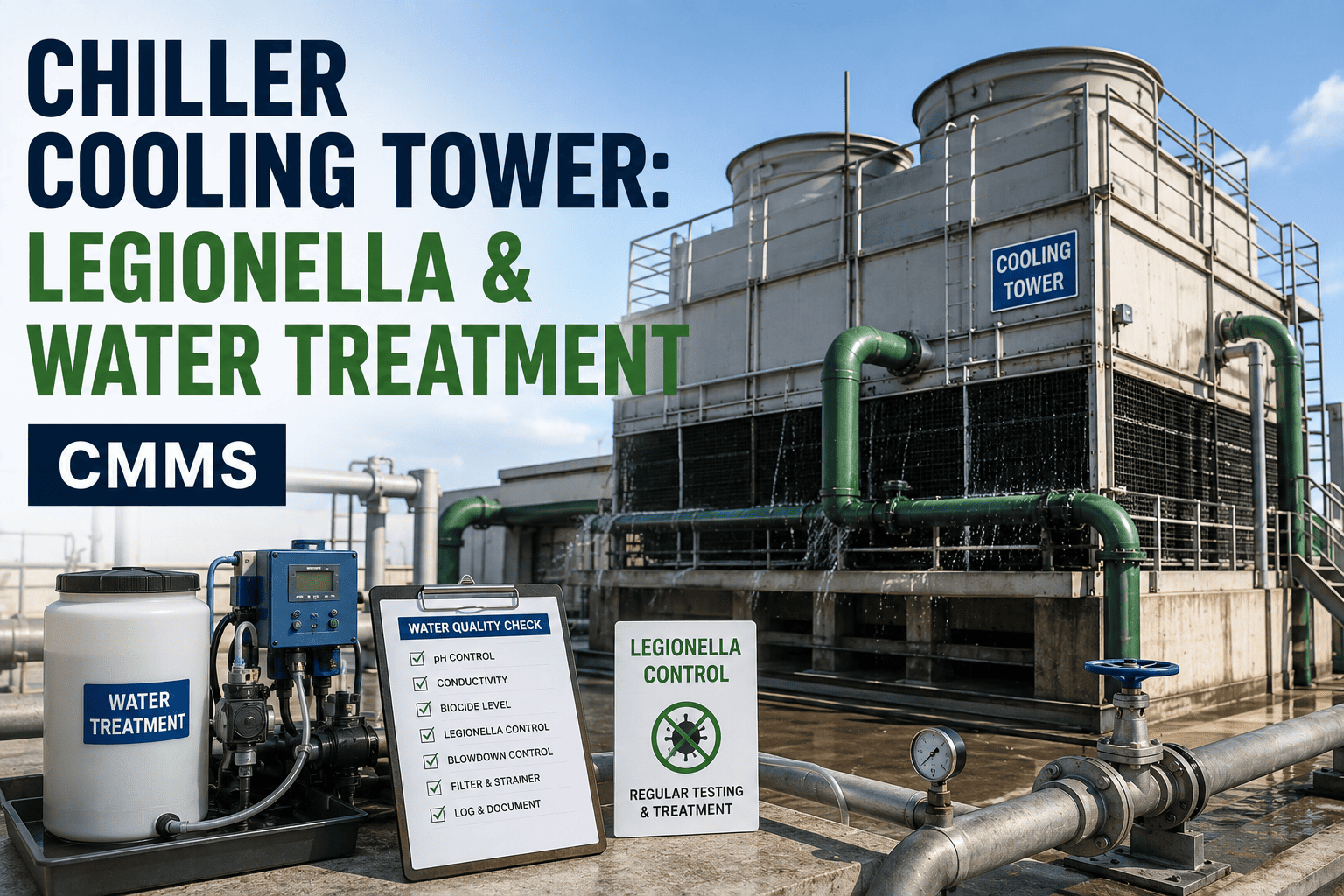
Cooling tower contamination is the invisible liability that kills people and bankrupts businesses. Every year, poorly maintained cooling towers aerosolize Legionella pneumophila across entire city blocks — causing severe pneumonia outbreaks that result in hospitalisations, deaths, regulatory shutdowns, and multi-million-dollar lawsuits. In 2025 alone, a single Harlem cooling tower cluster produced 113+ confirmed Legionnaires' disease cases and 6 deaths. The root cause in nearly every major outbreak: inadequate cleaning, missed biofilm, and reactive maintenance that only responds after people get sick.
In 2026, a growing number of facility operators are deploying robotic cleaning, inspection, and monitoring systems that eliminate the conditions Legionella needs to thrive — cutting contamination risk by 80%+ while keeping towers running at full capacity. This guide examines how robotics-assisted maintenance workflows are replacing dangerous confined-space entry, catching biofilm and sludge buildup that human crews miss, and satisfying the aggressive new regulatory requirements taking effect this year. Oxmaint integrates robotic diagnostic outputs with cooling tower maintenance programs, compliance documentation, and Legionella testing schedules — giving facility teams a single platform to manage water safety from inspection through verified remediation. Start free trial today.
Industry Guide 2026
Best Robotic Cooling Tower Cleaning and Legionella Prevention 2026
Legionella outbreaks from contaminated cooling towers cause severe pneumonia, fatalities, regulatory shutdowns, and litigation. This guide documents how facility operators are deploying robotic cleaning systems, IoT monitoring, and AI-powered inspection tools to eliminate the conditions that breed Legionella — cutting contamination risk, satisfying tightening regulations, and keeping towers running without dangerous confined-space entry or costly shutdowns.
113+Cases in NYC Harlem 2025 Outbreak
5–15%Legionnaires' Disease Fatality Rate
80%+Contamination Reduction with Robotics
May 2026NYC Monthly Sampling Law Takes Effect
1.5 km
Maximum dispersion range of Legionella-laden aerosol droplets from a contaminated cooling tower
77–113°FLegionella growth sweet spot — the exact operating temperature range of most commercial cooling towers
68%Of cooling tower Legionella events traced to biofilm buildup that resisted conventional chemical treatment
12 towersTested positive for Legionella in the 2025 NYC Harlem outbreak — all required emergency disinfection
Critical Update
NYC Local Law 159 takes effect May 7, 2026 — increasing mandatory Legionella sampling from every 90 days to monthly for all registered cooling towers. Compliance inspections shift to every 90 days. Facilities without robust, documented maintenance programs face immediate violations and potential shutdown orders.
Sign Up Free
Why Cooling Towers Breed Legionella
Cooling towers are designed to reject heat by evaporating water — creating the warm, aerosolized conditions that Legionella pneumophila needs to multiply and disperse. The same mechanism that makes cooling towers thermally efficient also makes them the most common source of large Legionnaires' disease outbreaks. Understanding the biology is the first step toward preventing it.
Legionella Risk Factors in Cooling TowersCDC / ASHRAE Data
01 — Primary Factor
Warm Water Temperature
Legionella thrives between 77–113°F (25–45°C) — precisely the operating range of commercial cooling towers. Bacteria multiply rapidly in this zone, especially in stagnant areas, dead legs, and low-flow pipe runs where temperatures remain elevated.
Growth Zone Match
02 — Protection Mechanism
Biofilm Shielding
Legionella embeds within biofilm matrices on tower fill media, basin surfaces, and distribution piping. These biofilms provide physical protection from chemical disinfectants, enabling rapid recolonisation after treatment and making conventional cleaning insufficient.
Disinfectant Resistance
03 — Dispersion Vector
Aerosol Generation
Cooling towers generate drift plumes containing microscopic water droplets. When contaminated, these droplets carry Legionella bacteria up to 1.5 km from the source — putting surrounding communities at risk far beyond the facility boundary.
Community Exposure
04 — Nutrient Source
Sediment & Sludge Buildup
Organic debris, scale, and sediment accumulating in cooling tower basins provide nutrients that feed microbial growth. This sludge layer becomes a reservoir for Legionella, continuously seeding the circulating water with bacteria.
Bacterial Reservoir
05 — System Design
Stagnation & Dead Legs
Piping dead legs, inactive cells, and low-flow zones create stagnant water pockets where disinfectant residuals drop to zero. These areas become Legionella incubators — invisible to standard water quality monitoring at the main loop.
Hidden Growth
06 — Amplification
Scale & Corrosion
Mineral scale and corroded surfaces increase surface area for biofilm attachment, reduce heat transfer efficiency forcing longer run times, and create micro-environments where chemical treatment cannot penetrate effectively.
Compounding Risk
Cooling Tower Maintenance Maturity: Where Does Your Facility Sit?
Facility operators fall into three tiers when it comes to cooling tower water safety. The majority remain in the "Reactive" category — responding to positive Legionella tests or health department citations after the risk has already materialised. Facilities deploying robotic systems are reaching the "Verified" tier where every cleaning, treatment, and inspection is confirmed by instrument data before signoff.
Reactive (Post-Incident)
48%
Scheduled (Calendar-Based)
38%
Verified (Robotics-Assisted)
14%
Robotic Cleaning Systems Leading the 2026 Market
The facilities achieving the best Legionella prevention outcomes are not deploying a single cleaning robot. They are building a toolkit of specialised robotic systems — each addressing a specific contamination risk factor — and integrating their outputs into standardised water management programs through their CMMS platform.
Sludge Removal
Submersible Basin Cleaning Robots
Weekly / Continuous Operation
Remote-operated robotic micro-dredging units deploy through openings as small as 24 inches, removing sediment from cooling tower basins while the system remains fully operational. Closed-loop filtration recycles water and chemicals — eliminating confined-space entry and tower shutdown.
Zero DowntimeClosed-Loop24/7 Run50 m³/hr
IoT Soft Robotics
Wireless Cleaning Crawlers
Complex Interior Geometries
Flexible, wirelessly-controlled soft robotic systems navigate the internal structures of cooling towers using electro-thermal actuation and IoT control. Built with boron nitride nanosheet composites, these platforms achieve high-precision cleaning in extreme environments where rigid robots cannot reach.
Wireless IoTNano-CompositeAdaptive8V DC Power
Self-Cleaning
Automated Self-Cleaning Towers
Built-In Continuous Prevention
Third-generation cooling towers with integrated automated cleaning mechanisms — engineering out the contamination problem at the design level. These systems continuously prevent sediment accumulation and biofilm formation through built-in mechanical and chemical processes.
Built-In AutoNo External Clean3rd GenBiofilm Block
Inspection
AI-Powered Inspection Robots
Quarterly / Pre-Treatment Scan
HVAC-specific robotic systems using sensor fusion, intelligent navigation, and real-time AI analysis to monitor tower conditions, water quality, and structural integrity. Identify biofilm formation, scale buildup, and corrosion before they create contamination risk.
Sensor FusionPredictive AIReal-TimeAuto-Report
Monitoring
Automated Water Quality Systems
Continuous Real-Time Monitoring
Smart sensor arrays continuously monitoring pH, ORP, disinfectant residuals, conductivity, and temperature throughout the cooling tower system. Automated dosing adjusts treatment in real time — maintaining Legionella-hostile conditions 24/7 without manual intervention.
pH / ORPAuto-Dose24/7 LogAlert System
Sampling
Robotic Legionella Sampling
Monthly (NYC 2026 Mandate)
Automated sampling robots that collect water specimens from multiple tower locations at programmable intervals — ensuring consistent, representative samples without technician exposure to contaminated aerosols. Digital chain-of-custody documentation for regulatory compliance.
Multi-PointTamper-ProofChain of CustodyAuto-Schedule
Key Players in Robotic Cooling Tower Cleaning
Three companies are driving innovation at the intersection of robotics, water treatment, and industrial cleaning automation — each with a distinct approach to the cooling tower contamination problem.
S
Sciphyn — Robotic Micro-Dredging
Submersible sludge-removal robots that deploy through small hatches into active cooling tower basins. Operate in toxic and restricted-access spaces where human divers cannot work. Closed-loop filtration recycles water and chemicals back to the system.
A
Arrow Ltd — Remote-Controlled Sludge Pumping
Remote-controlled robotic pumping units designed for online operation — processing up to approximately 50 m³ of liquid sludge per hour while the cooling tower runs continuously. Sludge dewatered via filter press; clean water returned to the tower.
M
Metso — Self-Cleaning Tower Design
Released third-generation self-cleaning cooling tower — engineering the cleaning function into the tower itself. Eliminates the need for external cleaning robots or manual intervention by continuously preventing sediment and biofilm accumulation.
Robotic vs. Traditional Cooling Tower Cleaning
The shift from manual to robotic cooling tower maintenance eliminates confined-space risk, enables continuous operation, and produces the documented evidence that regulators and insurers increasingly demand. Here is how the two approaches compare across every metric that matters.
Head-to-Head: Robotic vs. Manual Cooling Tower Maintenance
Traditional / Manual
Tower OperationShutdown Required
Confined-Space EntryRequired — High Risk
Biofilm DetectionVisual Only
Water MonitoringPeriodic Manual
Compliance DataManual Records
Water RecoveryDrained & Replaced
Robotic Systems
Tower OperationFull Operation Maintained
Confined-Space EntryEliminated Entirely
Biofilm DetectionAI + Sensor Fusion
Water MonitoringContinuous IoT Sensors
Compliance DataAuto-Logged & Auditable
Water RecoveryClosed-Loop Recycling
Legionella Risk Severity Scale
Not all cooling tower contamination events carry equal risk. A slightly elevated bacterial count in a well-treated system is a monitoring flag; a positive Legionella test in a tower serving a hospital campus is a public health emergency. This severity scale helps facility teams classify, prioritise, and respond appropriately — and measure where robotic systems deliver the greatest risk reduction.
5
Confirmed Outbreak
Positive Legionella in tower + confirmed human cases. Emergency shutdown, hyperchlorination, health department involvement. Full remediation required.
4
Positive Test Result
Legionella detected above action threshold. No confirmed cases yet. Immediate disinfection, increased sampling, root-cause investigation required.
3
Treatment Failure
Disinfectant residuals below targets, biofilm detected, or water quality parameters out of range. Conditions favour Legionella growth. Corrective action within 24 hours.
2
Maintenance Gap
Missed cleaning cycle, overdue sampling, or documentation gap. No contamination evidence but compliance risk. Schedule correction within 1 week.
1
Baseline Monitoring
All parameters within range, treatments on schedule, documentation current. Routine monitoring continues. Robotic verification confirms compliance.
The Escalating Cost of Inaction
Every month of deferred cooling tower maintenance compounds the biological, regulatory, and financial risk. Robotic cleaning tools break this cycle at the source — converting a reactive, high-risk posture into a proactive, verified, and documented water safety program.
$15K–$65K
Robotic System Investment
One-time cost for robotic cleaning and monitoring toolkit. Eliminates confined-space entry, enables zero-downtime basin cleaning, and provides continuous water quality documentation for regulatory compliance.
Prevention Cost
$50K–$200K
Remediation & Penalties
Emergency disinfection, system shutdown, regulatory fines, increased sampling requirements, and remediation consulting fees following a positive Legionella test or compliance violation.
Per Incident
$1M+
Outbreak & Litigation
Confirmed Legionnaires' disease cases trigger lawsuits, wrongful death claims, regulatory shutdown orders, brand destruction, and potential criminal liability for facility owners and operators.
Relationship-Ending
Don't Wait for a Positive Test to Act
Oxmaint connects robotic cleaning and monitoring outputs to your cooling tower maintenance program, Legionella testing schedule, compliance documentation, and water quality analytics — giving your facility team one platform to manage water safety from inspection through verified remediation.
2026 Legionella Prevention Protocol
A comprehensive prevention framework combining robotic cleaning systems with CDC Cooling Tower Toolkit guidance, ASHRAE Standard 188 requirements, OSHA worker protection standards, and the new NYC Local Law 159 monthly sampling mandate. This is the protocol that robotics-equipped facilities are following to achieve 80%+ contamination risk reduction.
Robotics-Integrated Legionella Prevention Protocol
Continuous — 24/7
Automated Water Treatment & Monitoring
Automated anti-corrosion, anti-scale, and disinfectant dosing with real-time pH and ORP monitoringMaintain measurable disinfectant residuals throughout each day per CDC guidelinesAutomated blowdown to sustain system water quality and prevent stagnation in dead legsIoT sensor alerts for any parameter excursion — triggering immediate corrective response
Weekly
Robotic Basin Cleaning & Flushing
Deploy submersible robots for continuous sludge removal — preventing sediment that feeds microbial growthFlush low-flow pipe runs and dead legs at least weekly per CDC recommendationsBalance operating times among multiple cooling tower cells to prevent stagnation zonesCirculate water 3 times per week through open loops of closed-circuit systems
Monthly — NYC 2026 Mandate
Legionella Sampling & Testing
Conduct Legionella water sampling monthly — required under NYC Local Law 159 effective May 7, 2026Use robotic multi-point sampling for consistent, representative specimens without worker aerosol exposureLog all results in digital compliance system for auditable records and trend analysis
Quarterly
Comprehensive Robotic Inspection
AI inspection of fill media, drift eliminators, distribution systems, and basin conditionThermal imaging to identify biofilm formation, scaling, and corrosion before they create contamination riskGenerate digital inspection reports meeting compliance requirements for 90-day regulatory inspections
Annually
Offline Disinfection & Deep Clean
Perform complete offline disinfection and deep mechanical cleaning at least annually per CDC guidelinesReview and update Maintenance Program and Plan (MPP) with current risk assessmentsVerify drift eliminator condition — replace if efficiency has degraded below design specification
2026 Regulatory Landscape
The regulatory environment for cooling tower water safety is tightening rapidly in 2026. Facilities must navigate overlapping federal guidance, state mandates, and industry standards — all of which increasingly expect documented, data-driven maintenance evidence that robotic systems are uniquely positioned to provide.
Key Regulations & Standards for 2026Compliance Guide
Effective May 2026
NYC Local Law 159
Increases mandatory Legionella sampling from every 90 days to monthly for all registered cooling towers. Compliance inspections conducted every 90 days. Requires robust, always-current documentation of maintenance programs.
New Mandate
US National Standard
ASHRAE Standard 188
Requires water management programs for all buildings with cooling towers — including hazard analysis, control measures, monitoring, and validation. The foundational standard for Legionella risk management in the United States.
Foundation Standard
Federal Guidance
CDC Cooling Tower Toolkit
Comprehensive guidance covering drift eliminators, automated disinfection, temperature management, stagnation prevention, and annual offline disinfection and cleaning protocols for cooling tower systems.
Best Practice
Workplace Safety
OSHA Legionellosis Guidelines
Establishes worker protection requirements for cooling tower maintenance and outbreak response — including PPE standards (N95/N100 respirators), confined-space protocols, and decontamination procedures.
Worker Safety
International
UK L8 Approved Code of Practice
One of the most comprehensive global frameworks — requiring risk assessment, cooling tower registration, and detailed control measures. Over 90% of UK cooling towers are now registered. Multiple guidance tiers from laws through technical documents.
Global Standard
Healthcare
CMS / VHA Directives
Medicare/Medicaid facilities face specific Legionella management requirements. VA Directive 1061 mandates prevention and control programs in all VHA-owned buildings where patients, residents, or visitors stay overnight.
Healthcare Mandate
KPIs for Robotics-Equipped Cooling Tower Programs
The facilities achieving the best Legionella prevention outcomes track metrics beyond just "positive or negative" test results. These KPIs reveal whether robotic systems are actually maintaining water quality, whether maintenance protocols are being followed consistently, and whether compliance documentation meets the standard regulators expect.
100%
Sampling Compliance
Target: 100% on-time monthly Legionella sampling per NYC 2026 mandate. Robotic auto-scheduling eliminates missed samples.
95%+
Treatment Uptime
Percentage of hours with disinfectant residuals within target range. Below 90% means gaps where Legionella can grow.
0
Positive Tests
Target: zero positive Legionella results. Robotics-verified programs achieve this through prevention — not luck.
80%+
Risk Reduction
Overall contamination risk reduction vs. pre-robotics baseline. Measured through biofilm surveys, sludge volume, and water quality trends.
CMMS Features That Make Robotics Work
Robotic cleaning and monitoring tools without a connected platform are just expensive equipment. The contamination risk reduction only holds when sensor data flows into a CMMS that enforces maintenance schedules, tracks compliance documentation, and turns water quality trends into actionable facility management decisions.
A
Automated Sampling Schedules
Auto-generate and assign monthly Legionella sampling work orders per NYC 2026 requirements. Calendar reminders, overdue alerts, and digital chain-of-custody documentation ensure zero missed samples.
B
Water Quality Trend Dashboard
Real-time visualisation of pH, ORP, temperature, conductivity, and disinfectant residuals from IoT sensors. Auto-flag parameter excursions and generate corrective work orders before conditions favour Legionella growth.
C
MPP Documentation Manager
Digital Maintenance Program and Plan repository with version control, required signoffs, and regulatory-ready formatting. Attach robotic inspection reports, cleaning verification evidence, and test results to the living MPP document.
D
Regulatory Inspection Prep
One-click compliance package generator that assembles all documentation regulators request: sampling history, treatment logs, cleaning records, robotic inspection reports, and MPP status — formatted for NYC, state, and federal review.
E
Robotic Cleaning Verification
Mandatory verification gates — cleaning work orders cannot be closed until robotic scan evidence is attached. Basin sludge levels, biofilm presence, and post-treatment water quality all confirmed before signoff.
F
Multi-Tower Portfolio View
Facilities managing multiple cooling towers across sites get a single dashboard showing compliance status, risk levels, upcoming maintenance, and water quality trends for every tower — eliminating the silos that allow individual towers to fall behind.
Your Cooling Towers Are a Liability Until They're Verified
The facilities with the best Legionella prevention outcomes use robotic cleaning and monitoring connected to a CMMS that enforces protocols, documents compliance, and proves safety to regulators, insurers, and building occupants. Oxmaint gives your team that platform — from first inspection through verified remediation.
Frequently Asked Questions
Q. Can robotic cleaning systems operate while the cooling tower is running?
Yes — this is one of the primary advantages. Submersible sludge-removal robots deploy into active cooling tower basins through openings as small as 24 inches and operate continuously while the tower runs at full capacity. There is no need to shut down, drain, or send workers into confined spaces. Companies like Sciphyn and Arrow Ltd specialise in zero-downtime robotic cleaning that keeps facilities operational during maintenance.
Sign up for Oxmaint to manage robotic cleaning schedules alongside your full tower maintenance program.
Q. What does NYC Local Law 159 require starting May 2026?
Local Law 159 of 2025 takes effect May 7, 2026 and increases mandatory Legionella sampling frequency from every 90 days to every month for all registered cooling towers in New York City. Compliance inspections will be conducted every 90 days. Building owners must maintain current Maintenance Program and Plans (MPPs) with documented evidence of all testing, treatment, and cleaning activities. Robotic monitoring and automated sampling systems help facilities meet this aggressive schedule without gaps.
Book a demo to see how Oxmaint automates NYC compliance documentation.
Q. How do robotic systems help prevent biofilm that shelters Legionella?
Biofilm is the primary reason Legionella survives conventional chemical treatment — bacteria embed within protective matrices on tower surfaces that disinfectants cannot penetrate. Robotic systems address this in three ways: submersible cleaning robots physically remove sludge and sediment that biofilm anchors to, AI inspection robots detect biofilm formation early through sensor fusion and thermal imaging, and continuous IoT monitoring ensures disinfectant residuals never drop to levels that allow biofilm regrowth. Together, these systems break the biofilm cycle that chemical-only approaches cannot.
Q. What is the investment range for a robotic cooling tower cleaning system?
A basic robotic cleaning system (submersible basin robot + IoT water quality monitoring) ranges from $15,000 to $40,000 depending on tower size and features. Comprehensive systems adding AI inspection, automated sampling, and self-cleaning tower upgrades range from $40,000 to $65,000+. Compare this against the cost of a single Legionella remediation event ($50K–$200K), regulatory penalties, or the litigation exposure from an outbreak ($1M+) — and the ROI case is clear.
Schedule a demo to model expected ROI for your facility.
Q. Do we still need annual offline disinfection if we use robotic cleaning continuously?
Yes. CDC guidelines and most regulatory frameworks still require at least one annual offline disinfection and deep cleaning regardless of continuous robotic maintenance. Robotic systems dramatically reduce the severity and duration of this annual event — because basins, fill media, and piping are already clean from continuous robotic maintenance — but they do not replace the regulatory requirement. Think of annual offline cleaning as a verification and reset event, not the primary defence line.