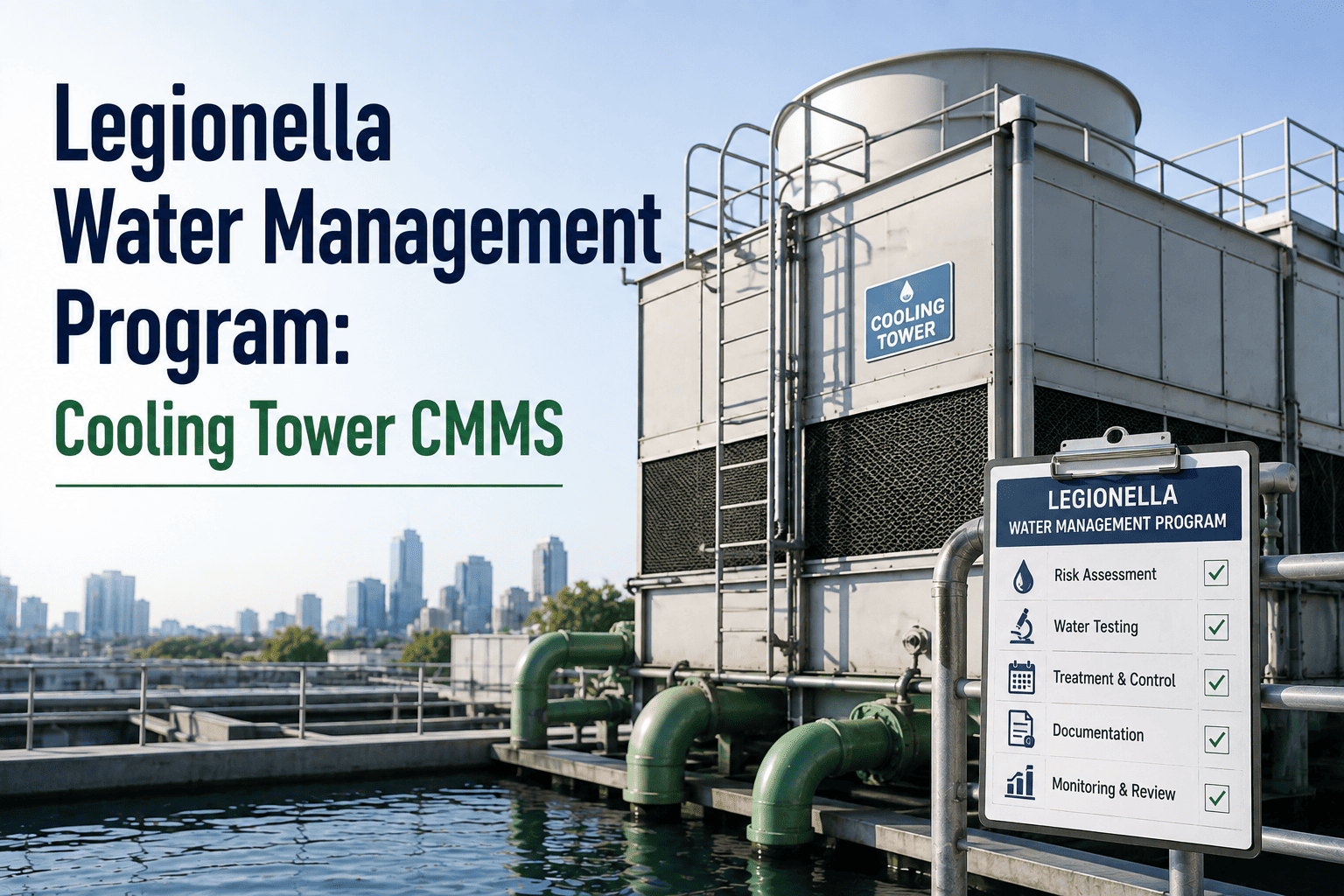
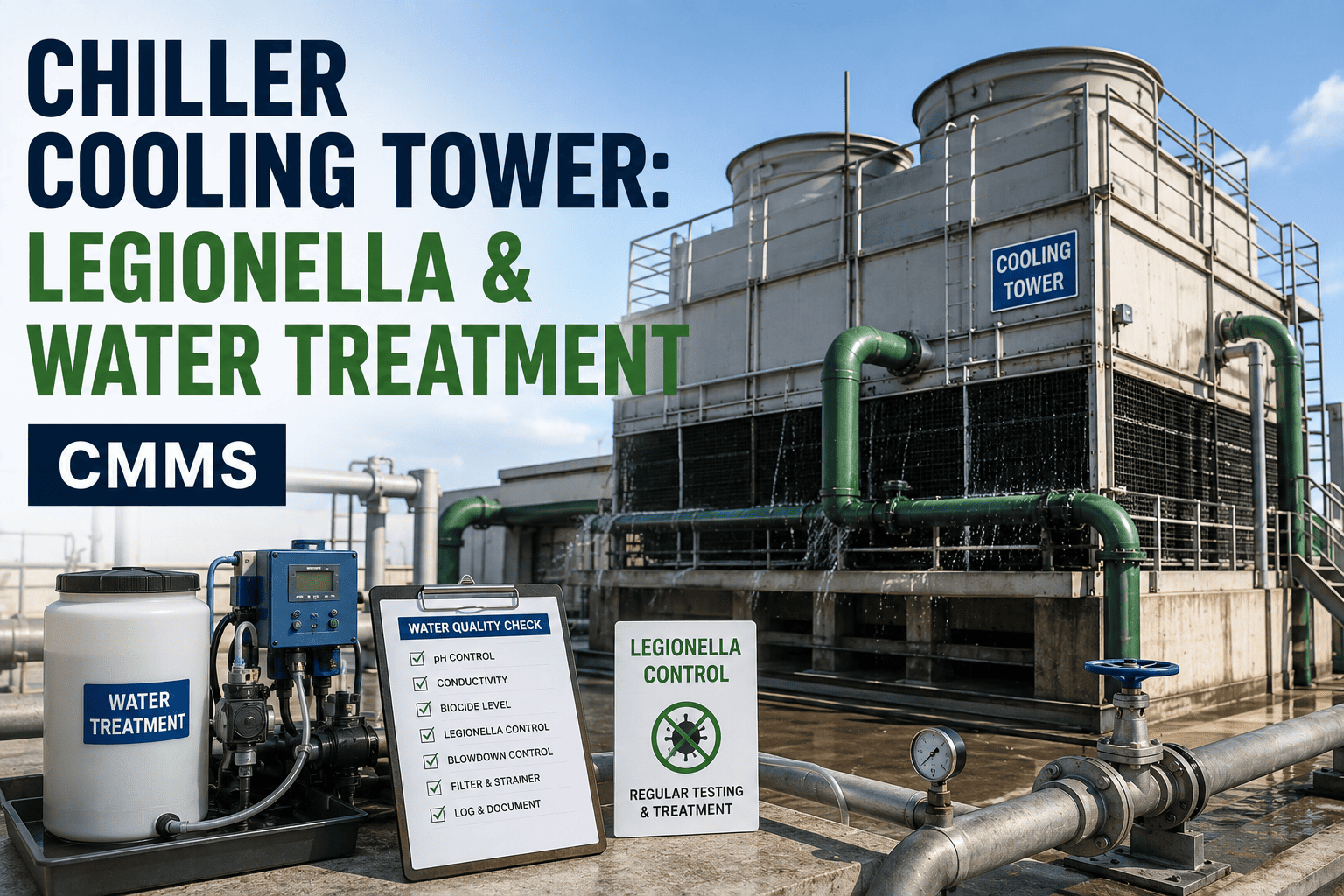
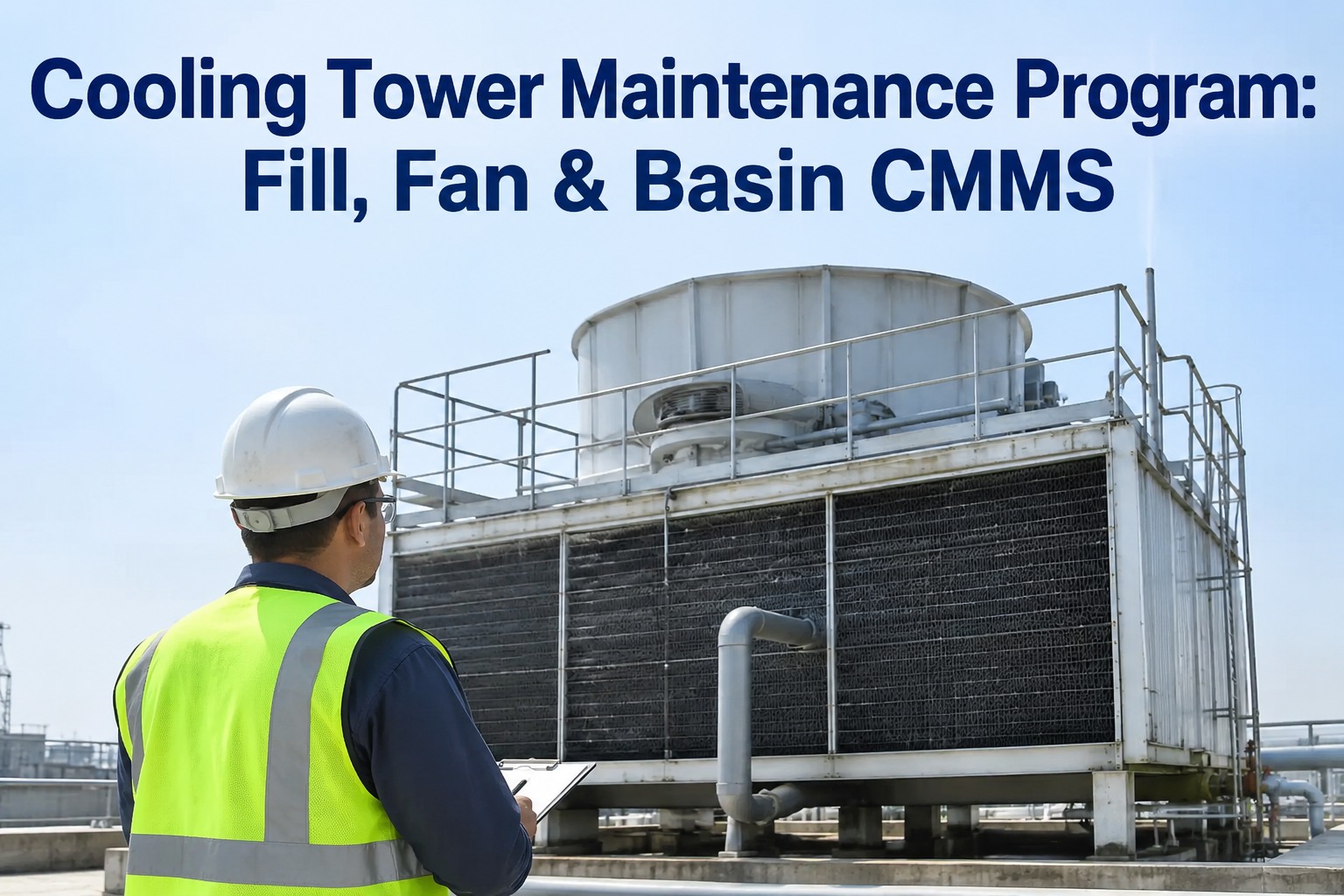
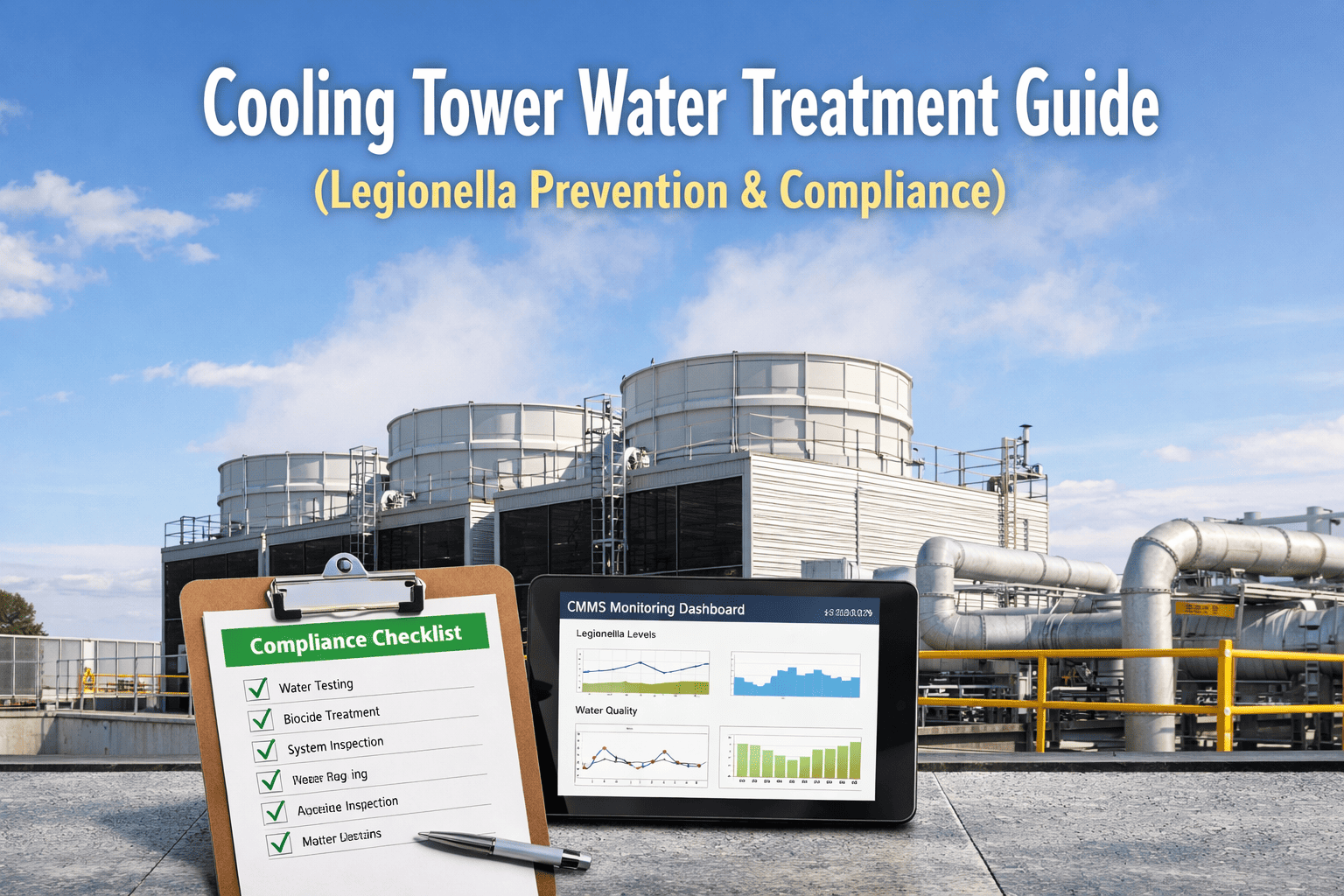
Cooling tower maintenance is one of the highest-stakes maintenance obligations in commercial facilities — not because towers are expensive to repair, but because a poorly maintained tower is the primary source of Legionella bacteria that causes Legionnaires’ disease outbreaks. OxMaint helps facilities teams execute and document cooling tower water treatment programs, basin cleaning schedules, microbiological testing, and Legionella risk assessments in a single compliant platform. This checklist covers water treatment chemistry, basin cleaning, drift eliminator condition, fill media, fan motor inspection, and testing schedules — everything required to maintain safe, efficient cooling tower operation and demonstrate regulatory compliance.
Checklist · Compliance Tracking · P1 Critical · Legionella Prevention
Cooling Tower Maintenance and Legionella Prevention Checklist
Water treatment, basin cleaning, drift eliminators, fill media, fan motor inspection, and microbiological testing — the complete compliance checklist for safe cooling tower operation.
!
Regulatory Notice: ASHRAE 188-2021, NYC Local Law 77, and numerous state regulations now require documented Water Management Plans (WMPs) for cooling tower systems. Non-compliance with Legionella prevention requirements can result in facility shutdown orders, fines up to $10,000 per day, and criminal liability in outbreak cases.
Risk Overview
Why Cooling Towers Are the Highest Legionella Risk System
95°F
Optimal Legionella growth temperature — basin water often in this range
1 km
Distance drift aerosols can travel from an infected tower
10–15%
Case fatality rate for Legionnaires’ disease in vulnerable populations
72 hrs
Maximum interval for water treatment inspection after tower restart
Water Treatment Program
Water Chemistry Control — Daily, Weekly & Monthly
Maintaining correct water chemistry is the first line of defense against Legionella. Out-of-range parameters accelerate biological growth, scaling, and corrosion simultaneously.
| Parameter | Target Range | Check Frequency | Out-of-Range Action |
|---|
| pH | 7.0 – 8.5 | Daily | Adjust acid/alkaline feed — recheck in 4 hours |
| Conductivity (µS/cm) | Per cycles-of-concentration target | Daily | Adjust blowdown rate — retest next day |
| Biocide residual | Per product specification | Daily | Dose biocide — confirm residual before logging |
| Inhibitor residual | Per product specification | Weekly | Add inhibitor, notify water treatment provider |
| Total dissolved solids | Per cycles of concentration | Weekly | Increase blowdown, check makeup water quality |
| Calcium hardness (ppm) | 100 – 300 ppm | Monthly | Adjust scale inhibitor dosage |
| Total alkalinity (ppm) | 100 – 300 ppm | Monthly | Adjust acid feed program |
| Chlorine / biocide (free) | 1.0 – 3.0 ppm | Daily at startup | Dose to target before releasing to operation |
Microbiological Testing
Legionella Testing Schedule & Action Levels
Required Testing Schedule
Heterotrophic Plate Count (HPC) — test monthly, target < 10,000 CFU/mL
Legionella culture test — quarterly minimum (monthly in high-risk facilities)
Post-shutdown Legionella test before returning tower to service
After any water treatment program change — retest within 2 weeks
Following any significant system repair or cleaning event — test before restart
Legionella Action Level Table
| Result (CFU/L) | Risk Level | Required Action |
|---|
| < 100 | Low | Continue monitoring schedule |
| 100 – 999 | Caution | Review WMP, increase biocide, retest in 2 weeks |
| 1,000 – 9,999 | Action | Hyperchlorinate, inspect system, notify management |
| ≥ 10,000 | Shutdown | Immediate shutdown, decontamination, regulatory notification |
Automate Legionella Compliance Tracking with OxMaint
Schedule mandatory water tests, log results, trigger corrective work orders at action levels, and generate Water Management Plan documentation — all in one compliant platform.
Physical Inspection
Basin, Fill, Drift Eliminators & Fan Motor Checklist
Basin & Structure
Inspect basin for sediment accumulation, biological growth, and debris — clean quarterly minimum
Check basin water level and float valve operation — verify makeup water shutoff function
Inspect structural integrity — corrosion on steel components, cracks in concrete basins
Verify blowdown valve and strainer operation — clean strainer basket
Fill Media
Inspect fill for biological fouling, scaling, and physical damage or collapse
Check fill support structure for sagging or displaced sections — replace damaged fill
Inspect distribution nozzles for blockage — flush clear, replace cracked nozzles
Verify water distribution uniformity across fill surface — no dry zones
Drift Eliminators
Inspect drift eliminator sections for fouling, biological growth, and physical damage
Check eliminator seating and seals — gaps allow drift aerosols to escape untreated
Clean eliminators semi-annually with high-pressure wash — inspect for cracks after cleaning
Verify drift rate compliance with applicable code (≤ 0.001% of circulating flow for most jurisdictions)
Fan Motor & Drive
Measure fan motor amp draw and compare to nameplate — log quarterly
Inspect fan blades for damage, erosion, and biological deposits — clean annually
Check gearbox oil level and condition — change per manufacturer schedule (typically annual)
Vibration check on motor, gearbox, and fan shaft bearings — compare to prior baseline
Seasonal Procedures
Startup, Shutdown & Annual Cleaning Protocol
Spring Startup
Full basin cleaning before filling — vacuum, scrub, and inspect
Disinfect with hyperchlorination to ≥ 5 ppm free chlorine, hold 24 hours
Legionella culture test — confirm negative result before placing in service
Verify all chemical feed systems and monitoring equipment are functional
Fall Shutdown
Drain and flush basin completely — remove all standing water
Clean and inspect all internal surfaces — document condition with photos
Disinfect tower before draining — prevent Legionella from desiccating in scale
Inspect fan motor windings, seals, and all bearings — schedule any repairs before spring
“Every Legionnaires’ disease outbreak linked to a cooling tower I have investigated had one thing in common — a maintenance record gap. Either the biocide dosing was not logged, or the monthly HPC test was skipped, or the basin cleaning was overdue with no escalation. The science of Legionella control is well understood. The failures are always documentation failures and accountability gaps, not knowledge gaps. Digital compliance tracking eliminates the gap.”
SN
Sandra Novak
CWT (Certified Water Technologist) · ASHRAE 188 Water Management Plan Specialist · 21 years cooling system compliance
FAQ
Cooling Tower Legionella Prevention — Common Questions
What regulations apply to cooling tower Legionella prevention? +
ASHRAE 188-2021 is the primary national standard requiring Water Management Plans for cooling towers in commercial buildings. New York City Local Law 77, California, and many other jurisdictions have enacted mandatory registration, inspection, and testing requirements with specific documentation obligations. The CDC and OSHA also publish Legionella guidance that sets liability standards even where specific statutes are absent.
OxMaint’s compliance module tracks all testing, treatment, and inspection records to satisfy ASHRAE 188 documentation requirements and local regulatory audits.
How often must a cooling tower be completely cleaned and disinfected? +
ASHRAE 188 and most regulatory frameworks require at minimum annual cleaning with full disinfection — typically scheduled at spring startup. High-risk facilities (hospitals, hotels, buildings with elderly occupants) and towers with recurring elevated HPC or Legionella results may require semi-annual cleaning. Any tower that has been offline for more than 5 days must be disinfected before being returned to service — a step that is frequently missed during shoulder-season cycling.
Book a demo to see how OxMaint automates restart disinfection protocols.
What is a Water Management Plan and who is responsible for it? +
A Water Management Plan (WMP) under ASHRAE 188 is a documented risk management program that identifies all water systems with Legionella risk, assigns a Water Management Team, defines control measures and their acceptable limits, establishes monitoring schedules, and specifies corrective action protocols. Building owners and operators are legally responsible for maintaining a current WMP. The plan must be reviewed annually and updated whenever the system or population served changes significantly. OxMaint generates the operational documentation layer — testing records, inspection logs, and corrective action history — that supports an ASHRAE 188-compliant WMP.
What is the correct biocide rotation for cooling tower Legionella control? +
Best practice for cooling tower Legionella control is to use two alternating biocides with different modes of action — typically an oxidizing biocide such as stabilized bromine or chlorine for continuous residual maintenance, combined with a non-oxidizing biocide such as DBNPA or isothiazolinone applied on a weekly or bi-weekly shock basis. Using a single biocide long-term can allow resistant biofilm to develop. Your water treatment provider’s program should specify both products, dosing concentrations, contact times, and monitoring targets — all of which should be logged in
OxMaint against each treatment event.
Protect Your Facility and Your Occupants with OxMaint
OxMaint tracks water chemistry logs, Legionella test results, basin cleaning records, and corrective actions — producing the complete compliance documentation your Water Management Plan requires.