VAV boxes and dampers are the invisible regulators of every modern commercial building's comfort and energy performance — hundreds or thousands of them buried above ceilings, behind access panels, and in mechanical shafts where they quietly control airflow to individual zones. When they fail — stuck actuators, seized dampers, drifting sensors, leaking housings — the symptoms are maddeningly vague: hot spots, cold complaints, rising energy bills, and pressure imbalances that propagate through entire floors before anyone traces the cause back to a single malfunctioning terminal unit.
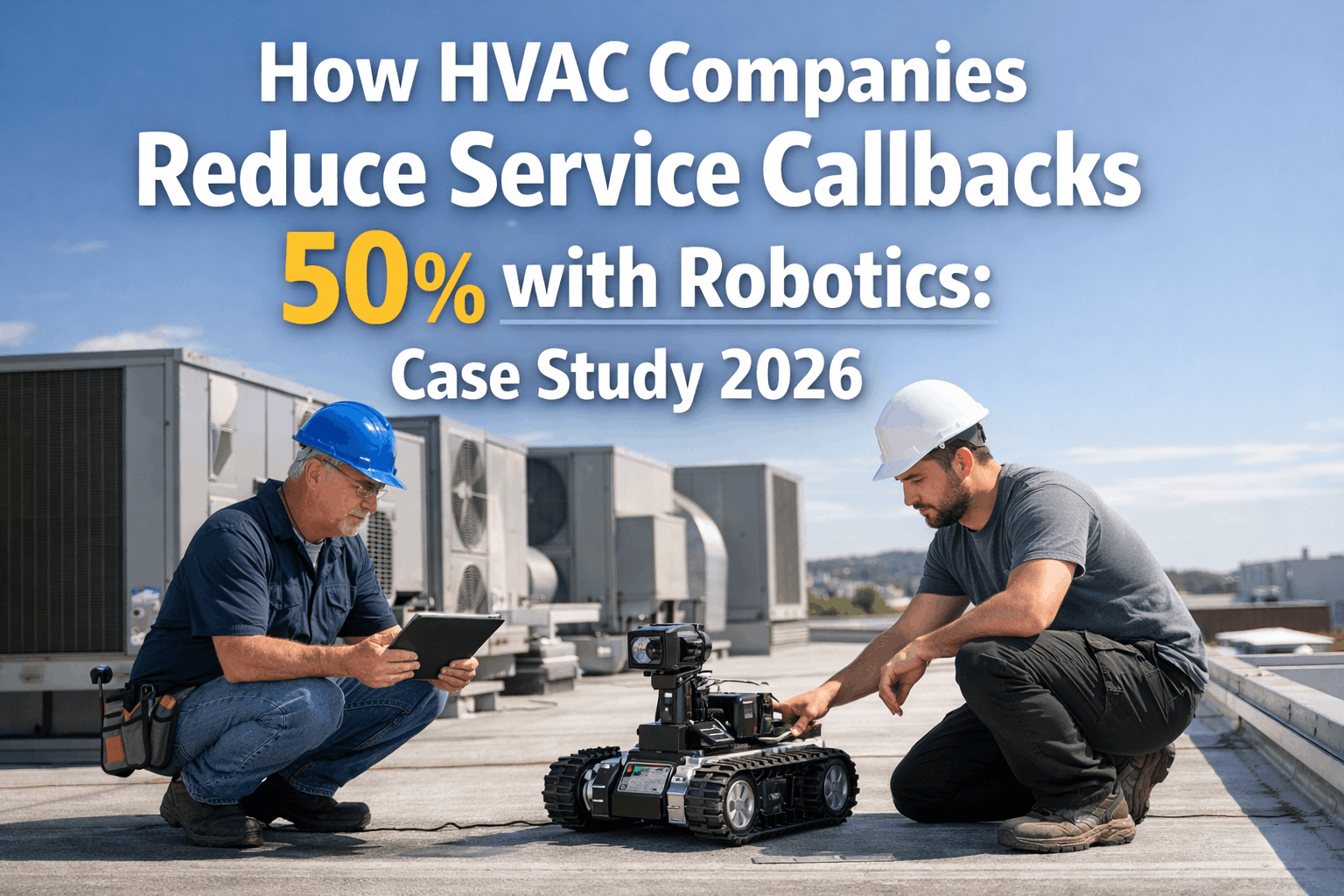
In 2026, robotic inspection systems purpose-built for above-ceiling and in-plenum environments are transforming how building teams find and fix VAV box and damper failures. Compact crawlers navigate ceiling voids autonomously, scanning actuator positions, measuring damper blade angles, checking airflow against BAS setpoints, and flagging discrepancies that manual inspections routinely miss. The result: comfort complaints resolved 3x faster, energy waste from stuck dampers eliminated within days instead of months, and a complete condition record for every terminal unit in the building — without displacing a single ceiling tile per unit manually. Oxmaint integrates robotic inspection data with asset registries, automated work orders, and BAS correlation workflows — giving facility teams a single platform to inspect, diagnose, and maintain every VAV box and damper across their portfolio. Start free trial today.
Technology Guide 2026
Best Robotic VAV Box and Damper Inspection for Buildings 2026
From autonomous plenum crawlers scanning actuator positions to AI-powered airflow verification drones mapping zone-by-zone delivery, this guide equips facility managers, building engineers, and HVAC contractors with the specifications, comparison data, and deployment frameworks needed to select and implement robotic VAV and damper inspection — and connect every finding to repair workflows and energy optimisation.
31%VAV Boxes with Faults in Typical Office Building
$4.20Annual Energy Waste Per Sq. Ft. from Stuck Dampers
8 minRobotic Inspection Per VAV Box
73%Of Faults Invisible to BAS Alone
$2.8M
Average annual energy wasted by faulty VAV boxes and dampers in a 500,000 sq. ft. commercial campus
45 minAverage time for manual above-ceiling inspection of a single VAV box — including ladder, tile removal, and restoration
62%Of stuck or drifted dampers go undetected for 6+ months under BAS-only monitoring strategies
1,200+Average number of VAV terminal units in a Class A office tower — each one a potential comfort and energy failure point
Did you know?
73% of VAV box faults are invisible to building automation systems alone. A BAS sees the commanded damper position — not the actual blade angle. A stuck actuator reporting 60% open while physically jammed at 100% appears perfectly normal on every dashboard and trend log. Only physical inspection — or a robot that verifies actual position — catches the discrepancy before it becomes a chronic comfort complaint and energy drain.
Sign Up Free
VAV Inspection Maturity Spectrum
Building teams approach VAV box and damper inspection at three distinct maturity levels. The majority remain in the "Complaint-Driven" tier — inspecting terminal units only when tenants report discomfort. Robotic inspection systems are enabling a shift toward "Systematic" and "Continuous" postures where every VAV box is verified on a recurring cycle and discrepancies between BAS commands and physical reality are caught automatically.
Complaint-Driven (Reactive)
56%
Systematic (Scheduled Robotic)
30%
Continuous (AI + Robotics)
14%
Critical Evaluation Pillars for VAV Inspection Robots
Above-ceiling environments present unique challenges that most general-purpose robots cannot handle — confined clearances as low as 12 inches, suspended grid ceilings that cannot bear weight, cable trays and conduit obstructions, poor lighting, dust accumulation, and the requirement to operate silently in occupied buildings during business hours. A rigorous evaluation framework ensures the robot you deploy actually navigates your specific plenum conditions.
VAV Inspection Robot Evaluation CheckpointsSelection Framework
Navigation
Plenum Traversal
Self-guided movement through above-ceiling plenums with 12–36 in. clearance. Must navigate around cable trays, conduit runs, fire sprinkler lines, and structural members without damaging ceiling grids or insulation.
Access Critical
Diagnostics
Damper Position Verification
Optical or LiDAR measurement of actual damper blade angle compared against BAS commanded position. Must detect stuck, drifted, and partially seized dampers with ±2° angular accuracy — the core capability that justifies robotic inspection.
Core Function
Airflow
CFM Measurement
Onboard anemometry or differential pressure sensing that measures actual airflow through each VAV box and compares against design CFM and BAS setpoint. Identifies restrictions, leakage, and duct disconnections upstream of the terminal unit.
Performance Check
Thermal
Reheat Coil & Actuator Scan
Integrated thermal imaging that detects hot-water reheat coil fouling, electric heater element failures, actuator motor overheating, and control valve leakage — all failure modes invisible to visual inspection and BAS trend logs.
Hidden Faults
Acoustic
Noise & Vibration Analysis
Ultrasonic microphones that detect bearing noise from failing actuators, rattling damper blades, and air turbulence from improper duct connections — identifying problems that tenants hear but technicians cannot localise without above-ceiling access.
Tenant Impact
Integration
BAS & CMMS Connectivity
Live data feed comparing robotic measurements against BAS setpoints in real time. Auto-generated CMMS work orders with fault type, location, severity, photo evidence, and recommended repair — not just a raw data dump.
Workflow Value
Top VAV Fault Categories Robots Detect
Robotic inspection across thousands of VAV boxes reveals that terminal unit faults cluster into five dominant categories — all of which are difficult or impossible to detect from BAS data alone. Understanding these fault profiles is essential for prioritising which buildings, floors, and equipment vintages to inspect first.
5
Stuck Fully Open
Damper jammed at 100% — zone overcooled/overheated continuously. Maximum energy waste. Adjacent zones starved of air. Immediate repair required.
4
Actuator Failure
Motor seized or linkage disconnected. Damper locked at last position. BAS shows normal commands but zone cannot modulate. Comfort loss accumulates.
3
Sensor Drift
Discharge air or zone temperature sensor drifted 3°F+. VAV box modulating to wrong setpoint. Subtle comfort drift that tenants feel but cannot articulate clearly.
2
Reheat Fault
Hot water valve leaking through or electric heater element failed. Simultaneous heating and cooling in same zone. Energy waste without comfort impact initially.
1
Housing Leakage
Casing seam separation or flex duct disconnection. Conditioned air lost to plenum. Reduced delivery to zone but compensated by damper opening wider.
Find the VAV Faults Your BAS Cannot See
Oxmaint connects robotic VAV inspection outputs to asset registries, BAS correlation dashboards, and automated work order workflows — giving building teams a single platform to inspect, diagnose, and repair every terminal unit across their portfolio without displacing a single ceiling tile manually.
Top Robot Categories for VAV Inspection 2026
The most effective VAV inspection programmes deploy different robot types matched to building construction, ceiling clearance, access constraints, and inspection scope. Each category excels in different environments — and understanding where each performs best prevents mismatches between robot capability and building reality.
Core
Plenum Crawler Robots
Primary Inspection Platform
Low-profile wheeled or tracked robots that traverse above-ceiling plenums autonomously. Equipped with articulating camera arms, LiDAR damper angle sensors, onboard anemometry, and thermal imaging. Navigate between VAV boxes on ceiling grid supports or dedicated rail systems.
4 in. ProfileSLAM Nav±2° DamperThermal + HD
Aerial
Micro Inspection Drones
Open Plenum & High-Bay Spaces
Ultra-compact UAVs (sub-12 in.) that fly through open ceiling plenums and high-bay spaces to visually inspect VAV box exteriors, flex duct connections, and damper positions from multiple angles. Best where crawlers cannot reach or ceiling grids cannot bear weight.
Sub-12 in.GPS-DeniedHD + Zoom6-10 min.
Smart
Actuator Diagnostic Probes
Targeted Component Testing
Robotic articulating arms that insert through ceiling tile openings and dock directly onto VAV box actuators. Perform full-stroke cycling tests, measure torque curves, verify linkage integrity, and confirm electrical connection health without removing the unit.
Full-Stroke TestTorque CurveLinkage Check2 min/Unit
Hybrid
BAS-Correlated Sensor Arrays
Permanent Monitoring Overlay
Networks of wireless sensors permanently installed at VAV box inlets and outlets that continuously compare actual airflow and temperature against BAS commands. Robotically deployed during initial survey, then monitor autonomously 24/7 and flag discrepancies.
24/7 MonitorBAS CompareWireless MeshBattery 3 yr.
Emerging
Acoustic Fault Detection Bots
Above-Ceiling Sound Mapping
Robots equipped with ultrasonic microphone arrays that create acoustic maps of ceiling plenums — identifying stuck actuators by motor noise signatures, leaking dampers by air turbulence patterns, and failing bearings by frequency analysis without physical contact.
Ultrasonic ArrayML ClassifyNon-ContactNoise Map
Service
Robotic Inspection as a Service
Per-Building Engagement
Third-party providers who deploy inspection robots on your building without capital equipment purchase. Deliver complete VAV condition reports with fault classifications, repair recommendations, and energy impact estimates. Ideal for portfolio-wide baseline assessments.
No CapExPer Sq. Ft.Full ReportBAS Correlation
Pro Tip
The highest-performing building teams use a layered approach: plenum crawlers for comprehensive initial surveys, actuator diagnostic probes for targeted component testing on flagged units, and BAS-correlated sensor arrays for ongoing monitoring between robotic inspection cycles. This combination catches faults at every stage of development — from early drift to full seizure.
Book a Demo
Head-to-Head Specification Matrix
Different building types demand different inspection approaches. A 1990s office tower with tight T-bar ceiling grids and hundreds of small VAV boxes presents a completely different challenge than a modern open-plan space with exposed structure and large-format terminal units. This matrix maps specifications across the three primary robotic inspection categories.
Plenum Crawler
Profile: 4–6 in. height
Speed: 15–25 VAV boxes/hour
Battery: 4–6 hrs continuous
Sensors: LiDAR, thermal, HD, anemometer
Price: $35,000–$90,000
Micro Drone
Size: Sub-12 in. frame
Speed: 8–15 VAV boxes/hour
Flight: 6–10 min. per battery
Sensors: HD camera, zoom, thermal optional
Price: $15,000–$45,000
Actuator Probe
Reach: 4 ft. articulation arm
Speed: 20–30 units/hour
Power: Mains + battery backup
Tests: Stroke, torque, linkage, electrical
Price: $20,000–$55,000
Before & After: What Changes with Robotic Inspection
Understanding the performance gap between complaint-driven manual VAV inspection and systematic robotic programmes translates directly into comfort complaints resolved, energy dollars recovered, and maintenance hours redirected from reactive firefighting to planned work. Here is what the data shows.
Performance Comparison: Manual vs. Robotic VAV Inspection
Manual Inspection
Time Per VAV Box45 min
Fault Detection Rate38%
Building CoverageComplaint-Only
Comfort ComplaintsChronic
Energy Waste IdentifiedLow
Robotic Inspection
Time Per VAV Box8 min
Fault Detection Rate94%
Building Coverage100% Cycle
Comfort Complaints70% Fewer
Energy Waste Identified$4.20/ft² Saved
The Cost of Ignoring Terminal Unit Health
For every chronic comfort complaint that reaches the property manager's desk, there are dozens of silently malfunctioning VAV boxes underneath — leaking energy, fighting each other, and degrading tenant satisfaction one degree at a time. The cost escalation pyramid shows how small inspection investments prevent the large operational losses that erode NOI and tenant retention.
$3 - $8K
Robotic Inspection Cycle
Cost to robotically inspect every VAV box in a 200,000 sq. ft. building. Complete condition report with fault classification, BAS correlation, and prioritised repair list delivered in days, not months.
Frequency: Semi-Annual
$85K - $210K
Annual Hidden Energy Waste
Stuck dampers, simultaneous heating-cooling, and airflow imbalances across a typical 200,000 sq. ft. office building. Energy waste invisible on utility bills until robotically identified and quantified per zone.
Frequency: Every Month Ignored
$500K+
Tenant Non-Renewal
Chronic comfort complaints drive tenant dissatisfaction. In Class A office, a single floor non-renewal represents $500K+ in lost annual revenue plus leasing commissions, TI costs, and vacancy carrying costs.
Frequency: Relationship-Ending
KPIs That Prove Inspection Programme Value
Units inspected is the most visible metric, but the best robotic VAV programmes track deeper KPIs that connect inspection activity to actual building performance outcomes — comfort complaints resolved, energy recovered, and maintenance hours redirected from reactive to planned.
94%
Fault Detection Rate
Robotic systems detect 94% of VAV faults vs. 38% for manual spot-check methods. Track per inspection cycle to verify robot calibration.
70%
Comfort Complaint Reduction
Buildings with systematic robotic VAV inspection average 70% fewer comfort calls. Track monthly against pre-inspection baseline.
$4.20
Energy Savings / Sq. Ft.
Annual energy waste recovered by fixing damper faults identified through robotic inspection. Compare utility bills pre/post remediation cycle.
5.6x
Inspection Speed Gain
Robotic inspection at 8 min/unit vs. manual at 45 min/unit. Enables complete building coverage on recurring cycles instead of complaint-only spot checks.
Your 6-Month Deployment Roadmap
You do not need to inspect every VAV box in every building on day one. The most successful programmes start with a single high-complaint building, prove the energy and comfort ROI, then scale across the portfolio using documented results — not promises — as the business case.
From Complaint-Driven to Systematic: VAV Inspection Rollout
Weeks 1-4
Audit & Baseline
Inventory all VAV boxes by building, floor, zone, manufacturer, vintage, and BAS point namePull 12-month comfort complaint data and map to specific VAV box locations and zonesAssess ceiling plenum conditions — clearance, obstructions, grid type — for robot compatibility
Weeks 5-10
Pilot Inspection
Deploy robotic inspection on your highest-complaint building — target 100% VAV box coverageCorrelate robotic findings with BAS trend data to identify command-vs-actual discrepanciesConfigure CMMS integration for auto-generated work orders with fault type, location, and severity
Weeks 11-16
Remediate & Measure
Repair faults prioritised by severity — stuck dampers and failed actuators first, sensor drift secondMeasure comfort complaint reduction and energy savings against pre-inspection baselineDocument ROI with actual numbers for portfolio expansion business case
Weeks 17-26+
Scale & Sustain
Roll out robotic inspection to additional buildings based on documented pilot ROIEstablish semi-annual inspection cycles with CMMS-scheduled robot deploymentsLayer in permanent BAS-correlated sensor arrays on highest-value floors for continuous monitoring
CMMS Features That Maximise Inspection ROI
A robotic inspection without a downstream maintenance platform is an expensive survey that gathers dust. The real return comes when every fault finding flows into a CMMS that creates prioritised work orders, correlates with BAS data, tracks repair completion, and measures the comfort and energy impact of every fix — closing the loop between detection and resolution.
A
VAV Box Asset Registry
Every terminal unit mapped with manufacturer, model, size, BAS point name, zone served, last inspection date, fault history, and current condition score in one searchable, auditable registry.
B
Fault-to-Work-Order Automation
Robotic findings auto-generate severity-classified CMMS work orders with fault type, damper angle deviation, thermal image, CFM measurement, and repair recommendation — zero manual ticket creation required.
C
BAS Correlation Dashboard
Side-by-side display of BAS commanded position vs. robotic-verified actual position for every inspected VAV box. Instantly reveals which units are lying to your building automation system.
D
Comfort Complaint Correlation
Maps tenant comfort complaints to specific VAV box fault findings — proving whether the fault explains the complaint and tracking complaint reduction after repair to verify resolution.
E
Energy Impact Calculator
Estimates annual energy waste per faulty VAV box based on fault type, zone size, and operating hours. Aggregates building-wide waste to quantify the financial case for repair prioritisation and portfolio-scale inspection.
F
Inspection Cycle Scheduler
Automated scheduling of semi-annual or quarterly robotic inspection cycles per building. Tracks coverage completion, outstanding faults, and re-inspection requirements to ensure no building falls off the programme.
Your VAV Boxes Are Telling Your BAS Exactly What It Wants to Hear
31% of terminal units in a typical building have active faults — and 73% of those faults are invisible to your building automation system. Oxmaint gives your team the platform to inspect robotically, correlate with BAS, automate repairs, and prove comfort and energy results to ownership — all from one place.
Frequently Asked Questions
Q. How quickly does robotic VAV inspection pay for itself?
Most buildings recover the inspection cost within 2–3 months through energy savings from fixed damper faults alone. A single stuck-open damper on a perimeter zone can waste $800–$2,000 per year in energy. Multiply across the 31% fault rate in a typical building and the payback is immediate. Add comfort complaint reduction and avoided tenant concessions and the ROI compounds further.
Schedule a demo to model projected savings for your portfolio.
Q. Can robots operate in occupied buildings during business hours?
Yes. Plenum crawlers operate above the ceiling out of sight and earshot of tenants. Noise levels are typically below 35 dB — quieter than a normal conversation. Most robotic inspections are scheduled during standard business hours to capture VAV boxes under actual load conditions, which produces more diagnostically useful data than after-hours inspections when zones are unoccupied.
Sign up for Oxmaint to see how inspection scheduling integrates with tenant notification workflows.
Q. What ceiling types are compatible with plenum crawlers?
Standard 2×2 and 2×4 T-bar suspended ceilings with 12+ inches of plenum clearance are fully compatible. Drywall ceilings require access panel placement. Open-plenum and exposed-structure designs may be better served by micro inspection drones. Some crawler models include rail systems that mount to the structure above the ceiling grid, avoiding any grid loading entirely. Always conduct a plenum walkthrough survey before selecting your robot platform.
Q. How does robotic inspection compare to BAS analytics for finding VAV faults?
BAS analytics detect faults visible in trend data — temperature control failures, airflow readings that deviate from setpoint, and scheduling errors. However, 73% of mechanical VAV faults — stuck actuators reporting normal position, leaking damper seals, disconnected linkages, and fouled reheat coils — are invisible to BAS because the BAS only sees commanded data, not physical reality. Robotic inspection catches the faults that analytics cannot. The two approaches are complementary, not competing.
Book a demo to see how Oxmaint correlates robotic findings with BAS data.
Q. How do I prioritise which buildings to inspect first?
Rank buildings by three factors: comfort complaint density (highest complaints first), equipment age (VAV boxes over 15 years have 2–3x higher fault rates), and lease sensitivity (buildings with major tenants approaching renewal decisions). A single robotic inspection of your highest-complaint building will produce enough documented faults and calculated energy waste to build the business case for portfolio-wide rollout.