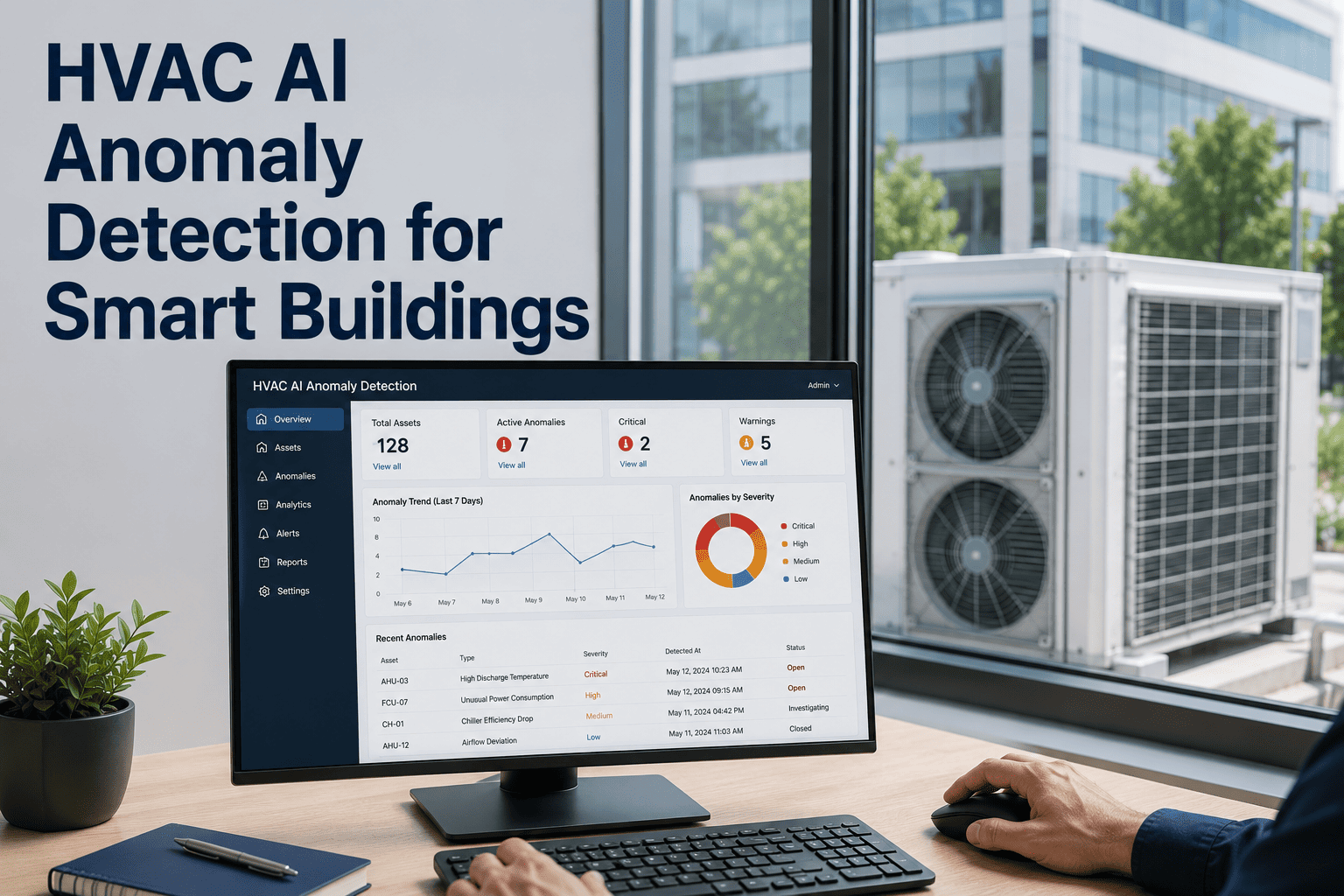
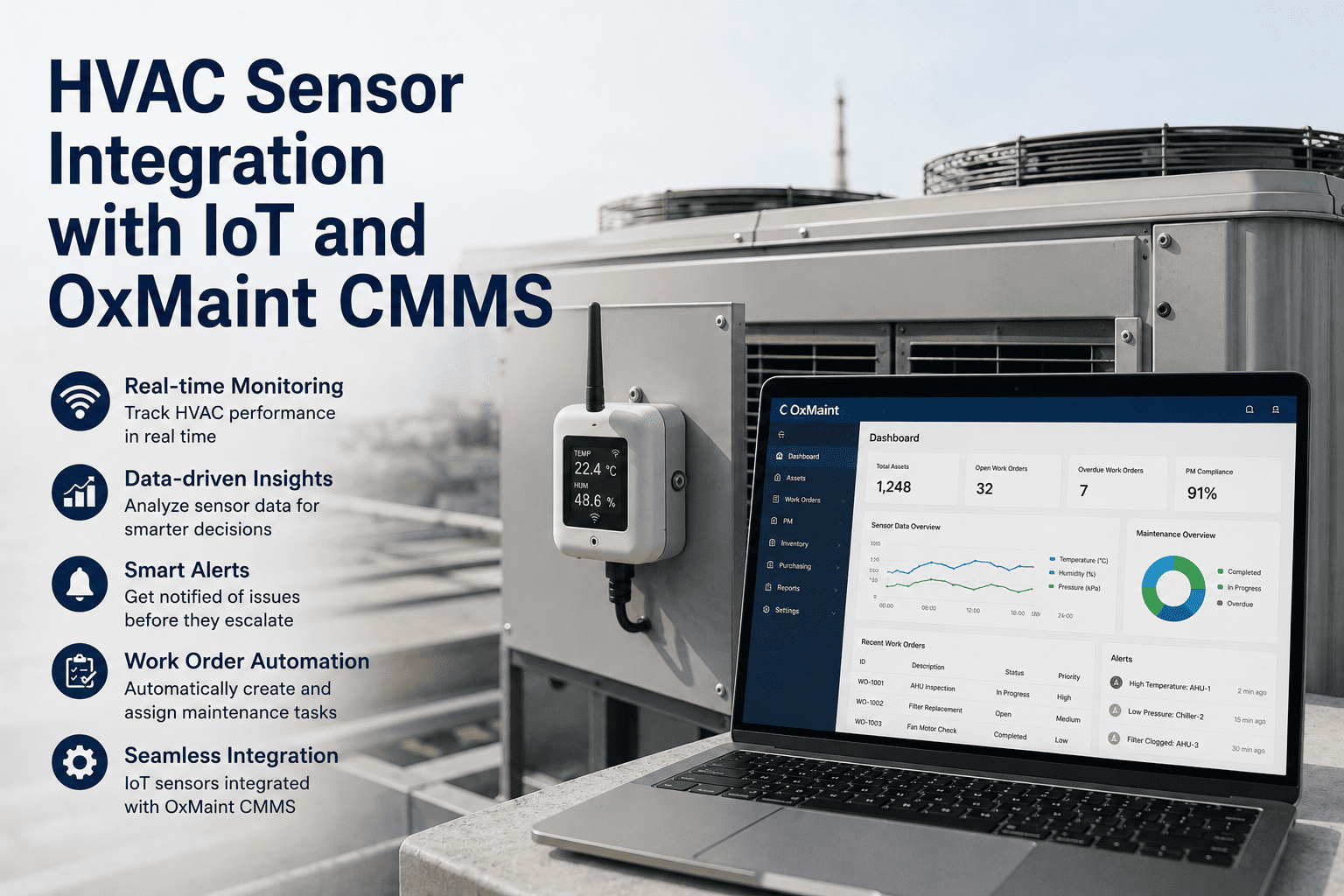
AI promises to transform HVAC maintenance — predicting failures weeks early, optimizing energy in real time, and scheduling technicians before equipment needs them. But AI models are only as good as the data they train on, and most commercial buildings are not AI-ready yet. Dirty asset records, inconsistent work order histories, miscalibrated sensors, and fragmented BMS data create a foundation that produces unreliable predictions instead of actionable ones. OxMaint's AI Copilot and CMMS platform builds the clean, structured data foundation that AI models require — so when your facility is ready to activate predictive analytics, the data is already there and trustworthy.
Is Your Building AI-Ready? The 5-Dimension Framework
AI readiness for HVAC maintenance is not a binary state. It exists across five dimensions — each one independently improvable, and each one measurable today.
AI Readiness Gap Analysis — Where Most Buildings Stand Today
| AI Readiness Dimension | Current State (Industry Avg) | AI-Ready Target | Time to Achieve with OxMaint |
|---|---|---|---|
| Asset Record Completeness | 28% of assets fully documented | 95%+ complete asset register | 30–60 days |
| PM History (Digital) | 45% digitized, often incomplete | 100% digital, structured records | Immediate — first work order closed |
| Sensor Coverage | 35% of HVAC assets monitored | 80%+ key assets with 3+ sensors | 60–120 days (phased sensor install) |
| Work Order Structure | 52% structured, 48% free-text | 90%+ structured fault codes | 1–2 weeks (fault code library setup) |
| BMS Data Continuity | 31% continuous streams | 95%+ uptime with gap logging | 2–4 weeks (integration configuration) |
Start Building Your AI-Ready Data Foundation Today
Every work order your team closes in OxMaint is a structured, timestamped data point that trains the AI model. The sooner you start, the sooner the predictions become reliable. Book a demo to see OxMaint's AI Copilot in action.
AI Readiness Roadmap: 90-Day Plan
Expert Review
The facilities industry has a pattern I see repeatedly: a building owner buys an AI predictive maintenance platform, connects it to their BMS, and gets disappointing results — not because the AI is poor, but because the data feeding it is poor. Incomplete asset records produce generic failure curves that miss the specific degradation signature of your equipment. Unstructured work order notes produce NLP parsing errors that mislabel maintenance history. Uncalibrated sensors produce systematic offsets that make the AI model think a healthy chiller is degrading. The investment required to get AI-ready is not primarily a technology investment — it is a data quality investment. A CMMS that enforces structured data at every work order, calibration PM task, and asset record update is the foundation that makes the AI model work. Without that foundation, the AI is solving the wrong equation with the wrong variables.
Every Work Order You Close Today Is Training Your Future AI Model
OxMaint's structured data engine builds the AI-ready asset and maintenance history your facility needs — automatically, as your team does their normal work. Start free and have a 30-day data foundation ready for AI activation.
Frequently Asked Questions
What does "AI-ready" mean for HVAC maintenance data?
An AI-ready HVAC maintenance environment has five characteristics: a complete structured asset register with manufacturer specs and design parameters for every monitored asset; at minimum 12 months of digital work order history with structured fault codes rather than free-text notes; continuous sensor data streams with documented calibration history; a CMMS that enforces data structure at work order creation rather than relying on technician discretion; and a BMS integration that provides gap-free data continuity with logged exceptions. OxMaint's platform is designed to build all five dimensions simultaneously through the team's normal maintenance workflow — the AI readiness is a byproduct of good maintenance data hygiene, not an additional project.
How long does it take for an AI model to become reliable for HVAC failure prediction?
Most HVAC AI prediction models require 30–90 days of calibration data to achieve reliable accuracy — long enough to observe the asset across enough operating conditions to distinguish normal variation from genuine degradation patterns. Facilities with 12+ months of clean historical work order data and continuous sensor streams achieve reliable predictions faster, often within 30 days, because the AI can calibrate against a rich historical baseline. Facilities starting from incomplete data typically reach reliable accuracy at 60–90 days. OxMaint displays a calibration confidence indicator per asset so teams know exactly which assets are ready for predictive alerting. Book a demo to see the calibration dashboard.
Can OxMaint's AI Copilot work with partial sensor coverage?
Yes. OxMaint's AI Copilot is designed for incremental deployment — it generates predictions at whatever level of data fidelity is available and clearly indicates what additional sensor coverage would enable for each asset. With supply air temperature and power consumption alone, the AI detects coil fouling and energy deviation. Adding vibration sensors unlocks bearing wear prediction. Adding refrigerant pressure data enables refrigerant system anomaly detection. The system starts delivering value on day one and becomes more precise as sensor coverage expands. Most facilities begin with their three to five highest-criticality assets and expand based on ROI demonstrated in the first 90 days.
What structured data fields does OxMaint require for optimal AI performance?
At the asset level: asset class, manufacturer, model, installation date, rated capacity, design supply temperature, rated power consumption, and location. At the work order level: fault category (from a standardized code library), asset condition at inspection, parts replaced with part numbers, labor time, and resolution method. At the sensor level: sensor type, measurement unit, calibration date, and calibration standard used. OxMaint enforces these as required fields in the mobile work order interface, with smart defaults that reduce technician data entry time to under 60 seconds per work order while ensuring AI-compatible data structure on every record.