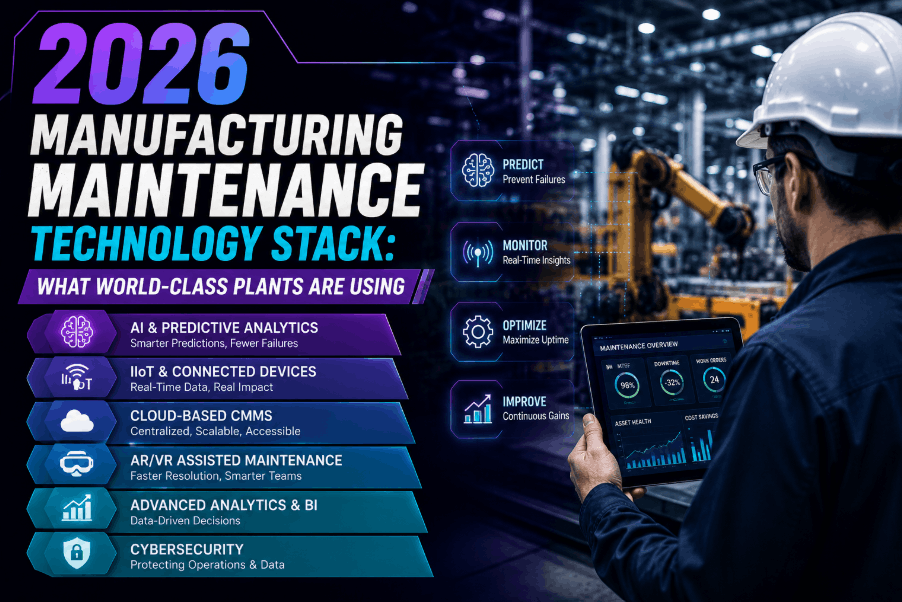
The gap between reactive and world-class manufacturing maintenance has never been wider — and what separates them in 2026 is not budget alone, it is the technology stack powering every decision, from a pump bearing anomaly detected at 3 AM to a work order dispatched before a technician's shift begins. Sign Up Free to see how OxMaint anchors the modern maintenance stack — connecting IoT sensors, AI-driven analytics, and automated workflows in one platform built for manufacturing teams. Leading plants are no longer running maintenance as a cost center. They are running it as a precision operation, and the technology stack is the engine. Book a Demo to explore how OxMaint fits into — and unifies — your existing technology environment. Whether you manage a single facility or a multi-site portfolio, understanding what world-class plants are deploying in 2026 gives you a clear roadmap for where your own program needs to go.
Build a World-Class Maintenance Stack with OxMaint
Connect IoT sensors, AI analytics, work order automation, and mobile inspection — all in one platform designed for modern manufacturing maintenance.
Why the 2026 Maintenance Technology Stack Looks Different
Three forces reshaped manufacturing maintenance technology between 2022 and 2026: the collapse of sensor hardware costs, the mainstreaming of AI-assisted diagnostics, and the widespread adoption of cloud-native CMMS platforms that replaced legacy on-premise systems. Book a Demo to see how OxMaint delivers on all three — without the implementation complexity of enterprise legacy platforms. World-class plants in 2026 are not running the most expensive stack. They are running the most integrated one.
The 6 Layers of the World-Class Maintenance Technology Stack
Top-performing plants in 2026 build their maintenance technology around six integrated layers. Each layer serves a distinct function — but the value is only fully realized when data flows freely between them. Sign Up Free and connect OxMaint as the operational core that ties your stack together — from sensor data intake to work order execution and reliability reporting.
CMMS — The Operational Core
A cloud-native CMMS is the foundation of every world-class stack. It manages assets, work orders, PM schedules, parts inventory, and compliance documentation. In 2026, best-in-class CMMS platforms like OxMaint are mobile-first, API-connected, and built to receive condition data and convert it automatically into prioritized maintenance actions.
IoT Sensor Network — The Eyes on the Floor
Wireless vibration, temperature, ultrasound, and current sensors mounted on critical assets provide continuous condition data streams. Costs have dropped dramatically — industrial IoT sensors that cost $800+ in 2019 are now deployed at under $150 per point. World-class plants monitor 80–100% of critical rotating equipment continuously.
AI Analytics Engine — Pattern Recognition at Scale
Machine learning models trained on asset-specific historical data detect degradation patterns that human analysts cannot track manually across large fleets. AI analytics in 2026 flag developing bearing faults 6–10 weeks before failure, identify lubrication-related wear from current signature changes, and generate remaining useful life estimates that guide parts ordering decisions.
Mobile Inspection Platform — Technicians in the Field
Mobile-first inspection apps allow technicians to execute rounds, log condition observations, capture photos, scan asset QR codes, and receive work order assignments — all without returning to a maintenance office. Offline sync capability ensures inspections proceed even in low-connectivity areas of large facilities.
ERP / MES Integration — Connecting Maintenance to Production
World-class plants connect maintenance systems to ERP (SAP, Oracle, Microsoft Dynamics) and MES platforms so production schedules and maintenance windows are coordinated. A planned maintenance window on a critical press line is negotiated with production scheduling — not scheduled in isolation. API-connected CMMS platforms make this bidirectional data exchange standard.
Reliability Analytics Dashboard — Measuring What Matters
MTBF trending, maintenance cost per asset, PM compliance rates, and technician wrench-time utilization are tracked live. Reliability engineers use dashboard analytics to make data-backed investment cases — justifying additional sensor deployment, headcount, or capital repair spend based on failure cost modeling rather than intuition.
2026 Maintenance Stack: Reactive vs Advanced vs World-Class
| Stack Layer | Reactive Plant | Advanced Plant | World-Class Plant |
|---|---|---|---|
| Work Order Management | Paper / Spreadsheet | Basic CMMS (desktop) | Cloud CMMS with auto-generation |
| Asset Monitoring | None / Walk-around | Periodic route collection | Continuous IoT sensor streams |
| Fault Detection | Operator complaints | Manual threshold alarms | AI pattern recognition |
| Inspection Execution | Paper checklists | Handheld analyzer | Mobile app with QR + offline sync |
| Parts Management | Reactive purchasing | Min/max stocking rules | Condition-triggered procurement |
| ERP Connection | None | Manual data export | Bidirectional API integration |
| Reliability Reporting | Monthly summary only | CMMS-generated reports | Live MTBF / cost-per-asset dashboard |
How to Build Toward a World-Class Maintenance Stack in 2026
Consolidate on a Cloud-Native CMMS
If your work order and asset management still runs on spreadsheets or a legacy on-premise system, the first move is consolidation. A cloud-native CMMS like OxMaint provides the data infrastructure everything else connects to — and it deploys in days, not months. This single step eliminates data silos that prevent stack integration.
Establish Your Asset Registry and Criticality Tiers
Before deploying any sensors or analytics, build a complete asset registry with criticality scores. Rank every piece of rotating equipment by failure impact, replacement cost, and production dependency. This criticality ranking drives sensor deployment priority and determines where AI monitoring investment generates the fastest ROI.
Deploy IoT Sensors on Tier-1 Assets First
Start with continuous wireless monitoring on your 10–20 highest-criticality assets. At 2026 sensor price points, this is achievable for most manufacturing facilities without major capital approval. Wireless sensors with cloud connectivity require no cabling infrastructure and can be operational within a day of mounting — generating condition data immediately.
Connect Condition Data to Automated Work Order Triggers
The single highest-value integration in the maintenance stack is connecting sensor alarms directly to CMMS work order creation. When a vibration threshold is breached, OxMaint automatically generates a prioritized work order with asset history, fault context, and recommended action pre-populated. This eliminates the analyst bottleneck and ensures nothing is missed.
Activate Mobile Execution for Field Teams
Equip technicians with OxMaint's mobile app for inspection route execution, work order updates, and condition data capture. Mobile execution eliminates paper-based delays and creates real-time visibility into what is happening on the floor — giving supervisors live status on open work orders and inspection progress during every shift.
Build Reliability Reporting Into Decision-Making
Use OxMaint's reliability analytics to surface MTBF trends, maintenance cost per asset class, and PM compliance rates. Present this data in monthly reliability reviews. When capital decisions about sensor expansion, staff hiring, or rebuild-vs-replace evaluations are driven by condition data and cost modeling rather than gut instinct, maintenance earns a seat at the strategic planning table. Book a Demo to see OxMaint's reliability dashboard configured for manufacturing operations.
What World-Class Maintenance Stacks Deliver in 2026
How World-Class Plants Apply the Stack Across Equipment Types
Rotating Equipment Fleets
Motors, pumps, fans, and compressors are the primary targets for IoT + AI deployment. Continuous vibration monitoring with AI-generated fault signatures replaces periodic handheld routes on the highest-criticality machines.
Gearbox and Drive Train Monitoring
High-value gearboxes receive dedicated monitoring using accelerometer arrays and oil analysis integration. AI models correlate gear mesh frequency changes with tooth wear progression, flagging intervention windows 4–8 weeks before audible deterioration.
Production Line Compliance Inspections
Mobile inspection routes driven by OxMaint ensure compliance checks — safety equipment, lubrication points, belt tension, guard integrity — are executed on schedule and digitally documented for audit purposes without paper-based record keeping.
Multi-Site Portfolio Management
Cloud-native CMMS platforms allow reliability managers to monitor asset health, PM compliance, and work order backlogs across multiple facilities from a single dashboard — standardizing maintenance practice across sites and benchmarking facility-to-facility performance.
Start Building Your World-Class Maintenance Stack Today
OxMaint provides the CMMS core, mobile execution layer, condition monitoring integration, and reliability analytics your manufacturing plant needs — deployable in days, not quarters.
2026 Manufacturing Maintenance Technology Stack — Common Questions
Ready to Run Maintenance Like a World-Class Plant?
OxMaint gives your team the CMMS foundation, IoT integration layer, automated work order engine, and reliability analytics to operate at the level the best manufacturing facilities run today.
.png)


.png)