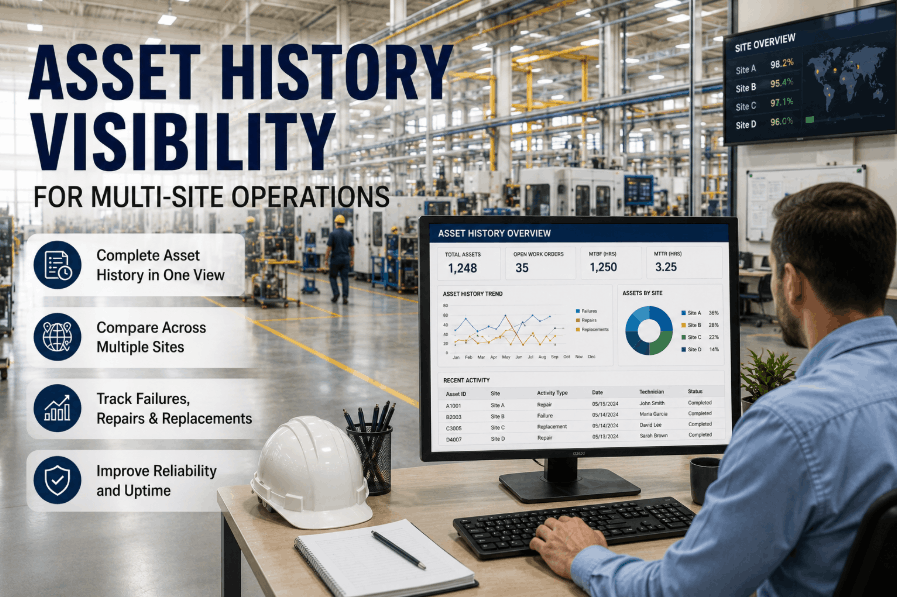
Asset history visibility for multi-site operations is the capability that separates manufacturing enterprises running proactive reliability programs from those fighting the same equipment failures across locations without ever connecting the dots. When maintenance records, repair histories, and failure trends are siloed by site — living in disconnected spreadsheets, local CMMS instances, or paper logs — reliability leaders cannot benchmark performance, identify systemic failure patterns, or make capital replacement decisions with confidence. Sign Up Free to see how OxMaint gives multi-site operations teams a unified asset history view that eliminates spreadsheet drift and puts failure, repair, and replacement data in one accessible platform. Organizations that centralize asset history across sites see faster root cause identification, better spare parts standardization, and significantly stronger capital planning decisions — because the data to support those decisions finally exists in one place.
Unify Asset History Across All Your Sites with OxMaint
Centralized asset records. Cross-site failure comparison. No spreadsheet drift. Built for multi-site reliability operations.
Why Multi-Site Operations Lose Asset History Visibility
Asset history fragmentation in multi-site operations is rarely a technology problem at its core — it is a data architecture problem. Each site accumulates maintenance records in isolation, using different formats, different asset naming conventions, and different work order categories. The result is a portfolio of maintenance data that cannot be compared, consolidated, or used to drive enterprise-level decisions. Book a Demo to see how OxMaint standardizes asset data architecture across sites from day one.
Spreadsheet Drift Across Sites
Each site maintains its own asset tracking spreadsheet — updated inconsistently, formatted differently, and impossible to consolidate without manual reconciliation that introduces new errors.
Failure Data Not Comparable Across Locations
When failure categories, severity codes, and asset identifiers differ by site, reliability engineers cannot compare failure rates across equivalent assets — losing the cross-site learning that drives MTBF improvement.
Repair History Lost at Site Transitions
When maintenance staff change or site systems are upgraded, historical repair records are frequently lost — forcing teams to treat equipment as having no history and repeating diagnostic work that was already done.
Replacement Decisions Made Without Lifecycle Data
Without centralized repair cost accumulation per asset across sites, capital planning teams cannot calculate true lifecycle cost — leading to premature replacements at some sites and deferred replacements at others.
Spare Parts Duplication Across Sites
Without a unified asset register, different sites stock different parts for equivalent assets — inflating inventory carrying costs and creating supply gaps when failures occur simultaneously at multiple locations.
No Enterprise Reliability Benchmarking
Reliability leaders cannot identify which sites are outperforming, which are struggling, or which maintenance strategies are producing the best results — because the data needed to benchmark never reaches a common platform.
Asset History Visibility Framework — 6 Core Capabilities
A complete asset history visibility solution for multi-site operations requires six interconnected capabilities — from data standardization through enterprise benchmarking. Each layer depends on the previous, building toward a single source of truth for every asset across every site. Sign Up Free to implement this framework using OxMaint's multi-site asset management platform.
| Capability |
What It Enables |
OxMaint Feature |
Business Outcome |
| Unified Asset Register |
All assets across all sites in one structured database |
Asset Management Module |
Eliminates naming inconsistency and data silos |
| Standardized Failure Coding |
Common failure categories and severity codes across sites |
Work Order Templates + Failure Library |
Cross-site failure rate comparison enabled |
| Repair Cost Accumulation |
Labor, parts, and contractor costs tracked per asset over lifetime |
Cost Tracking Module |
Lifecycle cost visibility per asset |
| Cross-Site MTBF Tracking |
Failure interval trends compared across equivalent assets at different sites |
Analytics and Reliability Dashboard |
Best-practice PM strategy identification |
| Audit Trail Continuity |
Complete maintenance history preserved through staff changes and system updates |
CMMS Record Archiving |
No lost repair history; consistent compliance records |
| Enterprise Reliability Benchmarking |
Site-by-site KPI comparison for uptime, reactive ratio, and PM compliance |
Multi-Site Analytics Dashboard |
Performance gaps identified and addressed at scale |
How OxMaint Delivers Cross-Site Asset History in One Platform
01
Unified Asset Register Across All Sites
OxMaint's asset management module supports multi-site hierarchies — allowing enterprise reliability teams to manage assets across all facilities from a single platform, with site-level access controls that let local teams view and update their assets while central teams see the full portfolio.
Book a Demo to see multi-site asset configuration in action.
02
Repair and Failure History Per Asset
Every work order completed in OxMaint is automatically linked to the relevant asset record — building a continuous repair and failure history that accumulates over the asset's lifetime regardless of which technician performed the work, which shift completed it, or which site it occurred at.
03
Cross-Site Failure Comparison and Benchmarking
OxMaint's analytics module allows reliability engineers to compare MTBF, failure frequency, repair cost, and PM compliance across identical asset classes at different sites — identifying which sites are outperforming and which maintenance strategies are producing the best results.
Sign Up Free to activate cross-site benchmarking for your asset portfolio.
04
Lifecycle Cost Tracking for Capital Planning
OxMaint accumulates all labor, parts, and contractor costs per asset over its operational lifetime — giving capital planning teams the total cost of ownership data needed to make replacement timing decisions based on actual spend history rather than estimated depreciation schedules.
Asset History Visibility Results Across Multi-Site Operations
The following examples show how multi-site manufacturing and processing operations use OxMaint to build centralized asset history visibility and eliminate the spreadsheet drift that was driving poor reliability decisions.
Packaging Manufacturer
Cross-Site Failure Benchmarking
ChallengeSame filling machine failing 3x more often at Site B than Site A — no data to diagnose why
AppliedOxMaint unified asset register with standardized failure coding across all 5 sites
ResultRoot cause identified as PM interval difference; MTBF at Site B improved 38% after alignment
Mining Operations
Eliminating Spare Parts Duplication
ChallengeEach site independently stocking spare parts for equivalent assets — $2.1M in redundant inventory
AppliedOxMaint unified asset and parts register; cross-site inventory visibility with transfer workflows
ResultSpare parts inventory reduced by 31% without any increase in stockout events
Food Processing
Capital Replacement Decision Support
ChallengeCapital planning team unable to justify replacement timing without lifecycle cost data per asset
AppliedOxMaint repair cost accumulation linked to asset records across all processing sites
ResultThree assets flagged for replacement that were costing 4x purchase price annually in repair spend
Pharmaceutical Manufacturing
Audit Trail Continuity Across Site Transitions
ChallengeGxP compliance at risk when local CMMS upgrade at one site lost 18 months of maintenance history
AppliedOxMaint centralized CMMS with complete record archiving; no site-level data silos
ResultComplete maintenance history preserved; regulatory inspection passed with full record continuity
Step-by-Step: Building Asset History Visibility in OxMaint
Step 1
Standardize Your Asset Register Across All Sites
Import all site asset lists into OxMaint using a standardized naming convention and asset hierarchy. Define equipment categories, sub-categories, and asset IDs that are consistent across every facility — so that equivalent assets at different sites can be directly compared.
Book a Demo to see multi-site asset import and standardization.
↓
Step 2
Configure Standardized Failure Codes and Work Order Categories
Define a common failure code library in OxMaint that all sites use when logging corrective work orders. Consistent failure categorization is the prerequisite for cross-site failure rate comparison — without it, the data generated by each site cannot be meaningfully aggregated.
↓
Step 3
Activate Cost Tracking Per Asset Across Sites
Enable OxMaint's cost tracking module to accumulate labor hours, parts costs, and contractor invoices against each asset record. Ensure all sites are logging costs consistently so that total cost of ownership comparisons across the portfolio are based on complete data.
Sign Up Free to activate lifecycle cost tracking for your asset portfolio.
↓
Step 4
Configure Cross-Site Reliability Dashboards
Build OxMaint analytics views that compare MTBF, reactive ratio, PM compliance, and repair cost across sites for each asset category. Make these dashboards accessible to enterprise reliability leaders who need portfolio-wide visibility without requiring manual data consolidation from site managers.
↓
Step 5
Run Monthly Cross-Site Benchmarking Reviews
Use OxMaint data to run monthly enterprise reliability reviews — comparing site performance, identifying underperforming asset classes, and propagating best-practice maintenance strategies from high-performing sites to lagging ones. This feedback loop is where multi-site asset history visibility converts into measurable reliability improvement.
Sign Up Free to set up your enterprise reliability review dashboard.
Key KPIs for Multi-Site Asset History Visibility
Centralizing asset history only delivers value if reliability leaders are tracking the right metrics across sites. These KPIs allow enterprise teams to compare asset performance, identify outliers, and drive data-informed maintenance strategy decisions. Book a Demo to see how OxMaint tracks these KPIs across your site portfolio.
Cross-Site MTBF Comparison
Average failure interval for equivalent asset classes at each site. Significant MTBF differences across sites with identical equipment signal PM strategy or execution gaps worth investigating.
Repair Cost per Asset (Lifetime)
Total accumulated maintenance spend per asset since commissioning. Assets where lifetime repair cost exceeds replacement cost threshold signal capital renewal priority.
Asset Data Completeness Rate
Percentage of asset records with complete failure history, repair cost data, and PM records. Incomplete records reduce the reliability of cross-site comparisons and capital planning models.
Failure Recurrence Rate by Site
Frequency of repeat failures on the same asset within 30 or 90 days. High recurrence rates at specific sites indicate PM strategy gaps or execution quality differences worth addressing.
PM Compliance Variance Across Sites
Difference in PM completion rates between highest- and lowest-performing sites. Large variance identifies sites where PM execution processes need reinforcement or resource support.
Reactive vs. Planned Ratio by Site
Emergency vs. planned work order split at each location. Sites with reactive ratios above 30% are likely to benefit most from PM strategy realignment driven by cross-site failure data.
Build One Asset History View Across All Your Sites
Unified asset register. Cross-site failure comparison. Lifecycle cost tracking. Enterprise reliability benchmarking. All in OxMaint — no spreadsheet drift.
Frequently Asked Questions
What is asset history visibility in multi-site operations?
It is the ability to access complete failure, repair, and replacement records for every asset across all facilities from a single platform — enabling cross-site comparison, lifecycle cost analysis, and enterprise reliability benchmarking without manual data consolidation.
How does OxMaint eliminate spreadsheet drift in multi-site asset management?
OxMaint centralizes all asset records, work orders, and maintenance histories in one cloud-based CMMS — so there are no local spreadsheets to maintain, no version conflicts, and no reconciliation effort required to compare sites.
Can OxMaint compare failure rates across equivalent assets at different sites?
Yes. OxMaint's analytics module enables cross-site MTBF comparison, failure frequency analysis, and repair cost benchmarking for identical asset classes — provided assets are registered with standardized naming and failure coding conventions.
How does centralized asset history support capital replacement decisions?
OxMaint accumulates lifetime repair costs per asset — giving capital planning teams the total cost of ownership data needed to identify assets where continued maintenance spend exceeds the cost of replacement.
What KPIs should multi-site reliability teams track for asset history visibility?
Key metrics include cross-site MTBF comparison, repair cost per asset, failure recurrence rate, PM compliance variance across sites, and reactive vs. planned ratio by location — all automatically captured in OxMaint.
Can OxMaint support compliance and audit requirements across multiple sites?
Yes. OxMaint maintains complete, timestamped maintenance records across all sites in a single audit-ready platform — ensuring record continuity through staff changes, system updates, and regulatory review cycles.
Book a Demo to review compliance record capabilities.
Give Your Multi-Site Reliability Team Complete Asset Visibility
OxMaint delivers unified asset history, cross-site failure comparison, lifecycle cost tracking, and enterprise reliability dashboards — purpose-built for multi-site operations who need one source of truth.