Multi-site manufacturing operations face a silent productivity crisis: when maintenance processes differ plant to plant, reliability gaps widen, costs diverge, and leadership loses the visibility needed to make confident capital decisions. Sign Up Free to see how OxMaint's enterprise CMMS helps maintenance leaders enforce consistent PM templates, work order workflows, and KPI benchmarks across every facility from a single platform.
Standardize Maintenance Across All Your Sites with OxMaint
OxMaint gives enterprise maintenance teams a single platform to deploy consistent PM templates, work order standards, inspection checklists, and KPI dashboards across every manufacturing facility — eliminating process inconsistency at scale.
Why Multi-Site Maintenance Standardization Fails Without a CMMS
Most multi-plant manufacturers attempt standardization through shared spreadsheets, tribal knowledge transfers, and periodic audits — none of which scale. Without a centralized enterprise CMMS enforcing consistent templates and workflows, every site gradually reverts to local habits. Book a Demo to see how OxMaint's multi-site architecture enforces standards at the platform level, not the policy level. Process drift is inevitable when maintenance standards live in documents instead of systems — technicians default to what's fastest, not what's specified, and managers lack the cross-site visibility to detect divergence before it compounds into reliability and compliance gaps.
The Core Pillars of Multi-Site Maintenance Standardization
Centralized PM Template Library
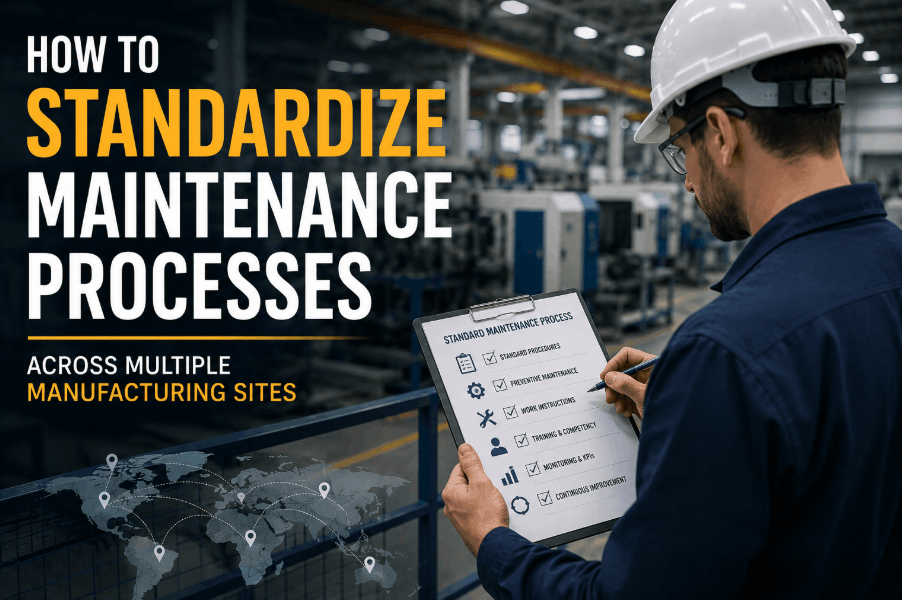
Enterprise-wide preventive maintenance standardization begins with a single, version-controlled PM template library. OxMaint allows corporate maintenance teams to build and push equipment-specific PM templates to all sites simultaneously, eliminating the local customization that fragments reliability programs.
Standardized Work Order Workflows
Consistent work order processes — from initiation to sign-off — ensure that every technician at every facility captures the same data fields, follows the same escalation logic, and records parts and labor in a format that enables cross-site benchmarking. Sign Up Free to deploy OxMaint's configurable work order templates across your entire facility network.
Unified Asset Taxonomy
Multi-site asset registers built on inconsistent naming conventions, category structures, and criticality ratings make cross-plant benchmarking impossible. OxMaint's enterprise asset hierarchy enforces a shared taxonomy that makes reliability data comparable and actionable at the corporate level.
Inspection Checklist Standardization
Mobile-first inspection checklists deployed through OxMaint ensure that condition assessments, safety checks, and compliance verifications follow identical procedures at every site. Standardized checklists eliminate documentation gaps that create audit exposure in regulated manufacturing environments.
Cross-Site KPI Alignment
Maintenance performance metrics — MTBF, MTTR, PM compliance rate, backlog hours — must be measured identically across sites to be useful for benchmarking and capital allocation. OxMaint's enterprise dashboards normalize KPI calculation so leadership compares real performance, not reporting methodology. Book a Demo to explore OxMaint's cross-site KPI reporting.
Role-Based Access & Governance
Enterprise maintenance standardization requires platform governance that gives corporate teams control over template standards while allowing site managers the operational flexibility to execute. OxMaint's role-based permission model separates corporate standard-setting from site-level execution without creating bottlenecks.
Deferred Maintenance vs. Planned Maintenance: The Cost Gap
The performance gap between standardized and non-standardized multi-site maintenance programs is measurable, predictable, and compounding. Book a Demo to see how OxMaint's enterprise CMMS closes this gap across your facility network.
A 5-Phase Roadmap for Multi-Site Maintenance Standardization
Successful enterprise maintenance standardization follows a phased approach — beginning with data alignment and culminating in continuous cross-site improvement loops driven by real-time CMMS analytics. Sign Up Free to begin Phase 1 of your standardization program in OxMaint today.
Audit Existing Processes Across All Sites
Before deploying any standard, document the current-state maintenance process at each facility — PM schedules, work order formats, inspection checklists, KPI definitions, and CMMS configurations. Gap analysis across sites reveals which processes are closest to the target standard and which require the most restructuring before rollout begins.
Define Corporate-Level Standards in OxMaint
Build the enterprise maintenance standard inside OxMaint's platform — PM templates organized by equipment category, work order field requirements, inspection checklist structures, and KPI calculation definitions. Locking these into the CMMS replaces policy documents with enforced platform logic that every site inherits automatically.
Pilot Standardization at One High-Visibility Site
Roll out the enterprise standard at a single pilot facility first — ideally a site with engaged maintenance leadership and representative asset complexity. Pilot results generate the performance data and operational proof points needed to overcome resistance during broader rollout, particularly from site managers protective of local processes.
Execute Phased Multi-Site Rollout with Change Management
Deploy OxMaint's enterprise configuration to remaining sites in cohorts — grouping facilities by similarity, region, or asset type. Pair each rollout with structured change management: technician training on the new workflows, site manager KPI alignment sessions, and a defined support window before full compliance tracking activates.
Monitor, Benchmark, and Continuously Improve Across Sites
Once all sites are live on OxMaint, the enterprise maintenance standard becomes a living benchmark — continuously updated based on cross-site performance data. Sites performing above the benchmark surface best practices that corporate teams can propagate to lower-performing facilities, creating a self-improving reliability network.
Industry Applications: Multi-Site Maintenance Standardization by Sector
How OxMaint Enables Enterprise Maintenance Standardization
OxMaint is built for enterprise manufacturing environments where maintenance consistency across dozens of facilities is not optional — it is a reliability and compliance requirement. From multi-site PM template deployment and mobile inspection workflows to cross-plant KPI dashboards and role-based governance, OxMaint gives corporate maintenance leaders the platform infrastructure to standardize processes at scale. Book a Demo to see OxMaint's enterprise multi-site configuration in action.
- PM templates vary site-to-site with no version control
- No cross-site benchmarking — data formats incompatible
- Compliance documentation fragmented across local systems
- KPI definitions inconsistent, leadership reporting unreliable
- New site onboarding requires complete process rebuild
- Corporate PM library pushed to all sites from one interface
- Real-time cross-site KPI dashboards with normalized metrics
- Unified audit trail across every facility — always compliant
- Role-based governance: corporate standards, site-level execution
- New sites inherit the enterprise standard from day one
Ready to Standardize Maintenance Across All Your Sites?
OxMaint deploys consistent PM templates, work order workflows, inspection checklists, and KPI frameworks across your entire manufacturing network — eliminating process inconsistency and giving leadership real-time cross-site visibility.
Frequently Asked Questions: Multi-Site Maintenance Standardization
What is multi-site maintenance standardization?
It is the process of aligning PM schedules, work order workflows, inspection checklists, KPI definitions, and asset records across all manufacturing facilities so maintenance performance is consistent, comparable, and governed from a central platform.
Why do maintenance processes differ across manufacturing plants?
Without a centralized CMMS enforcing standards, each site adapts processes to local preferences, equipment differences, and staffing constraints. Over time, these local variations compound into significant reliability, cost, and compliance gaps across the facility network.
How long does multi-site maintenance standardization take?
Most enterprise manufacturers achieve full multi-site standardization within 9–18 months using a phased CMMS rollout approach. OxMaint's enterprise onboarding program accelerates this timeline with pre-built templates, guided configuration, and site-level training support.
Can OxMaint support different asset types across different plants?
Yes. OxMaint's asset hierarchy supports site-specific equipment configurations while enforcing shared PM template structures and work order formats at the corporate level — giving sites operational flexibility within a governed enterprise standard.
How does maintenance standardization improve compliance across facilities?
Standardized inspection checklists, maintenance records, and audit trails captured in OxMaint ensure that every facility maintains identical documentation standards — making multi-site regulatory audits predictable, defensible, and significantly less resource-intensive.
What KPIs should be standardized across manufacturing sites?
Core multi-site maintenance KPIs include PM compliance rate, MTBF, MTTR, corrective-to-preventive work order ratio, backlog hours, and maintenance cost per asset. OxMaint calculates all of these identically across sites, enabling true cross-plant performance benchmarking.
Stop Managing Maintenance Site by Site
OxMaint gives enterprise maintenance leaders a single platform to standardize PM programs, align KPIs, enforce compliance, and benchmark performance across every manufacturing facility — from pilot plant to global network.