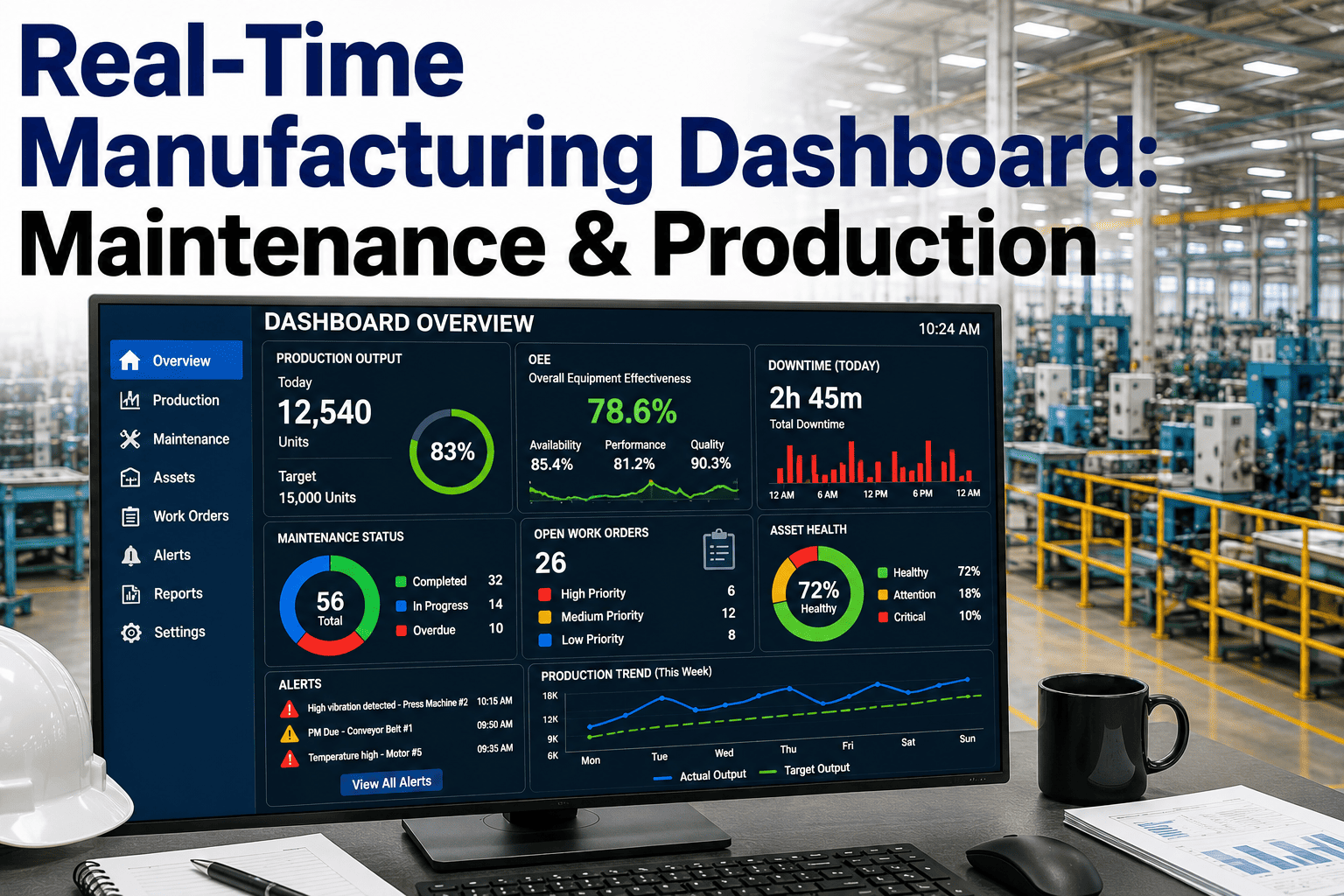
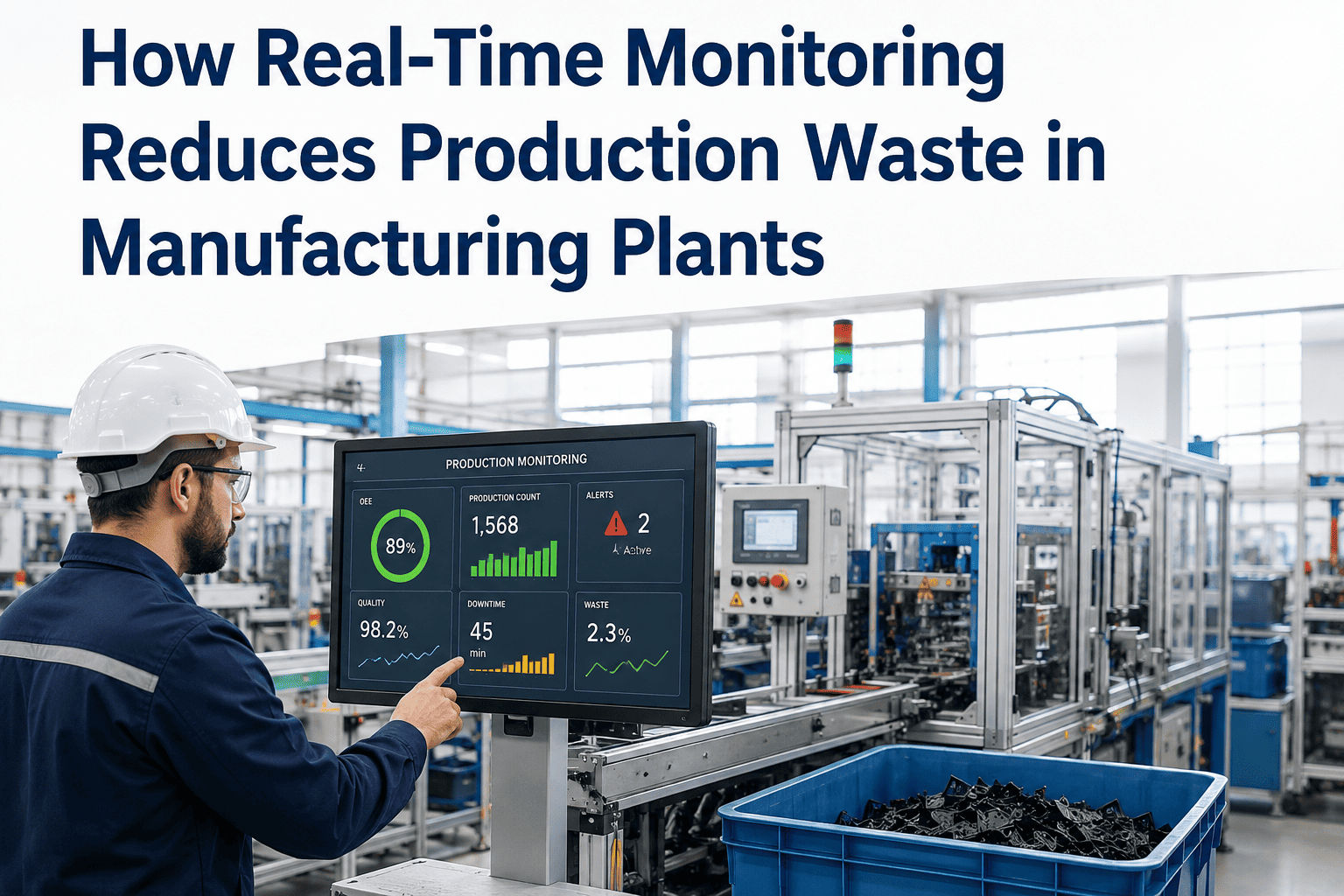
A mid-size automotive parts manufacturer running 12 production lines was bleeding $4.1M annually in unplanned downtime. OEE sat at 58% — well below the 85% world-class benchmark — while reactive maintenance consumed 67% of the maintenance team's time. Fourteen months after deploying Oxmaint's AI-powered predictive maintenance and real-time OEE dashboard, OEE climbed to 82%, unplanned downtime fell 71%, and the plant recovered $2.9M in production capacity. Book a demo to see how Oxmaint transforms OEE for automotive manufacturers.
Case Study · Automotive Manufacturing
From 58% to 82% OEE. $2.9M Recovered.
12 production lines. AI predictive maintenance. Real-time OEE dashboard. Zero extra headcount.
OEE: 58% → 82%
71% less unplanned downtime
$2.9M capacity recovered
Deployed in 21 days
ROI in 4 months
01 / The Plant
12 Lines. 847 Assets. One Critical Problem.
Facility
Mid-size Tier 2 automotive parts manufacturer. Produces brake components, suspension assemblies, and chassis sub-systems for OEM clients.
Scale
320,000 sq ft. 12 production lines. 847 tracked assets. 3-shift operation, 6 days/week.
Equipment
CNC machining centers, hydraulic presses, robotic welding cells, conveyor systems, CMM inspection stations, heat treatment ovens.
OEM Contracts
4 active OEM supply agreements with strict delivery SLAs. Penalty clauses for missed shipments above 2% of monthly volume.
Maintenance Model
Primarily reactive before Oxmaint. Scheduled PMs existed on paper but were missed 40% of the time due to production pressure.
Prior Systems
Legacy CMMS (2014). Paper-based PM logs. Manual OEE tallying in Excel. No real-time visibility across lines.
02 / The Breaking Point
What 58% OEE Actually Costs
An OEE of 58% means 42 cents of every production dollar is lost to downtime, slowdowns, or defects. For this plant, that translated into hard numbers the leadership team could no longer ignore.
$4.1M
Annual downtime cost
Unplanned stoppages averaged 19.4 hours per line per month. At $17,800/hour blended production cost, the bill was unavoidable.
67%
Reactive maintenance rate
Two-thirds of all work orders were break-fix. Technicians spent more time responding to failures than preventing them.
3.8%
Defect and scrap rate
Degraded tooling and out-of-spec machines were producing non-conforming parts. Rework and scrap added $620K in annual waste.
11
OEM penalty events in 18 months
Late shipments triggered $214K in contract penalties and put two long-term OEM relationships at serious risk of termination.
The plant was not failing because of bad engineers. It was failing because nobody could see what was about to break — until it already had.
The OEE Gap: Where 42% Was Disappearing
Availability Loss
16%
Unplanned stoppages
Performance Loss
14%
Speed reduction & micro-stops
Quality Loss
12%
Defects & rework
Total OEE Achieved
58%
vs. 85% world-class
03 / Why Oxmaint
One Platform. Two Problems Solved Simultaneously.
The plant evaluated four CMMS and OEE platforms over six weeks. The deciding factor was not feature count — it was integration depth and time-to-value. Oxmaint was the only platform that combined AI-driven predictive maintenance with a live OEE dashboard in a single interface, deployed using the existing team without additional data engineers or integration consultants. The plant manager's requirement was direct: results visible within 90 days or the contract would be reviewed. See how Oxmaint delivers results within 90 days — book a scoping session now.
| Capability |
Before Oxmaint |
With Oxmaint |
| OEE Visibility |
Manual Excel, updated weekly |
Real-time dashboard, per-line and per-shift |
| Failure Prediction |
None — run-to-failure |
AI flags failures 48–72 hrs in advance |
| PM Compliance |
60% completion rate |
96% completion with automated dispatch |
| Downtime Cause Analysis |
Guesswork, post-incident |
Categorized root cause logged at event |
| Maintenance Mode |
67% reactive |
78% planned and predictive |
| Reporting Time |
4–6 hours weekly manual prep |
Automated, available on demand |
04 / The Deployment
21 Days. 847 Assets. Zero Production Disruption.
Week 1
Asset Registry & Sensor Mapping
847 assets catalogued across 12 lines. Each asset assigned a criticality tier (1–3), failure mode library, and OEE impact weighting. Sensor data streams connected to Oxmaint's AI engine via existing PLC and SCADA outputs — no new hardware required on 91% of assets.
Week 2
AI Model Training & PM Scheduling
Oxmaint's predictive models ingested 18 months of historical sensor data and failure records. 64 PM schedules built — replacing the outdated calendar-based system with condition-triggered maintenance orders. First predictive alert fired on day 11: a hydraulic press showing early bearing wear on Line 7.
Week 3
OEE Dashboard Go-Live & Team Training
Real-time OEE dashboard live across all 12 lines. Shift supervisors trained in 2.5 hours. Maintenance team of 14 technicians onboarded to mobile app workflow in one session. All open work orders migrated from legacy CMMS. Full operational handover by day 21.
847 Assets. 21 Days. Real-Time OEE Across 12 Lines.
The same maintenance team ran the deployment without pausing production. See what the timeline looks like for your plant.
05 / The Results
14 Months Later: What the Numbers Say
The plant did not hire a single additional person. The same team, the same lines, the same equipment — with one system change that made everything visible and preventable.
OEE Performance
+24 Points
Before
58% OEE across 12 lines. 42% of potential capacity lost to downtime, speed loss, and defects.
After
82% OEE. Within striking distance of the 85% world-class threshold. Line 4 reached 88%.
Availability drove the biggest gain: from 71% to 91%, powered by AI-predicted interventions before failures occurred.
Unplanned Downtime
-71%
Before
19.4 hrs/line/month. $4.1M annual cost. Failures discovered only after production stopped.
After
5.6 hrs/line/month. 83% of predicted failures addressed during planned maintenance windows.
The AI engine flagged 147 high-risk events in the first year. 124 were resolved before becoming failures.
Capacity & Revenue Impact
$2.9M Recovered
Before
$4.1M in production capacity lost to unplanned stops. 11 OEM penalty events over 18 months.
After
$2.9M in capacity recovered. Zero OEM penalty events in the 14 months post-deployment.
Contract penalty exposure eliminated entirely. Two OEM clients extended supply agreements citing improved delivery reliability.
Maintenance Mode Shift
Reactive → Predictive
Before
67% reactive maintenance. PM compliance at 60%. Technicians in constant firefighting mode.
After
78% planned or predictive. PM compliance at 96%. Technicians focused on scheduled, purposeful work.
The same 14-person team now manages 847 assets confidently — without adding resources or overtime.
Scrap & Defect Rate
-61%
Before
3.8% defect rate. $620K annual scrap and rework cost. Root cause rarely identified.
After
1.5% defect rate. $241K scrap cost — a $379K annual reduction. Machine condition linked to quality data.
Connecting equipment health data to quality outputs revealed that 71% of defects traced back to degraded tooling or mis-calibrated machines.
Platform Investment
$18,400
Annual
Downtime Savings
$2.9M
Capacity recovered
Total ROI
158x
Payback in 4 months
06 / Root Cause Analysis
Four Findings That Changed Everything
01
Hydraulic press bearing failures were predictable — 3 weeks in advance
Line 7's hydraulic presses were the plant's most frequent failure point, responsible for 28% of all unplanned downtime. Oxmaint's vibration analysis identified a consistent bearing degradation signature that appeared 18–22 days before failure. Scheduled replacements during planned windows eliminated 9 unplanned stops in the first year alone, saving $483,000.
02
Robotic welding cells were running at 74% of rated speed — nobody knew
Real-time OEE tracking revealed that 4 welding cells were consistently performing at 74% of their designed cycle rate due to worn servo motors and outdated calibration. This performance loss alone was costing the plant 8.1% of its total OEE. Servo replacements and re-calibration on a scheduled basis added 640 parts per shift per line — output the plant had been leaving on the floor.
03
CNC tooling changes were scheduled by time, not condition — a costly mismatch
The legacy PM system triggered CNC tool changes every 500 machine hours regardless of actual tool wear. Oxmaint's condition data showed that 38% of tools were replaced prematurely (adding $87K in unnecessary tooling cost annually) while 22% ran past their effective life and contributed directly to the scrap rate spike. Condition-based tooling schedules corrected both errors simultaneously.
04
Heat treatment oven temperature drift was invisible — and destroying quality
Three heat treatment ovens showed gradual temperature drift that manual shift checks missed entirely. The drift was within the measurement tolerance of spot checks but was causing metallurgical inconsistencies in brake components. Continuous temperature monitoring through Oxmaint detected a 4.2°C average deviation over rolling 6-hour windows — a finding that resolved a recurring quality complaint from the plant's largest OEM client. Book a walkthrough to see how Oxmaint surfaces findings like these in your plant.
Predictive maintenance did not add complexity. It removed the anxiety of not knowing — and replaced it with a schedule the team could actually trust.
07 / Frequently Asked Questions
Questions Plant Managers Ask Before Deploying
Does Oxmaint work without replacing our existing PLC or SCADA systems?
Yes — Oxmaint integrates with existing PLC, SCADA, and MES infrastructure through standard industrial protocols including OPC-UA, Modbus, and REST API connectors. In this case study, 91% of assets were connected without any new hardware. For the remaining 9%, low-cost IoT sensors were added to assets with no existing data output.
Book a technical scoping session to map your plant's integration points.
How quickly does the AI model start generating useful predictions?
If historical data is available, the AI model can generate initial predictions within the first week of deployment — as happened in this case study, where the first high-confidence alert fired on day 11. For assets with limited history, the system builds predictive accuracy over 4–8 weeks of live monitoring. Most plants see meaningful prediction outputs within 30 days.
Start a free trial to see live predictions on your own equipment data.
What if our maintenance team is not technically experienced with AI tools?
Oxmaint is designed for maintenance technicians, not data scientists. The mobile app surfaces simple, actionable alerts — "Replace bearing on Press 7 by Thursday" — not raw sensor data or model confidence scores. In this case study, 14 technicians were fully onboarded in a single 2.5-hour session. The system does the analysis; the team does the work.
See the technician-facing interface in a live demo.
Can Oxmaint track OEE at the line level and the plant level simultaneously?
Oxmaint's OEE dashboard is fully hierarchical — it displays real-time OEE at the individual machine level, the production line level, and the plant-wide aggregate simultaneously. Shift supervisors see their line. Plant managers see the full picture. Maintenance leads see asset health correlated with OEE impact. All views update in real time, and reports can be exported automatically for leadership reviews.
Explore the OEE dashboard with a free trial.
What is a realistic OEE improvement target for a plant currently below 65%?
Plants operating below 65% OEE typically have significant availability losses from reactive maintenance — the highest-impact improvement lever. Based on results across Oxmaint customers in discrete manufacturing, plants in the 55–65% OEE range commonly reach 78–85% within 12–18 months of deployment. The improvement depends on asset type, failure mode mix, and how consistently the team acts on predictive alerts.
Book a session to get a realistic improvement estimate for your plant.
Does Oxmaint support multi-plant visibility for manufacturers with more than one facility?
Oxmaint supports multi-site deployment with a unified corporate dashboard that aggregates OEE, downtime, and maintenance compliance metrics across all facilities. Each plant operates independently with its own local team access, while operations directors and plant managers at the corporate level get a consolidated view. Several Oxmaint customers manage 3–8 facilities from a single account.
Book a multi-site scoping call to see how the rollout would work across your facilities.
Start Your OEE Transformation
Your Plant Is Losing Money Every Hour It Runs Without This Visibility.
847 assets. 21-day deployment. OEE from 58% to 82%. $2.9M recovered. Zero new hires. The same results are available to any automotive manufacturer running on reactive maintenance today.