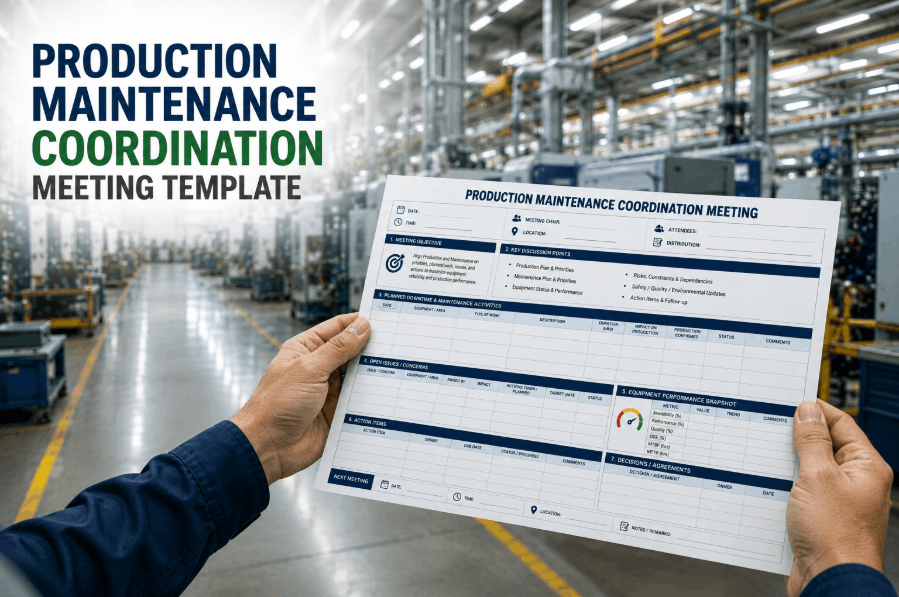
A production maintenance coordination meeting template is the operational backbone that bridges maintenance schedules with production targets — eliminating the communication gaps that drive unplanned downtime, missed PMs, and reactive repairs. Manufacturing plants that run structured coordination meetings with defined agendas, live work order visibility, and clear action ownership consistently outperform peers on OEE, MTTR, and schedule compliance. Sign Up Free on OxMaint to connect your coordination meetings to a live CMMS where work orders, asset status, and maintenance KPIs are always current — before the meeting starts.
What Is a Production Maintenance Coordination Meeting?
A production maintenance coordination meeting is a structured, recurring session where maintenance planners, production supervisors, and operations leadership align on equipment availability, upcoming planned maintenance windows, open work orders, and downtime risks — before production schedules are locked. Without this coordination layer, maintenance and production operate in parallel silos, creating schedule conflicts, premature equipment failures, and reactive firefighting that dominates shift hours. Book a Demo with OxMaint to see how live work order dashboards and asset status feeds directly into your weekly coordination cadence.
Review open, pending, and scheduled work orders against production windows — catching conflicts before they cause downtime.
Confirm upcoming preventive maintenance tasks are resourced, parts are available, and windows are cleared with production.
Validate current asset condition and any flagged reliability risks that could affect production targets this week or next.
Close outstanding actions from previous meetings with defined owners and completion dates — preventing recurring deferrals.
Production Maintenance Coordination Meeting Template: Core Agenda Sections
A meeting template that actually reduces downtime and conflicts requires a structured agenda that moves from review to decision to action in every session. The following sections define a complete, repeatable template for manufacturing environments.
Open every coordination meeting by reviewing actions assigned in the prior session — confirming completion status, escalating overdue items, and documenting carryovers with updated deadlines. This single discipline prevents the most common failure mode of coordination meetings: recurring deferrals with no accountability.
Review asset health status for all production-critical equipment — flagging any assets currently operating under degraded condition, active work orders in progress, or flagged for upcoming inspection. Sign Up Free on OxMaint to surface live asset condition status and open work orders in seconds, not spreadsheets.
Present all preventive maintenance tasks scheduled within the next 1–3 weeks — confirming window availability with production, verifying parts and labor are staged, and locking access windows into the production schedule before conflicts emerge.
Walk through all open work orders above priority threshold — confirming resource assignment, estimated completion, and production impact for each. Identify any overdue work orders requiring escalation or rescheduling. Book a Demo with OxMaint to see how work order dashboards drive faster coordination decisions.
Review any unplanned downtime events from the prior period — root cause status, corrective action assignments, and recurrence risk. Flag equipment with deteriorating trend data from predictive monitoring that may affect production targets in the upcoming window.
Confirm critical spare parts inventory levels against upcoming PM requirements — flagging any procurement lead time risks before they become stoppage events. Align contractor and technician availability with planned maintenance windows for the period ahead.
Assign all new actions from the meeting with a defined owner, deadline, and priority level. Confirm next meeting date and distribute meeting minutes with action log to all stakeholders within 24 hours of session close. Sign Up Free on OxMaint to automate work order assignments directly from coordination meeting outcomes.
Coordination Meeting Template: Field Reference
The table below defines the core data fields required in each section of a production-ready coordination meeting template for manufacturing facilities.
| Agenda Section | Required Fields | Owner |
|---|---|---|
| Action Review | Action ID, assigned owner, due date, completion status, escalation flag | Maintenance Planner |
| Equipment Status | Asset ID, current condition, active work orders, degraded status flag | Reliability Engineer |
| Upcoming PM Windows | PM task, asset, planned date, window duration, parts status, resource confirmed | Maintenance Planner |
| Open Work Orders | WO number, priority, asset, assigned tech, ETC, production impact | Maintenance Supervisor |
| Downtime Review | Event date, asset, downtime hours, root cause status, corrective action owner | Plant Manager |
| Spare Parts Status | Part number, current stock, reorder point, lead time, critical flag | Stores / Procurement |
| New Actions | Action description, owner, priority, due date, linked asset or WO | All Attendees |
6 Signs Your Coordination Meetings Are Failing
Most plants hold coordination meetings but fewer run them in ways that actually reduce downtime or resolve conflicts. These six indicators identify a coordination meeting process that needs a structural reset.
When the same assets, work orders, or production conflicts recur across consecutive meetings without resolution, the action tracking system has broken down — actions are assigned but not closed.
If work order status and equipment condition are compiled during the meeting rather than pulled from a live system, the coordination session becomes a data-gathering exercise rather than a decision-making forum.
When planned maintenance windows collide with production runs because the coordination meeting didn't surface the conflict, the meeting process is not reaching far enough into the forward schedule.
Verbal action assignments without a documented log guarantee that follow-up depends on individual memory — the single largest driver of coordination meeting ineffectiveness in manufacturing plants.
Coordination meetings that skip downtime event review miss the most valuable improvement signal available — each unplanned failure is a data point that should inform the next planning cycle.
A coordination meeting that operates without reviewing MTTR, PM compliance rate, and schedule adherence trend data is managing operations by feel — not by performance measurement. Book a Demo with OxMaint to see how maintenance KPI dashboards are built automatically from your work order and asset data.
Coordination Meeting KPIs to Review Every Session
These metrics should be reviewed in every production maintenance coordination meeting to validate that planning decisions are improving plant performance — not just filling agenda time.




![equipment-asset-register-template-for-manufacturing-plants-[free-excel]](./manage-post-2k26/uploads/equipment-asset-register-template-for-manufacturing-plants-[free-excel].png)
