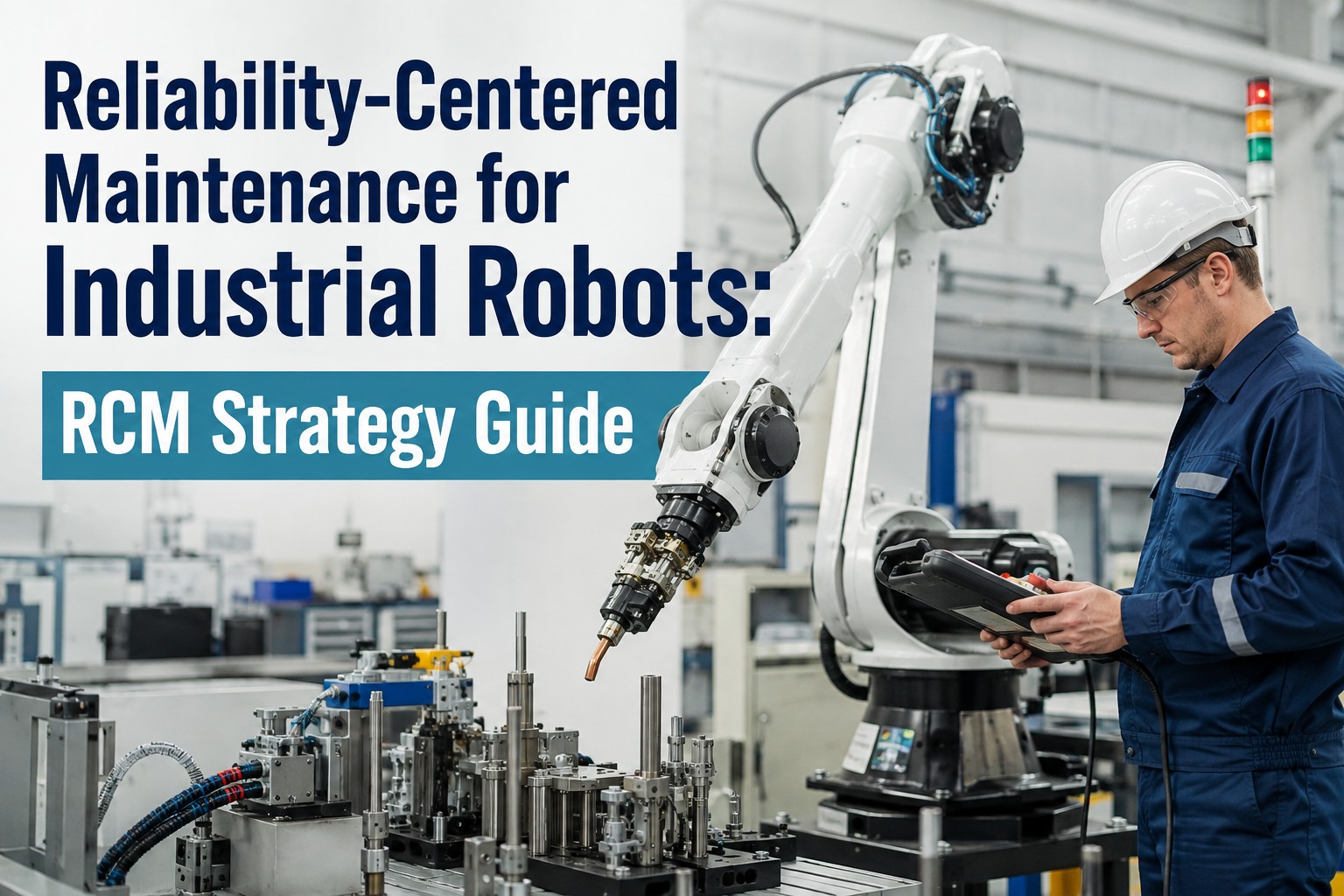
Reliability-Centered Maintenance (RCM) is the most structured framework ever developed for determining what maintenance to do, how often to do it, and which assets truly need it. Originally developed for commercial aviation and later adopted by military, nuclear, and process industries, RCM shifts maintenance strategy from calendar-based schedules toward consequence-driven decisions — asking not just what can fail, but what the operational impact of that failure actually is. Sign Up Free to explore how Oxmaint helps plants operationalise their RCM analysis through structured CMMS work orders, condition-based triggers, and predictive maintenance workflows. Most plants attempting RCM stall at analysis — producing detailed failure mode documentation that never translates into executable maintenance tasks. Oxmaint bridges that gap by converting RCM outputs directly into PM schedules, inspection checklists, and AI-driven condition alerts that maintenance teams can act on daily. Book a Demo to see how Oxmaint turns RCM strategy into operational maintenance execution.
Turn Your RCM Analysis into Executable Maintenance — Automatically
Oxmaint converts RCM outputs into PM schedules, condition-based alerts, and predictive work orders — making reliability-centered maintenance operational, not just theoretical. Most plants go live within 48 hours.
Why Most RCM Programs Fail Before Delivering ROI
Failure #1
Analysis Without Execution
RCM analysis produces detailed FMEA documentation but stops short of creating the maintenance schedules, checklists, and work orders that turn strategy into action on the plant floor.
Failure #2
No Condition Monitoring Integration
RCM recommends condition-based tasks for many failure modes — but without sensor data integration or inspection trigger workflows, these tasks default to fixed-interval schedules that defeat the purpose.
Failure #3
CMMS Not Aligned to RCM Logic
Legacy CMMS systems force all maintenance into fixed PM schedules regardless of failure mode. RCM-recommended run-to-failure, condition-based, and predictive tasks cannot be represented or triggered.
Failure #4
No Feedback Loop to Improve Decisions
RCM improves over time when failure data, maintenance findings, and condition trends feed back into the analysis. Without structured CMMS records, this learning loop never closes.
Failure #5
Criticality Not Reflected in Scheduling
RCM assigns different maintenance strategies to assets based on failure consequence — but without criticality-based scheduling in the CMMS, high and low consequence assets receive identical treatment.
Failure #6
Effort Concentrated on Wrong Assets
Without RCM logic guiding CMMS task allocation, maintenance effort is distributed by habit rather than consequence — over-maintaining non-critical equipment while under-protecting production-critical assets.
The Seven-Step RCM Process — From Analysis to Maintenance Execution
01
System Boundary & Function Definition
Define what the asset is required to do — its primary and secondary functions within its operating context. This forms the foundation of all subsequent RCM decisions.
→
02
Functional Failure Identification
Identify how each function can fail — what states constitute failure relative to the performance standard defined in the function statement for that operating context.
→
03
Failure Mode & Effects Analysis
For each functional failure, identify the specific failure modes — the physical causes — and the effects they produce at the equipment, system, and plant level.
→
04
Consequence Classification & Task Selection
Classify each failure by safety, environmental, operational, and economic consequence — then select the maintenance task type best suited to manage the failure mode at acceptable cost.
RCM Maintenance Task Types — and How Oxmaint Executes Each
Scheduled Restoration / Discard
Time-based replacement before age-related failure threshold
Oxmaint schedules automatically based on run hours or calendar
Mobile alerts notify technicians before task window closes
On-Condition / Predictive Tasks
Condition monitoring triggers maintenance before failure threshold
Oxmaint AI detects anomaly patterns and raises predictive WOs
Vibration, temperature, and pressure deviations trigger early intervention
Failure Finding Inspections
Scheduled inspections to reveal hidden function failures
Oxmaint digital checklists with pass/fail criteria per asset
Findings auto-trigger corrective work orders with asset linkage
Run to Failure Management
Non-critical assets with no applicable proactive task managed to failure
Oxmaint tracks failure events and repair costs for redesign decisions
Failure history feeds RCM review cycles for continuous improvement
25–35%
Reduction in total maintenance cost reported by plants implementing structured RCM programmes correctly
40%
Reduction in unplanned downtime events when condition-based RCM tasks replace fixed-interval scheduling
3×
Higher maintenance task relevance when RCM consequence analysis guides scheduling versus calendar defaults
48hrs
Time to go live in Oxmaint — from connecting your assets to first RCM-aligned work orders in the system
Applying RCM Across Industrial Asset Classes
Rotating Equipment
Pumps, Compressors & Turbines — Condition-First Maintenance
Rotating equipment failure modes — bearing wear, seal degradation, imbalance, cavitation — are ideally suited to RCM on-condition tasks. Oxmaint AI monitors vibration and temperature trends and raises predictive work orders when deviation patterns match known failure signatures. Sign Up Free to connect rotating equipment to Oxmaint predictive maintenance.
Static Equipment
Vessels, Heat Exchangers & Piping — Inspection-Driven RCM
Static equipment failure modes — corrosion, fouling, wall thinning — are managed through RCM failure finding inspections. Oxmaint structures inspection checklists per asset, captures thickness readings and findings digitally, and auto-triggers corrective WOs when inspection results fall below defined acceptance criteria. Book a Demo for static equipment inspection workflows.
Electrical & Instrumentation
Protective Functions — Failure Finding Task Management
Protective devices — safety instrumented systems, pressure relief valves, emergency shutdown systems — have hidden failure modes detectable only through periodic function testing. Oxmaint schedules these RCM failure finding tasks automatically and captures test results as digital records.
Facilities & Utilities
HVAC, Electrical Distribution & Utility Systems
Facility utility systems — HVAC, transformers, UPS, fire suppression — benefit from RCM analysis that separates critical utility assets from run-to-failure candidates. Oxmaint applies appropriate task types per asset class, reducing over-maintenance on non-critical utility equipment. Book a Demo for facilities maintenance optimisation.
RCM Programme Performance KPIs — Tracked Automatically in Oxmaint
These six KPIs measure whether your RCM programme is delivering operational improvements — not just documentation. Oxmaint calculates them continuously from live work order and asset data. Sign Up Free to activate your reliability performance dashboard.
KPI 01
Mean Time Between Failures (MTBF)
The primary indicator of RCM programme effectiveness. Rising MTBF on previously unreliable assets confirms that RCM-selected maintenance strategies are preventing the targeted failure modes.
Reliability
KPI 02
Planned vs Reactive Maintenance Ratio
Percentage of total maintenance hours spent on planned RCM tasks versus reactive breakdown repair. World-class RCM programmes achieve 85%+ planned maintenance ratios.
Strategy Mix
KPI 03
Failure Finding Task Completion Rate
Percentage of scheduled failure finding inspections completed within their required interval. Missed failure finding tasks on protective devices represent direct safety and compliance risk.
Safety Compliance
KPI 04
Condition Monitoring Coverage
Percentage of assets with RCM-recommended on-condition tasks that are actively monitored — either through sensor integration or regular manual condition readings captured in the CMMS.
Programme Completeness
KPI 05
Overall Equipment Effectiveness (OEE)
Availability, performance, and quality composite metric for RCM-managed asset classes. OEE improvement over successive quarters demonstrates the production value of reliability-centred strategy selection.
Production Impact
KPI 06
Maintenance Cost per Operating Hour
Total maintenance spend divided by operating hours for each asset or asset class. Declining cost per hour on RCM-covered assets validates that task rationalisation is removing unnecessary maintenance without increasing failure risk.
Cost Efficiency
RCM-Aligned Oxmaint vs Traditional Fixed-Interval CMMS
Traditional CMMS — Fixed Interval Maintenance
All assets maintained on calendar schedules — no failure consequence analysis
Over-maintenance of non-critical equipment wastes labour and parts budget
Under-maintenance of critical assets not flagged until breakdown occurs
No condition monitoring integration — faults missed between fixed PM cycles
Failure data stored in work orders but never analysed to improve strategy
MTBF, OEE, and reliability KPIs not calculated — no programme performance visibility
Oxmaint — RCM-Aligned Maintenance Execution
Task types matched to failure mode consequence — condition, time, or failure-finding — Sign Up Free
Critical assets receive condition-based and predictive coverage — not just fixed intervals
Non-critical run-to-failure assets tracked for failure events without scheduled labour waste
AI anomaly detection triggers predictive WOs before failure threshold — condition-based execution
Every failure event linked to asset history — closes RCM feedback loop for strategy improvement
MTBF, planned-reactive ratio, OEE — all calculated automatically in live dashboard
Operationalise Your RCM Programme — Not Just Document It
Oxmaint converts RCM analysis into executable PM schedules, condition-based alerts, and predictive work orders that maintenance teams act on every day. Book a Demo to see RCM-aligned maintenance execution live.
Frequently Asked Questions
What is Reliability-Centered Maintenance (RCM)?
RCM is a structured methodology for determining the most effective maintenance strategy for each asset based on its functions, failure modes, and the operational consequences of those failures. It results in the right task type — time-based, condition-based, failure finding, or run-to-failure — applied to each failure mode.
How is RCM different from preventive maintenance?
Preventive maintenance applies scheduled tasks to all assets regardless of failure consequence. RCM determines whether a proactive task is technically and economically justified for each specific failure mode — often resulting in reduced total maintenance tasks while improving reliability on critical assets.
How does Oxmaint support a Reliability-Centered Maintenance programme?
Oxmaint executes the maintenance tasks RCM analysis selects — scheduling PM and inspection tasks, triggering condition-based and predictive work orders from sensor data, capturing failure events, and calculating MTBF and reliability KPIs that feed back into the RCM review cycle.
What is the difference between RCM and RCM2?
RCM2 is John Moubray's refined version of the original RCM standard, introducing the seven questions framework and formalising the decision logic for task selection. Most industrial RCM programmes today follow RCM2 principles as the recognised best-practice methodology.
How long does it take to implement an RCM programme?
Full classical RCM analysis for a complex plant can take 12–24 months. Streamlined RCM approaches focusing on critical systems first typically deliver operational improvements within 3–6 months. Oxmaint accelerates execution by converting completed analysis into active maintenance schedules immediately.
From RCM Analysis to Live Maintenance Execution in 48 Hours
Oxmaint takes your RCM outputs and turns them into active PM schedules, inspection checklists, and predictive alerts — so reliability strategy becomes daily maintenance practice, not a document in a folder.



-for-manufacturing-plants-a-2026-guide.png)