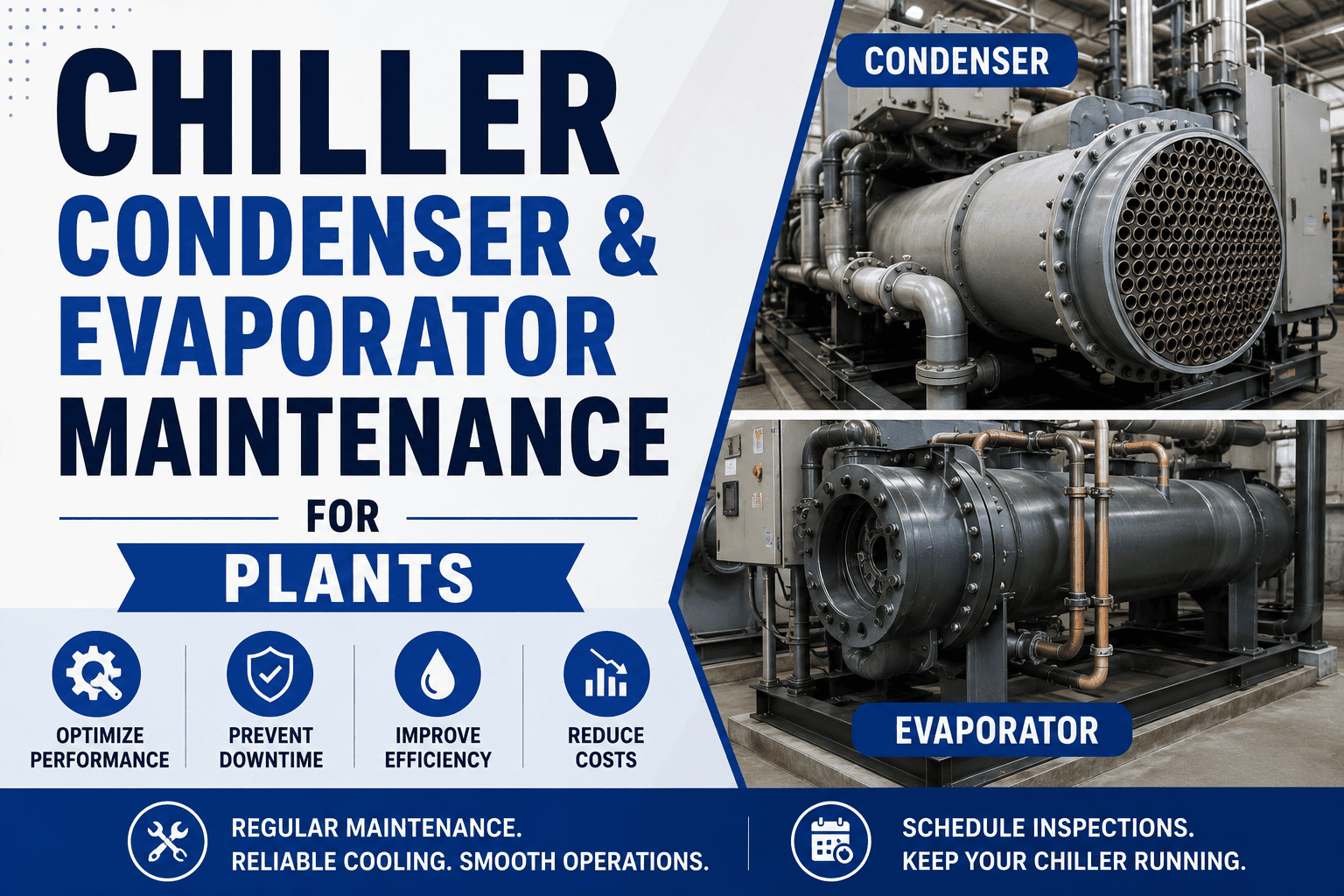
Chiller condenser and evaporator maintenance in manufacturing plants directly determines whether your process cooling runs at peak efficiency or bleles thousands of dollars in excess energy every month. A fouled condenser tube bundle raising approach temperature by just 1°C can increase chiller energy consumption by 2–3%, and when evaporator tubes scale up, compressor head pressure climbs until safety cutouts trigger unplanned shutdowns. This guide covers the full scope of chiller tube maintenance, refrigerant leak detection, oil analysis, and seasonal PM scheduling — and shows how a CMMS built for maintenance teams like OxMaint turns these tasks into an automated, audit-ready program. Ready to stop firefighting chiller downtime? Start Free Trial and digitize your chiller PM program today.
Is tube fouling silently driving your chiller energy bill up 15% a year?
Manufacturing chillers lose roughly 0.5–1% efficiency for every 1°C rise in condenser approach temperature. A disciplined condenser & evaporator maintenance plan — scheduled and tracked inside a CMMS — keeps approach temps tight, kW/ton low, and process cooling online all season. OxMaint automates the schedule, the work orders, and the analytics so nothing slips.
The real cost of skipping chiller condenser & evaporator maintenance
In a typical 500-ton manufacturing chiller running 6,000 hours per year, every 1°C of excess condenser approach temperature costs about $3,500 in additional electricity. At 3°C of drift — common in plants that clean tubes only reactively — you're losing over $10,000 per chiller annually, before any unplanned downtime is counted.
A Midwest plastics plant operating three 350-ton water-cooled chillers was spending $42,000/year on reactive chiller repairs and overtime. Condenser tubes were cleaned only when approach temperatures exceeded 4°C — by then, compressors were already running at 95% load. After implementing a quarterly tube-cleaning PM and monthly approach-temperature monitoring inside OxMaint, the plant cut chiller energy cost by 14%, eliminated three major downtime events in the first year, and recovered $38,400 in avoidable spend.
A 12-month manufacturing chiller PM schedule that keeps efficiency high year-round
Chiller load profiles in manufacturing plants are seasonal. Pre-cooling-season preparation, mid-summer monitoring, and off-season deep maintenance each have distinct tasks. Here's a proven chiller PM calendar that reliability teams can deploy inside any CMMS — and how OxMaint automates each trigger.
Condenser & evaporator tube inspection
- Eddy-current tube testing on condenser & evaporator bundles (every 3–5 yrs)
- Brush-clean condenser water tubes; log tube-sheet condition photos
- Refrigerant charge audit; log superheat & subcooling baselines
- Compressor oil sample for spectrometric analysis (wear metals, moisture)
Pre-cooling-season commissioning checks
- Calibrate approach-temperature sensors & refrigerant pressure transducers
- Verify cooling-tower water chemistry; adjust inhibitor dosing
- Test safety controls — low-pressure, high-pressure, oil-flow switches
- Confirm leak detector operation; perform electronic leak survey on all joints
Approach temperature & performance trending
- Weekly condenser approach temp log (target < 2°C for water-cooled, < 5°C air-cooled)
- Weekly evaporator approach temp log (target < 1.5°C)
- Log kW/ton at full & part load; flag > 5% degradation from baseline
- Monthly refrigerant leak check; oil level & filter-drier pressure-drop inspection
Post-season review & corrective actions
- Review seasonal approach-temp trends; schedule tube cleaning if drift detected
- Drain & inspect cooling-tower basin; clean sump & fill media
- Refrigerant moisture & acid test; replace filter driers if pressure drop elevated
- Update CMMS asset records with completed work, parts used & findings
Chiller approach temperature, oil analysis & refrigerant checks: what to monitor
Approach temperature is the single most powerful early-warning indicator of tube fouling in both condensers and evaporators. When it drifts, efficiency is already slipping. Here are the core metrics every manufacturing chiller PM program should log — and what each one tells you.
Refrigerant condensing temp minus leaving condenser water temp. Water-cooled target: < 2°C. Air-cooled target: < 5°C. A 1°C rise ≈ 2–3% more energy consumed.
Entering chilled-water temp minus refrigerant evaporating temp. Target: < 1.5°C. Rising trend signals evaporator tube fouling or low refrigerant charge.
Benchmark against OEM performance chart at current load. A 5%+ deviation from baseline indicates fouling, refrigerant loss, or mechanical wear requiring corrective action.
| Metric | Healthy Range | Action Trigger | PM Frequency |
|---|---|---|---|
| Condenser approach temp (water-cooled) | < 2.0°C | > 3.0°C → schedule tube cleaning | Weekly log |
| Evaporator approach temp | < 1.5°C | > 2.5°C → inspect tubes & refrigerant | Weekly log |
| Refrigerant superheat | 4–8°C (per OEM) | Out of range → check expansion valve | Monthly |
| Refrigerant subcooling | 8–12°C | < 5°C → check charge & condenser fouling | Monthly |
| Compressor oil moisture (ppm) | < 50 ppm | > 75 ppm → replace filter drier, oil | Quarterly lab sample |
| Oil wear metals (Fe, Cu, Al) | Per OEM baseline | Rising trend → schedule internal inspection | Quarterly lab sample |
| kW/ton vs. baseline | Within 5% | > 5% degradation → full performance audit | Continuous / monthly review |
How OxMaint CMMS streamlines chiller condenser & evaporator maintenance
Spreadsheets and wall calendars don't trigger work orders when approach temperatures drift — and they certainly can't trend chiller performance data over time. OxMaint turns your chiller PM program into an automated, predictive, audit-ready system that reliability teams can manage from any device.
Automated seasonal PM scheduling
Auto-generate quarterly tube-cleaning work orders, monthly approach-temp logs, and annual eddy-current inspections based on chiller runtime hours, calendar triggers, or condition thresholds — so no PM task ever falls through the cracks again.
Predictive approach-temp analytics
OxMaint's AI engine ingests sensor data from your BMS or SCADA and trends condenser & evaporator approach temperatures in real time. It flags degradation trends days or weeks before efficiency drops, automatically generating corrective work orders.
Spare-parts & refrigerant inventory tracking
Track refrigerant cylinders, filter driers, compressor oil, gasket kits, and tube-cleaning brushes by chiller asset. OxMaint auto-reorders at minimum-stock thresholds and links parts directly to work orders for full cost-of-maintenance visibility.
Audit-ready maintenance records
Every work order, inspection photo, oil analysis report, and refrigerant log is permanently attached to the chiller's asset record. Generate compliance reports for ISO 55000, internal audits, or insurance inspections in seconds — not days.
Condenser maintenance checklist for manufacturing plants
Use this tiered checklist to build out your chiller condenser and evaporator PM tasks inside OxMaint. Each tier maps to a frequency — weekly tasks catch drift early, quarterly tasks prevent efficiency loss, and annual tasks protect long-term asset integrity.
- Log condenser approach temperature; flag if > 3°C
- Log evaporator approach temperature; flag if > 2.5°C
- Record chiller kW/ton at current load
- Visual inspect for refrigerant oil stains at joints & fittings
- Check cooling-tower water level & makeup valve operation
- Perform electronic refrigerant leak survey on all chiller joints
- Check compressor oil level, color & acidity
- Inspect filter-drier pressure drop; replace if > OEM spec
- Verify refrigerant superheat & subcooling against OEM chart
- Review approach-temp trend for 4-week degradation pattern
- Test cooling-tower water chemistry; adjust treatment dosing
- Brush-clean condenser water tubes (water-cooled chillers)
- Clean condenser coil fins (air-cooled chillers)
- Draw compressor oil sample for lab spectrometric analysis
- Inspect tube sheets for corrosion, pitting & galvanic damage
- Calibrate refrigerant pressure & temperature sensors
- Test all safety interlocks: low-pressure, high-pressure, oil-flow
- Eddy-current tube testing (every 3–5 yrs per ASME standards)
- Compressor motor insulation resistance & megger test
- Refrigerant charge recovery, recycle & recharge to spec
- Replace filter driers; inspect & clean expansion valve
- Full cooling-tower descale, sump cleanout & fill inspection
- Update CMMS asset record with all findings & parts consumed
What reliability teams say about OxMaint chiller PM
"We cut chiller approach-temperature drift from 4°C to under 1.5°C within six months of moving our PM program into OxMaint. The auto-generated work orders meant our techs never missed a tube cleaning again."
"Before OxMaint we tracked chiller PMs on a whiteboard. We missed two condenser cleanings in one summer and paid $18K in extra energy. Now the CMMS schedules everything and we haven't had a surprise chiller shutdown in 14 months."
See OxMaint manage your chiller PM program — book a 30-min demo
Watch how OxMaint auto-schedules condenser & evaporator maintenance, trends approach temperatures, and generates audit-ready work orders for every chiller in your plant.
Chiller condenser & evaporator maintenance: frequently asked questions
How often should condenser tubes be cleaned in a manufacturing chiller?
Water-cooled condenser tubes should be brush-cleaned at least quarterly in manufacturing plants with open cooling towers, and semi-annually for closed-loop systems. Air-cooled condenser coils need quarterly cleaning in dusty environments and semi-annual cleaning otherwise. The best trigger is approach temperature: if condenser approach exceeds 3°C, clean regardless of schedule. OxMaint can auto-generate the cleaning work order when your sensor data crosses that threshold. Book a Demo to see condition-based PM triggers in action.
What is a good condenser approach temperature for a water-cooled chiller?
A healthy condenser approach temperature for a water-cooled chiller is under 2°C (3.6°F). For air-cooled chillers, target under 5°C (9°F). Approach temperature equals refrigerant condensing temperature minus leaving condenser-water temperature. Every 1°C rise above baseline typically increases chiller energy consumption by 2–3%, so tracking this metric weekly is one of the highest-ROI maintenance tasks you can perform.
What causes high evaporator approach temperature in a chiller?
High evaporator approach temperature is most commonly caused by fouling on the chilled-water side of evaporator tubes, low refrigerant charge, or a malfunctioning expansion valve. Other contributors include inadequate water flow (from air in the system or a failing pump) and biofilm or scale buildup. If the trend rises steadily over 2–4 weeks, schedule a tube inspection and refrigerant-level check before efficiency degrades further.
Can a CMMS help with chiller maintenance in manufacturing plants?
Yes — a CMMS like OxMaint is purpose-built for managing complex seasonal chiller PM programs. It auto-schedules tube cleanings, refrigerant checks, and oil sampling based on calendar triggers, runtime hours, or sensor-data thresholds. It also tracks spare parts (refrigerant, filter driers, gaskets), attaches inspection photos and lab reports to asset records, and provides analytics on approach-temperature trends and kW/ton so you can catch degradation before it becomes a failure.
How much does chiller tube fouling cost in extra energy per year?
A 500-ton chiller with 3°C of approach-temperature drift from tube fouling can waste $10,000–$15,000 in electricity annually. At 0.5 kW/ton degradation and $0.12/kWh, that's roughly $1,800 per 1°C of drift per 100 tons of cooling capacity over 6,000 operating hours. Plants with multiple chillers can lose $40K+ per year. A disciplined CMMS-driven cleaning program typically pays for itself within the first quarter. Start Free Trial to calculate and recover your losses.
Stop losing money to fouled chiller tubes and missed PMs
Deploy OxMaint's AI-powered CMMS and turn your chiller condenser & evaporator maintenance into an automated, predictive, audit-ready program — in days, not months.
Free 14-day trial · No credit card



.png)
