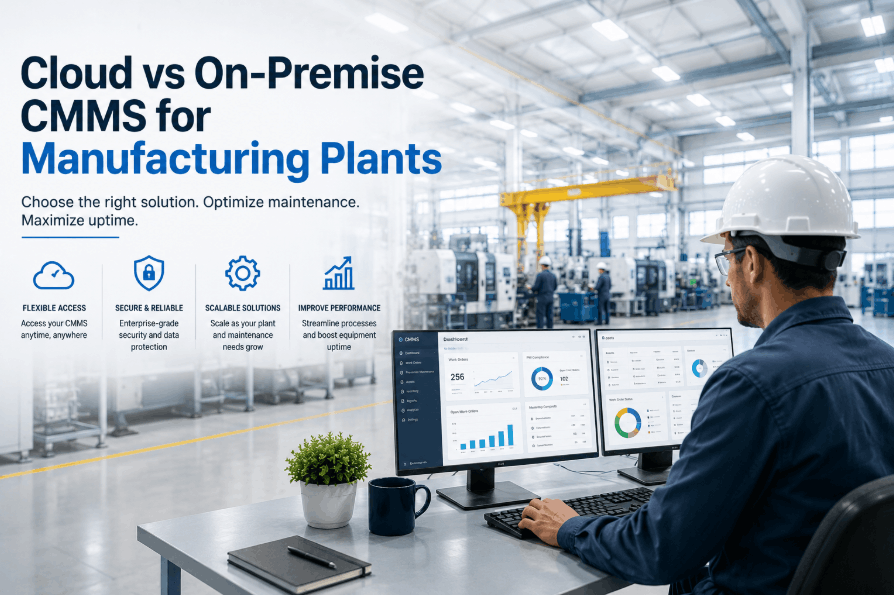
Choosing between a cloud-based and on-premise CMMS is one of the highest-impact infrastructure decisions a manufacturing plant will make in 2026. The wrong choice adds implementation costs, limits scalability, or creates security exposure. The right choice accelerates maintenance performance, reduces IT burden, and delivers real-time visibility into asset health across every production line. Both deployment models have genuine advantages — and the best fit depends on your plant's size, IT infrastructure, compliance requirements, and operational complexity. Sign Up Free to explore OxMaint's cloud CMMS platform and see how fast a modern deployment can transform your maintenance operations. Cloud CMMS platforms now account for over 70% of new CMMS deployments in manufacturing, driven by lower upfront costs, faster implementation, and built-in mobile access for technicians on the floor. On-premise solutions retain value in high-security environments, regulated industries, and plants with existing IT infrastructure investments. Understanding what each model delivers — and what it costs — prevents a costly mismatch between your deployment choice and your operational reality. Book a Demo to see how OxMaint's cloud CMMS deploys in days and integrates with your existing plant systems. The maintenance software market has shifted decisively toward cloud-native platforms, but the transition timeline and approach still require careful planning for each facility type. Sign Up Free to evaluate OxMaint's deployment model against your plant's requirements — no IT project required.
Cloud CMMS for Manufacturing
Deploy in Days. Not Months. Not Years.
OxMaint's cloud CMMS gives manufacturing plants real-time maintenance visibility, mobile work orders, and predictive maintenance capabilities — with zero server infrastructure required.
Cloud vs On-Premise CMMS: Core Differences Manufacturing Plants Need to Understand
Deployment Model, Cost Structure, and Operational Impact Compared
Deployment Speed
A
Cloud CMMS platforms deploy in days to weeks — no server procurement, no IT configuration, no lengthy installation. On-premise CMMS implementations average 3–9 months from contract to go-live, with significant internal IT resource commitment required for server setup, network configuration, and user access management.
Total Cost of Ownership
B
Cloud CMMS operates on predictable per-user subscription pricing with no hardware investment. On-premise requires upfront software licensing (often $30,000–$150,000+), server hardware, IT maintenance staff, and upgrade costs. Cloud TCO is typically 40–60% lower over a 5-year period for mid-size manufacturing operations.
Mobile and Field Accessibility
C
Cloud CMMS provides native mobile access for technicians on the floor, in the field, or at remote sites — instantly. On-premise systems require VPN configuration, remote desktop setups, or complex mobile middleware to achieve the same access. Floor-level mobile access is critical for real-time work order updates.
Security and Data Control
D
On-premise gives maximum data sovereignty — all maintenance data stays within your network, behind your firewall. Cloud providers implement enterprise-grade encryption, SOC 2 compliance, and redundant backups, but data leaves the plant boundary. For highly regulated industries or government-adjacent manufacturers, on-premise remains preferred for compliance reasons.
Scalability and Multi-Site Support
E
Cloud CMMS scales instantly — add users, sites, and assets with no infrastructure changes. On-premise scaling requires server upgrades, additional licensing, and IT project investment. For multi-plant manufacturers, cloud CMMS delivers consolidated visibility across all facilities from a single platform without replicating infrastructure at each location.
Updates and Feature Access
F
Cloud CMMS delivers continuous feature updates, AI enhancements, and security patches automatically. On-premise users receive periodic major version releases — often requiring costly upgrade projects. Manufacturers using cloud CMMS access predictive maintenance and analytics features months or years ahead of on-premise equivalents.
70%+
of new CMMS deployments in manufacturing now choose cloud over on-premise solutions
40–60%
lower 5-year total cost of ownership for cloud CMMS versus on-premise equivalents
3–9 mo
average on-premise CMMS deployment timeline versus days-to-weeks for cloud platforms
Decision Framework: When to Choose Cloud vs On-Premise CMMS
Six Evaluation Criteria to Match Deployment Model to Your Plant's Needs
1
Evaluate Your IT Infrastructure and Support Capacity
On-premise CMMS requires dedicated IT staff for server maintenance, backup management, and security patching. If your plant lacks an in-house IT team or has limited IT capacity, cloud eliminates this burden entirely. Cloud CMMS lets maintenance managers operate independently of IT for day-to-day operations.
Book a Demo to see OxMaint's zero-IT-overhead deployment model.
2
Assess Regulatory and Compliance Requirements
Industries with strict data residency laws, government contracts, or classified operations may require on-premise deployment. For most discrete manufacturing, food processing, and general industrial plants, cloud CMMS from SOC 2 compliant vendors fully satisfies security and compliance requirements without additional overhead.
3
Calculate True Total Cost of Ownership
On-premise upfront costs are visible — software licenses, server hardware, implementation consulting. Hidden costs include: ongoing IT staff time, upgrade projects every 3–5 years, and lost productivity during version migrations. Cloud TCO analysis should compare 5-year total spend including all IT support costs, not just subscription fees.
Sign Up Free to run a cost comparison with OxMaint's cloud pricing.
4
Evaluate Internet Connectivity Reliability at Your Sites
Cloud CMMS requires reliable internet connectivity. For remote manufacturing sites with poor connectivity, on-premise provides uninterrupted access regardless of network status. Modern cloud CMMS platforms offer offline mobile modes that sync when connectivity is restored — reducing but not eliminating this concern for unstable network environments.
5
Consider Multi-Site and Growth Requirements
If your organization operates multiple plants or plans expansion, cloud CMMS delivers consolidated maintenance visibility across all sites from day one — with no infrastructure replication. On-premise multi-site deployments require separate server environments, complex data synchronization, and significant IT investment to achieve the same cross-plant reporting.
6
Assess Implementation Timeline and Business Urgency
If your plant needs CMMS capability now — to stop reactive maintenance, capture downtime data, or meet audit requirements — cloud is the only viable option. A 6-month on-premise implementation timeline means 6 more months of untracked downtime, unoptimized PM, and reactive maintenance. Speed-to-value favors cloud decisively.
Book a Demo to see OxMaint live in your workflow within the week.
Cloud vs On-Premise CMMS: Feature and Capability Comparison
What Each Deployment Model Delivers for Manufacturing Maintenance Teams
- Deployment in days — immediate value delivery
- Native mobile access for all floor technicians
- Automatic updates with latest AI and analytics features
- Multi-site visibility from a single unified platform
- No server hardware or IT maintenance overhead
- Predictable per-user subscription pricing
- Requires reliable internet connectivity at the site
- Data resides on vendor servers (compliance review needed)
- Ongoing subscription cost vs. one-time license
- Customization may be more limited than on-premise
- Complete data sovereignty within your network
- Functions without internet connectivity
- Deep ERP/OT system integration possible
- Highly customizable for complex workflows
- One-time license may favor very long-term use
- Preferred for classified or high-security environments
- 3–9 month implementation timeline typical
- High upfront software and hardware investment
- Requires dedicated IT staff for ongoing management
- Major upgrades require separate IT projects
Cost Comparison: Cloud vs On-Premise CMMS for a Mid-Size Manufacturing Plant
5-Year Total Cost of Ownership Analysis
Cloud CMMS: Year 1 Investment
Per-user subscription × number of users + onboarding + integrations
Example: 15 users × $80/mo × 12 months + $2,000 setup = $16,400 total year-one investment
On-Premise CMMS: Year 1 Investment
Software license + server hardware + implementation consulting + IT staff time
Example: $45,000 license + $15,000 hardware + $25,000 consulting + 3 months IT = $100,000+
Cloud CMMS: 5-Year TCO
Annual subscription × 5 years + minor integration updates
Example: $14,400/yr × 5 years + $5,000 updates = $77,000 total 5-year cost for 15 users
On-Premise CMMS: 5-Year TCO
Initial investment + annual IT maintenance + major upgrade project at year 3–4
Example: $100,000 initial + $15,000/yr IT + $40,000 upgrade = $215,000 5-year total cost
Cloud CMMS Built for Manufacturing
Get Full CMMS Capability Without the On-Premise Overhead
OxMaint delivers cloud-native CMMS with predictive maintenance, mobile work orders, asset management, and real-time analytics — deployable in days with no IT infrastructure required.
Frequently Asked Questions: Cloud vs On-Premise CMMS
Is cloud CMMS secure enough for manufacturing plants?
Yes, for the vast majority of manufacturers. Leading cloud CMMS platforms maintain SOC 2 Type II certification, AES-256 encryption, and redundant data backups. Only highly regulated industries with specific data residency requirements or classified operations typically require on-premise deployment.
How long does it take to implement a cloud CMMS versus on-premise?
Cloud CMMS platforms typically deploy in 1–4 weeks including asset setup, user onboarding, and initial PM schedule configuration. On-premise implementations average 3–9 months from contract to go-live, with significant IT resource commitment throughout.
Can cloud CMMS integrate with existing plant systems like ERP or SCADA?
Yes. Modern cloud CMMS platforms offer REST API integrations, pre-built connectors for common ERP systems, and IoT sensor data ingestion. Book a Demo to review OxMaint's integration options for your existing plant systems.
What happens to our data if we switch cloud CMMS vendors?
Reputable cloud CMMS vendors provide full data export in standard formats (CSV, JSON, XML) upon request or contract termination. Review data portability guarantees before committing to any cloud vendor and ensure your contract includes data export rights.
Is on-premise CMMS cheaper in the long run?
Rarely. When full TCO is calculated — including server hardware, IT staff time, upgrade projects, and lost productivity during migrations — cloud CMMS is 40–60% less expensive over 5 years for most mid-size manufacturing plants. Sign Up Free to see OxMaint's transparent pricing.
Does OxMaint offer a cloud CMMS built specifically for manufacturing?
Yes. OxMaint is a cloud-native CMMS designed for manufacturing plants, with modules for preventive maintenance, predictive maintenance, work order management, asset tracking, spare parts inventory, and downtime analytics — all accessible on mobile from any location.
Manufacturing CMMS Decision Made Simple
Start With Cloud. See Results in Days.
OxMaint's cloud CMMS is built for manufacturing teams who need real results fast — without a 6-month IT project standing between them and better maintenance performance.
.png)


.png)