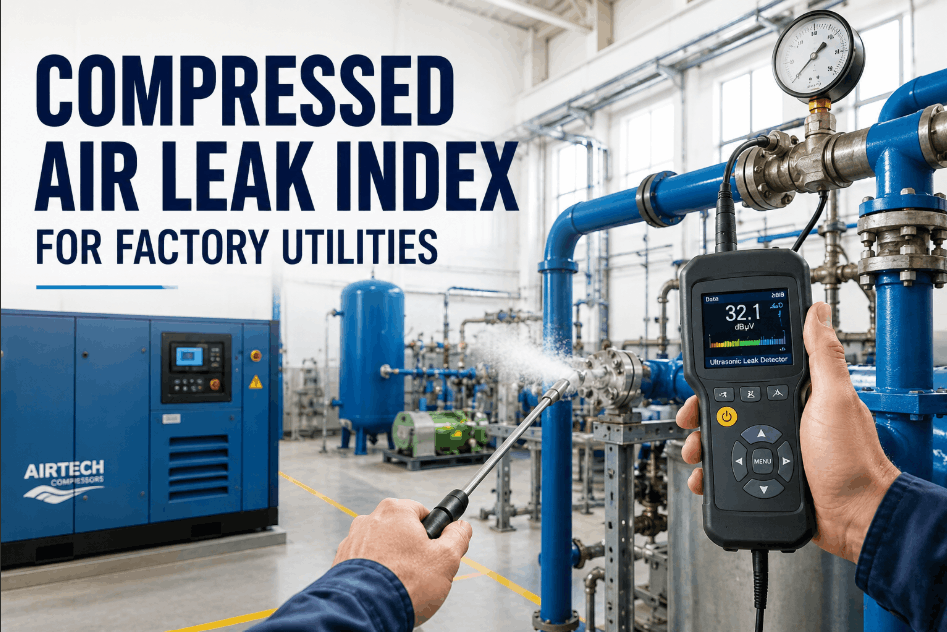
Compressed air is among the most expensive utilities in a manufacturing facility — and one of the most wasted. Industry data consistently shows that unmanaged compressed air systems lose 20–30% of generated air to leaks, with the majority of those losses undetected because they produce no visible symptom, no alarm, and no work order. A compressed air leak index changes this by quantifying leakage as a tracked metric — giving utility maintenance teams, energy managers, and FM leads a measurable baseline to improve against. For factory operations teams responsible for utility infrastructure across production lines, linking leak index data to a structured CMMS maintenance program is the difference between an energy audit recommendation and a sustained efficiency improvement. Sign Up Free with Oxmaint and connect your compressed air leak survey findings to digital work orders, asset records, and recurring PM schedules — so every identified leak becomes a tracked, assigned, and verifiably closed maintenance task.
Compressed Air Leak Index · Factory Utilities · Energy Savings · CMMS
Track Compressed Air Leaks, Drive Energy Savings — With Oxmaint
Oxmaint's Cloud CMMS platform gives factory utility teams compressed air leak work orders, asset-level energy tracking, recurring PM schedules, and mobile execution — turning leak index data into documented, measurable efficiency improvement.
Why Compressed Air Leak Management Is a Factory Utility Priority
Compressed air generation consumes 10–30% of a typical manufacturing facility's total electrical energy. Unlike other utility systems, compressed air leaks produce no visible output, generate no process alarm, and cause no immediate production disruption — making them structurally invisible to maintenance teams without a dedicated leak detection and tracking program. By the time compressed air operating costs escalate noticeably, a facility has already been absorbing avoidable energy expense for months or years. Book a Demo to see how Oxmaint structures compressed air leak work orders, asset condition records, and recurring utility PM schedules to give your factory maintenance team a sustained energy governance program — not a one-off audit.
Invisible Energy Waste
Compressed air leaks at fittings, joints, hoses, and condensate drains are inaudible at normal ambient noise levels and generate no control room alarm. Without ultrasonic leak detection surveys logged in a CMMS, leakage accumulates across the distribution network with no accountability trail.
Compressor Overload and Motor Load Increase
As leakage reduces system pressure, compressors run longer to maintain setpoint — increasing motor load, compressor wear, and energy consumption simultaneously. Tracking leak index trends in Oxmaint reveals when aggregate leakage has reached a threshold that is measurably affecting compressor operating hours and power factor.
No Submetering at Distribution Points
Facilities without compressed air submetering at production line inlets cannot isolate which zones or processes are consuming above baseline — masking both legitimate demand growth and leak-driven waste within a single generation-level consumption figure.
Deferred Leak Remediation
Leak surveys conducted without a CMMS backend generate paper reports that are rarely converted to repair work orders before the next survey cycle. Leaks identified but not tracked to completion continue consuming energy across the intervening weeks or months between surveys.
Carbon Intensity and Sustainability Reporting Gaps
Compressed air energy waste directly contributes to Scope 2 carbon emissions. Facilities with sustainability targets or energy governance frameworks need asset-level compressed air consumption records — not just utility bills — to demonstrate measurable efficiency improvement and support carbon intensity reporting.
Demand Profile Misreading
Compressed air demand profiles distorted by leak-driven baseline consumption lead to incorrect compressor sizing decisions and idle load management strategies. Accurate demand profiling requires separating legitimate process demand from leak waste — possible only with a structured leak index tracking program.
Compressed Air Leak Index Program Framework for Factory Utility Teams
A compressed air leak index program moves leak management from a periodic audit activity to a continuous operational metric — with survey frequency, remediation tracking, and efficiency benchmarking built into the maintenance program. The following framework reflects best practices for factory utility teams implementing a structured leak index measurement and improvement cycle. Book a Demo to see how Oxmaint structures these activities as recurring work orders accessible on any mobile device across your factory sites.
Ultrasonic Leak Survey and Leak Index Calculation
Scheduled ultrasonic leak detection surveys — conducted quarterly or semi-annually depending on system age and production intensity — identify and quantify leak points across the compressed air distribution network. Leak volume estimates at each point are aggregated into a site-level leak index expressed as a percentage of total compressed air generation. Oxmaint records each survey finding as an asset-linked work order, building a leak history by location that reveals chronic problem areas and repair effectiveness over time.
Leak Remediation Work Order Tracking
Every leak identified in a survey generates a repair work order in Oxmaint — assigned to a technician, linked to the specific fitting, hose, joint, or drain point asset, prioritized by estimated air loss volume, and tracked to verified completion with photo evidence. This converts the survey from a report into a live repair queue, ensuring that identified leaks are closed rather than deferred to the next survey cycle.
Compressor Operating Hours and Motor Load Monitoring
Logging compressor run hours, loading cycles, and current draw against production schedules in Oxmaint establishes the baseline that leak remediation improvement is measured against. A sustained reduction in compressor operating hours following a leak repair campaign is the most direct evidence of energy savings — and a compelling metric for energy governance reporting.
Condensate Drain and Auto-Drain PM Scheduling
Automatic condensate drains are among the highest-frequency leak sources in compressed air systems — either leaking continuously when solenoids fail open or blocking condensate removal when valves fail closed. Oxmaint schedules recurring auto-drain inspection work orders at the frequency recommended by the manufacturer or system operating conditions, keeping these high-wear components in verified working condition between leak surveys.
Energy Savings Reporting and Operating Cost Tracking
Translating a compressed air leak index improvement into energy cost savings — using site-specific compressor efficiency data and electricity tariff rates — gives facility managers and sustainability leads a financially quantified return on the leak management program. Oxmaint stores energy readings and maintenance completion records that support this calculation, providing the documented evidence base for operating cost reviews and energy governance reporting.
How Oxmaint Supports Compressed Air Utility Management Across Factory Sites
Oxmaint is a cloud CMMS platform built for industrial and commercial maintenance teams managing multi-asset, multi-site utility infrastructure. For factory energy managers and utility maintenance leads, Oxmaint provides the operational backbone — structured leak repair work orders, asset-level energy logging, recurring compressor PM schedules, and vendor accountability — that transforms compressed air from an unmanaged cost into a tracked, improvable efficiency metric. Sign Up Free to register your compressed air assets and build a leak management program that delivers measurable, documented energy savings from day one.
| Compressed Air Challenge |
Without CMMS Structure |
With Oxmaint |
| Leak survey follow-through |
Paper reports, deferred repairs, no completion tracking |
Every leak becomes an assigned, tracked digital work order |
| Compressor PM |
Manual scheduling, missed service intervals |
Auto-recurring mobile work orders with alert notifications |
| Energy savings documentation |
Estimated, not asset-verified |
Compressor run hours and energy readings logged against asset records |
| Condensate drain management |
Reactive — addressed only when drain failure is visible |
Scheduled inspection work orders with photo-verified completion |
| Multi-site utility visibility |
Site-level only, no cross-facility benchmark |
Portfolio dashboard comparing leak index and PM compliance across sites |
Most Common Compressed Air Leak Sources in Factory Utilities — And How to Prevent Them
Understanding where compressed air leaks concentrate in factory utility systems enables targeted survey effort and more effective remediation prioritization. The leak sources below represent the highest-frequency failure points across industrial compressed air distribution networks — each addressable through scheduled inspection work orders and verified repair tracking in a CMMS. Sign Up Free to build a structured leak management program in Oxmaint that closes these gaps systematically.
01
Threaded Fittings and Couplings
Threaded connections are the most common compressed air leak point in factory distribution networks — particularly in older installations where thread sealant has degraded or connections have been disturbed during equipment moves. Periodic ultrasonic surveys logged in Oxmaint track chronic fitting locations and prioritize re-sealing before cumulative leakage becomes significant.
02
Failed Automatic Condensate Drains
Timer-operated and zero-loss condensate drains fail to both open and closed modes — continuously venting compressed air or blocking condensate removal. Failed-open drains represent a persistent energy leak that Oxmaint's scheduled drain inspection work orders catch and close before the next compressor efficiency review.
03
Hose Assemblies and Quick-Connect Points
Flexible hose assemblies and quick-connect couplings in point-of-use applications degrade under repeated connection cycles, temperature cycling, and mechanical strain. These high-wear components are often excluded from formal PM schedules — making them a disproportionate source of aggregate leak volume across factory production areas.
04
Pressure Regulator and Filter Housing Seals
O-ring and gasket seals in filter-regulator-lubricator (FRL) assemblies harden and crack over time — producing steady leaks at the most numerous components in the compressed air distribution network. A recurring FRL inspection task in Oxmaint, tied to annual or biannual seal replacement, maintains network integrity across dozens or hundreds of point-of-use stations.
05
Compressor Discharge Valve and Check Valve Leakage
Internal leakage past discharge valves and check valves in reciprocating compressors reduces volumetric efficiency — causing compressors to run longer to maintain system pressure without any external visible leak. Quarterly valve condition assessment logged as a CMMS work order identifies internal leakage before it drives measurable motor load increases.
06
Unused Equipment Left at Pressure
Decommissioned tools, unused drop lines, and capped outlets left at system pressure continue generating small but continuous leaks through aging fittings and valve seats. Systematic isolation of unused outlets — tracked as a CMMS audit task — removes this chronic baseline leakage from the facility's compressed air leak index without any capital expenditure.
Compressed Air Leak Index · Factory Utility CMMS · Energy Governance · Sustainability
One Platform for Leak Surveys, Repair Tracking, and Compressor PM Across All Your Sites
Oxmaint connects your compressed air leak index program — surveys, repair work orders, compressor PM, and energy logging — into a single cloud platform accessible from any mobile device across every factory in your portfolio.
Frequently Asked Questions — Compressed Air Leak Index for Factory Utilities
What is a compressed air leak index and how is it calculated?
A compressed air leak index is the ratio of estimated leak flow to total compressed air generation — expressed as a percentage. It is calculated from ultrasonic leak survey data, submetering records, or compressor load analysis, and serves as the primary benchmark metric for compressed air efficiency improvement programs.
How does Oxmaint support compressed air leak management programs?
Oxmaint converts leak survey findings into asset-linked digital work orders, tracks repair completion with photo evidence, schedules recurring leak surveys and compressor PM, and logs energy data — giving utility teams a fully documented leak management program with measurable operating cost outcomes.
How much energy can a factory save by reducing compressed air leaks?
Facilities that reduce compressed air leak index from 25–30% to below 10% typically reduce compressor energy consumption by 15–20% — a significant operating cost reduction given that compressed air generation often represents 20–30% of total factory electrical demand.
Can Oxmaint help with sustainability and carbon intensity reporting for compressed air systems?
Yes. Oxmaint stores asset-level energy readings, maintenance completion records, and leak remediation history — providing the verified data documentation that supports Scope 2 carbon emission reporting and energy governance frameworks for sustainability audits.
How often should compressed air leak surveys be conducted in a factory?
Best practice for most manufacturing environments is quarterly ultrasonic surveys, with increased frequency during periods of high production intensity or following significant equipment changes. Oxmaint schedules recurring survey work orders and tracks completion compliance to ensure surveys happen at the programmed interval.
How quickly can a factory utility team deploy Oxmaint?
Most teams are live within one to two days — assets uploaded in bulk, QR codes attached to compressors, distribution points and drain assemblies, and technicians submitting mobile work orders the same week.
Sign Up Free to start your compressed air utility deployment today.
Book a Demo to see the full workflow in action.
Compressed Air Leaks · Factory Energy · CMMS Platform
Stop Leaking Energy. Start Tracking Repairs. Measure the Savings.
Oxmaint turns compressed air leak survey findings into tracked work orders, asset records, and energy savings documentation — giving your factory utility team the operational structure to reduce leak index and sustain the improvement across every site in your portfolio.