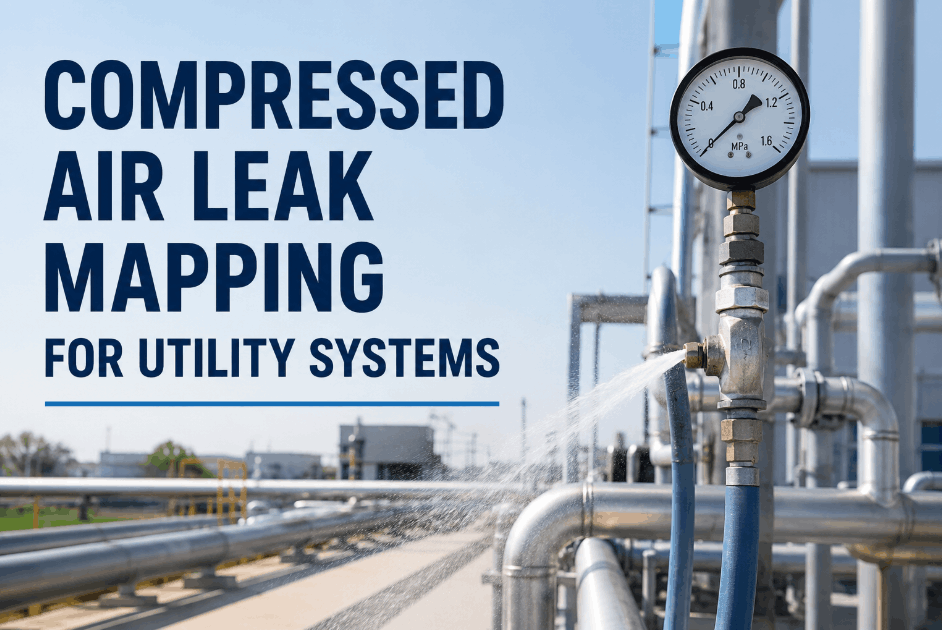
Compressed air is among the most expensive utilities in industrial operations — and most plants lose a significant portion of their compressed air output to undetected leaks before it reaches a production point. Without a structured leak mapping program, pressure losses accumulate invisibly across distribution networks while energy costs climb and demand on compressors rises to compensate. Sign Up Free to configure OxMaint's inspection and work order tools for compressed air loss audits — so every identified leak becomes a logged, tracked, and prioritized maintenance task with a documented cost impact.
Map Every Leak, Close Every Loss Pathway
OxMaint gives utility and facilities maintenance teams inspection checklists, location-tagged work orders, asset-linked audit trails, and energy efficiency reporting — built for compressed air and utility system teams targeting pressure loss elimination in 2026.
Why Compressed Air Losses Are an Operational Cost Problem, Not Just a Maintenance Problem
Every unit of compressed air that escapes through a leak represents electricity consumed, compressor capacity consumed, and pressure availability lost to the production process. In plants where compressed air pressure demand is already at design limits, even moderate leak volumes force compressors to run extended duty cycles — accelerating wear, increasing energy consumption, and reducing system reliability. Book a Demo to see how OxMaint's inspection tools allow utility teams to log leak locations with zone tags, estimated flow loss, and repair priority — building a location map that planners can route technicians against systematically rather than reactively. Facilities that manage compressed air leaks through reactive repair rather than structured mapping programs consistently carry hidden energy waste that survives every cost reduction initiative that doesn't target the distribution network directly.
Compressed Air Leak Pathway Categories for Utility Mapping Programs
Fittings and Threaded Connections
The most common leak source in aging distribution networks. Thread sealant degradation, vibration-induced loosening, and improper installation create persistent low-volume losses that aggregate to significant waste across large distribution systems. OxMaint inspection forms can tag individual fitting locations for scheduled re-inspection after repair.
Valves and Regulators
Control valves, isolation valves, and pressure regulators with worn seats or packing represent mid-volume loss points that are often overlooked during visual inspections. Sign Up Free to build valve inspection checklists in OxMaint with condition scoring and leak rate fields that feed directly into prioritized work orders.
Hose Assemblies and Quick Disconnects
Point-of-use hoses and quick-disconnect couplings on production tooling and pneumatic equipment are the highest-frequency leak source in active manufacturing areas. High replacement cycle rates require a CMMS-tracked inspection interval rather than ad hoc identification. Book a Demo to see OxMaint's interval-based inspection scheduling.
Distribution Pipe and Header Joints
Mainline distribution pipe joints, header connections, and condensate trap bypasses represent lower-frequency but higher-volume leak points. Losses at header level affect pressure availability across entire production zones — making them the highest priority target in a structured leak mapping program. OxMaint asset records support pipe segment and header tracking for zone-level loss attribution.
Leak Mapping Priority Standards by Loss Volume and Zone Impact
| Leak Location | Estimated Flow Loss | Zone Impact | Repair Priority | OxMaint Action |
|---|---|---|---|---|
| Header / Main Distribution | High volume | Entire production zone | Immediate | Emergency work order |
| Valves and Regulators | Medium volume | Sub-zone or process line | Within 48 hours | Urgent corrective order |
| Fittings and Connections | Low to medium | Localized — single drop | Within 72 hours | Scheduled repair order |
| Hoses and Quick Disconnects | Low volume (high frequency) | Point of use only | Batch route — weekly | Recurring inspection task |
Building a Compressed Air Leak Mapping Program: Phase by Phase
Distribution Network Asset Registration
Register compressed air distribution zones, headers, and major valve and regulator assets in OxMaint with zone tags and production dependency classification. Leak mapping without an asset registry cannot support location-specific prioritization. Sign Up Free to begin your utility asset registry today.
Structured Leak Detection Inspection Rounds
Deploy OxMaint mobile inspection checklists to technicians performing ultrasonic or visual leak detection rounds. Each identified leak is logged with location, estimated loss volume, and zone — creating a structured data set that planners can sort by priority and route for repair without relying on verbal handoffs or paper-based records.
Prioritized Repair Work Order Generation
Convert inspection findings directly to work orders in OxMaint with priority tags based on loss volume and zone impact. Batch lower-priority point-of-use repairs into technician routes to minimize travel time. OxMaint's dispatch routing assigns repairs to the right technician based on zone location and current workload.
Loss Reduction Tracking and Energy Reporting
Track cumulative leak elimination by zone over rolling periods in OxMaint's analytics dashboard. Loss reduction data supports energy efficiency reporting, compressor capacity planning, and program ROI documentation for facility and finance stakeholders. Book a Demo to see the utility analytics view.
Reactive Leak Response vs. Structured Leak Mapping
Stop Paying for Air That Never Reaches Production
OxMaint gives utility and facilities teams structured inspection tools, location-tagged leak logging, prioritized repair work orders, and energy efficiency analytics — purpose-built for compressed air and utility system teams targeting measurable loss reduction in industrial operations.
Frequently Asked Questions: Compressed Air Leak Mapping for Utility Systems
How much compressed air do industrial plants typically lose to leaks?
Plants without active leak detection programs typically lose between 25 and 30 percent of their compressed air output to distribution losses — with a significant portion concentrated in fittings, hose assemblies, and aging valve packing at point-of-use locations.
What is the most effective method for detecting compressed air leaks?
Ultrasonic leak detectors are the most accurate method for identifying leaks in active production environments, but structured visual inspection rounds using OxMaint checklists can capture the majority of high-volume losses at significantly lower program cost.
How does a CMMS support compressed air leak management?
OxMaint logs each identified leak as an asset-linked work order with location, estimated loss, and priority — enabling planners to route repairs systematically, track closure rates, and measure loss reduction over time rather than managing individual repairs in isolation.
How often should compressed air leak detection rounds be conducted?
High-throughput plants with aging distribution infrastructure benefit from quarterly formal leak detection surveys supplemented by ongoing visual inspection during preventive maintenance rounds — with OxMaint inspection forms capturing findings from both activities in the same system.
Can compressed air leak programs deliver measurable ROI?
Yes — structured programs that identify and eliminate high-volume leaks in the first 90 days typically recover their program cost within the same period through reduced compressor energy consumption and extended compressor service life, with OxMaint providing the documentation to verify savings.
Ready to Build a Compressed Air Leak Program That Delivers Measurable Results?
OxMaint gives utility maintenance teams mobile inspection tools, zone-tagged leak logging, prioritized repair work orders, and energy loss analytics — so every identified leak becomes a tracked, closed, and documented cost reduction rather than a recurring operating expense.