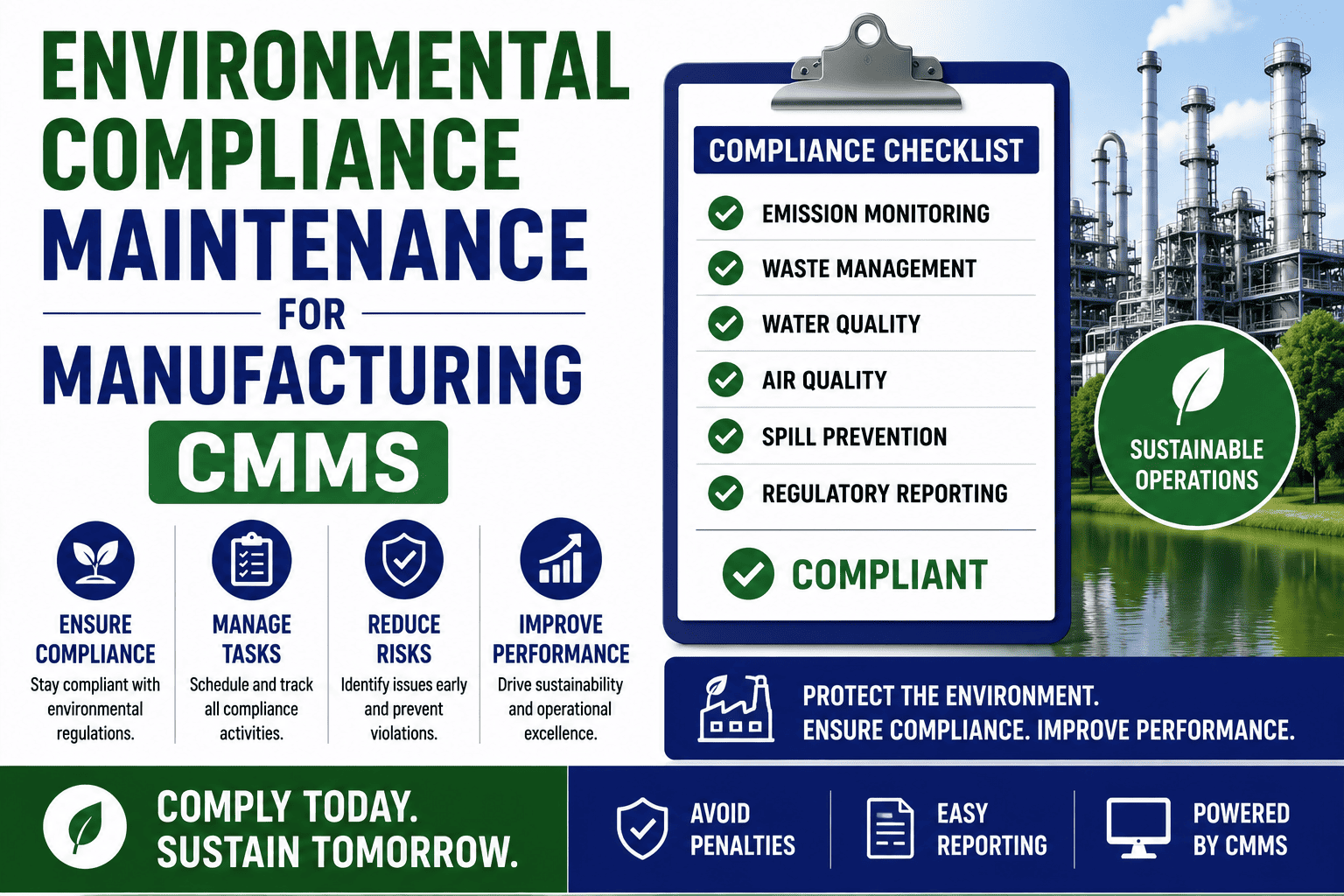
Environmental compliance maintenance for manufacturing plants encompasses the EPA-regulated PM tasks, inspection schedules, and recordkeeping workflows that keep air emissions, wastewater discharge, refrigerant management, and spill prevention equipment operating within legal permit limits. When a CMMS automates environmental PM scheduling and documentation, maintenance teams eliminate the manual spreadsheet chaos that leads to missed inspections, regulatory fines, and failed environmental audits. By linking environmental compliance requirements directly to work order execution, manufacturing facilities can maintain continuous audit readiness while reducing the administrative burden on reliability teams. OxMaint provides an AI-powered CMMS specifically designed to manage these complex compliance workflows, and you can Start Free Trial to experience the difference firsthand.
Can your plant prove environmental compliance in the next 48 hours?
When EPA inspectors or state regulators arrive unannounced, your maintenance records are the first line of defense. Plants without a structured environmental maintenance CMMS face $37,500+ in daily fines per violation — even when the equipment was maintained but the documentation was missing or buried in spreadsheets.
What environmental compliance maintenance covers in a manufacturing plant
Manufacturing environmental compliance spans four major EPA program areas — air, water, refrigerants, and hazardous materials — and every one of them depends on properly maintained, inspected, and documented equipment to stay within permit conditions.
Air Emissions Equipment
Scrubbers, baghouses, thermal oxidizers, and VOC destruct units require filter changes, pressure-drop checks, and monitoring calibration on strict PM cycles dictated by Title V permit conditions.
Wastewater & Discharge
NPDES-permitted outfalls, pH neutralization systems, and oil-water separators need sampling-port maintenance, chemical-dosing calibration, and flow-meter verification to meet effluent limits.
Refrigerant Management
Chillers, refrigeration units, and HVAC systems using regulated refrigerants require quarterly leak-detection inspections and prompt repair documentation under the Section 608 program.
Spill Prevention (SPCC)
Oil-filled equipment, tank secondary containment, loading rack sumps, and valves need integrity inspections and preventive maintenance to satisfy Spill Prevention, Control, and Countermeasure plans.
How to schedule environmental PM tasks in a CMMS
A common gap in manufacturing EPA maintenance is relying on calendar reminders or tribal knowledge. A CMMS converts every environmental permit obligation into a time-based or meter-based PM trigger, ensuring no inspection lapses go unnoticed.
Map each permit condition to an asset PM
Start by listing every environmental permit obligation — from quarterly refrigerant leak checks to annual SPCC tank integrity testing — and attach each as a PM trigger on the corresponding asset record inside the CMMS. This creates an unbroken digital link between the regulation, the equipment, and the maintenance task.
Set trigger frequencies and compliance windows
Configure each environmental PM on a calendar interval (e.g., every 90 days) or a meter reading (e.g., every 2,000 operating hours). Build in a compliance buffer — if the EPA requires quarterly sampling, schedule the PM at day 80 so there is a 10-day window to complete the work and document results before the deadline.
Attach regulatory checklists to every work order
Embed the specific inspection criteria, measurement fields, and required photo uploads directly into the CMMS work order template. Technicians complete the checklist on mobile devices, and the results are time-stamped and stored permanently — creating a defensible audit trail that inspectors can verify on demand.
Escalate overdue environmental PMs automatically
Configure the CMMS to send escalating notifications to the EHS manager and plant manager when an environmental PM approaches its compliance deadline or becomes overdue. This transforms environmental compliance from a reactive scramble into a managed, visible workflow with built-in accountability.
Preparing for an environmental inspection without the last-minute scramble
A facility producing $12M in annual revenue might spend 120 labor hours preparing for a single Title V compliance certification. With CMMS-backed environmental PM records, that preparation drops to under 8 hours because every task, reading, and repair is already logged and searchable.
| Audit Requirement | Spreadsheet / Paper System | CMMS Environmental Maintenance |
|---|---|---|
| PM Completion Records | Manual entry, often backfilled; dates missing or illegible | Auto-generated work orders with time-stamped technician sign-off |
| Inspection Evidence | Photos stored on phones, checklists in filing cabinets | Photos and readings attached to the work order record permanently |
| Corrective Action Tracking | Email chains and sticky notes; no closure verification | Follow-up work orders linked to the original environmental PM |
| Regulator Response Time | 3–5 days to compile records; risk of gaps discovered late | Filterable dashboard exports in under 5 minutes |
| Multi-Site Rollup | Each plant maintains separate sheets; no central visibility | Corporate EHS sees all facilities' compliance PM status live |
| Historical Retention | Paper degrades, files get misplaced during staff turnover | Cloud-based records retained for 5+ years with full searchability |
The cost of a missed environmental PM: a real-world scenario
The situation
A 180-asset chemical manufacturing plant in Texas operated its thermal oxidizer with a PM schedule tracked in an Excel spreadsheet maintained by a single maintenance planner. The quarterly burner inspection and damper calibration were due in March, but the planner was on a two-week medical leave and the reminder was missed.
The consequence
The oxidizer's combustion efficiency dropped below the 99% destruction removal efficiency (DRE) required by its Title V permit. During a routine state inspection in May, records showed no PM had been performed since December. The facility received a Notice of Violation and a proposed penalty of $112,500 — plus mandatory third-party monitoring for 18 months at $8,000 per month.
The CMMS solution
After implementing OxMaint, the same plant linked its thermal oxidizer PM to an automated 80-day compliance trigger. The work order auto-generates, routes to the assigned technician via mobile app, and escalates to the EHS manager if not closed by day 85. In the following audit cycle, the plant produced complete PM records in under 10 minutes and received zero findings.
How OxMaint CMMS powers environmental compliance maintenance
OxMaint maps four core platform capabilities directly to the environmental compliance challenges manufacturing plants face — turning scattered, reactive maintenance into structured, audit-proof workflows with measurable ROI.
Automated Environmental PM Scheduling
Configure calendar-based and meter-based PM triggers for every environmental asset — scrubbers, neutralization tanks, refrigerant systems, and SPCC equipment. OxMaint auto-generates work orders with regulatory checklists, compliance deadline buffers, and escalation rules so no EPA-mandated inspection is ever missed.
Digital Audit-Trail Work Orders
Every environmental work order captures technician identity, time-stamped completion, measurement readings, required photos, and corrective follow-up actions in a single permanent record. Export filtered compliance reports by asset, date range, or regulatory program in under five minutes when inspectors arrive.
Mobile Compliance Checklists
Technicians complete EPA-required inspection forms on mobile devices at the asset location — capturing pH readings, leak-detection results, pressure-drop measurements, and condition photos directly into the CMMS. No paper, no transcription errors, no lost documentation between the field and the filing cabinet.
Spare-Parts Inventory for Compliance
Maintain critical spares for environmental equipment — scrubber packing, filter bags, refrigerant recovery cylinders, containment boom — with min/max reorder triggers tied to PM consumption. When an environmental inspection reveals a worn component, the replacement part is already in stock, eliminating weeks of permit-risk downtime while waiting for procurement.
See OxMaint on your environmental assets
Book a 30-minute demo and we will show you exactly how to map your plant's EPA permit conditions into automated PM workflows, digital audit trails, and inspector-ready compliance reports.
How fast can a manufacturing plant deploy environmental compliance CMMS?
Most mid-sized manufacturing plants (50–500 assets) transition from spreadsheet-based environmental tracking to a fully operational OxMaint CMMS deployment in 4–6 weeks, including asset import, PM configuration, and team training.
Asset & Permit Data Import
Upload your existing asset register, environmental permit conditions, and current PM frequencies into OxMaint. Map each regulated asset to its corresponding EPA program area (air, water, refrigerant, SPCC).
PM Trigger Configuration
Set up calendar-based and meter-based PM triggers with compliance deadline buffers. Build environmental inspection checklists with required fields, photo uploads, and measurement ranges directly into work order templates.
Escalation & Notification Setup
Configure automated escalation paths so overdue environmental PMs notify the EHS manager and plant manager. Define approval workflows for corrective actions triggered by inspection findings.
Mobile App Rollout & Training
Deploy the OxMaint mobile app to maintenance technicians. Conduct hands-on training on completing environmental checklists in the field, capturing photos, and submitting work orders for compliance review.
First Audit-Cycle Validation
Run the first full environmental PM cycle through the CMMS. Generate a sample compliance report and validate that every required field, photo, and timestamp meets your permit documentation standards before the next real inspection.
Environmental compliance maintenance CMMS FAQs
Does a CMMS count as an environmental compliance recordkeeping system for EPA audits?
Yes. A CMMS that captures time-stamped work order completion data, technician identification, inspection measurements, and corrective action records satisfies EPA documentation requirements under most permit programs — including Title V air emissions (40 CFR Part 70), NPDES wastewater discharge (40 CFR Part 122), and SPCC oil pollution prevention (40 CFR Part 112). The key is that records must be contemporaneous, retrievable, and retained for the required period (typically 3–5 years). OxMaint stores all compliance records in a searchable cloud database with exportable audit reports, and you can Start Free Trial to test the audit-export functionality on your own assets.
How does a CMMS schedule refrigerant leak detection inspections under Section 608?
EPA Section 608 requires commercial refrigeration and HVAC equipment containing 50+ pounds of regulated refrigerant to undergo periodic leak inspections — quarterly for systems over 500 pounds, annually for 50–500 pounds. A CMMS like OxMaint schedules these as recurring PM work orders with the correct frequency per asset, attaches the leak-inspection checklist, and auto-generates the next work order upon completion. If a leak is found, the CMMS creates a follow-up repair work order with the 30-day repair deadline built in.
What happens if an environmental PM is overdue in the CMMS?
OxMaint automatically escalates overdue environmental PMs through a configurable notification chain — first alerting the assigned technician, then the maintenance supervisor, and finally the EHS manager or plant manager if the task remains open past the compliance deadline. This escalation ensures that permit-violation risks are visible to leadership before they become reportable incidents, and the escalation history itself becomes part of the due-diligence record.
Can a CMMS track environmental compliance across multiple manufacturing facilities?
Yes. OxMaint supports multi-site asset hierarchies, allowing corporate EHS and reliability leaders to view environmental PM compliance status across all plants from a single dashboard. Each facility's assets, permits, and PM schedules are managed independently, but compliance KPIs — such as on-time environmental PM completion rate, open findings, and upcoming deadlines — roll up to a corporate view for consolidated reporting. Book a Demo to see multi-site compliance dashboards in action.
How much does environmental compliance CMMS software cost for a manufacturing plant?
OxMaint pricing scales with the number of assets and users, with most mid-sized manufacturing plants (50–500 assets) investing between $75 and $200 per user per month. When measured against the cost of a single EPA violation penalty — which can exceed $37,500 per day under the Clean Air Act — the ROI of a CMMS that prevents even one missed environmental PM is typically realized within the first compliance cycle. Implementation, training, and data migration are included, and there are no charges for the environmental checklist builder or audit-report exports.
Make your next environmental audit the easiest one yet
Stop tracking EPA compliance obligations in spreadsheets and paper binders. Deploy OxMaint CMMS and turn every environmental permit condition into an automated, documented, audit-ready maintenance workflow.
Free 14-day trial · No credit card