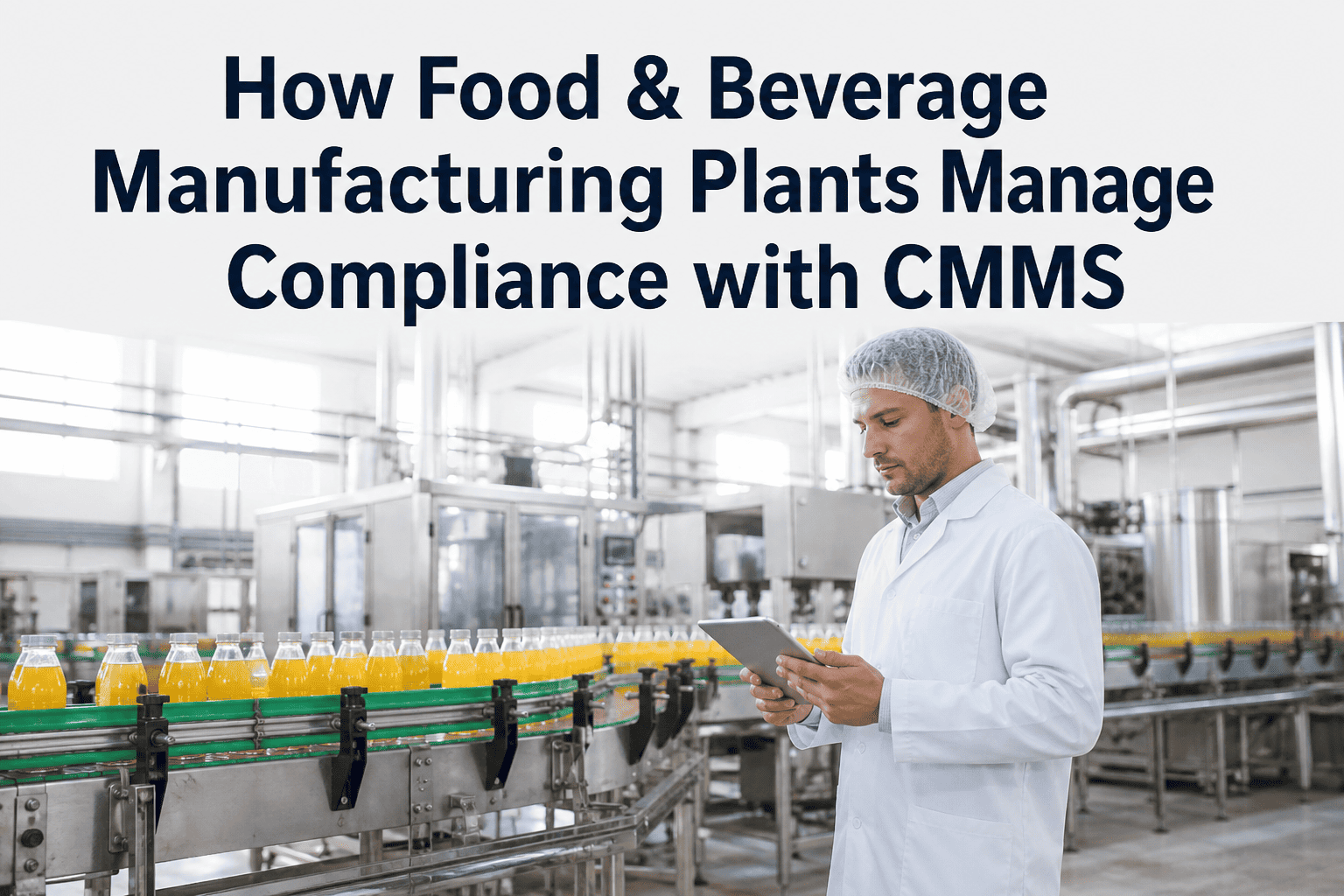
Food and beverage manufacturing is one of the most heavily regulated industries on the planet. Every shift produces documentation that an FDA inspector, SQF auditor, or BRC reviewer could request at any moment — sanitation logs, CIP cycle records, CCP temperature checks, allergen changeover verifications, and corrective action reports. When that documentation lives in paper binders, spreadsheets, or disconnected systems, compliance becomes a reactive scramble rather than a built-in process. A CMMS purpose-built for food and beverage manufacturing turns compliance from a burden into a baseline — one that protects your brand, your consumers, and your operations every single day. Start a free trial to see how Oxmaint structures F&B compliance workflows end-to-end.
COMPLIANCE-FIRST MAINTENANCE
Your Next FDA Inspection Is Already in Progress
HACCP, FSMA, GMP — three frameworks, one audit trail. See how food and beverage plants stay inspection-ready every single day with Oxmaint.
The Three Frameworks Every F&B Plant Must Satisfy
Food and beverage manufacturers don't answer to one regulator — they answer to several simultaneously. FSMA, HACCP, and GMP each govern a different layer of plant operations, and a compliance gap in any one of them exposes the entire facility. Understanding what each framework demands from your maintenance system is the starting point for building a plant that never fails an audit.
FSMA
Food Safety Modernization Act
Enacted 2011 — FDA enforced
Shifts food safety from reactive to preventive. Requires written food safety plans, hazard analyses, preventive controls on equipment, and immutable digital records that survive personnel changes and system migrations.
CMMS demand: Timestamped, unalterable work order records with digital signatures per 21 CFR Part 11.
HACCP
Hazard Analysis Critical Control Points
Mandatory for most food categories
Identifies critical control points in production where biological, chemical, or physical hazards must be actively monitored and controlled. Every CCP deviation triggers a mandatory corrective action record.
CMMS demand: CCP-tagged assets, automated corrective action work orders when thresholds are breached.
GMP
Good Manufacturing Practices
21 CFR Part 117 — baseline standard
Governs sanitation, hygiene, equipment condition, personnel practices, and facility maintenance. A failed GMP inspection doesn't require a contamination event — inadequate documentation alone is a violation.
CMMS demand: Scheduled sanitation PMs, NSF-verified chemical tracking, allergen changeover protocols with swab documentation.
What an FDA Inspector Actually Asks For
When an FDA inspector walks into your plant, the first hour is rarely spent on the production floor. It's spent at a table asking for documents. The plants that fail inspections are almost never the ones whose equipment is poorly maintained — they're the ones whose records don't prove it was done correctly. These are the six document categories that determine whether you pass or scramble.
01
Preventive Maintenance Records for CCP Equipment
All PM completions on metal detectors, pasteurizers, CIP systems, temperature-controlled rooms, and fillers must show timestamped technician sign-off, parameters measured, and corrective action if thresholds were missed.
02
CIP Cycle Validation Logs
Clean-in-place records must show time, temperature, chemical concentration, and flow rate for every cycle — verified against your HACCP critical limits. Missing a single cycle's data creates a compliance gap that auditors flag immediately.
03
Corrective Action Reports
Every CCP deviation — temperature excursion, failed metal detector check, out-of-spec pH — must have a documented corrective action with root cause, disposition of affected product, and verification that the issue was resolved.
04
Food-Grade Chemical Inventory
Every lubricant, cleaner, and sanitizer used on food-contact equipment must have NSF registration (H1, H2, or H3) logged against the work order. Non-food-grade chemicals applied to food-contact surfaces are an immediate violation.
05
Allergen Changeover Documentation
Line teardowns between allergen-containing and allergen-free products must document the cleaning protocol, swab test results, and QA sign-off. One undocumented changeover is an allergen cross-contact risk and a potential recall trigger.
06
Calibration Records for Measuring Equipment
Thermometers, pressure gauges, pH meters, and flow sensors linked to CCPs must have current calibration certificates attached to the asset record. An uncalibrated instrument invalidates every reading it has taken since its last certification.
AUDIT-READY IN MINUTES, NOT DAYS
Every Document. Every Signature. Instantly Retrieved.
Oxmaint generates FDA-ready compliance reports from live data — PM histories, CIP logs, corrective actions, and calibration records — all attached to the asset that produced them.
The Hidden Cost of a Documentation Failure
Most food plant managers believe they're compliant because their equipment is maintained and their people are trained. The gap is documentation — the evidence that maintenance happened correctly, at the right time, on the right equipment. A single FDA Warning Letter for documentation failures costs far more than a year of proper CMMS investment.
$340K
Average remediation cost after an FDA Warning Letter driven by documentation failures — not actual contamination events
90 days
Typical corrective period during which major retail contracts are suspended — revenue loss compounds daily
100%
Of FDA Warning Letters reviewed cite documentation failures as a primary violation — equipment performance alone is rarely the issue
2–3 yrs
Brand recovery time after a publicised recall linked to a compliance failure in a food manufacturing facility
How CMMS Turns Each Framework Into a Daily Workflow
FSMA Compliance
Preventive controls scheduled automatically on CCP-linked assets
Digital signatures locked on completion — immutable per 21 CFR Part 11
Corrective action work orders auto-generated on threshold breach
Compliance dashboard exports inspection-ready reports in minutes
HACCP Workflows
CCP assets tagged in asset registry with linked critical limits
PM checklists include mandatory CCP parameter recording
Deviations trigger escalation to food safety team in real time
HACCP maintenance records created at point of work — never reconstructed
GMP Maintenance
Sanitation PMs scheduled at defined frequencies per SSOP
Food-grade chemical database flags non-compliant products before use
Allergen changeover protocol enforces swab testing before line release
Facility hygiene inspections linked to GMP audit history per asset
Critical Equipment Categories and Their Compliance Obligations
Not every asset in a food plant carries the same regulatory weight. CCP-linked equipment requires flawless documentation on every maintenance event. Treating a food-contact pasteurizer the same as a warehouse forklift creates documentation gaps that auditors find immediately. The table below maps equipment categories to their compliance requirements.
| Equipment |
Framework |
Key Documentation Required |
Failure Consequence |
| Pasteurizers & Cookers |
HACCP / FSMA |
Temperature logs, calibration records, CCP deviation reports |
Batch condemnation, recall risk |
| CIP Skids & Spray Balls |
HACCP / GMP |
Cycle time, temp, chemical concentration, flow validation per cycle |
Contamination, FDA violation |
| Metal Detectors & X-Ray Units |
HACCP |
Daily verification logs, sensitivity test records, corrective actions |
Physical hazard liability, recall |
| Cold Storage & Blast Freezers |
FSMA / HACCP |
Continuous temperature logs, PM records, alarm response documentation |
$50K–$500K product loss per excursion |
| Filling & Packaging Lines |
GMP / HACCP |
Allergen changeover records, swab results, QA sign-off per run |
Allergen mislabeling, recall trigger |
| pH, Temp & Flow Sensors |
FSMA / HACCP |
Calibration certificates, drift verification, full replacement history |
Invalidates all readings since last calibration |
CMMS vs Paper-Based Compliance
CCP deviation records
Written after the fact, often incomplete
Auto-generated at point of deviation, locked and signed
Sanitation PM scheduling
Supervisor memory, missed on busy shifts
Auto-dispatched on interval, escalated if overdue
Audit document retrieval
Hours of manual searching across binders
Dashboard report generated in under 5 minutes
Chemical compliance tracking
No NSF verification — violations found at audit
Food-grade database flags violations before application
Allergen changeover protocol
Inconsistently followed, swab results scattered
Enforced workflow with mandatory swab documentation
Regulatory audit trail
Reconstructed manually — prone to gaps and errors
Native, immutable, attached to every asset record
Frequently Asked Questions
How does FSMA differ from HACCP for maintenance purposes?
HACCP focuses on critical control points in the production process, while FSMA requires a broader food safety plan covering all preventive controls. For maintenance, FSMA adds the requirement for digital, immutable records with QA sign-off — a paper HACCP log no longer satisfies FSMA documentation standards on its own.
What happens if a CCP deviation goes undocumented?
An undocumented CCP deviation is treated by FDA inspectors as if the corrective action never occurred. This creates a regulatory gap that can result in a Warning Letter, mandatory product hold, or recall — regardless of whether the product was actually unsafe.
Can Oxmaint work alongside our existing food safety plans?
Yes. Oxmaint is designed to integrate with existing HACCP plans and FSMA food safety programs. It does not replace your safety plans — it enforces and documents them at the work order level, closing the gap between written procedures and provable execution.
How quickly can we generate documentation for an unannounced FDA inspection?
With Oxmaint, audit-ready reports covering PM histories, CIP validation, corrective actions, and calibration records for any asset or time period can be generated from the compliance dashboard in under five minutes — not hours of manual document searching across filing systems.
Does Oxmaint handle multi-scheme certifications like SQF and BRC?
Oxmaint's compliance workflows align with SQF, BRC Global Standards, FSSC 22000, and IFS Food in addition to FDA requirements. The asset-level audit trail and digital sign-off system satisfies the documentation requirements across all major third-party food safety certification schemes.
OXMAINT FOR FOOD MANUFACTURING
Pass Every Audit. Prevent Every Recall. Run Every Shift With Confidence.
Oxmaint automates HACCP workflows, CIP tracking, allergen changeover protocols, food-grade inventory control, and instant compliance reporting — in one platform built for food and beverage manufacturing.



.png)