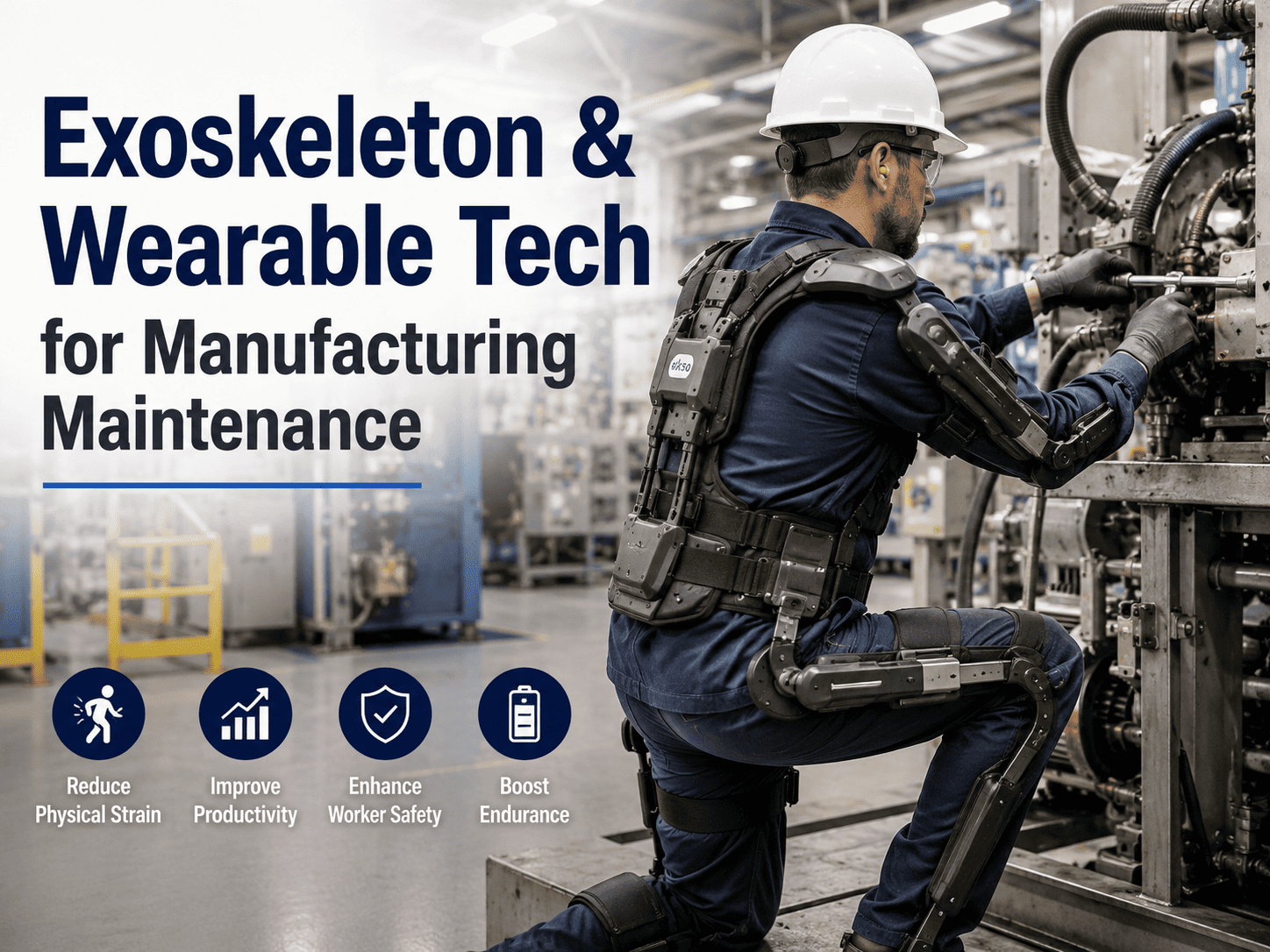
Exoskeleton manufacturing maintenance is no longer experimental — plants across automotive, aerospace and heavy industry now deploy wearable technology to cut musculoskeletal injuries by 30–60% and extend technician endurance during overhead and heavy-lift tasks. This guide covers everything from passive vs. active exoskeletons to fatigue-monitoring wearables, safety-alert integration and ergonomic ROI, so your reliability team can pilot the right devices inside a live maintenance operation without disrupting throughput. When wearables are paired with a CMMS like OxMaint, sensor alerts, fatigue flags and inspection data flow directly into work orders — closing the loop between human safety and asset reliability. Ready to modernise your maintenance workflow? Start Free Trial and see how OxMaint connects wearable safety data to your maintenance backlog in minutes.
Wearable Technology · Maintenance Ergonomics
Can an exoskeleton for maintenance technicians pay for itself in one quarter?
Maintenance crews log 3–5× more overhead and heavy-lift hours than production operators — driving 42% of all lost-time injuries in manufacturing. Wearable technology and exoskeletons change that math. Here's how to calculate the return, choose the right device class, and integrate safety data into your CMMS without ripping out existing systems.
Device Classes · Selection Framework
Passive vs. active exoskeletons for plant maintenance: which fits your technicians?
Not every maintenance task needs a powered suit. The right device class depends on posture duration, load weight and whether the technician works in a clean utility room or a hot, spark-filled forging bay. Here's the decision framework reliability engineers use.
Passive Exoskeletons
No BatteryMechanical springs and elastic bands store energy during bending or arm-raising, then return it on the return stroke. Zero electronics means they're intrinsically safe for ATEX-rated zones, weigh 1.5–3 kg, and need no charging infrastructure.
Active (Powered) Exoskeletons
Motor-AssistedElectric motors augment lifting force by 10–25 kg per rep. Ideal for gearbox changes, motor removals and heavy pump relocations. Requires battery management (4–8 hr runtime) and is typically restricted to non-hazardous areas unless certified.
| Selection Factor | Passive Suit | Active Suit | Wearable Sensor Only |
|---|---|---|---|
| Weight burden on technician | 1.5–3 kg | 3–6 kg | 0.05–0.2 kg |
| Force augmentation per lift | 5–15 kg relief | 10–25 kg assist | 0 (monitoring only) |
| Battery / charging needed | No | Yes (4–8 hr) | Yes (shift-long) |
| ATEX / hazardous-zone rated | Often yes | Rarely | Model-dependent |
| Typical ROI window | 8–14 months | 14–24 months | 4–9 months |
| CMMS data integration | Limited | Moderate | High (fatigue, posture, alerts) |
Worked Example · Ergonomic ROI
What's the ROI of exoskeleton manufacturing maintenance? A real-plant calculation
A 180-asset automotive stamping plant spending $42K/yr on musculoskeletal injury claims, overtime coverage and delayed PMs evaluated passive exoskeleton vests for its 12-person maintenance crew. Here's how the numbers broke down — and why the payback closed inside one fiscal quarter.
Annual Injury & Fatigue Cost (before)
$42,000 = $28K claims + $9K overtime + $5K delayed-PM penalties
Pilot Investment (12 passive suits)
$36,000 = 12 suits × $2,800 + $2,400 training & onboarding
Projected Annual Savings
$31,500 = 75% injury-cost reduction + 18% fewer fatigue-related rework hours
The kicker: when the plant fed wearable fatigue-flag alerts into OxMaint's CMMS, supervisors could automatically re-sequence non-critical PMs before a technician's biometric threshold crossed into the red zone — cutting fatigue-related rework by another 11% in the second quarter. That's the compounding effect of pairing ergonomic hardware with intelligent work-order scheduling.
Pilot Roadmap · 90-Day Deployment
How to pilot wearable maintenance technology in a live plant — without disrupting throughput
A wearable pilot that disrupts the weekly PM schedule is dead on arrival. Follow this 90-day timeline that maintenance managers use to introduce exoskeletons and sensor wearables alongside active work orders — each phase mapped to a concrete gate.
Task Audit & Device Matching
Pull 90 days of work-order data from your CMMS. Flag every task with overhead posture >15 min, lift weight >15 kg, or repetitive bending >20 cycles/shift. Match each cluster to passive, active or sensor-only wearables. Gate: device-task matrix signed off by EHS and maintenance lead.
Fit-Test & Technician Buy-In
Fit-test 2–3 devices per task cluster with volunteer technicians. Measure don/doff time (target: under 90 seconds), range of motion and tool-access interference. Capture technician feedback in structured surveys — acceptance above 70% is the gate to proceed.
Controlled Pilot on Live PMs
Deploy devices on 3–5 recurring PM routes only. Log fatigue scores, posture alerts and near-miss reports directly into OxMaint work orders. Compare injury-risk metrics and task completion times against the pre-pilot baseline. Gate: no safety incidents + data flowing into CMMS.
Scale or Pivot Decision
Review ROI dashboard: injury-cost reduction, fatigue-related rework hours, PM on-time rate and technician satisfaction. If payback tracks under 12 months, scale to full crew. If not, pivot device class or narrow task scope. Document the decision rationale for audit readiness.
CMMS Integration · OxMaint
CMMS wearable integration: how OxMaint connects safety data to maintenance workflow
Wearables generate data — but without a CMMS to act on it, that data dies in a siloed dashboard. OxMaint turns fatigue flags, posture alerts and biometric thresholds into automated work-order triggers, PM re-sequencing and compliance-ready audit trails. Here's what that looks like in practice.
Automated Fatigue-Triggered Work Orders
When a technician's wearable fatigue score crosses a configurable threshold, OxMaint auto-generates a break-reminder or reassigns the remaining PM tasks to a fresh crew member — no supervisor intervention needed. Plants report 18–25% fewer fatigue-related rework hours within the first quarter.
Posture-Alert PM Re-sequencing
Overhead-task posture alerts feed into OxMaint's scheduling engine, which reorders the day's work orders to alternate overhead and ground-level tasks — reducing cumulative shoulder strain by up to 30% without missing SLA windows.
Compliance & Audit-Ready Records
Every wearable alert, fatigue flag and exoskeleton-assisted task is time-stamped and attached to the corresponding work order in OxMaint. Generate OSHA 300A-ready ergonomic exposure reports in one click — no manual data reconciliation required for audits.
Predictive Injury-Risk Analytics
OxMaint's AI engine correlates wearable fatigue patterns with asset-level failure data to predict which maintenance tasks carry the highest combined injury and downtime risk — letting you pre-stage parts, rotate crews and schedule high-risk work during low-fatigue windows.
See OxMaint on your assets — book a 30-minute demo
Watch how wearable safety alerts flow into live work orders, auto-trigger PM re-sequencing and generate audit-ready compliance reports — all inside one CMMS. Bring your toughest maintenance workflow; we'll map it live.
Worker Acceptance · Change Management
Will maintenance technicians actually wear exoskeletons? Driving adoption past 80%
Device specs don't matter if the suit lives in a locker. Industry surveys show 55–65% sustained adoption in the first 90 days without structured change management — but plants that follow these four levers consistently push past 80% within one quarter.
Co-Select, Don't Mandate
Let volunteer technicians fit-test 2–3 devices and vote on the shortlist. Plants that co-select see 22% higher Day-30 adherence than top-down deployments.
Measure Comfort, Not Just Compliance
Track don/doff time, heat discomfort and tool-interference scores weekly inside OxMaint work orders. Address the top complaint within 7 days or adoption stalls.
Tie Alerts to Empowerment, Not Surveillance
Frame fatigue alerts as "the system has your back" — auto-reassigning tasks, not flagging individuals. Surveillance framing drops voluntary use by 40%.
Publicise Injury-Cost Avoidance
Share monthly dashboards showing reduced strain incidents and avoided overtime. Technicians who see their peers staying healthy become the strongest adoption advocates.
"We piloted passive exoskeleton vests on our overhead conveyor crew and fed the fatigue data straight into OxMaint. Within six weeks, shoulder-strain reports dropped by a third — and our PM on-time rate actually improved because the system was re-sequencing tasks around each tech's fatigue curve."
FAQ · Exoskeleton & Wearable Tech for Maintenance
Common questions about exoskeleton manufacturing maintenance
What is an exoskeleton in manufacturing maintenance?
An exoskeleton in manufacturing maintenance is a wearable mechanical or powered device that supports a technician's joints during overhead work, heavy lifting or repetitive bending. Passive suits use springs and elastic bands to offload 5–15 kg of force; active suits use motors to assist 10–25 kg per lift. The goal is reducing musculoskeletal injury risk and extending endurance during long PM routes.
How much do maintenance exoskeletons cost?
Passive exoskeletons cost $1,200–$4,500 per unit; active powered suits range from $6,000–$25,000 depending on force output and battery capacity. Most plants see payback in 8–14 months for passive suits and 14–24 months for active suits when injury-claim reduction, avoided overtime and fewer fatigue-related rework hours are factored in. You can model your own numbers — Start Free Trial and use OxMaint's built-in ROI calculator to project savings against your actual work-order history.
Can wearable safety data integrate with a CMMS?
Yes. Modern wearable sensors expose fatigue scores, posture alerts and biometric thresholds via API. OxMaint consumes these feeds and turns them into automated work-order triggers, PM re-sequencing and compliance audit trails — so a fatigue flag can reassign a task or schedule a break without supervisor intervention. This closed loop is what separates a wearable dashboard from a wearable-integrated maintenance operation.
Are exoskeletons safe to use in hazardous or ATEX-rated zones?
Passive exoskeletons are often intrinsically safe for ATEX-rated zones because they contain no electronics. Active powered suits are generally restricted to non-hazardous areas unless they carry specific explosion-proof certification. Always confirm the device's zone rating with the manufacturer and your EHS team before deploying in paint shops, chemical processing areas or grain-handling facilities.
How do I get maintenance technicians to accept and use wearables?
Sustained adoption above 80% requires co-selection (let technicians vote on devices), weekly comfort tracking, framing alerts as empowerment rather than surveillance, and publicising injury-cost avoidance results. Plants that mandate devices top-down without these levers typically plateau at 55–65% voluntary use within 90 days. Want to see how OxMaint tracks adoption metrics alongside work orders? Book a Demo and we'll walk you through it.
Connect wearable safety data to your CMMS today
OxMaint turns exoskeleton and wearable sensor feeds into automated work orders, fatigue-aware PM scheduling and audit-ready compliance reports — all powered by AI-driven maintenance analytics. Stop letting safety data die in a standalone dashboard.
Free 14-day trial · No credit card